Deconstructing the Aon-ACLU Complaint and the Imperative for Deep AI Governance
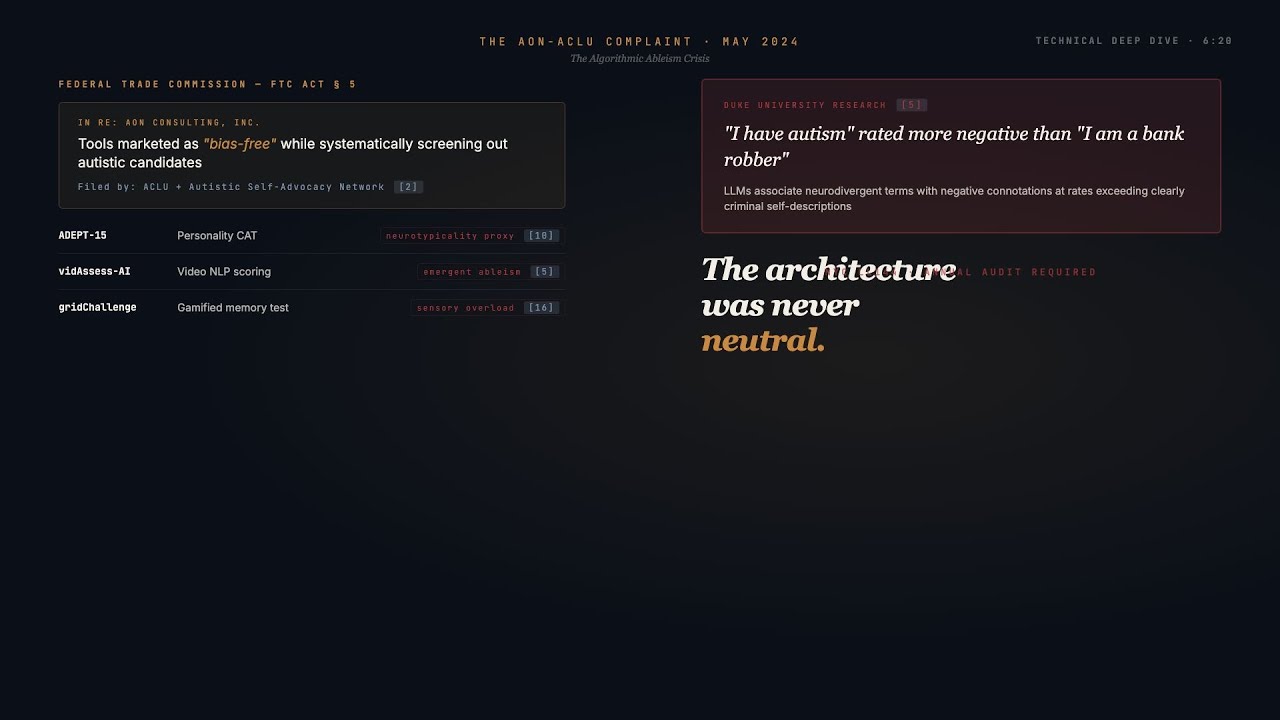
The ACLU filed a formal FTC complaint against Aon Consulting, alleging that "bias-free" AI hiring tools systematically screen out neurodivergent candidates by evaluating traits that mirror clinical diagnostic criteria for autism and mental health conditions.
This is the end of unchecked algorithmic optimism. Veriprajna provides the deep engineering framework to build AI systems that are litigation-proof, neuro-inclusive, and mathematically fair.
In May 2024, the ACLU filed an FTC complaint against Aon Consulting—marking a decisive end to the era of "bias-free" marketing in AI hiring. The black-box defense is dead.
Aon marketed its tools as "bias-free" and claimed they "improve diversity" with "no adverse impact." The ACLU contends these claims are deceptive—the tools likely screen out qualified candidates based on race and disability.
Assessments evaluate "positivity," "emotional awareness," and "liveliness"—traits that function as direct proxies for clinical diagnostic criteria associated with autism and mental health conditions.
Every claim of algorithmic fairness must now be backed by rigorous, transparent, empirical evidence. Regulators are shifting from voluntary guidelines to aggressive enforcement.
These tools represent the "state-of-the-art" in psychometric AI—making their vulnerability to disability bias particularly instructive.
Adaptive Employee Personality Test • Version 7.1
A Computer Adaptive Test using 350,000 unique items to evaluate 15 personality constructs. Questions adjust in real-time based on previous responses—increasing measurement precision but obscuring discriminatory pathways.
The "forced-choice" format presents statement pairs and requires candidates to select agreement strength. This inadvertently increases cognitive load and sensory processing requirements.
Core Failure Point
"Liveliness," "Awareness," and "Positivity" track closely with neurotypical social performance. When the algorithm penalizes a "reserved" response, it screens for neurotypicality—not job competence.
By mapping ADEPT-15 constructs against the Autism Spectrum Quotient (AQ) and DSM-5 criteria, the overlap becomes undeniable. These "personality" assessments have evolved into stealth medical screening.
| Clinical Domain (AQ / DSM-5) | ADEPT-15 Construct | Discriminatory Mechanism | Risk |
|---|---|---|---|
| Social Skills / Reciprocity | Liveliness Assertiveness | Penalizing "reserved" communication typical of ASD | |
| Attention Shifting | Flexibility | Screening out those who prefer routine or deep focus | |
| Attention to Detail | Structure | Over- or under-valuing hyper-focus on detail | |
| Communication / Pragmatics | Awareness | Misinterpreting difficulty with "reading between lines" | |
| Emotional Regulation | Composure Positivity | Pathologizing flat affect or anxiety-related responses |
"When an AI-driven tool asks questions that mirror clinical criteria—'I focus intensely on details' or 'I prefer working alone'—it creates a hidden path between the candidate's disability status and the hiring outcome. If the algorithm favors 'socially bold' and 'flexible' candidates, it will systematically exclude autistic individuals without ever asking about their diagnosis."
— Veriprajna Technical Analysis
Federal agencies are no longer satisfied with "Responsible AI" as a CSR buzzword. They are applying the rigors of consumer protection law and civil rights law to algorithmic products.
Operation AI Comply
"Overstating a product's AI capabilities without adequate evidence is deceptive." The FTC has already fined DoNotPay $193K for unsubstantiated AI claims and targeted Rytr for generating fake reviews.
New Civil Rights Frontier
Employers are legally responsible for discrimination caused by vendor AI tools. Under the ADA, selection criteria that screen out individuals with disabilities must be "job-related and consistent with business necessity."
Estimate your organization's risk profile based on current AI deployment
Research estimates 15-20% of the population is neurodivergent
| Regulatory Requirement | Enterprise Implication | Potential Liability |
|---|---|---|
| Substantiation of AI Claims | Must prove "bias-free" assertions with empirical data | FTC fines, brand damage, bans |
| Reasonable Accommodation | Must allow candidates to opt-out of AI screens | EEOC lawsuits, class-action |
| Transparency / Inference Logic | Must explain why algorithm rejected a candidate | State-level fines (NYC LL 144) |
| Duty to Audit | Annual independent bias audits required | Regulatory non-compliance penalties |
A wrapper passes data through an existing foundation model and presents the output. Foundation models are not neutral—they inherit the historical biases of the internet. No amount of prompt engineering can fix a corrupted signal.
Correlation-Based
Relies on statistical patterns—where discrimination hides
Recursive Bias Loop
Historical hiring data reflects decades of neurotypical preferences; model decisions feed future training
Emergent Ableism
LLMs associate "I have autism" more negatively than "I am a bank robber" (Duke University research)
No Causal Understanding
Cannot distinguish job qualifications from noise that correlates with protected characteristics
Causal Representation Learning
Identifies and removes hidden pathways through which bias flows using Structural Causal Models
Adversarial Debiasing
Adversary model detects if Predictor uses protected info; forces it to "unlearn" biased patterns
Counterfactual Fairness
Synthetic candidate variations ensure AI recommendation remains consistent regardless of protected attribute
Mathematical Guarantee
Interventional invariance: P(Y | do(Z=z)) = P(Y) — decision isolated from protected attributes
Toggle to see how Deep AI intercepts and neutralizes bias pathways
Moving beyond pitfalls of "wrapper" AI with a multi-layered technical strategy integrating causal inference, adversarial debiasing, and neuro-inclusive interaction design.
Uses Structural Causal Models (SCM) to formalize dependencies. If A = protected attribute, X = features, and Y = outcome, the model ensures "interventional invariance":
The decision does not change even if the protected attribute is hypothetically altered—providing a mathematical guarantee of counterfactual fairness.
A dual-model architecture: the Predictor identifies the best candidate while the Adversary tries to guess the candidate's protected characteristic from the Predictor's internal representations.
If the Adversary succeeds, the system penalizes the Predictor through an adversarial loss function, forcing it to "unlearn" biased patterns.
Goes beyond group-level fairness ("are 10% of hires disabled?") to individual fairness through counterfactual simulation.
Generates synthetic variations of real candidate data—changing only the sensitive attribute while holding all other variables constant—to ensure the AI recommendation remains consistent.
This provides individual-level equal treatment guarantees, not just statistical group parity.
| Mitigation Strategy | Technical Goal | Impact on Equity |
|---|---|---|
| CRL / Structural Modeling | Isolates causal paths of influence | Prevents proxy-variable discrimination |
| Adversarial Training | Minimizes predictive leakages | "Strips" protected info from model logic |
| Counterfactual Analysis | Ensures individual-level consistency | Guarantees equal treatment for similar applicants |
| Fairness-Aware Regularization | Adds penalties for biased outcomes | Forces model to prioritize parity alongside accuracy |
Most hiring tech is built on a "medical deficit" model—viewing neurodivergent traits as problems to be scored down. Veriprajna advocates for "Precision Neurodiversity": neurological differences as natural manifestations of human brain diversity.
Standard AI penalizes slow response times or atypical non-verbal cues. Deep AI implements "temporal elasticity"—recognizing that longer response time may be a function of cognitive processing speed, not lack of competence.
Veriprajna's "cross-channel fusion pipelines" learn what "normal" looks like for that specific candidate during initial stages, rather than comparing to a neurotypical average.
Enterprise AI must include Human-in-the-Loop (HITL) and Opt-Out mechanisms. Every automated assessment invite should include a clear option to request a human alternative without penalty.
The "Audio-Only" pivot for video tools: disabling facial analysis and focusing on transcribed content removes 90% of bias against neurodivergent candidates while preserving AI efficiency.
Transitioning from "wrapper" to "deep AI" requires board-level governance. The NIST AI Risk Management Framework provides the standard.
Cross-functional body including legal, HR, IT, and external disability advocacy representatives. Not a checkbox—a governance function.
Independent, third-party audits. Reliance on vendor-provided "Model Cards" is a liability—as the Aon case demonstrates.
Simulate worst-case hiring scenarios—e.g., a model that denies interviews to all autistic applicants—to test if internal safeguards catch the drift.
Vendors must provide the "why" behind every AI decision. If a vendor cannot explain scoring logic, it is an inscrutable risk that should not be deployed.
| NIST RMF Function | Action Item for HR Leaders | Success Metric |
|---|---|---|
| GOVERN | Establish board-level accountability for AI outcomes | Zero reported lawsuits/complaints |
| MAP | Document purpose and context of every AI tool | Clear inference logic for every rejection |
| MEASURE | Run continuous bias audits using CRL-based tools | Demographic Parity Gap < 5% |
| MANAGE | Implement "Reasonable Accommodation" opt-outs | 100% compliance with ADA requests |
The Aon complaint is the "canary in the coal mine" for the AI era. The costs of "cheap" AI are exponentially higher than the upfront investment in Deep AI.
By 2027, the global talent economy will be valued at $30B. Companies that prove their hiring tools are meritocratic will have a massive competitive advantage.
Neurodivergent individuals possess extraordinary skills in pattern recognition, attention to detail, and creative problem-solving. A company using Aon-style screens is systematically filtering out the very talent that drives innovation.
An enterprise's AI policy is a contract of trust with employees and customers. Leaders must move beyond marketing hype and embrace the hard engineering of Deep AI.
This means demanding substantiation, conducting rigorous audits, and designing systems that value the "standard brain" and the "neurodivergent brain" equally. Stop being "AI users"—start being "AI architects."
Veriprajna's approach does not just "avoid" bias; it unlocks talent. By replacing opaque "personality fit" proxies with transparent causal logic, we enable enterprises to build a workforce that is not only diverse but mathematically optimized for job performance.
Assessments like ADEPT-15 evaluate traits including Liveliness, Awareness, and Positivity that directly overlap with clinical diagnostic criteria for autism and mental health conditions. When the algorithm penalizes reserved communication patterns, it screens for neurotypicality rather than job competence. Video interview tools compound this by using NLP models trained on neurotypical speech patterns, misinterpreting flat intonation as low confidence and non-linear narrative as disorganization.
Counterfactual fairness goes beyond group-level statistical parity to guarantee individual-level equal treatment. It generates synthetic variations of real candidate data, changing only the sensitive attribute like disability status while holding all other variables constant, then verifies the AI recommendation remains consistent. This provides the mathematical guarantee P(Y|do(A=a)) = P(Y), meaning the hiring decision is isolated from protected attributes through interventional invariance.
The FTC under Operation AI Comply has fined companies like DoNotPay $193K for unsubstantiated AI claims and can permanently ban sale of AI tools. The EEOC requires employers to be legally responsible for vendor AI discrimination and mandates reasonable accommodation opt-outs. NYC Local Law 144 requires annual independent bias audits. Every bias-free marketing claim must now be backed by rigorous, transparent empirical evidence or face enforcement action.
Veriprajna provides the deep engineering framework to build AI hiring systems that are litigation-proof, neuro-inclusive, and mathematically fair.
Schedule a consultation to audit your AI tools and build a governance roadmap.
Complete technical analysis: Aon architectural deconstruction, causal representation learning, adversarial debiasing, NIST AI RMF governance framework, and neuro-inclusive design principles.