The Algorithmic Accountability Crisis: Architecting Deep AI Solutions for the Era of Enforcement
The financial services landscape is currently navigating a fundamental transformation in the oversight of automated decision systems. The era of algorithmic impunity—a period characterized by the rapid deployment of "black-box" models under the guise of proprietary innovation—has been superseded by a regime of strict accountability and defensible intelligence. This shift is punctuated by high-profile regulatory interventions, most notably the $2.5 million settlement reached by Earnest Operations LLC in July 2025 and the systemic scrutiny of Navy Federal Credit Union’s mortgage lending disparities.1 For modern fiduciaries and institutional lenders, these incidents represent more than isolated legal setbacks; they are symptomatic of a profound architectural failure.
The transition toward artificial intelligence in underwriting and risk assessment was initially marketed as a panacea for human subjectivity. However, the reliance on superficial "wrapper" architectures—systems that merely pass structured or unstructured data to third-party large language models (LLMs) like OpenAI’s GPT-4 or Google’s Gemini—has introduced a new class of systemic risks. These thin integrations lack the domain-specific guardrails, transparency mechanisms, and causal reasoning required to withstand the current scrutiny of the Consumer Financial Protection Bureau (CFPB) and state attorneys general.3 Veriprajna positions itself at this critical juncture, advocating for a "Deep AI" philosophy that prioritizes structural integrity, fairness engineering, and robust governance over mere probabilistic efficiency.
The Earnest Operations Settlement: A Taxonomy of Algorithmic Bias
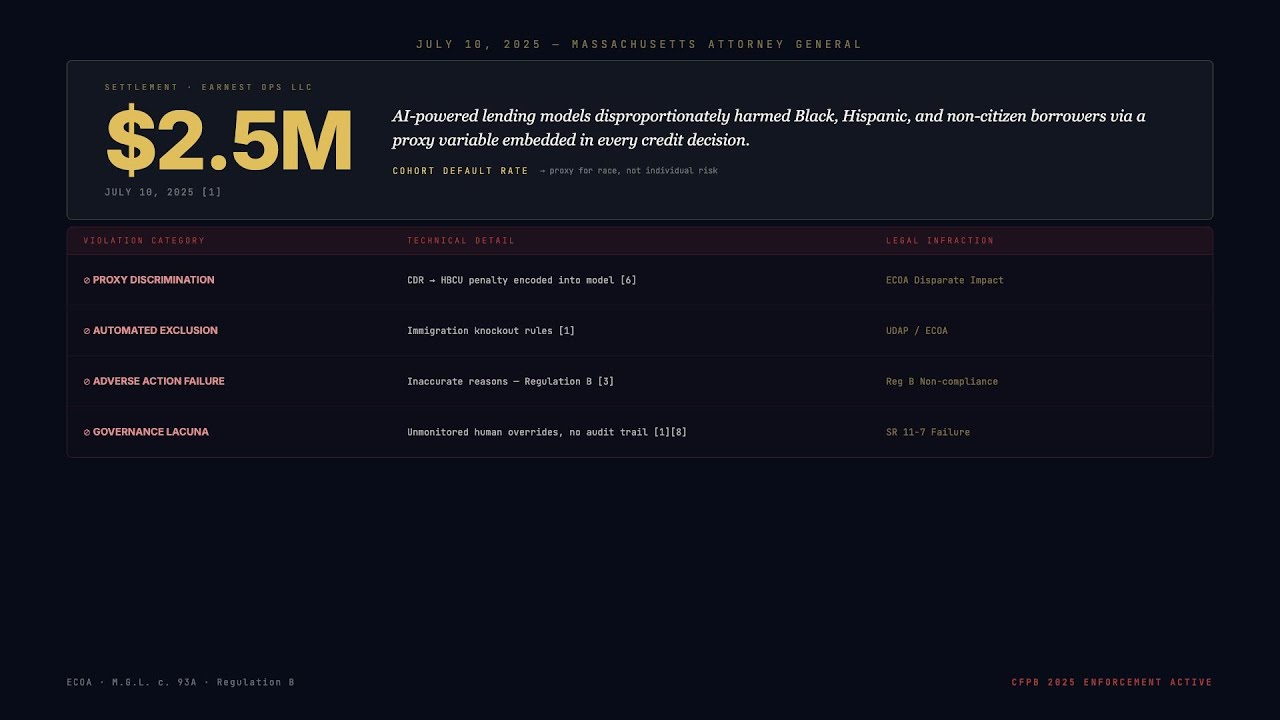
On July 10, 2025, the Massachusetts Attorney General announced a landmark settlement with Earnest Operations LLC, resolving allegations that the company’s AI-powered lending models disproportionately harmed Black and Hispanic applicants and non-citizen borrowers.1 This case serves as a seminal case study in how "proxy variables" and "knockout rules" can inadvertently hard-code historical discrimination into modern digital platforms.
The Mechanism of Proxy Discrimination via CDR
A central element of the Massachusetts investigation was Earnest’s use of the Cohort Default Rate (CDR) as a weighted subscore in its student loan refinancing model.1 The CDR tracks the average rate of loan defaults at specific educational institutions. From a statistical perspective, the variable appears to offer a high-level view of institutional risk. However, the Attorney General alleged that the predictive power of this variable was derived not from individual creditworthiness, but from its strong correlation with protected racial and socioeconomic classes.6
Historically, Historically Black Colleges and Universities (HBCUs) and institutions serving high concentrations of low-income minority students have faced systemic underfunding and higher average default rates due to intergenerational wealth gaps.6 By penalizing applicants based on their school’s CDR, the model effectively applied a collective penalty to individuals regardless of their personal financial stability or credit history. This represents a classic failure of "conceptual soundness" under the SR 11-7 framework: using a group-based historical artifact as a proxy for individual risk.6
Automated Exclusions and Governance Failures
The Earnest investigation further highlighted the danger of "knockout rules"—hard-coded algorithmic gates that automatically deny applications based on specific criteria.1 Earnest utilized a knockout rule to deny applicants who lacked at least a green card, a practice the Attorney General identified as a violation of the Equal Credit Opportunity Act (ECOA) disparate impact risks.1
Crucially, the settlement revealed a disconnect between the company’s stated policies and its operational reality. While Earnest’s internal policies mandated senior oversight for exceptions to the model, investigators found that underwriters frequently bypassed the models or applied arbitrary standards without documentation.1 This inconsistency creates a hybrid risk profile where both algorithmic bias and unmonitored human bias coexist, making the system impossible to audit and defend.8
| Violation Category | Technical Trigger | Legal Infraction |
|---|---|---|
| Proxy Discrimination | Cohort Default Rate (CDR) | ECOA Disparate Impact / M.G.L. c. 93A |
| Automated Exclusion | Immigration Status "Knockout Rules" | Unfair/Deceptive Practices (UDAP) |
| Transparency Failure | Inaccurate Adverse-Action Notices | Regulation B (ECOA) Non-compliance |
| Governance Lacuna | Lack of Independent Model Validation | Failure to Mitigate Fair Lending Risks |
| Process Instability | Unstandardized Human Overrides | Failure to Implement Internal Controls |
Navy Federal Credit Union: Statistical Accountability and Systemic Drift
While the Earnest case focused on specific variable failures, the investigation into Navy Federal Credit Union (NFCU) demonstrates the macro-level impact of algorithmic systems that have drifted away from equitable outcomes over time. Analysis of 2022 Home Mortgage Disclosure Act (HMDA) data revealed that NFCU, the nation's largest credit union, rejected more than half of its Black conventional mortgage applicants.9
The Disparity Gap in Mortgages
The statistical disparities at Navy Federal were particularly stark when compared to other top-tier lenders. In 2022, the credit union approved approximately 77% of white applicants but only 48.5% of Black applicants and 55.8% of Hispanic applicants.9 The nearly 29-percentage-point gap between white and Black approval rates was the widest of any top 50 mortgage lender.10
The defense offered by NFCU—that public HMDA data lacks credit scores and cash-on-hand metrics—has been challenged by rigorous third-party analysis. When researchers controlled for more than a dozen variables, including income, DTI ratio, property value, and neighborhood characteristics, Black applicants were still more than twice as likely to be denied as white applicants with identical profiles.2 This suggests a "residual bias" within the credit union's "secret" underwriting algorithm that cannot be explained away by traditional credit factors.12
Litigation and Regulatory Blowback
The Navy Federal incident has triggered a wave of consolidated class-action lawsuits and Congressional inquiries. In May 2024, a U.S. District Judge ruled that disparate impact claims could proceed, allowing plaintiffs to seek discovery regarding the internal logic of NFCU’s underwriting models.12 This underscores a critical lesson for the industry: statistical disparity alone is often enough to survive a motion to dismiss, placing the burden on the institution to prove that its "secret" process is both necessary and the least discriminatory alternative (LDA) available.12
| Metric | White Applicants | Black Applicants | Gap |
|---|---|---|---|
| Raw Approval Rate | 77.1% | 48.5% | 28.6% |
| Denial Rate | 23.0% | 52.0% | 29.0% |
| VA Loan Denial Rate | 15-17% (est) | 28.6% | ~12% |
| National Avg Denial (CFPB) | 5.6% | 16.2% | 10.6% |
Structural Vulnerabilities: Why Wrappers Fail the Fiduciary Test
The reliance on simple LLM wrappers or "horizontal" AI tools creates a fundamental mismatch between technological capability and regulatory requirements. Financial services require high-stakes, deterministic logic, yet foundation models are inherently probabilistic and non-deterministic.4
The Hallucination and Accuracy Paradox
Large Language Models operate by predicting the next token in a sequence, not by retrieving facts or performing actuarial calculations.15 In a credit underwriting context, an LLM might generate a "hallucination"—a fabricated justification for a loan denial that sounds plausible but has no basis in the applicant's financial file.16 If a bank's chatbot or automated system misstates eligibility criteria or interest rates, the institution faces direct liability for misleading consumers, as seen in the Air Canada chatbot precedent.16
The Context Vacuum of Horizontal AI
Generic AI platforms lack the "vertical" context required to process mortgage documents, tax returns, and bank statements accurately. Without industry-specific training, these models struggle to interpret nuances in income patterns or cash flow analytics, often leading to "false negatives" where creditworthy borrowers are rejected due to the model's inability to recognize alternative data patterns.4 Lenders that implement "Deep AI" architectures—those that include dedicated data ingestion, entity extraction, and domain-specific risk layers—see significantly higher precision and fewer compliance triggers.4
The Problem of Training Data Contamination
LLMs are trained on vast corpora of internet text, which are saturated with historical, gender, and racial biases.19 When an institution uses an LLM wrapper to "evaluate" a borrower’s story or employment history, the model may inadvertently apply the stereotypes found in its training data.15 For instance, certain nationalities or professions might be associated with lower creditworthiness in the model's "latent space," even if the individual's specific data points are pristine.15
The 2026 Regulatory Landscape: Standards of Defensibility
The regulatory environment for 2025 and 2026 has transitioned from general guidance to explicit mandates. The era of claiming that an algorithm is "too complex to explain" has ended.
CFPB and behavioral Specificity
The CFPB has finalized guidance (Circular 2023-03 and 2025 updates) stating that creditors must provide "accurate and specific reasons" for adverse actions.3 Lenders cannot hide behind broad categories like "purchasing history" or "insufficient income" if the underlying reason was an algorithmic identification of a specific shopping habit or a non-traditional data point.3 The Bureau has made it clear that "the algorithm decided" is not a legally defensible statement.20
SR 11-7 and the Evolution of Model Risk Management (MRM)
Supervisory Regulation 11-7 remains the definitive standard for model governance in banking.7 In the context of AI, regulators are now focusing on:
1. Conceptual Soundness: Lenders must document the economic and mathematical logic of the model, proving it isn't just relying on spurious correlations.7
2. Independent Validation: The team validating the model must be technically competent and entirely independent of the development team.7
3. Outcomes Analysis: Regular back-testing and "effective challenge" are required to ensure the model performs as expected in real-world conditions.7
NIST AI RMF 2.0: The Governance Blueprint
The National Institute of Standards and Technology (NIST) released its updated AI Risk Management Framework (RMF) 2.0 in 2025, which introduces the concept of an "AI Bill of Materials" (AI-BOM).25 This requires institutions to know exactly where their data comes from, what models are being used (including third-party APIs), and how these components interact.25
| RMF 2.0 Function | Implementation Requirement | Defensible Evidence |
|---|---|---|
| Govern | Define AI risk ownership | Board-level oversight records |
| Map | Inventory all AI systems | Dynamic AI-BOM and data lineage |
| Measure | Quantify bias and drift | SHAP/LIME audits and TPR logs |
| Manage | Continuous risk mitigation | Automated model "kill switches" |
Fairness Engineering: The Mathematics of Equity
Deep AI providers move beyond qualitative "fairness" to quantitative "fairness engineering." This involves the application of mathematical constraints at multiple stages of the model lifecycle.
Fairness Metrics in Credit Underwriting
Veriprajna utilizes a suite of fairness metrics to audit and calibrate models:
● Demographic Parity: The requirement that the approval rate ( ) for protected group ( ) is equal to the approval rate for group ( ).
● Equalized Odds: The requirement that both true positive rates (TPR) and false positive rates (FPR) are consistent across groups. This ensures that the model is equally accurate for all demographics.29
● Disparate Impact Ratio: A metric where the ratio of the approval rate of the protected group to that of the control group should typically be above 0.8 (the four-fifths rule) to avoid regulatory scrutiny.31
Debiasing Strategies: Pre, In, and Post-processing
Mitigating bias requires intervention across the pipeline 32:
1. Pre-processing: Addressing bias in the training data using techniques like SMOTE (Synthetic Minority Oversampling Technique) or generating "synthetic data" to balance underrepresented demographics.18
2. In-processing: Modifying the learning algorithm itself. "Adversarial Debiasing" is the current gold standard, where a secondary model (the adversary) is trained to predict the protected attribute from the primary model's predictions. The primary model is then optimized to minimize its prediction error while maximizing the adversary's error.33
3. Post-processing: Adjusting thresholds after the model has produced its initial score to ensure equalized odds without requiring a complete retraining of the base model.32
Explainable AI (XAI): Forensic Transparency
For an AI system to be enterprise-grade, it must be explainable. Veriprajna integrates XAI frameworks that move beyond simple feature importance to "local interpretability".20
SHAP and LIME Integration
SHAP (SHapley Additive exPlanations) values provide a mathematically rigorous way to assign credit for a decision to specific input features.31 Based on cooperative game theory, the SHAP value for feature ( ) is calculated as:
This allows the system to generate a specific, auditable "behavioral detail" for every adverse action notice, satisfying the highest standard of CFPB compliance.20
Contrastive and Counterfactual Explanations
Modern regulators increasingly expect counterfactual explanations: "What would have needed to change for this applicant to be approved?".20 Veriprajna systems generate these in real-time: "If your credit utilization were 15% lower, or if your income were $5,000 higher, the loan would have been approved".20 This provides actionable transparency that builds trust and reduces litigation risk.37
The Veriprajna Architecture: A Deep AI Framework
The Veriprajna approach replaces the "thin wrapper" with a multi-layered, socio-technical system designed for the rigors of financial services.38
Layer 1: The Orchestration and Abstraction Layer
Instead of calling an LLM directly from a controller—which blocks server threads and hides costs—Veriprajna implements an orchestration layer.39 This layer manages queues, handles provider-specific retry logic, and uses semantic caching to ensure cost-efficiency and responsiveness.39
Layer 2: The Data Integrity and Context Layer
Before data ever reaches an AI model, it passes through a validation pipeline that evaluates it across six dimensions: Accuracy, Completeness, Consistency, Timeliness, Relevance, and Representativeness.40 This ensures that "dirty data" does not lead to biased or hallucinatory outcomes.40
Layer 3: The Multi-Model Risk Engine
Veriprajna does not rely on a single foundation model. Instead, it uses a hybrid approach:
● Deterministic Rule Engines: For "knockout" compliance checks (e.g., age or residency requirements) that must be 100% accurate.41
● Gradient Boosted Models (XGBoost/LightGBM): For structured credit scoring where interpretability and stability are paramount.36
● Fine-tuned LLMs: Specifically for unstructured document analysis and entity extraction, utilizing RAG (Retrieval-Augmented Generation) to ground the model in the applicant's actual documents.39
Layer 4: The Continuous Monitoring and Audit Vault
A Deep AI system includes a "shadow" monitoring layer that tracks:
● Model Drift: Detecting when the distribution of incoming data deviates from the training set.23
● Bias Drift: Real-time alerts when the Disparate Impact Ratio falls below established thresholds.27
● Hallucination Detection: Cross-referencing AI outputs against the original source data (the "ground truth") to flag anomalies.15
Strategic Implementation: A Roadmap for Fiduciaries
Transitioning from a legacy or wrapper-based system to a Deep AI architecture requires a phased approach focused on "defensibility from day one."
Step 1: Algorithmic Inventory and Risk Ranking
Institutions must catalog all quantitative systems, including embedded AI components in third-party software.23 Each system is then risk-ranked based on its complexity, materiality, and regulatory sensitivity.23
Step 2: The "Search for Alternatives" (LDA Audit)
Under current fair lending law, it is not enough to say a model is accurate. Lenders must actively search for "less discriminatory alternatives".13 This involves training multiple model configurations and selecting the one that maximizes fairness without a "material" loss in predictive power.13
Step 3: Human-in-the-Loop (HITL) Formalization
The "human element" must be as auditable as the algorithm. Veriprajna implements "Human-in-the-Loop" systems where every manual override is logged with a mandatory justification field and reviewed by an independent compliance officer.37 This prevents the "Earnest Pitfall" where arbitrary human decisions undermine the AI's intended fairness.1
| Implementation Phase | Action Item | Expected Outcome |
|---|---|---|
| Phase I: Discovery | AI-BOM and Data Lineage Audit | Full visibility of potential proxy risks |
| Phase II: Calibration | Adversarial Debiasing and LDA Search | Optimized fairness-accuracy trade-off |
| Phase III: Integration | XAI and Counterfactual Engine | CFPB-compliant adverse action notices |
| Phase IV: Governance | Continuous Monitoring and HITL Audit | Long-term model resilience and trust |
Conclusion: The New Standard of Fiduciary Intelligence
The incidents at Earnest Operations and Navy Federal Credit Union mark the end of the first wave of AI in finance—a wave defined by "black-box" experimentation and superficial integration. The second wave, defined by Deep AI, requires a fundamental commitment to architectural integrity, mathematical fairness, and radical transparency.
Veriprajna’s philosophy is built on the realization that in 2026, an algorithm is not just a tool for efficiency; it is a statement of corporate values and a binding legal record. The $2.5 million settlement paid by Earnest was not just a fine for bias; it was a price paid for the lack of governance, the failure to identify proxies, and the inability to explain a decision.1 Navy Federal’s ongoing litigation is a reminder that statistical disparities, if left unaddressed by "Deep AI" auditing, can threaten even the most storied institutions.2
By moving beyond the LLM wrapper and building socio-technical systems that integrate fairness at the code level, financial institutions can fulfill their dual mandate: maximizing shareholder value through predictive accuracy while upholding their fiduciary duty to the communities they serve. The choice is no longer between AI and manual processes; it is between fragile "wrapper" technology and the robust, defensible intelligence of Deep AI. This is the new standard of excellence, and it is the only path toward sustainable innovation in a regulated world.
Works cited
Mass. AG reaches settlement with student loan firm for $2.5M over AI lending bias, accessed February 6, 2026, https://bankingjournal.aba.com/2025/08/mass-ag-reaches-settlement-with-earnest-operations-for-2-5m-over-ai-lending-bias/
Hicks et al. v. Navy Federal Credit Union - 1:23-cv-01798 - Class Action Lawsuits, accessed February 6, 2026, https://www.classaction.org/media/hicks-et-al-v-navy-federal-credit-union.pdf
CFPB Issues Guidance on Credit Denials by Lenders Using Artificial Intelligence, accessed February 6, 2026, https://www.consumerfinance.gov/about-us/newsroom/cfpb-issues-guidance-on-credit-denials-by-lenders-using-artificial-intelligence/
AI adoption pitfalls: what lenders get wrong about automation | Ocrolus, accessed February 6, 2026, https://www.ocrolus.com/blog/ai-adoption-pitfalls-lenders-get-wrong-about-automation/
State action targets use of biased AI underwriting models: Key points - DLA Piper, accessed February 6, 2026, https://www.dlapiper.com/en/insights/publications/ai-outlook/2025/state-action-targets-use-of-biased-ai-underwriting-models
AI Discrimination Risk in Lending: Lessons from the Massachusetts ..., accessed February 6, 2026, https://www.debevoisedatablog.com/2025/07/20/ai-discrimination-risk-in-lending-lessons-from-the-massachusetts-ags-recent-2-5-million-settlement/
SR 11-7 Model Risk Management: Compliance, Validation & Governance - ModelOp, accessed February 6, 2026, https://www.modelop.com/ai-governance/ai-regulations-standards/sr-11-7
AG Campbell Announces $2.5 Million Settlement With Student Loan ..., accessed February 6, 2026, https://www.mass.gov/news/ag-campbell-announces-25-million-settlement-with-student-loan-lender-for-unlawful-practices-through-ai-use-other-consumer-protection-violations
Brown, Colleagues Call for a Review of Navy Federal After Reported Racial Disparities in Mortgage Lending | United States Committee on Banking, Housing, and Urban Affairs, accessed February 6, 2026, https://www.banking.senate.gov/newsroom/majority/brown-colleagues-call-for-a-review-of-navy-federal-after-reported-racial-disparities-in-mortgage-lending
Reps. Cleaver, Horsford Demand Answers from Navy Federal Credit Union Following Reports of Alarming Racial Disparities in Mortgage Lending, accessed February 6, 2026, https://cleaver.house.gov/media-center/press-releases/reps-cleaver-horsford-demand-answers-navy-federal-credit-union
Members of Congress say they're still concerned over racial disparities after meeting with Navy Federal Credit Union CEO | Congressman Steven Horsford, accessed February 6, 2026, https://horsford.house.gov/media/in-the-news/members-of-congress-say-they-re-still-concerned-over-racial-disparities-after-meeting-with-navy-federal-credit-union-ceo
Court Grants Part, Not All, of Navy Federal Credit Union's Motion to ..., accessed February 6, 2026, https://www.americascreditunions.org/blogs/compliance/court-grants-part-not-all-navy-federal-credit-unions-motion-dismiss-fair-lending
How To Identify Less Discriminatory Lending Alternatives and Why the Search Matters, accessed February 6, 2026, https://www.rmahq.org/journal-articles/2024/feb-mar-2024/how-to-identify-less-discriminatory-lending-alternatives-and-why-the-search-matters/
Navy Federal Mortgage Discrimination Litigation Civ. No. 23-cv - Class Action Lawsuits, accessed February 6, 2026, https://www.classaction.org/media/navy-federal-mortgage-discrimination-litigation.pdf
An Executive's Guide to the Risks of Large Language Models (LLMs) - FairNow AI, accessed February 6, 2026, https://fairnow.ai/executives-guide-risks-of-llms/
LLM Hallucinations: What Are the Implications for Financial Institutions? | BizTech Magazine, accessed February 6, 2026, https://biztechmagazine.com/article/2025/08/llm-hallucinations-what-are-implications-financial-institutions
Top 5 challenges in Manual Credit Underwriting - Accumn - Corpository, accessed February 6, 2026, https://hello.accumn.ai/top-5-challenges-in-manual-credit-underwriting/
Synthetic Data in Model Risk Management - NexaStack, accessed February 6, 2026, https://www.nexastack.ai/blog/synthetic-data-model-risk-management
LLM or Large Liability Model? The risks of ChatGPT in Finance - Global Relay, accessed February 6, 2026, https://www.globalrelay.com/resources/thought-leadership/large-language-model-or-large-liability-model-what-are-the-risks-of-chatgpt-in-financial-services/
AI in Lending: AI Credit Regulations Affecting Lending Business 2025 - HES FinTech, accessed February 6, 2026, https://hesfintech.com/blog/all-legislative-trends-regulating-ai-in-lending/
CFPB Applies Adverse Action Notification Requirement to Artificial Intelligence Models | Insights | Skadden, Arps, Slate, Meagher & Flom LLP, accessed February 6, 2026, https://www.skadden.com/insights/publications/2024/01/cfpb-applies-adverse-action-notification-requirement
How Model Risk Management (MRM) Teams Can Comply with SR 11-7 - ValidMind AI, accessed February 6, 2026, https://validmind.com/blog/sr-11-7-model-risk-management-compliance/
Managing AI model risk in AML: A step-by-step guide for banks and fintechs - Taktile, accessed February 6, 2026, https://taktile.com/articles/managing-ai-model-risk-in-aml
Sustaining model risk management excellence amid deregulations - KPMG International, accessed February 6, 2026, https://kpmg.com/us/en/articles/2025/sustaining-model-risk-excellence-deregulations.html
NIST AI RMF 2025 Updates: What You Need to Know About the Latest Framework Changes, accessed February 6, 2026, https://www.ispartnersllc.com/blog/nist-ai-rmf-2025-updates-what-you-need-to-know-about-the-latest-framework-changes/
AI Vendor Risk Assessment Questionnaire for Compliance (2026) - Atlas Systems, accessed February 6, 2026, https://www.atlassystems.com/blog/ai-vendor-risk-questionnaire
Risk Management Framework 2025 | NIST, COSO, ISO, AI RMF - Neotas, accessed February 6, 2026, https://www.neotas.com/risk-management-framework/
AI Governance Checklist for 2026 Compliance - RadarFirst, accessed February 6, 2026, https://www.radarfirst.com/blog/2026-ai-governance-and-privacy-readiness-checklist/
(PDF) AI-powered credit risk assessment and algorithmic fairness in digital lending: A comprehensive analysis of the United States digital finance landscape - ResearchGate, accessed February 6, 2026, https://www.researchgate.net/publication/392902124_AI-powered_credit_risk_assessment_and_algorithmic_fairness_in_digital_lending_A_comprehensive_analysis_of_the_United_States_digital_finance_landscape
Debiasing Machine Learning - GeeksforGeeks, accessed February 6, 2026, https://www.geeksforgeeks.org/machine-learning/debiasing-machine-learning/
Structural Gender Bias in Credit Scoring: Proxy Leakage - arXiv, accessed February 6, 2026, https://arxiv.org/html/2601.18342v1
The Fair Game: Auditing & Debiasing AI Algorithms Over Time - arXiv, accessed February 6, 2026, https://arxiv.org/html/2508.06443
Fairness and Bias in Machine Learning: Mitigation Strategies - Lumenova AI, accessed February 6, 2026, https://www.lumenova.ai/blog/fairness-bias-machine-learning/
Explainable Artificial Intelligence for Credit Risk Assessment: Balancing Transparency and Predictive Performance - ResearchGate, accessed February 6, 2026, https://www.researchgate.net/publication/395996196_Explainable_Artificial_Intelligence_for_Credit_Risk_Assessment_Balancing_Transparency_and_Predictive_Performance
Disparate Impact as Uniquely Relevant in the Age of AI, accessed February 6, 2026, https://civilrights.org/disparate-impact-age-of-ai/
Interpreting LLMs as Credit Risk Classifiers: Do Their Feature Explanations Align with Classical ML? - arXiv, accessed February 6, 2026, https://arxiv.org/html/2510.25701v1
AI Risk Management Framework - Palo Alto Networks, accessed February 6, 2026, https://www.paloaltonetworks.com/cyberpedia/ai-risk-management-framework
Advance Journal of Econometrics and Finance Vol-3, Issue-1, 2025 ..., accessed February 6, 2026, https://ajeaf.com/index.php/Journal/article/download/131/142
From Wrappers to Workflows: The Architecture of AI-First Apps | by Silversky Technology | Jan, 2026 | Medium, accessed February 6, 2026, https://medium.com/@silverskytechnology/stop-building-wrappers-the-architecture-of-ai-first-apps-a672ede1901b
Checklist for Validating AI Financial Systems - Lucid.Now, accessed February 6, 2026, https://www.lucid.now/blog/checklist-validating-ai-financial-systems
Revolutionizing Underwriting: The Depth of ML Assistance and Algorithmic LLMs in Financial Decision-Making | by Rakesh patel | Medium, accessed February 6, 2026, https://medium.com/@rakesh.sruhad/revolutionizing-underwriting-the-depth-of-ml-assistance-and-algorithmic-llms-in-financial-8f338ad4e3a8
Strengthening Model Risk Management: Adapting to New Regulations and Emerging Risk - Solytics Partners, accessed February 6, 2026, https://www.solytics-partners.com/resources/blogs/strengthening-model-risk-management-adapting-to-new-regulations-and-emerging-risk
Navigating AI compliance: A risk-based framework for financial services in 2026, accessed February 6, 2026, https://www.advisorengine.com/action-magazine/articles/navigating-ai-compliance-a-risk-based-framework-for-financial-services-in-2026
Prefer a visual, interactive experience?
Explore the key findings, stats, and architecture of this paper in an interactive format with navigable sections and data visualizations.
Frequently Asked Questions
How did the Earnest Operations AI lending model discriminate against minority borrowers?
Earnest used the Cohort Default Rate (CDR) as a weighted subscore that penalized applicants from HBCUs and institutions serving minority students. Since these institutions faced systemic underfunding and higher default rates due to intergenerational wealth gaps, the CDR acted as a proxy for race, applying collective penalties regardless of individual creditworthiness, resulting in a $2.5 million Massachusetts AG settlement.
What is adversarial debiasing in AI credit underwriting?
Adversarial debiasing trains a secondary model (the adversary) to predict protected attributes from the primary model's predictions. The primary model is then optimized to minimize prediction error while maximizing the adversary's error, ensuring the model cannot infer race, gender, or other protected characteristics. This is complemented by pre-processing techniques like SMOTE and post-processing threshold adjustments for equalized odds.
What are CFPB requirements for AI-generated adverse action notices?
The CFPB requires creditors to provide accurate and specific behavioral reasons for adverse actions, not broad categories like 'purchasing history.' SHAP values based on cooperative game theory assign mathematically rigorous credit to specific input features, while counterfactual explanations provide actionable transparency such as 'if your credit utilization were 15% lower, the loan would have been approved.'
Also Published On
Build Your AI with Confidence.
Partner with a team that has deep experience in building the next generation of enterprise AI. Let us help you design, build, and deploy an AI strategy you can trust.
Veriprajna Deep Tech Consultancy specializes in building safety-critical AI systems for healthcare, finance, and regulatory domains. Our architectures are validated against established protocols with comprehensive compliance documentation.