Architecting Deep AI Solutions for the Era of Enforcement
The era of algorithmic impunity has ended. From Earnest Operations' $2.5M settlement to Navy Federal's 29-point racial disparity gap, regulators are dismantling black-box AI in financial services.
Veriprajna's Deep AI framework replaces fragile LLM wrappers with defensible, fair, and transparent intelligence—engineered from the ground up for CFPB, SR 11-7, and NIST RMF 2.0 compliance.
The first wave of AI in finance—defined by black-box experimentation and thin wrapper integrations—has collided with an enforcement regime that demands architectural accountability.
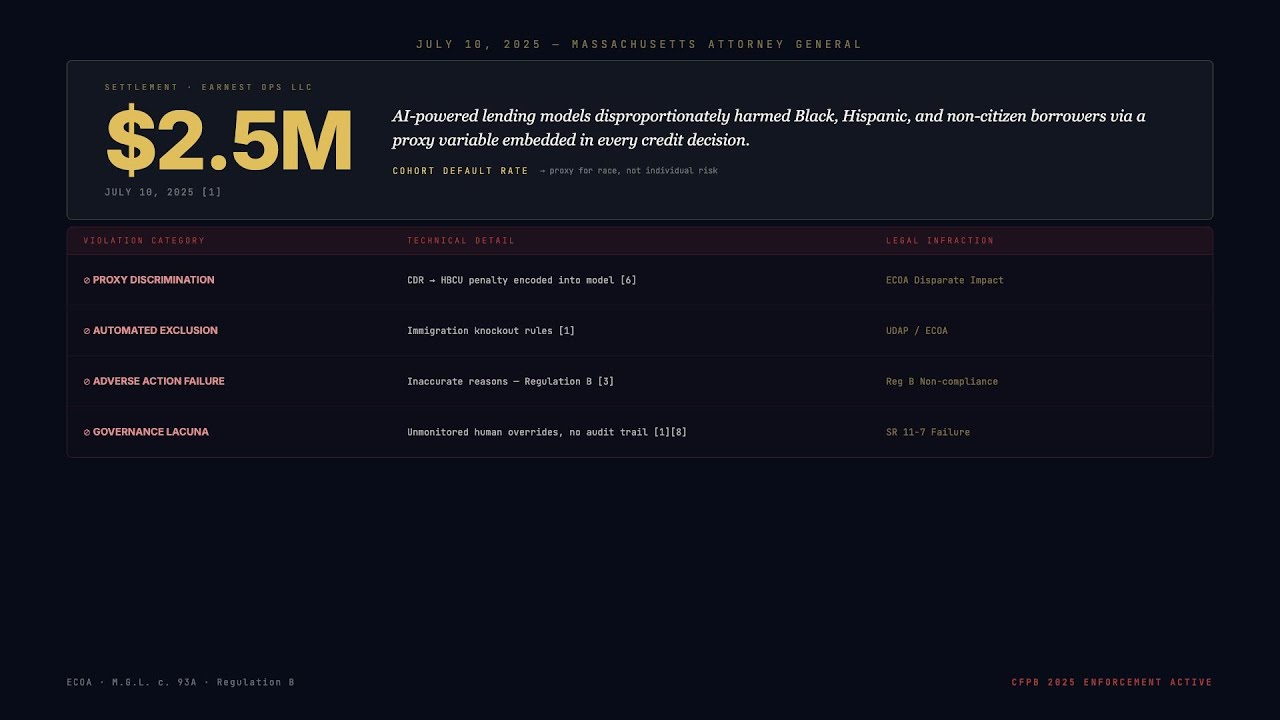
Earnest's use of Cohort Default Rate as a weighted subscore penalized HBCU graduates regardless of personal creditworthiness. The variable's predictive power derived from racial correlation, not individual risk.
Hard-coded algorithmic gates automatically denied applicants lacking at least a green card. Underwriters bypassed models or applied arbitrary standards without documentation—making the system impossible to audit.
Navy Federal rejected more than half of its Black mortgage applicants while approving 77% of white applicants. Even controlling for income and DTI, Black applicants were twice as likely to be denied.
The Massachusetts AG's settlement with Earnest exposed five distinct failure modes. Each represents a systemic vulnerability that exists in most AI lending platforms today.
"While Earnest's internal policies mandated senior oversight for exceptions to the model, investigators found that underwriters frequently bypassed the models or applied arbitrary standards without documentation."
— Massachusetts AG Investigation Findings
| Violation Category | Technical Trigger | Legal Infraction |
|---|---|---|
| Proxy Discrimination | Cohort Default Rate (CDR) | ECOA Disparate Impact |
| Automated Exclusion | Immigration Status "Knockout Rules" | UDAP Violations |
| Transparency Failure | Inaccurate Adverse-Action Notices | Regulation B Non-compliance |
| Governance Lacuna | No Independent Model Validation | Fair Lending Risk Failure |
| Process Instability | Unstandardized Human Overrides | Internal Controls Failure |
Navy Federal Credit Union's mortgage data reveals systemic disparities that controlled analysis cannot explain away. Interact with the data to understand the magnitude.
"Controlled" view adjusts for income, DTI ratio, property value, and neighborhood characteristics
The widest gap of any top-50 US mortgage lender. White applicants: 77.1% approved. Black applicants: 48.5% approved.
Even after controlling for 12+ financial variables, Black applicants were still twice as likely to be denied as white applicants with identical profiles.
In May 2024, a U.S. District Judge ruled that disparate impact claims could proceed, placing the burden on the institution to prove its process is both necessary and the least discriminatory alternative available.
Financial services require high-stakes, deterministic logic. Foundation models are inherently probabilistic and non-deterministic. This is a structural mismatch.
LLMs predict the next token, they don't retrieve facts. A hallucinated justification for a loan denial has no basis in the applicant's file and creates direct liability.
Generic AI platforms lack vertical context for mortgage documents, tax returns, and bank statements. They generate "false negatives"—rejecting creditworthy borrowers.
LLMs trained on internet text absorb historical stereotypes. Certain nationalities or professions get associated with lower creditworthiness in latent space.
Toggle above to compare architectural approaches. The choice is no longer between AI and manual processes—it is between fragile wrapper technology and the robust, defensible intelligence of Deep AI.
The era of claiming that an algorithm is "too complex to explain" has ended. Three regulatory pillars now define what defensible AI looks like.
Creditors must provide "accurate and specific reasons" for adverse actions. Lenders cannot hide behind broad categories if the underlying reason was an algorithmic identification of a specific data point.
Key Mandate:
"The algorithm decided" is not a legally defensible statement.
The definitive standard for model governance. Requires conceptual soundness documentation, independent validation by technically competent teams, and regular outcomes analysis.
Introduces the "AI Bill of Materials" (AI-BOM). Institutions must know exactly where data comes from, what models are used, and how components interact.
| RMF Function | Implementation Requirement | Defensible Evidence |
|---|---|---|
| Govern | Define AI risk ownership | Board-level oversight records |
| Map | Inventory all AI systems | Dynamic AI-BOM and data lineage |
| Measure | Quantify bias and drift | SHAP/LIME audits and TPR logs |
| Manage | Continuous risk mitigation | Automated model "kill switches" |
Deep AI moves beyond qualitative "fairness" to quantitative fairness engineering—mathematical constraints applied at every stage of the model lifecycle.
The requirement that the approval rate for the protected group equals the approval rate for the control group. Ensures outcomes are statistically independent of protected attributes.
Use when regulatory context demands equal outcomes regardless of group membership. Most stringent fairness standard.
Requires that both true positive rates (TPR) and false positive rates (FPR) are consistent across demographic groups. Ensures the model is equally accurate for all demographics.
Preferred when both accuracy and fairness matter. Balances correct approvals with false alarm rates across all groups.
The ratio of the approval rate of the protected group to that of the control group. Must typically exceed 0.8 (the "four-fifths rule") to avoid regulatory scrutiny.
Address bias in training data before it reaches the model. Balance underrepresented demographics using synthetic data generation techniques.
Modify the learning algorithm itself. Adversarial Debiasing trains a secondary model to detect protected attribute leakage in predictions.
Adjust decision thresholds after scoring to ensure equalized odds without retraining. Calibrate cutoffs per-group for statistical parity.
Enterprise-grade AI must be explainable. Veriprajna integrates XAI frameworks that move beyond simple feature importance to local interpretability and counterfactual reasoning.
Based on cooperative game theory, SHAP provides a mathematically rigorous way to assign credit for every decision to specific input features. Generates auditable "behavioral detail" for every adverse action notice.
Modern regulators increasingly expect answers to: "What would have needed to change for this applicant to be approved?" Veriprajna generates these in real-time, providing actionable transparency.
A multi-layered, socio-technical system designed to replace the thin wrapper with defensible intelligence. Click each layer to explore.
Instead of calling an LLM directly from a controller—which blocks server threads and hides costs—Veriprajna implements an orchestration layer that manages queues, handles provider-specific retry logic, and uses semantic caching for cost-efficiency.
Before data ever reaches an AI model, it passes through a validation pipeline evaluating six dimensions. This ensures that "dirty data" does not lead to biased or hallucinatory outcomes.
Rather than relying on a single foundation model, Veriprajna uses a hybrid approach that matches the right tool to each task's requirements.
A "shadow" monitoring layer that provides real-time oversight across three critical vectors, ensuring the system remains fair and accurate in production.
Detects when incoming data distribution deviates from training set. Triggers revalidation.
Real-time alerts when Disparate Impact Ratio falls below established thresholds.
Cross-references AI outputs against source data ground truth to flag anomalies.
Adjust approval rates to see how your institution's numbers compare against the four-fifths rule threshold. Understand when regulatory scrutiny is triggered.
The baseline approval rate for the majority/control group
The approval rate for the protected demographic group
Transitioning from legacy or wrapper-based systems to Deep AI requires a phased approach focused on "defensibility from day one."
AI-BOM and Data Lineage Audit
Adversarial Debiasing & LDA Search
XAI & Counterfactual Engine
Continuous Monitoring & HITL Audit
The Earnest investigation revealed that underwriters frequently bypassed models or applied arbitrary standards without documentation. This creates a hybrid risk profile where both algorithmic and human bias coexist.
Veriprajna implements formalized HITL systems where every manual override is logged with a mandatory justification field and reviewed by an independent compliance officer.
In 2026, an algorithm is not just a tool for efficiency—it is a statement of corporate values and a binding legal record. The $2.5 million Earnest settlement was not just a fine for bias; it was a price paid for the lack of governance, the failure to identify proxies, and the inability to explain a decision.
By moving beyond the LLM wrapper and building socio-technical systems that integrate fairness at the code level, financial institutions can fulfill their dual mandate: maximizing shareholder value through predictive accuracy while upholding their fiduciary duty to the communities they serve.
"The choice is no longer between AI and manual processes; it is between fragile wrapper technology and the robust, defensible intelligence of Deep AI. This is the only path toward sustainable innovation in a regulated world."
Earnest used Cohort Default Rate (CDR) as a weighted subscore in its lending model, which penalized graduates of Historically Black Colleges and Universities regardless of personal creditworthiness. The variable's predictive power derived from racial correlation, not individual risk, constituting disparate impact under ECOA. Additionally, hard-coded knockout rules automatically denied applicants without at least a green card, and underwriters frequently bypassed models without documentation.
The Disparate Impact Ratio measures the ratio of the protected group's approval rate to the control group's rate. It must typically exceed 0.8 (the four-fifths rule) to avoid regulatory scrutiny. Navy Federal's effective ratio was 48.5% / 77.1% = 0.63 — far below the 0.8 threshold. Even after controlling for 12+ financial variables, Black applicants were twice as likely to be denied. A U.S. District Judge ruled that disparate impact claims could proceed.
Veriprajna's pipeline includes: (1) Pre-Processing — balancing underrepresented demographics using synthetic data generation (SMOTE), (2) In-Processing — adversarial debiasing where a secondary model detects protected attribute leakage in predictions, with the primary model optimizing for minimum error plus maximum adversary error, and (3) Post-Processing — adjusting decision thresholds per-group to ensure equalized odds (consistent TPR and FPR across demographics) without retraining.
Veriprajna architects Deep AI systems that are transparent, fair, and audit-ready—engineered to withstand the rigors of CFPB, SR 11-7, and class-action discovery.
Schedule a consultation to assess your algorithmic risk posture and model defensibility.
Complete analysis: Earnest & Navy Federal case studies, fairness mathematics, XAI implementation, regulatory compliance maps, and the Deep AI architecture specification.