The Algorithmic Accountability Mandate: Transforming Enterprise Talent Systems from Commodity Wrappers to High-Fidelity Deep AI Solutions
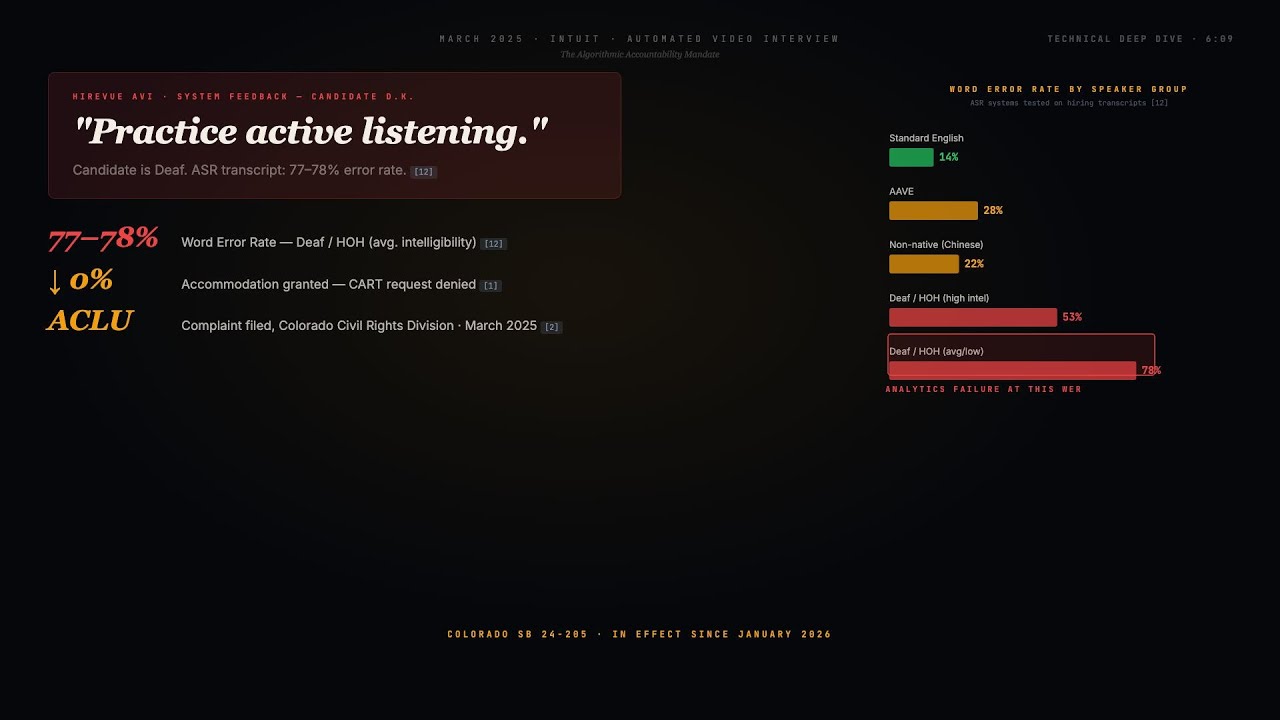
The administrative complaint filed in March 2025 by the American Civil Liberties Union (ACLU) of Colorado against Intuit and its technology vendor HireVue serves as a defining inflection point for the global enterprise software sector. The case, brought on behalf of a Deaf Indigenous woman—identified as D.K. in public filings—alleges that an automated video interview (AVI) platform utilized by her employer systematically blocked her promotion to a Seasonal Manager position due to profound, unmitigated biases related to her disability and race.1 For organizations positioning themselves at the cutting edge of technological innovation, this incident highlights a catastrophic failure of the current market-standard approach to artificial intelligence: the reliance on generic, large-scale models or "LLM wrappers" that lack the granular sensitivity required for high-stakes human assessment.3
The shift from speculative concern to active litigation indicates that enterprises can no longer treat AI-driven hiring as a secondary administrative convenience. Instead, the emergence of the Colorado Artificial Intelligence Act (SB 24–205), effective in early 2026, alongside federal scrutiny from the Equal Employment Opportunity Commission (EEOC) and the Department of Justice (DOJ), has elevated algorithmic fairness to a primary risk management and compliance priority.5 This whitepaper argues that the era of "black-box" automation is over, replaced by a mandate for "Deep AI" solutions—architectures that integrate causal reasoning, multimodal fusion, and human-in-the-loop (HITL) governance to ensure both operational efficiency and civil rights integrity.7
The Intuit and HireVue Conflict: An Autopsy of Algorithmic Exclusion
The facts of the ACLU complaint provide a sobering look at how sophisticated technologies can reinforce ancient biases when deployed without rigorous domain-specific oversight. D.K., a high-performing employee with a history of positive evaluations and annual bonuses, was required to complete an automated interview as part of a promotional application.2 Despite alerting the company’s accessibility team to the platform’s limitations and requesting human-generated Communication Access Realtime Translation (CART) as an accommodation, she was forced to rely on error-prone automated captions.1
The resulting technical failure was not merely a glitch but a fundamental misalignment of the software's predictive logic with the reality of Deaf communication. The Automated Speech Recognition (ASR) system failed to interpret her speech accurately due to her "Deaf accent," leading the system to output feedback suggesting she "practice active listening"—a comment that is as technically absurd as it is offensive in the context of a candidate with hearing loss.3 This underscores a "representation bias" in the training data, where the models were likely trained on standard, hearing-centric speech patterns, causing them to categorize any deviation as a lack of "confidence" or "communication skill".2
Quantitative Disparities in Automated Speech Recognition
The technical root of the failure in the Intuit case lies in the massive performance gap between standard ASR systems and the diverse linguistic reality of a global workforce. While many cloud providers claim "human-parity" in transcription, these metrics are often derived from homogeneous datasets. Research consistently demonstrates that when these systems encounter accented speech or linguistic variations associated with disabilities, the Word Error Rate (WER) escalates to levels that render the data useless for subsequent analysis.12
| Speaker Group | Word Error Rate (WER) % | Severity of Data Loss | Source |
|---|---|---|---|
| Standard American English | 10% - 18% | Low (Passable for analytics) | 12 |
| African American Vernacular English (AAVE) | 20% - 35% | Moderate (Keywords lost) | 10 |
| Non-Native English (Chinese Accent) | 22% | Moderate | 14 |
| Deaf/HOH (High Intelligibility) | 53% | High (Frequent loss of context) | 12 |
| Deaf/HOH (Average/Low Intelligibility) | 77% - 78% | Catastrophic (Analytics failure) | 12 |
The statistical implication for an enterprise using such systems is clear: if the foundational data (the transcript) has a 78% error rate, any high-level "Deep Learning" model analyzing that transcript for leadership traits or cultural fit is essentially hallucinating results based on noise.12 This constitutes a "disparate impact" violation under Title VII and the ADA, as the system creates a barrier that is mathematically insurmountable for a specific protected class.17
The Technical Fallacy of LLM Wrappers in High-Stakes HR
The consultancy market has been flooded with companies offering "AI for Hiring" that are essentially thin interfaces (wrappers) for public APIs like OpenAI’s GPT-4 or Anthropic’s Claude. While these models are impressive in general reasoning, they are fundamentally unsuited for the high-precision, low-bias requirements of enterprise talent selection for several reasons.
First, general-purpose LLMs inherit the "historical bias" of the massive, uncurated internet datasets upon which they were trained. If historical hiring data reflects a preference for male engineers or white executives, the LLM treats this correlation as an optimization target.5 Second, wrappers lack "Sovereign Data Controls." They cannot easily be audited for "Counterfactual Fairness"—the ability to prove that a candidate’s score would have remained identical had their protected attributes (race, gender, disability) been different.19
Deep AI providers like Veriprajna move beyond the wrapper model by implementing "Adversarial Debiasing." In this framework, the primary scoring model is trained alongside an "adversary" model whose only job is to predict the candidate's protected attributes from the primary model's internal data representations.21 The primary model is then penalized until the adversary can no longer distinguish between groups, ensuring that the final output is "representationally blind" to sensitive variables.21
In this equation, represents the loss in prediction accuracy for job performance, while represents the loss in the adversary's ability to detect a protected attribute . By balancing these through a hyperparameter , Veriprajna architectures achieve a mathematical guarantee of fairness that is impossible for a standard API wrapper.22
Regulatory Tsunami: The Legal Risks of "Black-Box" Solutions (2025-2026)
The legal landscape has shifted from voluntary "ethical guidelines" to mandatory "compliance audits." The March 2025 ACLU complaint is part of a broader regulatory surge that includes the Colorado Artificial Intelligence Act (SB 24–205), which establishes a first-of-its-kind "duty of reasonable care" for developers and deployers of high-risk AI.5 This law requires that any system making "consequential decisions"—such as hiring or promotion—must be accompanied by an annual impact assessment that screens for algorithmic discrimination.5
Furthermore, the NYC Local Law 144 and similar pending bills in California and Illinois mandate independent bias audits and public transparency regarding how AI tools rank candidates.23 These laws do not care whether the discrimination was "unintentional." If a model’s output violates the "Four-Fifths Rule"—where the selection rate for a protected group is less than 80% of the highest-selected group—the enterprise is liable for disparate impact.5
| Regulation | Scope | Mandatory Action | Penalty/Risk |
|---|---|---|---|
| Colorado SB 24-205 | High-risk AI (Employment) | Annual Impact Assessments.5 | Civil litigation/Regulatory fines |
| NYC Local Law 144 | Automated Employment Decision Tools | Independent Bias Audits.23 | Daily fines/Barred usage |
| EU AI Act | High-risk AI (Recruitment) | Transparency & Human Oversight.5 | Global revenue-based fines |
| EEOC Title VII/ADA | All Employers | Disparate Impact Analysis.18 | Federal lawsuits/Back-pay |
In the federal case Mobley v. Workday, a district court took the precedent-setting step of certifying a collective action, reasoning that an AI vendor acts as an "agent" or "indirect employer" when its software performs functions traditionally exercised by a human hiring manager.5 This means that "Deep AI" providers like Veriprajna must assume a shared responsibility for compliance, a posture that contrasts sharply with "Wrapper" companies that use legal disclaimers to push all liability onto the enterprise customer.2
Multimodal Fusion: Architecting for Diversity and Accessibility
The primary failure in the Intuit/HireVue case was a "Modality Collapse." The system likely over-indexed on the audio/speech prosody of the candidate while failing to provide a robust visual or textual channel for a Deaf applicant.2 Veriprajna's approach utilizes Early Multimodal Fusion, where features from video (facial expression), audio (speech), and text (transcripts) are integrated at a foundational level rather than being processed in silos.27
This is critical because, as the FAIR-VID project has demonstrated, single-modality models are inherently more prone to bias.20 For instance, an audio model might penalize a Deaf accent, but a visual model could identify signs of engagement or "authenticity" that counteract the audio penalty.29 By using Modality Fusion Collaborative De-biasing (CoD), the system can identify "impoverished" modalities—such as a noisy audio track or a non-standard accent—and artificially augment the role of the "enriched" modalities (like the candidate’s written credentials or visual non-verbal communication) to maintain an accurate and fair assessment.30
Human-in-the-Loop (HITL) as an Operational Standard
The denial of a human captioner to D.K. was a failure of "Human-in-the-Loop" architecture. In a truly professional AI deployment, human intervention is not an "exception" but a core component of the workflow.8 Veriprajna integrates HITL as an event-driven mechanism where the model triggers a human review whenever its "confidence interval" drops below a predefined threshold.8
In the case of a Deaf or hard-of-hearing candidate:
1. The system identifies a high probability of a non-standard accent during the initial voice check.2
2. The ASR model flags a "Low Confidence" score for the transcription.8
3. The workflow automatically routes the interview to a human CART provider or triggers a "Bimodal Assessment" where the candidate can provide written responses alongside the video.13
This creates a "supervised validation" layer that ensures the final decision is based on the candidate's actual qualifications, not the machine's failure to parse their identity.31
Explainable AI (XAI): From "Black-Box" to "Glass-Box" Governance
Enterprises are increasingly rejecting "black-box" models where a score is generated without rationale. The ISO/IEC 42001 standard for AI Management Systems (AIMS) emphasizes that AI-based decisions must be "explainable and auditable".33 If a candidate like D.K. is rejected, the system must be able to state exactly which features led to that decision—and those features must be "job-related and consistent with business necessity".26
Veriprajna utilizes SHAP (SHapley Additive exPlanations) to quantify the contribution of each feature to the final hiring recommendation.36 If a SHAP analysis reveals that a candidate was penalized for "prosody" or "facial micro-expressions"—features that have little to no scientific link to job performance but high correlation with race or disability—the model is automatically flagged for remediation.10
| Metric | Wrapper Methodology | Veriprajna "Deep AI" Strategy |
|---|---|---|
| Feature Extraction | Unstructured prompt response | Bias-neutral, competency-mapped features.7 |
| Fairness Metric | None (Post-hoc manual review) | Continuous "Equalized Odds" monitoring.21 |
| Explainability | Probabilistic next-word prediction | Technical traceability (SHAP/LIME).35 |
| Audit Readiness | Minimal (Dependent on API logs) | Full ISO 42001 & NIST RMF alignment.33 |
| Accessibility | Generic (Subtitles often missing) | Integrated HITL & CART workflows.1 |
Conclusion: The Strategic Imperative of Algorithmic Integrity
The March 2025 incident involving Intuit and HireVue is not an indictment of AI itself, but an indictment of a "move fast and break things" approach to talent technology.5 For the enterprise, the cost of biased AI is no longer just reputational—it is a matter of legal survival and operational efficiency.10 When a qualified candidate is screened out due to a "Deaf accent" or an Indigenous dialect, the company loses access to the very diversity of thought that drives innovation.2
Deep AI providers like Veriprajna represent the next evolution of this market. By moving away from commodity wrappers and toward custom-engineered, bias-resistant architectures, we provide enterprises with a "Verified Fairness" that allows them to scale their hiring without scaling their liability.4 The mandate is clear: AI should be a bridge to talent, not a barrier to it.3 As the regulatory reckoning of 2025-2026 unfolds, organizations that invest in "Deep AI" integrity today will be the only ones standing when the "black-box" era finally collapses.
Works cited
AI Screening Systems Face Fresh Scrutiny: 6 Key Takeaways From Claims Filed Against Hiring Technology Company | Fisher Phillips, accessed February 6, 2026, https://www.fisherphillips.com/en/news-insights/ai-screening-systems-face-fresh-scrutiny-6-key-takeaways-from-claims-filed-against-hiring-technology-company.html
- This complaint alleges violations of the Colorado Anti ... - ACLU, accessed February 6, 2026, https://assets.aclu.org/live/uploads/2025/03/Redacted-HireVue_Intuit-Complaint-of-Discrimination_Redacted.pdf
I Should Not Have to Fight for Fair Treatment in the Workplace - ACLU of Florida, accessed February 6, 2026, https://www.aclufl.org/news/i-should-not-have-fight-fair-treatment-workplace/
AI-Driven Solution for Talent Acquisition: a White Paper - rinf.tech, accessed February 6, 2026, https://www.rinf.tech/ai-driven-solution-for-talent-acquisition-a-white-paper/
Why the Workday collective action and Colorado AI Act signal the end of “move fast and break things” in recruiting technology | by Jesse Hogan | Medium, accessed February 6, 2026, https://medium.com/@jesse.hogan/why-the-workday-collective-action-and-colorado-ai-act-signal-the-end-of-move-fast-and-break-12a8e801e5f4
Justice Department and EEOC Warn Against Disability Discrimination, accessed February 6, 2026, https://www.justice.gov/archives/opa/pr/justice-department-and-eeoc-warn-against-disability-discrimination
Algorithmic Equity Playbook: Fair AI in Recruitment & HR - V2Solutions, accessed February 6, 2026, https://www.v2solutions.com/whitepapers/ai-recruitment-bias-playbook/
CTOs Guide to Designing Human-in-the-Loop Systems for Enterprises - Electric Mind, accessed February 6, 2026, https://www.electricmind.com/whats-on-our-mind/ctos-guide-to-designing-human-in-the-loop-systems-for-enterprises
AI hiring software was biased against deaf employees, ACLU alleges in ADA case | HR Dive, accessed February 6, 2026, https://www.hrdive.com/news/ai-intuit-hirevue-deaf-indigenous-employee-discrimination-aclu/743273/
AI Hiring Bias: Real Cases, Legal Consequences, and Prevention | Knowledge Hub, accessed February 6, 2026, https://responsibleailabs.ai/knowledge-hub/articles/ai-hiring-bias-legal-cases
White Paper: Bias Neutralisation Framework by SniperAI, accessed February 6, 2026, https://cdn.prod.website-files.com/6704a5dd7a950c4d6667982c/68627e9b44e1f16ab8077e26_White%20Paper_%20Bias%20Neutralisation%20Framework%20by%20SniperAI.pdf
Feasibility of Using Automatic Speech Recognition with Voices of Deaf and Hard-of-Hearing Individuals - arXiv, accessed February 6, 2026, https://arxiv.org/pdf/1909.01167
Communication Access Real-Time Translation Through Collaborative Correction of Automatic Speech Recognition - arXiv, accessed February 6, 2026, https://arxiv.org/html/2503.15120v1
Algorithmic Accent Bias: Are AI Video Interview Tools Discriminating by National Origin?, accessed February 6, 2026, https://www.bbwmlaw.com/blog/algorithmic-accent-bias-are-ai-video-interview-tools-discriminating-by-national-origin/
Fairness of Automatic Speech Recognition: Looking Through a Philosophical Lens - arXiv, accessed February 6, 2026, https://arxiv.org/html/2508.07143v1
AI in HR: How Artificial Intelligence Is Changing Human Resources for the Better, accessed February 6, 2026, https://hcm.sage.com/white-papers/ai-in-hr
Lead Article: When Machines Discriminate: The Rise of AI Bias Lawsuits - Quinn Emanuel, accessed February 6, 2026, https://www.quinnemanuel.com/the-firm/publications/when-machines-discriminate-the-rise-of-ai-bias-lawsuits/
Artificial Intelligence and Disparate Impact Liability: How the EEOC's End to Disparate Impact Claims Affects Workplace AI | Epstein Becker Green - Workforce Bulletin, accessed February 6, 2026, https://www.workforcebulletin.com/artificial-intelligence-and-disparate-impact-liability-how-the-eeocs-end-to-disparate-impact-claims-affects-workplace-ai
Behind the Screens: Uncovering Bias in AI-Driven Video Interview Assessments Using Counterfactuals - arXiv, accessed February 6, 2026, https://arxiv.org/html/2505.12114v2
Bias and Fairness in Multimodal Machine Learning: A Case Study of Automated Video Interviews, accessed February 6, 2026, https://par.nsf.gov/servlets/purl/10381212
Advancing Fairness in Multimodal Machine Learning for Internet‑Scale Video Data: Comprehensive Bias Mitigation and Evaluation Framework - International Journal of Computer Applications, accessed February 6, 2026, https://www.ijcaonline.org/archives/volume187/number64/advancing-fairness-in-multimodal-machine-learning-for-internetscale-video-data-comprehensive-bias-mitigation-and-evaluation-framework/
(PDF) Fairness-Aware Multimodal Learning in Automatic Video Interview Assessment, accessed February 6, 2026, https://www.researchgate.net/publication/374860594_Fairness-aware_Multimodal_Learning_in_Automatic_Video_Interview_Assessment
AI and Workplace Discrimination: What Employers Need to Know after the EEOC and DOL Rollbacks | Husch Blackwell, accessed February 6, 2026, https://www.huschblackwell.com/newsandinsights/ai-and-workplace-discrimination-what-employers-need-to-know-after-the-eeoc-and-dol-rollbacks
NIST AI Risk Management Framework: A simple guide to smarter AI governance - Diligent, accessed February 6, 2026, https://www.diligent.com/resources/blog/nist-ai-risk-management-framework
Is Using Artificial Intelligence Discriminatory for Workers with Disabilities? | Filippatos PLLC, accessed February 6, 2026, https://www.filippatoslaw.com/blog/is-using-artificial-intelligence-discriminatory-for-workers-with-disabilities/
EEOC Issues Title VII Guidance on Employer Use of AI, Other Algorithmic Decision-Making Tools | Insights | Mayer Brown, accessed February 6, 2026, https://www.mayerbrown.com/en/insights/publications/2023/07/eeoc-issues-title-vii-guidance-on-employer-use-of-ai-other-algorithmic-decisionmaking-tools
Exploring Fusion Techniques in Multimodal AI-Based Recruitment: Insights from FairCVdb, accessed February 6, 2026, https://arxiv.org/html/2407.16892v1
A Survey of Multi-sensor Fusion Perception for Embodied AI: Background, Methods, Challenges and Prospects - arXiv, accessed February 6, 2026, https://arxiv.org/html/2506.19769v1
FAIR-VID: A Multimodal Pre-Processing Pipeline for Student Application Analysis - MDPI, accessed February 6, 2026, https://www.mdpi.com/2076-3417/15/24/13127
Collaborative Modality Fusion for Mitigating Language Bias in Visual Question Answering, accessed February 6, 2026, https://www.mdpi.com/2313-433X/10/3/56
Engineering AI Agents for Clinical Workflows: A Case Study in Architecture, MLOps, and Governance - arXiv, accessed February 6, 2026, https://arxiv.org/html/2602.00751v1
REAL TIME CAPTIONING ON SPEECH - Jetir.Org, accessed February 6, 2026, https://www.jetir.org/papers/JETIR2504C77.pdf
ISO/IEC 42001: a new standard for AI governance - KPMG International, accessed February 6, 2026, https://kpmg.com/ch/en/insights/artificial-intelligence/iso-iec-42001.html
how does iso 42001 address ai ethics and bias? - CertPro, accessed February 6, 2026, https://certpro.com/how-does-iso-42001-address-ai-ethics-and-bias/
Explaining explainable AI | Deloitte UK, accessed February 6, 2026, https://www.deloitte.com/uk/en/services/consulting-risk/services/explaining-explainable-ai.html
Explainable AI (XAI) in 2025: How to Trust AI in 2025 - Blog de Bismart, accessed February 6, 2026, https://blog.bismart.com/en/explainable-ai-business-trust
AI Resume Parsing Bias: 20% Boost in Diversity Hires - 4Spot Consulting, accessed February 6, 2026, https://4spotconsulting.com/rectifying-ai-bias-global-talent-solutions-20-diversity-hire-increase/
Understanding ISO 42001 and Demonstrating Compliance - ISMS.online, accessed February 6, 2026, https://www.isms.online/iso-42001/
Prefer a visual, interactive experience?
Explore the key findings, stats, and architecture of this paper in an interactive format with navigable sections and data visualizations.
Frequently Asked Questions
Why do AI hiring tools discriminate against Deaf candidates?
Standard Automated Speech Recognition systems exhibit Word Error Rates of 77-78% for Deaf and hard-of-hearing speakers, compared to 10-18% for standard American English. This data corruption cascades into AI scoring models, producing assessments based on noise rather than candidate qualifications, creating legally actionable disparate impact.
How does adversarial debiasing ensure algorithmic fairness in recruitment?
Adversarial debiasing trains a primary scoring model alongside an adversary model that attempts to predict protected attributes from internal representations. The primary model is penalized until the adversary cannot distinguish between demographic groups, achieving mathematical guarantees of representational blindness to sensitive variables.
What does the Colorado AI Act require for AI hiring tools?
Colorado SB 24-205, effective in early 2026, establishes a duty of reasonable care for developers and deployers of high-risk AI systems making consequential employment decisions. It mandates annual impact assessments screening for algorithmic discrimination, with civil litigation and regulatory fines for non-compliance.
Build Your AI with Confidence.
Partner with a team that has deep experience in building the next generation of enterprise AI. Let us help you design, build, and deploy an AI strategy you can trust.
Veriprajna Deep Tech Consultancy specializes in building safety-critical AI systems for healthcare, finance, and regulatory domains. Our architectures are validated against established protocols with comprehensive compliance documentation.