Transforming Enterprise Talent Systems from Commodity Wrappers to High-Fidelity Deep AI Solutions
The ACLU's March 2025 complaint against Intuit and HireVue marks the end of "black-box" hiring AI. When a Deaf Indigenous employee was blocked from promotion by biased automated screening, it exposed a systemic failure in how enterprises deploy artificial intelligence for talent decisions.
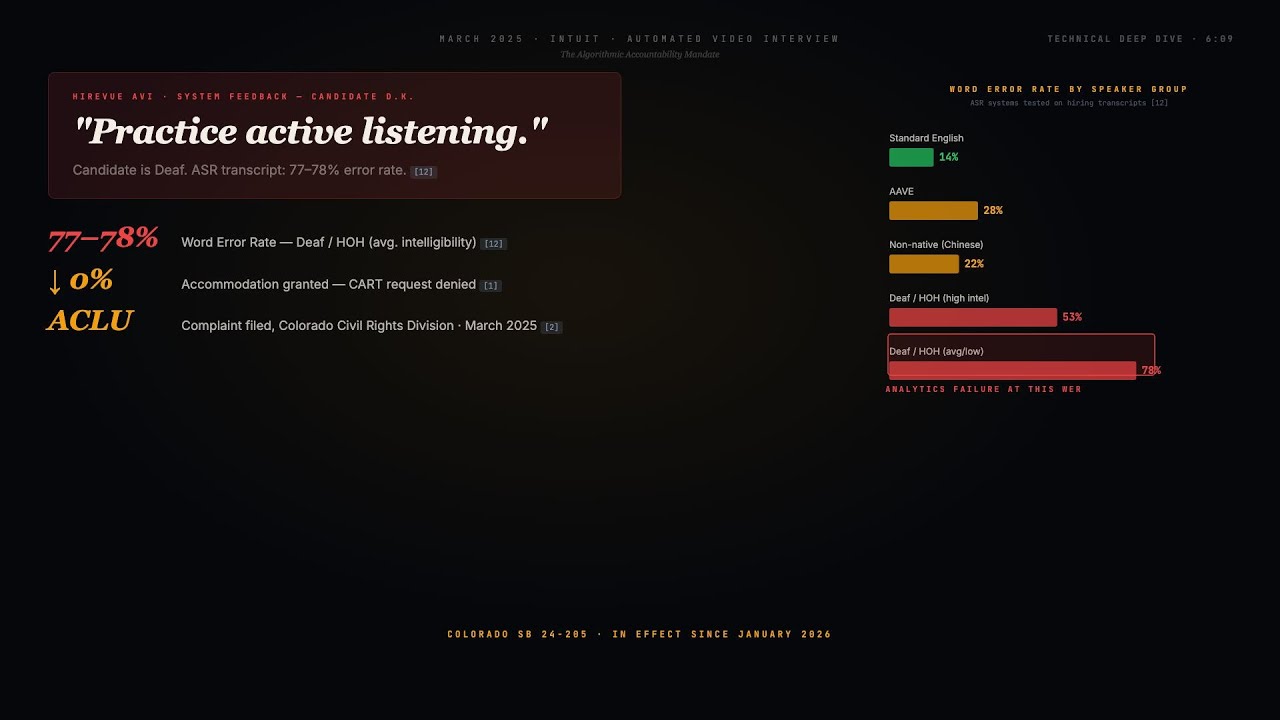
In March 2025, the ACLU of Colorado filed an administrative complaint against Intuit and HireVue — exposing how automated video interviews can systematically exclude qualified candidates.
D.K., a Deaf Indigenous woman, was a high-performing employee with a history of positive evaluations and annual bonuses. She applied for a Seasonal Manager promotion and was required to complete an automated video interview.
The ASR system failed to interpret her speech due to her "Deaf accent." Despite requesting human-generated CART captioning as an accommodation, she was forced to rely on error-prone automated captions.
The system suggested she "practice active listening" — a recommendation that is as technically absurd as it is offensive for a candidate with hearing loss. This was not a glitch. It was a fundamental misalignment of predictive logic with reality.
This incident highlights a catastrophic failure of the current market-standard approach to artificial intelligence: the reliance on generic, large-scale models that lack the granular sensitivity required for high-stakes human assessment. If the foundational data has a 78% error rate, any model analyzing that data for leadership traits is essentially hallucinating results based on noise.
— Veriprajna Technical Analysis, 2025
While cloud providers claim "human-parity" transcription, these metrics come from homogeneous datasets. The real-world gap is catastrophic.
Word Error Rate (WER) by speaker group — higher = more data loss for downstream AI analysis
At 78% WER, nearly 4 out of 5 words are wrong. Any "deep learning" model analyzing this transcript for leadership traits or cultural fit is operating on noise, not signal.
AAVE speakers and non-native English speakers face error rates that systematically degrade keyword extraction and sentiment analysis — creating invisible barriers.
This constitutes a "disparate impact" violation under Title VII and the ADA — the system creates a barrier that is mathematically insurmountable for specific protected classes.
ASR errors don't stay at the transcription layer. They compound through every stage of the analysis pipeline.
Adjust the ASR Word Error Rate to see how errors cascade through the hiring pipeline
The market is flooded with "AI for Hiring" products that are thin interfaces over public APIs. While impressive for general reasoning, they are fundamentally unsuited for the precision and fairness required in talent selection.
General-purpose LLMs inherit biases from massive, uncurated internet datasets. If historical hiring data reflects a preference for certain demographics, the LLM treats these correlations as optimization targets.
Wrappers cannot be audited for "Counterfactual Fairness" — the ability to prove that a candidate's score would remain identical had their protected attributes been different.
Probabilistic next-word prediction cannot explain why a candidate was scored low. When regulators or courts ask for rationale, wrappers have nothing to offer but statistical noise.
Deep AI providers move beyond the wrapper model. The primary scoring model is trained alongside an "adversary" whose only job is to predict the candidate's protected attributes from the model's internal representations. The primary model is penalized until the adversary can no longer distinguish between groups.
The legal landscape has shifted from voluntary "ethical guidelines" to mandatory "compliance audits." These laws do not care whether discrimination was unintentional.
First-of-its-kind "duty of reasonable care" for developers and deployers of high-risk AI. Any system making consequential decisions — hiring, promotions — must be accompanied by annual impact assessments screening for algorithmic discrimination.
Mandates independent bias audits and public transparency for how AI tools rank candidates. Similar bills are pending in California and Illinois.
Classifies recruitment AI as "high-risk," requiring transparency, human oversight, and rigorous conformity assessments before deployment.
Disparate impact analysis applies to all employers using algorithmic decision tools. In Mobley v. Workday, the court ruled that an AI vendor acts as an "agent" of the employer — creating shared liability.
If a model's output produces a selection rate for any protected group that is less than 80% of the highest-selected group, the enterprise is liable for disparate impact — regardless of intent. "Wrapper" vendors use legal disclaimers to push all liability onto customers. Deep AI providers like Veriprajna assume shared responsibility for compliance.
The primary failure in the Intuit/HireVue case was "Modality Collapse" — the system over-indexed on audio while failing to provide robust alternative channels. Veriprajna's architecture prevents this by design.
Modality Fusion Collaborative De-biasing (CoD): When the system detects an "impoverished" modality — such as noisy audio from a non-standard accent — it augments the weight of "enriched" modalities like written credentials and visual non-verbal communication to maintain accurate and fair assessment.
The denial of a human captioner to D.K. was a failure of HITL architecture. In a professional AI deployment, human intervention is a core component, not an exception.
Detect: System identifies high probability of non-standard accent during initial voice check
Flag: ASR model flags "Low Confidence" transcription score below threshold
Route: Workflow automatically triggers human CART provider or enables "Bimodal Assessment" with written responses
This creates a "supervised validation" layer that ensures the final decision is based on the candidate's actual qualifications — not the machine's failure to parse their identity.
Enterprises are rejecting models where scores are generated without rationale. ISO/IEC 42001 mandates that AI decisions must be explainable and auditable.
Veriprajna uses SHAP (SHapley Additive exPlanations) to quantify the contribution of each feature to every hiring recommendation. If analysis reveals a candidate was penalized for "prosody" or "facial micro-expressions" — features with no scientific link to job performance but high correlation with race or disability — the model is automatically flagged for remediation.
Every feature must pass the EEOC standard: "job-related and consistent with business necessity."
The cost of biased AI is no longer just reputational — it is a matter of legal survival and operational efficiency. When a qualified candidate is screened out due to a "Deaf accent" or an Indigenous dialect, the company loses access to the very diversity of thought that drives innovation.
Courts now certify collective actions against AI vendors. In Mobley v. Workday, the precedent was set: vendors are "agents" sharing employer liability.
Biased systems reject qualified candidates en masse. Every false negative is a lost hire, a longer vacancy, and a competitive disadvantage.
Deep AI architectures with adversarial debiasing, SHAP explainability, and HITL governance allow enterprises to scale hiring without scaling liability.
"AI should be a bridge to talent, not a barrier to it. Organizations that invest in Deep AI integrity today will be the only ones standing when the black-box era collapses."
ASR errors do not stay at the transcription layer — they compound through every downstream stage. At 78% word error rate (measured for Deaf speakers), nearly 4 out of 5 words are wrong. This cascades through four stages: Stage 1 (Transcript Accuracy) drops to 22%, Stage 2 (Keyword Detection) collapses further as critical qualifications and competencies are garbled, Stage 3 (Sentiment Analysis) becomes unreliable as the system analyzes noise rather than signal, and Stage 4 (Hiring Confidence) approaches near-random chance. Any deep learning model analyzing such a transcript for leadership traits or cultural fit is operating on noise, not signal. For AAVE speakers at 20-35% WER and non-native English speakers, errors systematically degrade keyword extraction and sentiment analysis — creating invisible barriers that constitute disparate impact violations under Title VII and the ADA.
Veriprajna's early multimodal fusion pipeline processes three channels simultaneously — audio (speech prosody, tone, pace at 30% weight), video (expression, engagement, authenticity at 35% weight), and text (content, structure, credentials at 35% weight). When the system detects an 'impoverished' modality — such as noisy audio from a non-standard accent or Deaf speech pattern — it applies Modality Fusion Collaborative De-biasing (CoD), which augments the weight of 'enriched' modalities like written credentials and visual non-verbal communication to maintain accurate and fair assessment. This prevents the catastrophic 'modality collapse' that occurred in the HireVue case, where the system over-indexed on audio while failing to provide robust alternative channels.
Veriprajna uses SHAP (SHapley Additive exPlanations) to quantify the contribution of each feature to every hiring recommendation. Job-relevant features like Problem-Solving Depth (+0.34), Technical Accuracy (+0.28), and Communication Clarity (+0.18) receive positive attribution. However, if analysis reveals a candidate was penalized for 'prosody' or 'facial micro-expressions' — features with no scientific link to job performance but high correlation with race or disability — the model is automatically flagged for remediation. Every feature must pass the EEOC standard of being 'job-related and consistent with business necessity.' This transforms the system from a black-box that cannot explain rejections to a glass-box where every decision is traceable, every feature is justified, and every audit is ready.
The regulatory reckoning of 2025-2026 is here. Veriprajna helps enterprises transition from liability-laden black-box automation to verified, auditable Deep AI.
Request an algorithmic audit to assess your current hiring technology stack for bias risk, regulatory compliance gaps, and fairness optimization opportunities.
Complete analysis: ACLU case autopsy, ASR bias quantification, regulatory compliance frameworks, adversarial debiasing architecture, multimodal fusion design, and XAI governance standards.