Algorithmic Equity and the Deep AI Imperative: Redressing Systemic Bias in Clinical Decision Support
The integration of artificial intelligence into the clinical environment has transitioned from a theoretical promise to a structural necessity. However, as healthcare organizations increasingly rely on automated systems to augment diagnostic precision and triage efficiency, a critical disconnect has emerged between algorithmic performance in controlled environments and the lived reality of patient outcomes. The recent surge in empirical evidence—ranging from the hardware-level inaccuracies of pulse oximetry to the architectural failures of proprietary sepsis models—reveals that many current AI implementations are not merely neutral tools but are active participants in the perpetuation of historical healthcare inequities. The crisis in Black maternal health, where mortality rates remain three times higher than those of white populations, serves as the most harrowing indicator of these systemic failures. This report, presented by Veriprajna, argues that the solution to these disparities lies not in the superficial application of Large Language Model (LLM) "wrappers," but in a fundamental reorientation toward deep AI solutions that prioritize physiological integrity, demographic parity, and rigorous external validation.
The Crisis of Confidence: Beyond the LLM Wrapper Trap
The current technological landscape is saturated with "wrapper" applications—software layers that provide a thin user interface over generalized public APIs such as OpenAI’s GPT, Google’s Gemini, or Anthropic’s Claude. While these tools excel at administrative drafting and surface-level data summarization, they are fundamentally ill-equipped for the high-stakes, multimodal demands of clinical decision support. An LLM is a statistical engine trained on language probabilities; it does not possess a conceptual understanding of pathophysiology, nor is it inherently grounded in the rigorous constraints of clinical evidence.1 In the context of maternal health or acute sepsis management, the "wrapper" approach introduces unacceptable risks, including hallucinations, the reinforcement of internet-scale biases, and a lack of explainability that renders the "black box" nature of the model a liability rather than an asset.3
Veriprajna positions itself as a deep AI solution provider, advocating for a methodology that integrates real-time physiological signals, expert-labeled datasets, and fairness-aware loss functions. The failure of "off-the-shelf" models—such as the Epic Sepsis Model—to generalize across diverse patient populations demonstrates that accuracy metrics averaged across a population often mask lethal deficiencies within marginalized subgroups.5 True clinical intelligence requires an architecture that accounts for the interdependency of hardware sensors, socioeconomic determinants of health (SDOH), and the physiological variations across demographic cohorts.
Physiological Data Integrity: The Pulse Oximeter and the Foundation of Bias
The efficacy of any AI system is inextricably linked to the quality of the data it ingests. In triage and early warning systems, pulse oximetry serves as a primary source of input for determining respiratory distress and sepsis risk. However, the physical mechanism of these devices contains a long-documented but frequently ignored bias: the differential absorption of light by melanin.
The Physics of Optical Interference
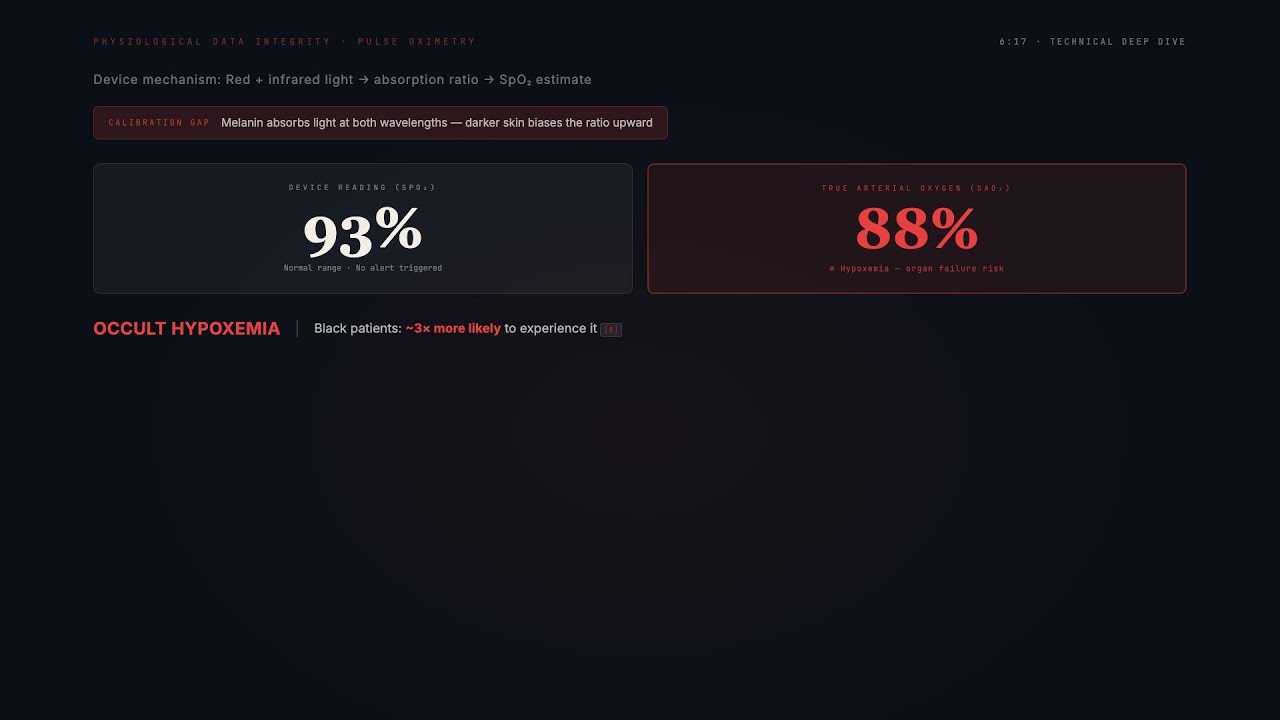
Pulse oximeters function by transmitting red and infrared light through the tissue and measuring the absorption ratio of oxygenated and deoxygenated hemoglobin. Melanin, however, also absorbs light across these wavelengths. When these devices are calibrated primarily on lighter-skinned populations, the additional absorption in darker-skinned patients is often misinterpreted by the device as a higher concentration of oxygenated hemoglobin.8 This leads to "occult hypoxemia"—a condition where the device reports a peripheral oxygen saturation ( ) within the normal range while the true arterial oxygen saturation ( ) is dangerously low.
Recent findings published in the New England Journal of Medicine (NEJM) and the British Medical Journal (BMJ) underscore the magnitude of this measurement error and its subsequent impact on AI-driven triage logic. Research indicates that Black patients are nearly three times more likely to experience occult hypoxemia than white patients, a disparity that has persisted since the 1990s without adequate regulatory intervention.8
| Parameter | Impact on Lighter Skin Tones | Impact on Darker Skin Tones | Source |
|---|---|---|---|
| Mean Overestimation | Baseline | 0.6 to 1.5 percentage points higher | 8 |
| False Negative Rate (SpO₂) | 1.2% - 26.9% | 7.6% - 62.2% | 8 |
| Occult Hypoxemia Incidence | Baseline | ~3x higher frequency | 8 |
| Pediatric Detection Failure | 0% Missed | 7% Missed in darkest skin tones | 11 |
The Cascading Effect on AI Triage
When an AI triage system utilizes as a core feature, it inherits this hardware-level bias.
If an algorithm is designed to trigger a "high-priority" alert for an below 92%, it will systematically fail to flag Black patients whose true arterial oxygen is at 88% but whose pulse oximeter reading remains at 93%. This leads to a systemic delay in supplemental oxygen administration, increased risk of organ failure, and higher in-hospital mortality.9
For a deep AI provider like Veriprajna, this data reveals that "clean" EHR data is an illusion. A sophisticated model must be engineered to apply demographic-specific calibration offsets or to utilize multimodal sensors (such as combining oximetry with heart rate variability and respiratory rate) to triangulate a patient’s true clinical state. The 2024 Vanderbilt study (POSTer-Child) highlighted that even in pediatric populations, common pulse oximetry devices failed to detect low oxygen in 7% of patients with the darkest skin tones while missing zero cases in those with the lightest tones.11 This suggests that current FDA guidelines, which until recently required testing on only ten subjects, are fundamentally inadequate for ensuring the safety of AI systems built upon these sensors.10
Predictive Failure in Acute Care: An Analysis of the Epic Sepsis Model
The transition from hardware bias to algorithmic bias is most evident in the widespread adoption of the Epic Sepsis Model (ESM). Integrated into the Electronic Health Records (EHR) of hundreds of hospitals, the ESM was marketed as a proactive tool to identify sepsis before clinical recognition. However, the reality of its deployment has been characterized by poor generalization and significant racial performance disparities.
The Generalization Gap
Internal validation by the developer claimed an Area Under the Curve (AUC) of 0.76 to 0.83. However, independent external validation conducted at Michigan Medicine revealed a staggering drop in performance, with an AUC of only 0.63.5 This discrepancy illustrates the "site-specific overfitting" common in proprietary models. When a model is calibrated on a specific patient population (e.g., three US health systems from 2013-2015), it often fails when confronted with the different demographic mixes, clinical practices, and documentation habits of a new institution.5
| Performance Metric | Developer Claims | External Validation (Michigan) | Source |
|---|---|---|---|
| Sensitivity (True Positive) | High | 33% (Misses 67% of cases) | 6 |
| Positive Predictive Value | N/A | 12% (88% False Alarm rate) | 7 |
| Early Detection Advantage | Marketed | 6% of cases (Rare alert before clinician) | 13 |
| Alert Burden | Managed | High (Significant alert fatigue) | 7 |
Racial Disparities and the Label Bias Problem
The ESM's failure is not merely a matter of low sensitivity; it is a matter of unequal protection. Black and Hispanic patients experience nearly double the incidence of sepsis compared to white patients and often present at younger ages.14 Yet, studies have noted that the ESM exhibits poor "calibration" across these groups, often failing to account for the specific physiological trajectories of sepsis in marginalized populations.14
A primary driver of this failure is "label bias." Many sepsis models are trained on clinical definitions or billing codes that are themselves the products of biased human judgment. If clinicians are historically slower to order blood cultures or recognize sepsis in Black patients, the AI learns to associate "sepsis" with the data signatures of white patients, effectively becoming "blind" to the presentation of the disease in Black patients.14 This creates a lethal feedback loop: the AI misses the patient because the historical data was biased, and the clinician misses the patient because they are over-reliant on an AI that hasn't fired an alert.
The Maternal Health Crisis: Systemic Neglect and Algorithmic Failure
Perhaps no area of medicine demonstrates the intersection of structural racism and technological failure more clearly than maternal health. The Centers for Disease Control and Prevention (CDC) reports that Black women face a pregnancy-related mortality rate of 50.3 per 100,000 live births—nearly 3.5 times higher than the 14.5 recorded for white women.17 This disparity persists even when controlling for education and income, suggesting that the root cause lies in the quality of care and the structural biases of the healthcare system.19
The California Maternal Data Center (MDC) Findings
California has historically been a leader in maternal health quality improvement through the California Maternal Quality Care Collaborative (CMQCC). However, even in this data-rich environment, AI early warning systems (EWS) have shown critical deficiencies. The MDC found that automated early warning systems missed 40% of severe morbidity cases in Black patients.20
Severe Maternal Morbidity (SMM) is a measure of life-threatening complications, such as hemorrhage, preeclampsia, and sepsis, which occur 100 times more frequently than maternal death.21 The failure of AI to flag these cases in Black women is often linked to the "weathering" effect—the physiological manifestation of chronic stress caused by systemic racism, which can lead to higher baseline blood pressures and altered cardiovascular responses that the AI may interpret as "normal" for that individual.20
| Outcome Measure | Black Non-Hispanic | White Non-Hispanic | Hispanic | Source |
|---|---|---|---|---|
| Maternal Mortality (per 100k) | 50.3 | 14.5 | 12.4 | 17 |
| Preterm Birth Rate | 14.7% | 9.4% | 10.1% | 19 |
| Late or No Prenatal Care | 10.4% | 4.7% | 9.7% | 19 |
| Mistreatment in Maternity Care | 1 in 3 | 1 in 5 (Average) | N/A | 23 |
The "Failure to Rescue" and the Economic Imperative
The disparity is not only in the incidence of complications but in the "failure to rescue." Black women are 1.79 times more likely to die once a severe morbidity has occurred compared to white women.24 This indicates that when an AI system fails to alert, or when its alert is ignored due to implicit bias, the window for life-saving intervention closes more rapidly for Black patients.
McKinsey’s analysis on closing the Black maternal health gap highlights that addressing these disparities is not only a moral necessity but an economic one. Restoring healthy life years for Black women could add $24.4 billion to the US GDP and save $385 million in annual preventable healthcare costs.25 This requires a transition from passive observation to proactive, AI-enabled intervention strategies that prioritize "Count, Study, Care, Include, and Invest".25
Deep AI vs. LLM Wrappers: A Technical Critique
The rise of Generative AI has led to a surge in clinical "chatbots" and summarization tools. However, for a high-stakes environment like maternal triage or sepsis detection, these "wrappers" are fundamentally inadequate. Veriprajna advocates for a distinction between these probabilistic language models and deep AI architectures designed for clinical utility.
The Limitations of Statistical Probability
Large Language Models (LLMs) operate on word probabilities, not clinical logic. In a medical environment, this manifests as:
1. Clinical Inaccuracy: Studies found LLMs achieved only 16.7% accuracy in dose adjustments for renal dysfunction when patient-specific variables were complex.26
2. Lack of Real-time Grounding: Most public LLMs are trained on static datasets and lack access to real-time clinical databases or updated guidelines.1
3. Black Box Opacity: LLMs cannot provide a transparent reasoning chain that a clinician can verify, which is a requirement under European GDPR and evolving US health regulations.2
4. Adversarial Hallucination: Systems can be manipulated or mistakenly transcribe content, leading to the insertion of fabricated clinical data into the patient record.1
The Veriprajna Deep AI Paradigm
A deep AI solution, as defined by Veriprajna, must be:
● Multimodal: Integrating waveform data (EKG/Oximetry), structured labs, and unstructured nursing notes rather than relying solely on text-based inputs.13
● Expert-Validated: Using labels derived from adjudicated expert review rather than noisy billing codes.6
● Fairness-Aware by Design: Implementing mathematical constraints during the training phase to ensure demographic parity.28
Mathematical Foundations of Algorithmic Fairness
To move beyond the theoretical and into the enterprise-grade, we must address the mathematical structure of bias. Traditional optimization aims to minimize the empirical risk (average error) across the entire dataset. This naturally favors the majority group. Veriprajna implements fairness-aware loss functions to correct this.
Fairness-Aware Loss Functions
One approach is the integration of a "fairness penalty" into the standard loss function. If is the standard cross-entropy loss, a fairness-aware model minimizes:
where is a measure of disparity across protected groups (e.g., race or gender) and is a regularization parameter that controls the trade-off between overall accuracy and group fairness.28
Worst-Group Loss Optimization
In many medical scenarios, we are interested in minimizing the risk for the most vulnerable population. The Worst-Group Loss approach seeks to minimize the maximum loss across all demographic subgroups:
where is the set of all subgroups (e.g., Black non-Hispanic, White, Hispanic). Research in automated depression detection has shown that while this approach may slightly lower overall accuracy, it significantly improves outcomes for underrepresented groups, such as Hispanic participants, who are often misclassified by standard models.30
Equalized Odds and Demographic Parity
Deep AI models are also evaluated using metrics beyond simple accuracy.
● Demographic Parity: Ensures the probability of a positive prediction (e.g., "High Risk") is equal across all groups: .
● Equalized Odds: Requires that both the True Positive Rate (Sensitivity) and the False Positive Rate (1-Specificity) are equal across groups:
.
In sepsis detection, achieving Equalized Odds is critical. If a model has 80% sensitivity for white patients but only 40% for Black patients, it is effectively providing a different tier of care based on race.12
Architectural Strategies for Clinical Bias Mitigation
Veriprajna’s technical framework for deep AI solutions involves a four-layered approach to ensure that models are robust, equitable, and generalizable.
Layer 1: Representation Alignment
Before training, the dataset must be scrutinized for "hidden stratification." For example, if a chest X-ray model is trained on a dataset where "portable" X-rays (usually used for sicker, bedbound patients) are more common for one demographic, the model might learn to associate the presence of portable equipment with disease rather than the actual pathology.13 We utilize "adversarial debiasing," where an auxiliary model is trained to predict the protected attribute (race) from the primary model's internal features. The primary model is then penalized if the adversary succeeds, forcing it to learn features that are "blind" to race but "sightful" to clinical pathology.35
Layer 2: Domain-Specific Fine-Tuning
Unlike LLM wrappers that use generalist weights, deep AI models must be fine-tuned on specialized clinical corpuses. For maternal health, this includes training on the California Maternal Data Center’s Obstetric Comorbidity Scoring System, which predicts Severe Maternal Morbidity with a higher degree of accuracy than general metrics by adjusting for specific comorbidities like chronic hypertension and diabetes.21
Layer 3: Multimodal Signal Fusion
To address the pulse oximetry gap, our models do not treat as a standalone ground truth. Instead, they utilize "temporal regression of nonlinear dynamics" to fuse oximetry with other markers. If a patient's heart rate and lactate levels are rising while remains stable, the deep AI flags a "signal discrepancy" alert, prompting the clinician to order a gold-standard arterial blood gas (ABG) test.9
Layer 4: External Validation and Continuous Auditing
Model drift is a significant risk in healthcare. As clinical protocols change or patient demographics shift, a model's performance can degrade. Veriprajna implements a "Local Validation" framework where every deployment starts with a retrospective audit of the institution’s own data. We measure the "Population Stability Index" (PSI) to quantify how different the local population is from the training cohort, ensuring that the model is re-calibrated for the specific community it serves.7
The Role of the Deep AI Consultancy: Strategic Governance
For healthcare executives, the decision is no longer whether to adopt AI, but how to do so without introducing catastrophic liability or exacerbating health inequities. The "Veriprajna Method" provides a framework for enterprise-level AI governance.
Demand Transparency and Model Cards
AI vendors must be held to a higher standard of transparency. General claims of "99% accuracy" are often meaningless. Enterprises should demand:
● Subgroup Performance Metrics: Detailed breakdowns of sensitivity, specificity, and PPV for age, sex, and race.7
● Calibration Curves: Proof that a "90% probability" of sepsis actually means that 9 out of 10 such patients have the condition.7
● Peer-Reviewed Validation: Rejection of vendor whitepapers in favor of independent, external studies like those conducted by Wong et al. or the EXAKT study team.6
Implementing "Human-in-the-Loop" Oversight
AI should transform, not replace, clinical roles. In maternal health, this means using AI to free up time for clinicians to focus on high-value activities like active listening and physical assessment.38 However, the law and ethics require that automated systems never be the sole decision-makers.2 We advocate for "collaborative intelligence," where the AI provides the data-driven "nudge," but the final diagnostic and therapeutic path is determined by a human clinician who has been trained to recognize and correct for algorithmic bias.3
Future Outlook: Reclaiming the Narrative of Innovation
The current era of "AI hype" has led many organizations to settle for the convenience of LLM wrappers. However, the data from the CDC, NEJM, and the California Maternal Data Center serves as a stark reminder that in medicine, convenience cannot come at the cost of equity. The "Deep AI" approach championed by Veriprajna represents a return to scientific rigor.
By addressing the hardware limitations of sensors, correcting the label biases in historical datasets, and implementing fairness-aware mathematical architectures, we can build a healthcare system where technology serves to close the mortality gap rather than widen it. The economic and social gains from such an endeavor—saving thousands of mothers and infants every year—is the true metric of success for the next generation of artificial intelligence.25
Veriprajna is committed to this deep-work philosophy, moving beyond the API call to build the foundations of a truly equitable clinical future. The integration of high-fidelity data, demographic awareness, and expert validation is not just a technical challenge; it is the new standard of care.
Summary of Enterprise Clinical AI Risk Mitigation
| Risk Category | Wrapper/Proprietary Model Weakness | Deep AI/Veriprajna Solution |
|---|---|---|
| Data Bias | Inherits hardware bias (e.g., Oximetry) | Multimodal triangulation and sensor-specific offsets |
| Label Bias | Trained on biased billing/clinical codes | Expert-adjudicated ground truth labels |
| Generalization | Site-specific overfitting; fails on new pop. | Local validation and Population Stability Index (PSI) audits |
| Explainability | Black-box output; high hallucination risk | Transparent feature weighting and clinical reasoning chains |
| Equity | Optimizes for the majority average | Worst-group loss and Equalized Odds constraints |
| Compliance | Public APIs lack HIPAA/GDPR safeguards | On-premise or Private Cloud medical-grade architecture |
In conclusion, the path to clinical excellence in the age of AI requires a rejection of the superficial. As the crisis in maternal mortality and the failures of sepsis models demonstrate, the stakes are nothing less than the lives of our most vulnerable patients. Deep AI is the only viable path forward for an enterprise-grade healthcare system that values both innovation and justice.
Works cited
The dangers of using non-medical LLMs in healthcare communication - Paubox, accessed February 6, 2026, https://www.paubox.com/blog/the-dangers-of-using-non-medical-llms-in-healthcare-communication
LLMs in Healthcare: what's helpful, harmful and what do you need to know? - Cranium, accessed February 6, 2026, https://www.cranium.eu/llms-in-healthcare-whats-helpful-harmful-and-what-do-you-need-to-know/
Challenges and barriers of using large language models (LLM) such as ChatGPT for diagnostic medicine with a focus on digital pathology – a recent scoping review - PMC, accessed February 6, 2026, https://pmc.ncbi.nlm.nih.gov/articles/PMC10898121/
The Limitations of Large Language Models (in Medical Environments). | by Juan Placer Mendoza, accessed February 6, 2026, https://jpm75.medium.com/the-limitations-of-large-language-models-in-medical-environments-3843054bb042
The Epic Sepsis Model Falls Short—The Importance of External Validation - ResearchGate, accessed February 6, 2026, https://www.researchgate.net/publication/352593220_The_Epic_Sepsis_Model_Falls_Short-The_Importance_of_External_Validation
External Validation of a Widely Implemented Proprietary Sepsis Prediction Model in Hospitalized Patients - PMC, accessed February 6, 2026, https://pmc.ncbi.nlm.nih.gov/articles/PMC8218233/
Evaluating AI Clinical Decision Support Systems - The Physician AI Handbook, accessed February 6, 2026, https://physicianaihandbook.com/implementation/evaluation.html
The impact of skin tone on performance of pulse oximeters used by ..., accessed February 6, 2026, https://pmc.ncbi.nlm.nih.gov/articles/PMC12801414/
Pulse oximeters overestimate blood oxygen levels in patients with darker skin, accessed February 6, 2026, https://www.news-medical.net/news/20260114/Pulse-oximeters-overestimate-blood-oxygen-levels-in-patients-with-darker-skin.aspx
Racial Bias in Pulse Oximetry Measurement - AI & Digital Health Innovation, accessed February 6, 2026, https://aidhi.umich.edu/impact-stories-blog/racial-bias-in-pulse-oximetry-measurement
Skin tone may affect accuracy of blood oxygen measurement in children: study - VUMC News, accessed February 6, 2026, https://news.vumc.org/2025/03/04/skin-tone-may-affect-accuracy-of-blood-oxygen-measurement-in-children-study/
Mitigating AI Risks in Healthcare: Why Local Validation Matters - EisnerAmper, accessed February 6, 2026, https://www.eisneramper.com/insights/blogs/health-care-blog/mitigating-ai-risks-in-healthcare-0625/
AI in Diagnostic and Clinical Decision Support - The Public Health AI Handbook, accessed February 6, 2026, https://publichealthaihandbook.com/applications/clinical.html
Full article: Mitigating Bias in Machine Learning Models with Ethics-Based Initiatives: The Case of Sepsis - Taylor & Francis Online, accessed February 6, 2026, https://www.tandfonline.com/doi/full/10.1080/15265161.2025.2497971
Mitigating Bias in Machine Learning Models with Ethics-Based Initiatives: The Case of Sepsis, accessed February 6, 2026, https://www.tandfonline.com/doi/pdf/10.1080/15265161.2025.2497971
Sepsis Prediction Models are Trained on Labels that Diverge from Clinician-Recommended Treatment Times - NIH, accessed February 6, 2026, https://pmc.ncbi.nlm.nih.gov/articles/PMC12099352/
Health E-Stats, February 2025, Maternal Mortality Rates in the United States, 2023 - CDC, accessed February 6, 2026, https://www.cdc.gov/nchs/data/hestat/maternal-mortality/2023/Estat-maternal-mortality.pdf
Health E-Stat 100: Maternal Mortality Rates in the United States, 2023 - CDC, accessed February 6, 2026, https://www.cdc.gov/nchs/data/hestat/maternal-mortality/2023/maternal-mortality-rates-2023.htm
Racial Disparities in Maternal and Infant Health: Current Status and Key Issues | KFF, accessed February 6, 2026, https://www.kff.org/racial-equity-and-health-policy/racial-disparities-in-maternal-and-infant-health-current-status-and-key-issues/
How California is taking on inequity for Black patients during pregnancy, childbirth, accessed February 6, 2026, https://med.stanford.edu/news/insights/2024/01/california-inequity-black-patients-pregnancy-childbirth.html
CA-PAMR Recent Data | California Maternal Quality Care ..., accessed February 6, 2026, https://www.cmqcc.org/education-research/maternal-mortality-review-ca-pamr/ca-pamr-recent-data
CENTERING BLACK MOTHERS IN CALIFORNIA - CDPH, accessed February 6, 2026, https://www.cdph.ca.gov/Programs/CFH/DMCAH/CDPH%20Document%20Library/Centering-Black-Mothers/Centering-Black-Mothers-Report-2023.pdf
Disrespected and Ignored: Black Pregnant Women Demand Congressional Action, accessed February 6, 2026, https://nationalpartnership.org/disrespected-and-ignored-black-pregnant-women-demand-congressional-action/
Racial and Ethnic Disparities in Death Associated With Severe Maternal Morbidity in the United States: Failure to Rescue | Request PDF - ResearchGate, accessed February 6, 2026, https://www.researchgate.net/publication/350768676_Racial_and_Ethnic_Disparities_in_Death_Associated_With_Severe_Maternal_Morbidity_in_the_United_States_Failure_to_Rescue
Black maternal health disparities: reducing mortality rates | McKinsey, accessed February 6, 2026, https://www.mckinsey.com/institute-for-economic-mobility/our-insights/closing-the-black-maternal-health-gap-healthier-lives-stronger-economies
Navigating the potential and pitfalls of large language models in patient-centered medication guidance and self-decision support - PMC, accessed February 6, 2026, https://pmc.ncbi.nlm.nih.gov/articles/PMC11798948/
AI Horizons Institute: AI In Healthcare Workgroup Introduction - University of Rochester, accessed February 6, 2026, https://www.rochester.edu/warner/lida/wp-content/uploads/2025/02/AI-Horizons-Healthcare-White-Paper.pdf
Bias in AI systems: integrating formal and socio-technical approaches - PMC, accessed February 6, 2026, https://pmc.ncbi.nlm.nih.gov/articles/PMC12823528/
From Lab to Clinic: Addressing Bias and Generalizability in AI Diagnostic Systems, accessed February 6, 2026, https://journalwjarr.com/sites/default/files/fulltext_pdf/WJARR-2025-4249.pdf
Assessing Algorithmic Bias in Language-Based Depression Detection: A Comparison of DNN and LLM Approaches - arXiv, accessed February 6, 2026, https://arxiv.org/html/2509.25795v1
Fair Machine Learning in Healthcare: A Survey | Request PDF - ResearchGate, accessed February 6, 2026, https://www.researchgate.net/publication/384486736_Fair_Machine_Learning_in_Healthcare_A_Survey
Assessing Algorithmic Bias in Language-Based Depression Detection: A Comparison of DNN and LLM Approaches | Request PDF - ResearchGate, accessed February 6, 2026, https://www.researchgate.net/publication/398470731_Assessing_Algorithmic_Bias_in_Language-Based_Depression_Detection_A_Comparison_of_DNN_and_LLM_Approaches
Assessing Algorithmic Bias in Language-Based Depression Detection: A Comparison of DNN and LLM Approaches - arXiv, accessed February 6, 2026, https://www.arxiv.org/pdf/2509.25795
False hope of a single generalisable AI sepsis prediction model: bias and proposed mitigation strategies for improving performance based on a retrospective multisite cohort study - ResearchGate, accessed February 6, 2026, https://www.researchgate.net/publication/390249394_False_hope_of_a_single_generalisable_AI_sepsis_prediction_model_bias_and_proposed_mitigation_strategies_for_improving_performance_based_on_a_retrospective_multisite_cohort_study
A Comprehensive Survey on Bias and Fairness in Gen- erative AI: Legal, Ethical, and Technical Responses - OpenReview, accessed February 6, 2026, https://openreview.net/pdf/7bd31cd005e56d87b5ed85b266cf1d1ad2693958.pdf
Effects of post-training mitigation on classifier performance and... - ResearchGate, accessed February 6, 2026, https://www.researchgate.net/figure/Effects-of-post-training-mitigation-on-classifier-performance-and-fairness-Different_fig3_382523592
ICLR 2025 Papers, accessed February 6, 2026, https://iclr.cc/virtual/2025/papers.html
Principles for Artificial Intelligence (AI) and its application in healthcare | BMA, accessed February 6, 2026, https://www.bma.org.uk/media/njgfbmnn/bma-principles-for-artificial-intelligence-ai-and-its-application-in-healthcare.pdf
Whitepaper for the ITU/WHO Focus Group on Artificial Intelligence for Health, accessed February 6, 2026, https://www.itu.int/en/ITU-T/focusgroups/ai4h/Documents/FG-AI4H_Whitepaper.pdf
Despite high Black maternal death rate, California hospitals ignored training about bias in care - CalMatters, accessed February 6, 2026, https://calmatters.org/health/2023/10/despite-high-black-maternal-death-rate-california-hospitals-ignored-training-about-bias-in-care/
Prefer a visual, interactive experience?
Explore the key findings, stats, and architecture of this paper in an interactive format with navigable sections and data visualizations.
Frequently Asked Questions
How does pulse oximetry bias affect AI triage for patients with darker skin?
Melanin absorbs light across the wavelengths used by pulse oximeters, causing overestimation of oxygen saturation by 0.6 to 1.5 percentage points in darker-skinned patients. Black patients are nearly 3x more likely to experience occult hypoxemia where the device reports normal SpO2 while true arterial oxygen is dangerously low. This cascades into AI triage systems that fail to trigger high-priority alerts.
Why did the Epic Sepsis Model fail in external validation?
The Epic Sepsis Model claimed an AUC of 0.76-0.83 internally but dropped to 0.63 in independent external validation at Michigan Medicine. It achieved only 33% sensitivity, missing 67% of sepsis cases, with an 88% false alarm rate. The model suffered from site-specific overfitting and label bias, where training on biased clinical codes caused it to miss sepsis presentations in Black and Hispanic patients.
What is worst-group loss optimization and how does it improve clinical AI equity?
Worst-group loss optimization minimizes the maximum loss across all demographic subgroups rather than the average loss across the entire dataset. While this may slightly lower overall accuracy, it significantly improves outcomes for underrepresented groups. In clinical AI, this ensures that sepsis detection sensitivity for Black patients equals that for White patients, preventing racially stratified tiers of care.
Also Published On
Build Your AI with Confidence.
Partner with a team that has deep experience in building the next generation of enterprise AI. Let us help you design, build, and deploy an AI strategy you can trust.
Veriprajna Deep Tech Consultancy specializes in building safety-critical AI systems for healthcare, finance, and regulatory domains. Our architectures are validated against established protocols with comprehensive compliance documentation.