Redressing systemic bias in clinical decision support — from pulse oximeter physics to fairness-aware neural architectures.
AI systems trained on biased hardware and historical labels are widening the mortality gap for Black mothers and marginalized patients. Veriprajna's Deep AI framework replaces shallow LLM wrappers with multimodal, fairness-constrained architectures engineered for clinical equity.
The healthcare AI landscape is flooded with "wrapper" applications — thin interfaces over generalized public APIs. These tools excel at drafting notes and summaries, but are fundamentally unfit for clinical decision support where lives depend on precision.
The efficacy of any AI system is inextricably linked to the quality of its input data. Pulse oximetry — a primary input for triage and early warning — contains a physics-level racial bias that cascades through every downstream algorithm.
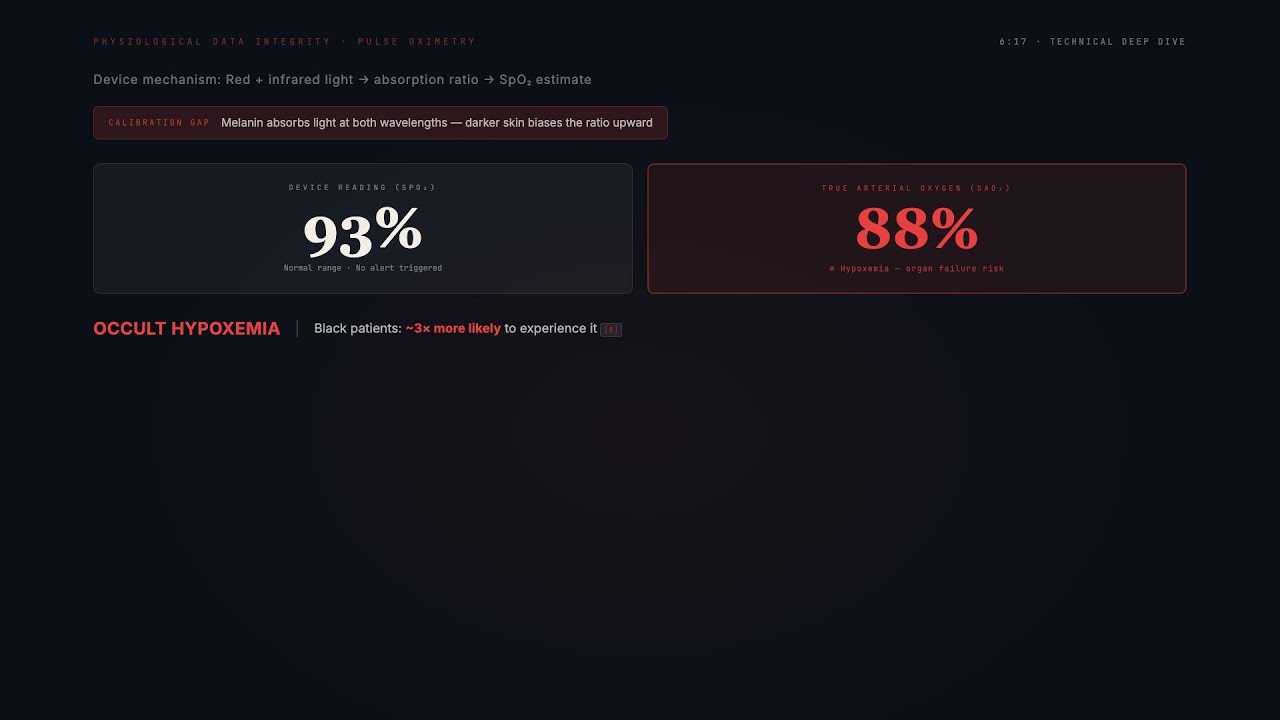
Pulse oximeters transmit red and infrared light through tissue, measuring the absorption ratio of oxygenated vs deoxygenated hemoglobin. Melanin also absorbs light across these wavelengths.
When devices are calibrated primarily on lighter-skinned populations, the additional melanin absorption in darker skin is misinterpreted as higher oxygenated hemoglobin — creating "occult hypoxemia" where the device reports normal while the patient is in danger.
Deployed across hundreds of hospitals, the Epic Sepsis Model was marketed as a proactive clinical tool. Independent validation revealed a system that misses the majority of cases — with unequal impact across racial groups.
Independent validation at Michigan Medicine revealed performance far below developer claims
Developer claimed 0.76-0.83. At Michigan Medicine, the model achieved only 0.63 — barely better than a coin flip for clinical utility.
The model missed 67% of actual sepsis cases. For every three patients with sepsis, two received no algorithmic warning.
Only 12% positive predictive value. Clinicians learn to ignore the constant stream of false alerts — alert fatigue becomes a patient safety hazard.
Only 6% of cases where the model alerted before the clinician would have recognized sepsis independently. The marketed "early detection" advantage was largely illusory.
Many sepsis models are trained on clinical definitions or billing codes that are themselves products of biased human judgment. If clinicians historically delay blood cultures for Black patients, the AI learns to associate "sepsis" with the data signatures of white patients — becoming effectively blind to the disease in Black patients.
No area of medicine demonstrates the intersection of structural racism and technological failure more starkly. Black women face a pregnancy-related mortality rate 3.5 times higher than white women — a disparity that persists even when controlling for education and income.
"The failure of AI to flag severe morbidity in Black women is often linked to the 'weathering' effect — the physiological manifestation of chronic stress caused by systemic racism, which leads to higher baseline blood pressures and altered cardiovascular responses that the AI may interpret as 'normal' for that individual."
— California Maternal Data Center Research
A systematic comparison of the two paradigms across the dimensions that matter most in clinical deployment.
Inherits hardware bias directly. Treats pulse oximetry SpO2 readings as ground truth without accounting for melanin-related optical interference.
Trained on billing codes and clinical labels that encode historical disparities in care delivery. If clinicians delay diagnosis for Black patients, the model learns that pattern.
Site-specific overfitting. AUC drops from 0.76-0.83 (internal) to 0.63 (external) when confronted with different demographics, clinical practices, and documentation styles.
Black-box output with high hallucination risk. Clinicians cannot verify the reasoning chain. The model may confidently present fabricated clinical data.
Optimizes for population-average accuracy, which naturally favors the majority demographic group. Lethal deficiencies in minority subgroups are masked by aggregate metrics.
Public APIs lack HIPAA/GDPR safeguards. Patient data may traverse uncontrolled endpoints. Audit trails are incomplete or non-existent for regulatory compliance.
Multimodal triangulation with sensor-specific calibration offsets. Fuses oximetry with heart rate variability, respiratory rate, and lactate to detect signal discrepancies.
Expert-adjudicated ground truth labels derived from retrospective review by specialist panels, not from the outputs of biased clinical workflows.
Local validation framework with Population Stability Index (PSI) audits. Every deployment begins with retrospective analysis of the institution's own data before going live.
Transparent feature weighting and clinical reasoning chains. Every prediction comes with an interpretable explanation clinicians can verify against their own assessment.
Worst-group loss optimization and Equalized Odds constraints ensure that sensitivity and specificity are maintained across all demographic subgroups.
On-premise or private cloud medical-grade architecture. Full audit trails, HIPAA-compliant data handling, and GDPR-aligned explainability by design.
Moving beyond theory into enterprise-grade implementation. Traditional optimization minimizes average error — which naturally favors the majority group. Deep AI corrects this with fairness-constrained loss functions.
A "fairness penalty" is integrated into the standard cross-entropy loss. The model minimizes total loss plus a weighted disparity term across protected groups.
Rather than minimizing average loss, optimize for the most vulnerable subgroup. This may slightly lower overall accuracy but dramatically improves outcomes for underrepresented populations.
Both True Positive Rate and False Positive Rate must be equal across all demographic groups. If sensitivity is 80% for one group, it must be 80% for all.
Adjust the fairness constraint weight (λ) to see how it affects model performance across demographic groups
Veriprajna's technical framework ensures models are robust, equitable, and generalizable through a systematic four-layered approach.
Before training, datasets are scrutinized for "hidden stratification." Adversarial debiasing trains an auxiliary model to predict race from internal features — the primary model is penalized if the adversary succeeds, forcing it to learn features that are blind to race but sightful to clinical pathology.
Unlike LLM wrappers using generalist weights, deep AI models are fine-tuned on specialized clinical corpuses. For maternal health, this includes the California MDC's Obstetric Comorbidity Scoring System that predicts severe morbidity by adjusting for specific comorbidities.
SpO2 is never treated as standalone ground truth. Temporal regression of nonlinear dynamics fuses oximetry with heart rate, lactate, and respiratory markers. If signals diverge, a "discrepancy alert" prompts an arterial blood gas test.
Every deployment starts with a retrospective audit using the institution's own data. The Population Stability Index (PSI) quantifies how different the local population is from the training cohort, ensuring re-calibration before the model goes live.
For healthcare executives, the question is no longer whether to adopt AI, but how to do so without catastrophic liability or exacerbating health inequities.
Reject vendor claims of "99% accuracy." Require subgroup performance metrics, calibration curves, and peer-reviewed external validation studies.
AI should augment, not replace clinical judgment. Implement "collaborative intelligence" where the AI provides data-driven nudges while clinicians make final decisions.
Model drift is a significant risk. Clinical protocols change, demographics shift, and performance degrades silently. Implement ongoing auditing with automatic recalibration triggers.
Pulse oximeters transmit light through tissue to measure blood oxygen, but melanin in darker skin absorbs light across the same wavelengths. When calibrated primarily on lighter-skinned populations, devices overestimate oxygenation in darker-skinned patients by up to 5%, creating 'occult hypoxemia' where the device reports normal while the patient is in danger. This bias cascades into every downstream AI algorithm that uses SpO2 as input, with false negative rates reaching 62.2% for darker skin versus 26.9% for lighter skin.
The Epic Sepsis Model claimed an AUC of 0.76-0.83 internally but achieved only 0.63 at Michigan Medicine external validation. It missed 67% of actual sepsis cases, had an 88% false alarm rate, and provided early detection advantage in only 6% of cases. The model was trained on billing codes that encoded historical disparities in care delivery, creating a label bias feedback loop where AI learned biased patterns as ground truth.
Veriprajna's architecture includes: (1) Representation Alignment using adversarial debiasing to force models to learn race-blind clinical features, (2) Domain-Specific Fine-Tuning on specialized clinical corpuses rather than generalist weights, (3) Multimodal Signal Fusion that never treats SpO2 as standalone ground truth but triangulates with heart rate, lactate, and respiratory markers, and (4) External Validation with Population Stability Index audits ensuring recalibration before deployment at each institution.
The gap between population-level accuracy and subgroup equity is where patients are lost. Veriprajna builds clinical AI that closes that gap.
Schedule a consultation to audit your clinical decision support systems for demographic parity, sensor bias, and label integrity.
Complete analysis: Pulse oximetry physics, sepsis model failures, maternal health data, fairness-aware loss functions, four-layer mitigation architecture, and enterprise governance framework.