Algorithmic Integrity and the Deep AI Mandate: Navigating the $2.2 Million SafeRent Precedent and the Future of Enterprise Risk Management
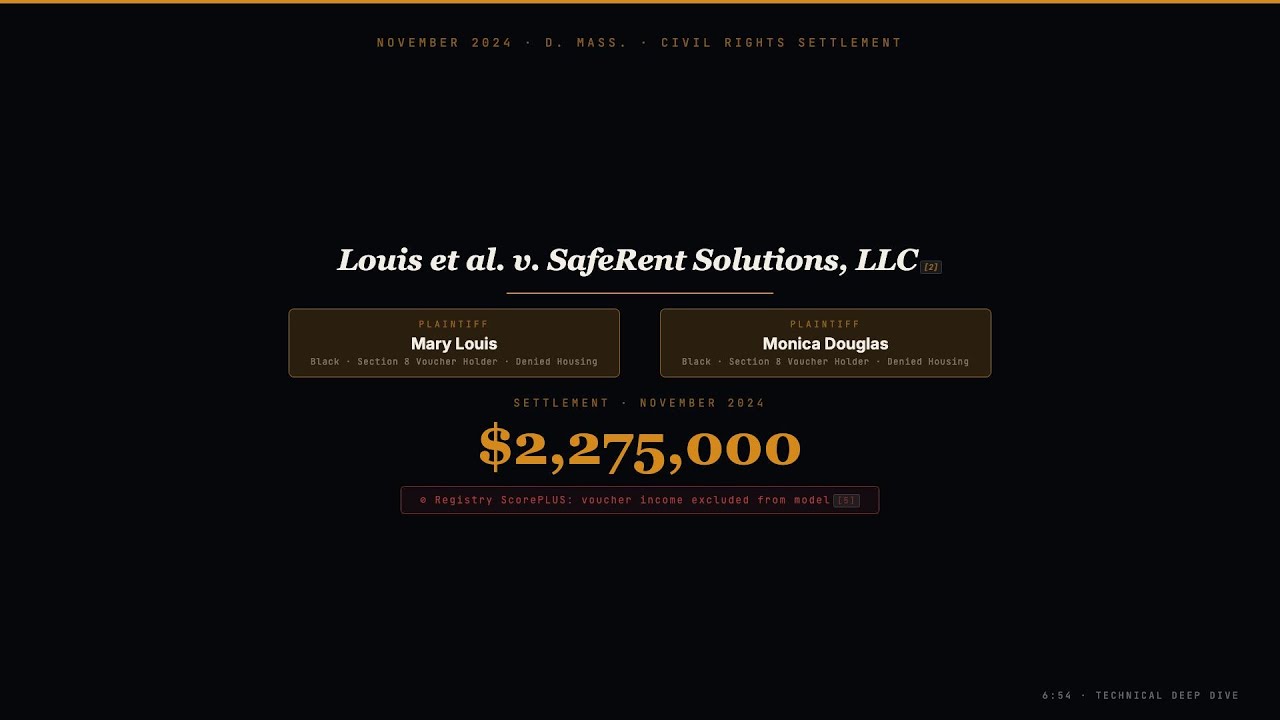
The final approval of a $2.275 million settlement against SafeRent Solutions in November 2024 marks a watershed moment for the artificial intelligence sector, signaling the end of the "black box" era in automated decision systems.1 This case, Louis et al. v. SafeRent Solutions, LLC, is more than a legal defeat for a single vendor; it is a structural critique of how predictive models are built, deployed, and governed in regulated environments. For enterprises and their strategic advisors, the incident illuminates the fundamental dangers of the "LLM wrapper" philosophy, where superficial layers of logic are applied to foundational models without deep architectural intervention.3 The failure of SafeRent’s "Registry ScorePLUS" algorithm to account for the unique financial stability of housing choice voucher holders demonstrated a profound disconnect between mathematical optimization and the socioeconomic realities of protected classes.2 As the Department of Housing and Urban Development (HUD) and the Department of Justice (DOJ) increasingly apply the Fair Housing Act (FHA) to algorithmic developers, the mandate for "Deep AI" solutions—systems that internalize ethical and legal constraints at the code level—has become an existential necessity for the modern enterprise.6
The SafeRent Paradigm: Anatomy of an Algorithmic Failure
The litigation against SafeRent Solutions originated from a class-action lawsuit filed in May 2022, led by Mary Louis and Monica Douglas, two Black women who were denied housing despite holding federally funded vouchers.1 The plaintiffs alleged that SafeRent’s proprietary scoring model, which generated a "SafeRent Score" between 200 and 800, created a disparate impact on Black and Hispanic applicants.2 The technical failure resided in the model’s feature weighting: it relied heavily on traditional credit history and non-tenancy debt while ignoring the guaranteed income stream provided by housing vouchers.5 This omission created a scenario where the model predicted a high "lease performance risk" for individuals who were, by virtue of their subsidies, statistically likely to maintain rent compliance.2
Settlement Dynamics and Monetary Allocation
The settlement reached in 2024 is high-impact, not merely for its total value but for its distribution and the legal precedents it established regarding the standing of software vendors under the Fair Housing Act.2
| Settlement Parameter | Quantitative and Qualitative Detail | Strategic Impact |
|---|---|---|
| Total Settlement Value | $2.275 Million | Benchmark for algorithmic bias liability.2 |
| Cash Compensation Fund | $1.175 Million | Directed to eligible class members.2 |
| Attorney's Fees and Costs | $1.1 Million | Reflects the high cost of forensic AI litigation.2 |
| Named Plaintiff Awards | $10,000 per individual | Incentivizes whistleblowing and private enforcement.2 |
| Injunction Duration | 5 Years | Mandates long-term court-monitored behavioral change.2 |
Beyond the financial penalty, the court’s rejection of SafeRent’s motion to dismiss was critical.6 SafeRent argued that as a technology provider and not a landlord, it was not subject to the FHA.2 The court disagreed, ruling that if a landlord relies solely or primarily on a third-party score to make housing decisions, the provider of that score is integrated into the decision-making chain and shares liability.8 This ruling effectively ends the "neutral vendor" defense that many AI companies have used to evade responsibility for the outputs of their software.
Injunctive Relief and the Operational Shift
The settlement mandates a fundamental re-engineering of SafeRent’s screening products for voucher holders.2 These requirements serve as a preview of the type of "Deep AI" engineering that will soon be standard across all regulated industries.
1. Mandatory Algorithm Validation: SafeRent may no longer issue automated "approve" or "decline" recommendations for voucher holders unless the model is validated for fairness by independent civil rights experts.2
2. Information Limitation: In the absence of such validation, the system is restricted to providing raw background information, stripping it of its predictive "scoring" value.2
3. Client Education and Training: The company must proactively train its clients on the limitations of scoring models when applied to subsidized populations, shifting the burden of awareness back to the software developer.2
4. National Precedent: While the case focused on Massachusetts law, the settlement terms apply nationwide, establishing a new floor for the tenant-screening industry.11
The Fallacy of the Neutral Feature: Why LLM Wrappers Fail
The SafeRent failure highlights a deeper crisis in contemporary AI development: the reliance on "proxy variables" that appear race-neutral but encapsulate historical bias.5 Traditional credit scores are a prime example. As of October 2021, the median credit score for White consumers was 725, compared to 661 for Hispanic consumers and 612 for Black consumers.5 When an algorithm like "Registry ScorePLUS" treats credit history as a neutral predictor of lease performance, it inadvertently hard-codes racial disparities into the housing market.5
The Limits of Generative AI in High-Stakes Decisioning
Many consultancies currently offer LLM-based solutions for document analysis and risk scoring. However, these "wrappers" lack the granular control required to mitigate the types of bias seen in the SafeRent case.3 Large Language Models (LLMs) often lack the ability to explain their reasoning in a way that meets the "Reason Codes" disclosure requirements of the Fair Credit Reporting Act (FCRA).3
| Failure Mode | Wrapper Behavior | Deep AI Intervention |
|---|---|---|
| Automation Bias | Uncritically presents a score or recommendation. | Incorporates human-in-the-loop validation triggers.16 |
| Explainability Gap | Provides plausible but potentially hallucinated reasoning. | Uses model-agnostic XAI (SHAP/LIME) to map feature importance.19 |
| Data Drift | Performance degrades as socioeconomic norms shift. | Implements continuous monitoring with automated retraining triggers.17 |
| Latent Bias | Mirrors stereotypes found in training corpora. | Applies adversarial debiasing and counterfactual testing.20 |
The SafeRent incident proves that in high-stakes environments like finance and real estate, the "generative" capabilities of an AI are less important than its "evaluative" rigor.26 A system that can summarize a lease agreement is useful; a system that can certify that its rejection of a minority applicant is based on non-discriminatory, statistically sound alternatives is essential.29
The Regulatory Tsunami: HUD’s May 2024 Guidance
In direct response to the rising concerns over algorithmic redlining, HUD issued comprehensive guidance in May 2024 regarding the application of the FHA to artificial intelligence.7 This guidance clarifies that the standard for liability is "Disparate Impact"—meaning a policy can be illegal even if there was no intent to discriminate, provided it results in a disproportionate negative effect on a protected class that cannot be justified by a "legitimate, nondiscriminatory interest".7
Guiding Principles for Enterprise Compliance
HUD’s roadmap for developers and housing providers emphasizes transparency, accuracy, and the proactive search for "Less Discriminatory Alternatives" (LDAs).34
| HUD Mandate | Technical Translation | Enterprise Requirement |
|---|---|---|
| Relevant Screening | Feature selection must have a causal link to outcome. | Audit every data point for its predictive relationship to the lease.34 |
| Accuracy Assurance | Models must use up-to-date and verified data. | Implement data provenance and cleaning pipelines.32 |
| Policy Transparency | Criteria must be public and available pre-application. | Move away from "black box" proprietary scoring.34 |
| Dispute Mechanisms | Applicants must have a path to challenge AI results. | Integrate human-in-the-loop (HITL) review layers.22 |
| LDA Implementation | Must adopt the least biased model that achieves the goal. | Conduct side-by-side "fairness-accuracy" trade-off studies.23 |
The guidance specifically targets credit history, eviction records, and criminal backgrounds as "high-risk" categories where overbroad AI screenings are most likely to violate the law.32 For a deep AI provider like Veriprajna, this regulatory clarity transforms compliance from a burden into a design principle.15
Technical Architectures for Algorithmic Accountability
To meet the standards set by the SafeRent settlement and the HUD guidance, organizations must move toward a modular, microservices-based AI architecture that treats fairness and compliance as first-class operational properties.21 This involves the integration of the "Hybrid MLOps Framework" (HAMF), which embeds resilience-by-design into the model lifecycle.21
The Three Pillars of Fairness Engineering
Fairness in AI is not a checkbox; it is a mathematical constraint that must be managed at three distinct stages of the pipeline.24
Pillar 1: Pre-processing (Data Calibration) This stage focuses on mitigating bias before the model is even trained. Techniques include re-sampling underrepresented groups, applying "re-weighting" to balance the influence of different demographics, and generating synthetic data to fill representation gaps.23 In the SafeRent context, this would involve explicitly over-sampling successful voucher holders to correct for historical credit biases.2
Pillar 2: In-processing (Optimization Constraints) This is the heart of Deep AI. Instead of just optimizing for accuracy, the model’s loss function is modified to include a "fairness penalty".21 One powerful technique is "Adversarial Debiasing," where a primary network (e.g., a screening model) is trained alongside a "discriminator" network that tries to predict a protected attribute (like race) from the primary model’s predictions.23 The primary model is then penalized if the discriminator succeeds, forcing it to learn features that are truly independent of the protected class.23
Pillar 3: Post-processing (Outcome Alignment) Once a model is trained, its outputs can be further adjusted to ensure equitable results.24 This often involves "Equalized Odds," where the decision threshold (e.g., the score required for an "approve" recommendation) is slightly varied for different groups to ensure that the false positive and false negative rates are identical across all demographics.14
The "Fair Game" Framework: Dynamic Governance
Static fairness audits are no longer sufficient in a world of evolving social norms and regulatory shifts.45 The "Fair Game" framework proposes a continuous loop where an "Auditor" and a "Debiasing Algorithm" interact with the core ML model via Reinforcement Learning (RL).45
| "Fair Game" Component | Technical Role | Compliance Benefit |
|---|---|---|
| Algorithmic Auditor | Samples input-output pairs to estimate bias metrics. | Provides "Data Frugality" by auditing without total data access.45 |
| Debiasing Agent | Adjusts model weights based on Auditor feedback. | Enables "Active Alignment" with evolving legal standards.45 |
| Human-in-the-Loop | Intervenes via preference feedback (RLHF). | Ensures "Social Alignment" with non-quantifiable ethical norms.45 |
This dynamic approach ensures that a screening tool doesn't just meet the 2024 HUD standards but can adapt as new case law or socioeconomic data (such as shifting voucher utilization rates) becomes available.45
Mathematical Formalization of Justice: Metrics and Benchmarks
For a Deep AI solution to be "enterprise-grade," its fairness must be quantifiable and auditable.14 Veriprajna utilizes a suite of statistical metrics to certify model integrity.
1. Demographic Parity (Statistical Parity): The requirement that the probability of a positive outcome (e.g., loan approval) be the same regardless of group membership. where is the prediction and is a protected attribute.14
2. Disparate Impact Ratio (DIR): The ratio of the positive rate for the unprivileged group compared to the privileged group. The "four-fifths rule" often applied by regulators suggests that a DIR below 0.8 is evidence of discrimination.
SafeRent's failure to credit vouchers almost certainly resulted in a DIR significantly below this threshold for voucher holders.10
3. Equalized Odds: Requires the model to have equal true positive rates (TPR) and false positive rates (FPR) across all groups. This is critical in tenant screening, as it ensures that "good" tenants from minority groups are not unfairly rejected more often than "good" tenants from majority groups.24
| Metric | Focus | Strategic Use Case |
|---|---|---|
| SPD (Statistical Parity Difference) | Absolute difference in approval rates. | High-level regulatory reporting.18 |
| Counterfactual Fairness | Comparison of individual outcomes in alternate realities. | Individual "Algorithmic Recourse" and dispute resolution.20 |
| Individual Fairness | Similar individuals receive similar decisions. | Preventing "arbitrary" or noisy AI behavior.14 |
By embedding these metrics into the MLOps dashboard, an enterprise can detect "fairness drift" in real-time—often before it results in a legal violation.17
Search for the Least Discriminatory Alternative (LDA)
The "Least Discriminatory Alternative" (LDA) is a key provision of the disparate impact doctrine.29 In the SafeRent case, the fundamental question was whether a model could have been built that achieved the same goal (predicting lease performance) without the negative impact on voucher holders.8
The Promise of Model Multiplicity
The concept of "Model Multiplicity" suggests that for any dataset, there are millions of models that perform with equal accuracy but have vastly different fairness profiles.39 Without a "Deep AI" consultant to explicitly search for these alternatives, a developer will likely settle on the first "accurate" model found—which, as SafeRent showed, often inherits the biases of historical data.10
1. LDA Discovery: Using automated searches to find models that maintain performance while maximizing the Disparate Impact Ratio.29
2. LDA Refutation: In cases where no such model exists, providing the forensic proof that the current disparities are "unavoidable" to fulfill a legitimate business need—a critical defense in litigation.29
3. Alternative Feature Engineering: Replacing biased proxies like "Credit Score" with more accurate and fair indicators for subsidized tenants, such as direct history of rent payment or the "VantageScore 4.0" model which some SafeRent clients have successfully used.29
The SafeRent settlement specifically requires the company to have civil rights experts validate their models—effectively a mandatory LDA search.2 Enterprises that proactively conduct these searches insulate themselves from both regulatory scrutiny and moral hazard.30
From Pyramid to Obelisk: The Evolution of AI Consultancy
The complexity of the SafeRent settlement underscores why traditional "pyramid-style" consulting—reliant on large cohorts of junior analysts—is becoming obsolete in the age of Deep AI.47 What is needed is the "Obelisk" model: smaller, high-leverage teams of "AI Facilitators," "Engagement Architects," and "Client Leaders" who bridge the gap between technical engineering and ethical governance.47
The Veriprajna Advantage: Deep AI for Regulated Markets
The "Deep AI" approach championed by Veriprajna positions itself at the intersection of technical excellence and regulatory foresight.54 Unlike LLM wrapper companies that prioritize speed-to-market, Veriprajna prioritizes "Model Durability"—the ability of a system to withstand forensic audits, court challenges, and shifting demographic realities.31
| Consultancy Model | Operational Focus | Outcome in SafeRent Scenario |
|---|---|---|
| LLM Wrapper Provider | Rapid API deployment; generic "risk summaries." | Likely would have missed the latent credit-voucher correlation. |
| Traditional Big 4 | Manual audits; policy documentation; "reactive" fixes. | High billable hours with limited real-time technical intervention. |
| Veriprajna (Deep AI) | Architectural debiasing; LDA search; HAMF integration. | Proactive detection of bias via counterfactual testing and adversarial debiasing.21 |
The goal is to move beyond "Bias Detection" (finding problems after they occur) toward "Bias Prevention" (building systems where unfairness is mathematically impossible to sustain).25
Governance as a Product: The NIST AI RMF and Beyond
True algorithmic accountability requires integrating AI risk management into the broader enterprise risk framework (ERM).17 The NIST AI Risk Management Framework (AI RMF 1.0) provides a voluntary but highly influential standard for this integration.58
The Four Pillars of the NIST Framework
1. Govern: Establishing a "culture of accountability" where AI ethics boards have the power to block biased deployments.18
2. Map: Identifying the context-specific risks of a model. For SafeRent, this would have meant "mapping" how credit scores affect low-income renters differently than high-income renters.22
3. Measure: Utilizing standard metrics like SPD and DIR to track performance across different jurisdictions (e.g., CCPA, GDPR, EU AI Act).38
4. Manage: Creating "incident response" plans for when a model fails, including clear paths for applicant recourse and manual overrides.22
The upcoming EU AI Act (2025-2026) will formalize many of these requirements, classifying systems used for credit scoring and housing as "High Risk".17 Organizations that align with Veriprajna’s deep-compliance architecture now will find themselves ahead of the curve as these regulations become mandatory.
Conclusion: The Strategic Imperative of Algorithmic Integrity
The SafeRent settlement is a signal to the market that the period of "AI exceptionalism" is over. Software developers and their enterprise clients are now held to the same civil rights standards as the human decision-makers they replaced.6 The $2.275 million penalty and the subsequent HUD guidance prove that ignoring "voucher income" or "credit bias" is no longer just an ethical oversight—it is a financial and legal catastrophe.2
For the modern enterprise, the path forward requires a transition from superficial AI implementations to Deep AI solutions. This involves a rigorous commitment to:
● Adversarial Fairness: Building models that actively resist the pull of historical data bias.23
● Explainable Accountability: Providing transparent "Recourse" to every individual affected by an algorithmic decision.20
● Proactive LDA Searching: Never deploying a model without proving it is the least discriminatory option available.29
As a Deep AI solution provider, Veriprajna stands ready to help enterprises navigate this complex landscape, transforming the "risk" of algorithmic bias into the "opportunity" of trustworthy, resilient, and inclusive innovation.31 The future of AI is not just about what it can predict; it is about what it can prove to be fair.
Works cited
Algorithmic Redlining: How AI Bias Works & How to Stop It | IntuitionLabs, accessed February 6, 2026, https://intuitionlabs.ai/articles/algorithmic-redlining-solutions
Case: Louis v. SafeRent Solutions, LLC - Civil Rights Litigation Clearinghouse, accessed February 6, 2026, https://clearinghouse.net/case/45888/
Pros and Cons of Using LLMs for Financial Analysis: Opportunities and Risks - Daloopa, accessed February 6, 2026, https://daloopa.com/blog/analyst-best-practices/pros-and-cons-of-using-llms-for-financial-analysis
What are the pros and cons of using LLMs in compliance? - Global Relay, accessed February 6, 2026, https://www.globalrelay.com/resources/the-compliance-hub/compliance-insights/what-are-the-pros-and-cons-of-using-llms-in-compliance/
Memorandum and Order - Mary Louis v. Saferent Solutions, LLC (D ..., accessed February 6, 2026, https://www.justice.gov/crt/media/1310736/dl
Louis et al. v. SafeRent et al. (D. Mass.) - Department of Justice, accessed February 6, 2026, https://www.justice.gov/crt/case/louis-et-al-v-saferent-et-al-d-mass
HUD Issues Fair Housing Act Guidance on Applications of Artificial Intelligence, accessed February 6, 2026, https://archives.hud.gov/news/2024/pr24-098.cfm
U.S. Statement of Interest - Louis et al v. SafeRent et al - Department of Justice, accessed February 6, 2026, https://www.justice.gov/d9/2023-01/u.s._statement_of_interest_-_louis_et_al_v._saferent_et_al.pdf
A Home for Digital Equity: Algorithmic Redlining and Property Technology, accessed February 6, 2026, https://www.californialawreview.org/print/a-home-for-digital-equity
Louis, et al. v. SafeRent Solutions, et al. - Cohen Milstein, accessed February 6, 2026, https://www.cohenmilstein.com/case-study/louis-et-al-v-saferent-solutions-et-al/
AI Landlord Screening Tool Will Stop Scoring Low-Income Tenants After Discrimination Suit, accessed February 6, 2026, https://www.cohenmilstein.com/ai-landlord-screening-tool-will-stop-scoring-low-income-tenants-after-discrimination-suit/
Incident 844: SafeRent AI Screening Tool Allegedly Discriminated Against Housing Voucher Applicants, accessed February 6, 2026, https://incidentdatabase.ai/cite/844/
Law and Algorithms : Louis v. Saferent Solutions, LLC | H2O - Open Casebooks, accessed February 6, 2026, https://opencasebook.org/casebooks/2606-law-and-algorithms/resources/4.4-louis-v-saferent-solutions-llc/
AI Bias and Fairness: The Definitive Guide to Ethical AI | SmartDev, accessed February 6, 2026, https://smartdev.com/addressing-ai-bias-and-fairness-challenges-implications-and-strategies-for-ethical-ai/
7 AI Governance Best Practices for Enterprises - eSystems Nordic, accessed February 6, 2026, https://www.esystems.fi/en/blog/ai-governance-best-practices-for-enterprises
The Impact of Large Language Models in Finance: Towards Trustworthy Adoption - The Alan Turing Institute, accessed February 6, 2026, https://www.turing.ac.uk/sites/default/files/2024-06/the_impact_of_large_language_models_in_finance_-_towards_trustworthy_adoption_1.pdf
Enterprise AI Risk Management: Frameworks & Use Cases - Superblocks, accessed February 6, 2026, https://www.superblocks.com/blog/enterprise-ai-risk-management
AI Governance Framework: Building Ethical and Compliant AI Systems in 2024, accessed February 6, 2026, https://www.floodlightnewmarketing.co.uk/blog/ai-governance-framework-ethical-compliance
AI Risk Management Framework - Palo Alto Networks, accessed February 6, 2026, https://www.paloaltonetworks.com/cyberpedia/ai-risk-management-framework
(PDF) Fair Recourse for All: Ensuring Individual and Group Fairness in Counterfactual Explanations - ResearchGate, accessed February 6, 2026, https://www.researchgate.net/publication/400178060_Fair_Recourse_for_All_Ensuring_Individual_and_Group_Fairness_in_Counterfactual_Explanations
Hybrid MLOps framework for automated lifecycle management of adaptive phishing detection models - PubMed Central, accessed February 6, 2026, https://pmc.ncbi.nlm.nih.gov/articles/PMC12586440/
Enterprise AI Governance: Essential Strategies for Modern Organizations - Transcend.io, accessed February 6, 2026, https://transcend.io/blog/enterprise-ai-governance
Three approaches to fairness-aware machine learning without holding sensitive characteristics. - ResearchGate, accessed February 6, 2026, https://www.researchgate.net/figure/Three-approaches-to-fairness-aware-machine-learning-without-holding-sensitive_fig1_321249365
Ensuring Fairness in Machine Learning Algorithms - GeeksforGeeks, accessed February 6, 2026, https://www.geeksforgeeks.org/machine-learning/ensuring-fairness-in-machine-learning-algorithms/
Engineering Fairness: How Technical Innovation is Reshaping AI Anti-Discrimination Law, accessed February 6, 2026, https://medium.com/@yuliyagorshkova/engineering-fairness-how-technical-innovation-is-reshaping-ai-anti-discrimination-law-fcd6b086b9f8
AI Governance: Best Practices for Real Estate Organizations - EisnerAmper, accessed February 6, 2026, https://www.eisneramper.com/insights/real-estate/ai-governance-real-estate-organization-best-practices-1025/
AI in the workplace: A report for 2025 - McKinsey, accessed February 6, 2026, https://www.mckinsey.com/capabilities/tech-and-ai/our-insights/superagency-in-the-workplace-empowering-people-to-unlock-ais-full-potential-at-work
Auditing and Validating Fairness and Ethics in Machine Learning Systems, accessed February 6, 2026, https://ojs.aaai.org/index.php/AIES/article/view/36795
Operationalizing the Search for Less Discriminatory Alternatives in Fair Lending, accessed February 6, 2026, https://www.law.upenn.edu/live/files/13245-gillis-meursault-ustun-less-discriminatory-alterna
The Use of AI for Less Discriminatory Alternative Models in Fair Lending - Treliant, accessed February 6, 2026, https://www.treliant.com/knowledge-center/the-use-of-ai-for-less-discriminatory-alternative-lda-models-in-fair-lending/
AI Act: what are the implications for sensitive sectors in Europe? - Polytechnique Insights, accessed February 6, 2026, https://www.polytechnique-insights.com/en/columns/digital/ia-act-what-are-the-implications-for-sensitive-sectors-in-europe/
HUD Offers Fair Housing Act Guidance on AI Applications - CohnReznick, accessed February 6, 2026, https://www.cohnreznick.com/insights/hud-offers-fair-housing-act-guidance-on-ai-applications
HUD's New Guidance Adjusts Screening Policy - Zip ReportsZip Reports, accessed February 6, 2026, https://zipreports.net/huds-new-guidance-adjusts-screening-policy/
HUD Issues Guidance on Applicability of the Fair Housing Act to ..., accessed February 6, 2026, https://www.consumerfinancialserviceslawmonitor.com/2024/05/hud-issues-guidance-on-applicability-of-the-fair-housing-act-to-tenant-screening-and-housing-related-advertising-that-relies-upon-algorithms-and-ai/
HUD Fair Housing Guidance on Screening Tenants - Virginia REALTORS®, accessed February 6, 2026, https://virginiarealtors.org/2024/11/13/hud-fair-housing-guidance-on-screening-tenants/
New HUD Guidance on Tenant Screening - Released April 2024, accessed February 6, 2026, https://www.prosperpm.com/blog/hud-guidance-april-2024
Fair Housing Focus: Tenant Screening - Housing Opportunities Made Equal, accessed February 6, 2026, https://www.homecincy.org/post/fair-housing-focus-tenant-screening
7 Important Components of an Effective AI Governance Framework - Lumenova AI, accessed February 6, 2026, https://www.lumenova.ai/blog/ai-governance-framework-key-components/
The Legal Duty to Search for Less Discriminatory Algorithms - arXiv, accessed February 6, 2026, https://arxiv.org/html/2406.06817v1
SCRAM: A Scenario-Based Framework for Evaluating Regulatory and Fairness Risks in AI Surveillance Systems - MDPI, accessed February 6, 2026, https://www.mdpi.com/2076-3417/15/16/9038
Introduction to Fairness-aware ML | by Subash Palvel - Medium, accessed February 6, 2026, https://subashpalvel.medium.com/introduction-to-fairness-aware-ml-327df1b61538
A Comprehensive Review and Benchmarking of Fairness-Aware Variants of Machine Learning Models - MDPI, accessed February 6, 2026, https://www.mdpi.com/1999-4893/18/7/435
Auditing and instructing text-to-image generation models on fairness - PMC, accessed February 6, 2026, https://pmc.ncbi.nlm.nih.gov/articles/PMC12103484/
Bias in LLMs: Origins and Mitigation Strategies - Newline.co, accessed February 6, 2026, https://www.newline.co/@zaoyang/bias-in-llms-origins-and-mitigation-strategies--10e3570a
The Fair Game: Auditing & Debiasing AI Algorithms Over Time - arXiv, accessed February 6, 2026, https://arxiv.org/html/2508.06443
The Fair Game: Auditing & debiasing AI algorithms over time - ResearchGate, accessed February 6, 2026, https://www.researchgate.net/publication/392411091_The_Fair_Game_Auditing_debiasing_AI_algorithms_over_time
AI Is Changing the Structure of Consulting Firms | AAPL Publication, accessed February 6, 2026, https://www.physicianleaders.org/articles/ai-is-changing-the-structure-of-consulting-firms
The Fair Game: Auditing & Debiasing AI Algorithms Over Time - arXiv, accessed February 6, 2026, https://arxiv.org/pdf/2508.06443
Counterfactual Explanations and Algorithmic Recourses for Machine Learning: A Review - arXiv, accessed February 6, 2026, https://arxiv.org/pdf/2010.10596
A New Paradigm for Counterfactual Reasoning in Fairness and Recourse - arXiv, accessed February 6, 2026, https://arxiv.org/html/2401.13935v1
Day 59: Prompt Engineering in the context of LLMs (Part 6) | by LAKSHMI VENKATESH, accessed February 6, 2026, https://luxananda.medium.com/day-59-prompt-engineering-in-the-context-of-llms-part-6-455320415815
Consumer Support - SafeRent Solutions, accessed February 6, 2026, https://saferentsolutions.com/consumer-support/
How AI is Redefining Strategy Consulting: Insights from McKinsey, BCG, and Bain - Medium, accessed February 6, 2026, https://medium.com/@takafumi.endo/how-ai-is-redefining-strategy-consulting-insights-from-mckinsey-bcg-and-bain-69d6d82f1bab
Designing enterprise AI: Balancing centralization and federation for scalable, trusted intelligence - PwC, accessed February 6, 2026, https://www.pwc.com/us/en/technology/alliances/library/salesforce-designing-enterprise-ai.html
Enterprise AI Consulting Framework: A Broad-Level Guide | by Megha Verma - Medium, accessed February 6, 2026, https://medium.com/predict/enterprise-ai-consulting-framework-a-broad-level-guide-3fd135a5fcc5
Large language models in FinTech: A boon or bane for compliance officers, accessed February 6, 2026, https://fintech.global/2023/07/20/large-language-models-in-fintech-a-boon-or-bane-for-compliance-officers/
AI Governance Best Practices: A Framework for Data Leaders | Alation, accessed February 6, 2026, https://www.alation.com/blog/ai-governance-best-practices-framework-data-leaders/
NIST AI Risk Management Framework: A simple guide to smarter AI governance - Diligent, accessed February 6, 2026, https://www.diligent.com/resources/blog/nist-ai-risk-management-framework
Artificial Intelligence Risk Management Framework (AI RMF 1.0) - NIST Technical Series Publications, accessed February 6, 2026, https://nvlpubs.nist.gov/nistpubs/ai/nist.ai.100-1.pdf
NIST AI Risk Management Framework 1.0 | Consulting Services - RSI Security, accessed February 6, 2026, https://www.rsisecurity.com/services/nist-ai-risk-management-old/
NIST AI Risk Management Framework 1.0 — What It Means For Enterprises, accessed February 6, 2026, https://www.forrester.com/blogs/nist-ai-risk-management-framework-1-0-what-it-means-for-enterprises/
(PDF) Enterprise-wide AI-Driven compliance framework for real-time cross-border data transfer risk mitigation - ResearchGate, accessed February 6, 2026, https://www.researchgate.net/publication/396599006_Enterprise-wide_AI-Driven_compliance_framework_for_real-time_cross-border_data_transfer_risk_mitigation
Prefer a visual, interactive experience?
Explore the key findings, stats, and architecture of this paper in an interactive format with navigable sections and data visualizations.
Frequently Asked Questions
Why was SafeRent held liable under the Fair Housing Act as a technology vendor?
The court ruled that when a landlord relies solely or primarily on a third-party AI score to make housing decisions, the score provider is integrated into the decision-making chain and shares liability. SafeRent's model penalized voucher holders by relying on credit history while ignoring guaranteed income streams, creating disparate impact on Black and Hispanic applicants.
What is the Least Discriminatory Alternative in AI tenant screening?
The Least Discriminatory Alternative (LDA) is a key provision of disparate impact doctrine requiring demonstration that no model achieving the same goal exists with less discriminatory impact. Model Multiplicity research shows millions of equally accurate models exist for any dataset with vastly different fairness profiles, making automated LDA search essential.
How does the Fair Game framework ensure continuous algorithmic fairness?
The Fair Game framework uses reinforcement learning where an Algorithmic Auditor samples input-output pairs to estimate bias metrics with data frugality, while a Debiasing Agent adjusts model weights based on auditor feedback. A Human-in-the-Loop layer provides preference feedback ensuring social alignment with non-quantifiable ethical norms.
Also Published On
Build Your AI with Confidence.
Partner with a team that has deep experience in building the next generation of enterprise AI. Let us help you design, build, and deploy an AI strategy you can trust.
Veriprajna Deep Tech Consultancy specializes in building safety-critical AI systems for healthcare, finance, and regulatory domains. Our architectures are validated against established protocols with comprehensive compliance documentation.