Navigating the $2.2 Million SafeRent Precedent and the Future of Enterprise Risk Management
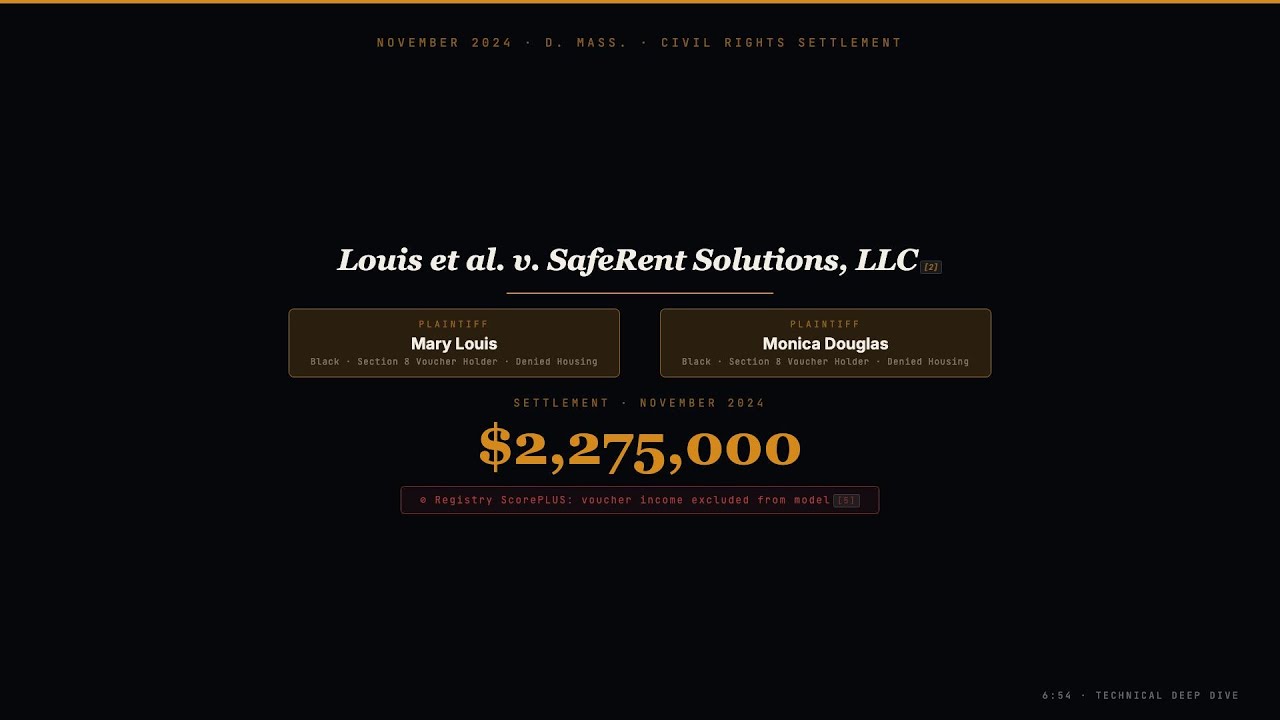
The final approval of a $2.275 million settlement against SafeRent Solutions signals the end of the "black box" era. Software vendors are now co-liable under the Fair Housing Act. The mandate for Deep AI—systems that internalize legal and ethical constraints at the code level—has become an existential necessity.
The SafeRent ruling extends far beyond tenant screening. Any enterprise deploying automated decision systems in regulated environments now faces identical liability exposure.
Tenant screening algorithms that rely on credit scores as a proxy for lease performance systematically exclude voucher holders and protected classes. The FHA now applies directly to software vendors.
Credit decisioning and lending algorithms face ECOA, FCRA, and state-level scrutiny. LLM wrappers cannot produce the "Reason Codes" or explainability that regulators demand.
Hiring algorithms, insurance underwriting, and healthcare risk scoring all deploy predictive models on protected-class data. The EU AI Act classifies these as "High Risk" systems.
A class-action lawsuit revealed how a proprietary scoring model systematically excluded Black and Hispanic voucher holders—not through intent, but through architecture.
SafeRent's "Registry ScorePLUS" relied heavily on traditional credit history while ignoring the guaranteed income from housing vouchers. The model predicted high "lease performance risk" for individuals who were statistically likely to maintain rent compliance.
SafeRent argued it was a "neutral vendor," not subject to the FHA. The court ruled that if a landlord relies primarily on a third-party score, the vendor shares liability—ending the "neutral vendor" defense industry-wide.
The settlement requires fundamental re-engineering: no automated approve/decline for voucher holders without independent fairness validation. Raw data only until models are certified by civil rights experts.
| Parameter | Detail | Strategic Impact |
|---|---|---|
| Total Settlement | $2.275 Million | Benchmark for algorithmic bias liability |
| Cash Compensation | $1.175 Million | Direct restitution to affected class members |
| Litigation Costs | $1.1 Million | Reflects high cost of forensic AI litigation |
| Injunction Duration | 5 Years | Long-term court-monitored behavioral change |
| Scope | Nationwide | New floor for tenant-screening industry |
"If a landlord relies solely or primarily on a third-party score to make housing decisions, the provider of that score is integrated into the decision-making chain and shares liability. This ruling effectively ends the 'neutral vendor' defense."
— Louis et al. v. SafeRent Solutions, LLC, U.S. District Court, D. Mass.
Generative capabilities are less important than evaluative rigor. A system that can summarize a lease is useful; one that can certify its rejection of a minority applicant is based on non-discriminatory alternatives is essential.
Likely would have missed the latent credit-voucher correlation that triggered the SafeRent lawsuit.
High billable hours with limited real-time technical intervention. Audit reports delivered after bias has already caused harm.
Proactive detection via counterfactual testing and adversarial debiasing. Bias is mathematically impossible to sustain.
HUD, DOJ, NIST, and the EU AI Act are converging on a single mandate: automated decision systems must be transparent, auditable, and provably fair.
Class action alleging disparate impact on Black and Hispanic voucher holders
Comprehensive FHA guidance on algorithmic screening, LDA mandates
Court approves nationwide settlement; "neutral vendor" defense rejected
Housing and credit systems classified "High Risk" with mandatory conformity assessments
Every feature must have a causal link to the outcome. Audit all data points.
Models must use up-to-date, verified data. Implement provenance pipelines.
Criteria must be public and available pre-application. No black-box scoring.
Applicants must have a path to challenge AI results. HITL review layers.
Must adopt the least biased model that achieves the goal. Side-by-side fairness studies.
Fairness is not a checkbox—it is a mathematical constraint managed at three distinct stages of the pipeline. Click each pillar to explore.
Mitigate bias before the model is trained. Historical data encodes decades of discrimination—credit scores, eviction records, and criminal backgrounds all carry racial signal. Calibration corrects for this at the data layer.
Training data over-represents non-voucher tenants with high credit scores. Model learns "low credit = high risk" without voucher context.
Voucher holders with successful lease histories are over-sampled. Model learns that guaranteed income = lease stability regardless of credit score.
The heart of Deep AI. Instead of optimizing only for accuracy, the model's loss function includes a fairness penalty. The model is mathematically constrained from producing discriminatory outputs.
Screening Model → Lease Risk Score
Tries to predict race from score. Success = Penalty applied.
Model learns features truly independent of protected class
Once a model is trained, its outputs are calibrated to ensure equitable results across all demographics. This final layer ensures that even residual biases are corrected before decisions reach applicants.
The Four-Fifths Rule: if the approval rate for the unprivileged group is less than 80% of the privileged group's rate, disparate impact is presumed. Adjust the sliders to explore.
SafeRent scenario: With median credit scores of 725 (White) vs 612 (Black) as the primary screening feature, approval rate disparities of this magnitude are structurally inevitable without architectural intervention.
True algorithmic accountability integrates AI risk management into the broader enterprise risk framework. Veriprajna's architecture maps directly to the four pillars of the NIST AI Risk Management Framework.
AI ethics boards with authority to block biased deployments. Risk ownership at C-suite level.
How do credit scores affect low-income renters differently? Map the differential impact before deployment.
SPD, DIR, Equalized Odds tracked across jurisdictions—CCPA, GDPR, EU AI Act compliance.
Clear paths for applicant recourse and manual overrides. Bias incident playbooks with escalation protocols.
For any dataset, there are millions of models with equal accuracy but vastly different fairness profiles. Without a Deep AI approach to explicitly search for these alternatives, a developer will settle on the first "accurate" model—which inherits the biases of historical data.
Automated search for models that maintain performance while maximizing the Disparate Impact Ratio across all protected classes.
When no fairer model exists, provide forensic proof that current disparities are unavoidable for a legitimate business need—a critical litigation defense.
Replace biased proxies like "Credit Score" with direct rent payment history, voucher tenure, or models designed for subsidized populations.
The period of "AI exceptionalism" is over. Veriprajna's Deep AI architecture moves beyond finding problems after they occur to building systems where unfairness is mathematically impossible to sustain.
Build models that actively resist the pull of historical data bias. Counterfactual testing at every stage ensures decisions are independent of protected attributes.
Every affected individual receives transparent reasoning. SHAP/LIME-backed feature importance meets FCRA Reason Code requirements out of the box.
Never deploy a model without proving it is the least discriminatory option available. Automated model multiplicity exploration across millions of candidate architectures.
The $2.275 million settlement against SafeRent Solutions established that AI vendors are decision chain participants sharing liability with deployers. SafeRent's 'Registry ScorePLUS' relied heavily on credit scores (White median 725 vs. Black median 612) while ignoring guaranteed voucher income, systematically excluding Black and Hispanic voucher holders from housing. The court rejected SafeRent's 'neutral vendor' defense, ruling that if a landlord relies primarily on a third-party score, the vendor shares Fair Housing Act liability. The settlement includes $1.175M in direct restitution, $1.1M in litigation costs, a 5-year court-monitored injunction mandating algorithm re-engineering, and a nationwide ban on automated approve/decline for voucher holders without independent fairness validation. This precedent extends to any enterprise deploying automated decision systems in regulated environments.
Fairness is managed as a mathematical constraint across three pipeline stages: Pillar 1 (Pre-processing Data Calibration) mitigates bias before model training through re-sampling of underrepresented groups like successful voucher holders, re-weighting demographic influence in training distributions, and synthetic data generation to fill representation gaps. Pillar 2 (In-processing Optimization Constraints) adds fairness penalties directly to the model's loss function — an adversarial discriminator network tries to predict protected attributes from predictions, and the primary model is penalized until the discriminator performs at random chance, mathematically constraining discriminatory outputs. Pillar 3 (Post-processing Outcome Alignment) calibrates outputs through equalized odds where decision thresholds are adjusted per group so false positive and false negative rates are identical across demographics — achieving parity with delta less than 0.5% across all rates.
For any dataset, there are millions of models with equal accuracy but vastly different fairness profiles. Without explicitly searching for alternatives, developers settle on the first 'accurate' model which inherits historical data biases. HUD's May 2024 guidance now requires adopting the least biased model that achieves the business goal. Veriprajna's LDA Discovery automates this search across millions of candidate architectures, maximizing the Disparate Impact Ratio across all protected classes while maintaining performance. LDA Refutation provides forensic proof when no fairer model exists — documenting that current disparities are unavoidable for a legitimate business need, creating a critical litigation defense. Alternative Features replaces biased proxies like credit scores with direct rent payment history, voucher tenure, or models designed for subsidized populations.
The SafeRent precedent proves that "we didn't intend to discriminate" is no longer a defense. The question regulators will ask: did you search for a fairer alternative?
Veriprajna's Deep AI Audit provides forensic-grade fairness analysis, LDA discovery, and NIST-aligned governance—before the lawsuit, not after.
Complete analysis: SafeRent case law, HUD regulatory mapping, three-pillar fairness architecture, mathematical formalization, NIST AI RMF alignment, LDA methodology.