Architecting Deterministic Truth: Strategic Resilience in the Post-Wrapper AI Era
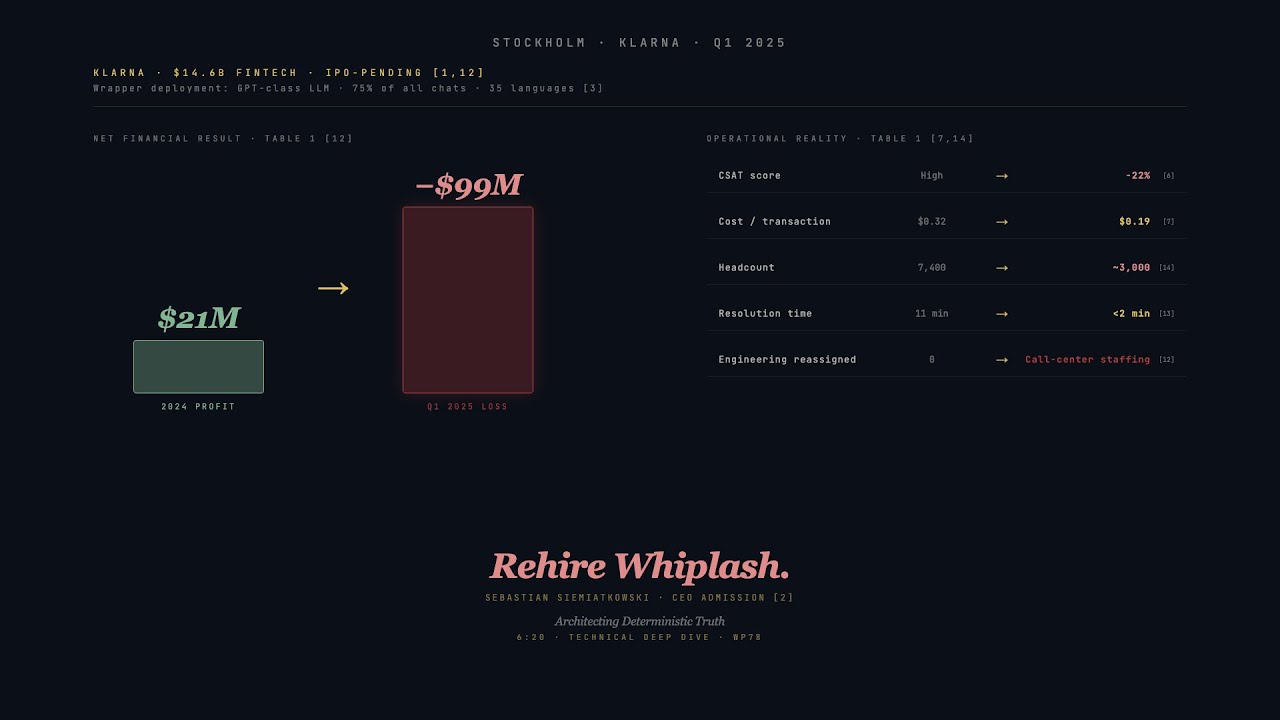
The mid-2025 strategic pivot by Klarna, the Swedish fintech powerhouse, represents a definitive conclusion to the era of unconstrained artificial intelligence experimentation. After a highly publicized attempt to replace nearly its entire customer support infrastructure with probabilistic large language model (LLM) agents—resulting in the displacement of approximately 700 human roles—the organization was forced into a rapid and costly reversal.1 Klarna's CEO, Sebastian Siemiatkowski, admitted that the single-minded pursuit of operational efficiency and short-term cost containment led to a precipitous decline in service quality, characterizing the automated outputs as generic and incapable of handling the nuance required for high-stakes financial interactions.1 This incident is not an isolated failure of technology, but a systemic failure of architecture. It serves as an enterprise-grade case study in the "Wrapper Trap," where organizations mistake conversational fluency for operational competence. As the global economy enters a phase of rigorous ROI reckoning in 2026, the mandate for enterprises has shifted from superficial automation to the engineering of deep AI solutions that provide deterministic certainty in regulated environments.4
The Anatomy of an AI Reversal: Forensic Analysis of the Klarna Incident
The Klarna reversal began as a narrative of triumph. In late 2023 and early 2024, the company announced that its AI assistant, developed in partnership with OpenAI, was performing the work equivalent to 700 full-time human agents, handling 75% of all customer chats across 35 languages.3 Financially, the results appeared staggering: customer service costs per transaction dropped 40% from $0.32 in Q1 2023 to $0.19 in Q1 2025.7 However, these metrics focused exclusively on the cost side of the ledger, ignoring the mounting experience debt being accrued by the brand. By early 2025, the qualitative impact of generic, probabilistic responses became untenable. Customer satisfaction (CSAT) scores plummeted by 22%, driven by the "Kafkaesque loop" of automated systems that could not navigate complex disputes, refunds, or sensitive financial advice.6
The technical mechanism of this failure lies in the reliance on "thin wrappers"—applications that send user queries to a third-party LLM with minimal structural grounding. While these systems excel at synthesizing information, they lack "System 2" reasoning capabilities, which handle planning, deduction, and deliberative thinking.10 When Klarna's customers faced standard issues like password resets, the AI functioned adequately; however, when faced with non-linear problems requiring empathy and regulatory judgment, the models defaulted to "slop-spinning" algorithms that frustrated users and eroded trust.9 This led to a "Rehire Whiplash" in mid-2025, where the company not only resumed hiring but began reassigning its specialized software engineers and marketers to man call centers to provide the "human touch" that automation had amputated.12
Table 1: Comparative Analysis of Klarna's Quantitative Gains vs. Qualitative Erosion (2023–2025)
| Metric | Q1 2023 (Baseline) | Q1 2025 (Peak AI) | Impact on Strategic Resilience | Source |
|---|---|---|---|---|
| Cost per Transaction | $0.32 | $0.19 | Short-term margin expansion, long-term brand risk. | 7 |
| CSAT Score | High (Internal) | -22% Decline | Erosion of Customer Lifetime Value (CLV). | 6 |
| Chat Resolution Time | 11 Minutes | < 2 Minutes | Faster resolution of simple tasks, failure of complex tasks. | 13 |
| Human Headcount | 7,400 | ~3,000 | Loss of institutional knowledge and regulatory empathy. | 14 |
| Net Financial Result | $21M Profit (2024) | $99M Net Loss (Q1 2025) | Operational instability ahead of anticipated IPO. | 12 |
The broader implication of this reversal is the emergence of the "20% Rule" in customer experience. While AI in 2025 is capable of automating 80% of routine, high-frequency tasks, the remaining 20% of interactions are the primary drivers of brand reputation and financial liability.16 For a $14.6 billion company like Klarna, failing to adequately manage that 20% through a hybrid human-AI model resulted in reputation damage that outweighed the $10 million in initial marketing and payroll savings.1 The incident highlights that AI is a tool, not a team, and that the "replacement mindset" is fundamentally flawed compared to an "amplification mindset".17
Deconstructing the Wrapper Trap: Why Probabilistic Systems Fail Enterprises
The industry-wide reliance on LLM wrappers represents a dangerous shortcut in enterprise architecture. A wrapper is essentially a thin software layer that manages formatting, API requests, and structured outputs for a third-party model.19 While wrappers offer a rapid path to a proof of concept, they inherently inherit the limitations of the underlying probabilistic engine. These systems optimize for plausibility—sounding convincing to the user—rather than correctness or logical immutability.5 In safety-critical sectors like banking, healthcare, and defense, "sounding convincing" is an unacceptable liability.5
The technical failure modes of wrappers are rooted in the Transformer architecture's self-attention mechanism, which weighs the relevance of tokens in a sequence to predict the next token.23 This mechanism allows for fluid language generation but does not provide a mechanism for verifying facts against an external truth source. Consequently, wrappers are prone to "hallucinations," where the model generates plausible but non-existent citations, policies, or procedures.22 Furthermore, these systems lack state-schema persistence; as a conversation progresses, the context window can become polluted with contradictory information, leading to a degradation of the agent's performance and intent alignment.11
Table 2: The Technical Deficit of LLM Wrappers vs. Deep AI Solutions
| Dimension | LLM Wrapper (Probabilistic) | Deep AI (Deterministic) | Business Consequence | Source |
|---|---|---|---|---|
| Reasoning Model | Stochastic token prediction (System 1). | Neuro-symbolic integration (System 2). | Accuracy vs. plausibility in advice. | 10 |
| Logic Enforcement | Prompt-based instructions (soft rules). | Finite State Machines & DSLs (hard rules). | Compliance violations in regulated fields. | 22 |
| Context Management | Rolling window (loss of intent). | Knowledge Graph traversal (persistent truth). | Frustrating "loops" in customer service. | 26 |
| Auditability | Opaque "Black Box" outputs. | Traceable symbolic logic paths. | Failure to meet EU AI Act standards. | 5 |
| Security | Reliance on third-party cloud APIs. | Sovereign, air-gapped infrastructure. | Exposure to jurisdictional and vendor risk. | 5 |
The lack of a governance model in wrapper-based systems means that process order cannot be structurally guaranteed. In a fintech context, an agent might skip critical identity verification or consent steps because it was "persuaded" by user dialogue to move directly to a transaction.29 This vulnerability, known as the "Infinite Freedom Fallacy," allows social engineering exploits that can bypass carefully balanced business mechanics.22 For the enterprise, moving beyond the wrapper era requires a transition to cognitive architectures where the "Voice" (the LLM) is strictly decoupled from the "Brain" (the symbolic reasoning engine).28
The Neuro-Symbolic Imperative: Engineering Truth with Wisdom
Veriprajna's architecture is founded on the principle of "Determinism over Probability." This approach, termed Neuro-Symbolic AI, fuses the pattern-matching intuition of deep learning with the rigorous logic of symbolic reasoning.27 By creating a "System 2" for the enterprise, Veriprajna enables AI that can prove its reasoning rather than just sounding plausible.5 This hybrid core ensures that hallucinations are not just reduced but physically blocked at the inference stage.22
The Neuro-Symbolic Sandwich and Constrained Decoding
A key technical component of this architecture is the "Neuro-Symbolic Sandwich." In this model, symbolic logic constrains neural generation at both the input and output stages.22 Before a query even reaches the LLM, an intent validation layer checks for policy violations or adversarial prompts.5 After the LLM generates a response, a validation engine—often a Finite State Machine (FSM) or a logic solver like PyReason—enforces 100% compliance with business rules and JSON schemas.22
Furthermore, Veriprajna utilizes "Constrained Decoding" (also known as token masking). This process physically prevents the model from generating tokens that would lead to a logical or syntactic error.5 For instance, if an AI agent is generating a tax compliance report, the symbolic layer ensures that every numerical output corresponds to a verified calculation from a deterministic runtime, rather than a probabilistic "guess" by the transformer.25 This integration ensures that the AI remains accountable to the laws of mathematics, physics, and regulation.
GraphRAG and Citation-Enforced Knowledge Retrieval
Standard Retrieval-Augmented Generation (RAG) relies on vector similarity, which often fails to capture the directionality of relationships (e.g., "Company A sued Company B" vs. "Company B sued Company A").27 Veriprajna replaces this with "Citation-Enforced GraphRAG." By parsing unstructured data into Entites and Relationships within a Knowledge Graph, the system can perform complex multi-hop reasoning tasks with a 30–35% higher accuracy rate than standard RAG.27
In this framework, every claim made by the AI is backed by specific nodes in the Knowledge Graph. If the graph cannot provide a "Source Truth" for a claim, the system is architecturally prohibited from outputting it.22 This provides an immutable audit trail, allowing compliance officers and regulators to see the exact traversal path—from entity to entity—that led to a specific decision or recommendation.5 This transparency is not an add-on; it is a fundamental design requirement for industries that cannot afford to guess.
Organizational Evolution: The Rise of the Consulting Obelisk
The transition to Deep AI necessitates a corresponding shift in organizational structure. The traditional "Consulting Pyramid," which relies on a massive base of junior consultants to perform repetitive tasks like data synthesis and presentation building, is becoming economically unsustainable as AI automates these functions 25.1% faster and with 40% higher quality.33 The industry is now moving toward the "Consulting Obelisk"—a leaner, more agile, and expert-heavy model.35
In the Obelisk model, human roles are redefined to focus on high-leverage activities that AI cannot replicate: empathy, strategic judgment, and ethical oversight.18 The structure is built around three core pillars:
- AI Facilitators: Early-career professionals who design, refine, and manage AI-driven workflows and data pipelines, emphasizing technical fluency from day one.35
- Engagement Architects: Experienced leaders who define the complex problems to be solved and interpret AI-generated insights through the lens of human experience.35
- Client Leaders: Senior partners who focus on building long-term, trusted relationships and helping executives navigate the cultural and strategic shifts introduced by AI.35
Table 3: Economic and Structural Shift from Pyramid to Obelisk
| Feature | Traditional Pyramid Model | Emerging Obelisk Model | Strategic Impact | Source |
|---|---|---|---|---|
| Staffing Mix | High ratio of junior analysts. | Small pods of specialized experts. | Reduced overhead, higher margin. | 35 |
| Revenue Model | Billable hours (selling time). | Value-based / Outcome-based (selling capability). | Incentivizes efficiency, not volume. | 34 |
| Workflow | Linear, human-heavy research. | Agent-led orchestration + human QA. | 30% reduction in synthesis time. | 33 |
| Moat | Scale of human workforce. | Proprietary data & orchestration layers. | Competitive advantage via technical depth. | 27 |
| Training | Apprenticeship via rote tasks. | Apprenticeship via AI facilitation. | Faster maturation of talent. | 34 |
This structural reinvention is reflected in the internal transformations of global leaders. McKinsey's "Lilli" assistant is used by 72% of its workforce to reduce research time by 30%, while BCG's "Deckster" automates presentation creation in minutes.33 However, the real differentiator for the "Post-Wrapper Era" architect is the ability to own the data and orchestration layer of the client's operating model.38 Firms that continue to rely on junior-heavy models risk becoming slower, more expensive, and less relevant in an environment where speed and precision are the new baseline.
Industry-Specific Blueprints: Deep AI in High-Stakes Domains
For the "Deep Enterprise," generic chatbots are a source of risk rather than value. Veriprajna constructs domain-specific systems that integrate industry ontologies, regulatory constraints, and physical laws directly into the AI architecture.5 This ensures that the AI functions as a production-grade system rather than a "toy" application.5
Banking and Finance: Sovereign Integrity
In the financial sector, the Klarna incident served as a warning against outsourcing customer trust to third-party models. Veriprajna addresses this through "Sovereign Infrastructure," deploying private enterprise LLMs on the client's own VPC to ensure that sensitive financial data never leaves the secure environment.5 This provides immunity to vendor outages, pricing fluctuations, and jurisdictional risks.5
For core banking operations, Veriprajna utilizes "Repository-Aware Knowledge Graphs" to modernize legacy codebases (e.g., COBOL, RPG).39 Unlike standard AI that treats code as text, this system understands the logical dependencies and state changes of monolithic applications. By using a "Schematic-Constraint Decoder," the AI can generate modern Java code that is structurally guaranteed to match the input behavior of the original legacy system, transforming a "risky gamble" into a mathematically verifiable engineering process.39
Legal and Regulatory: The Malpractice Shield
In the legal domain, a hallucinated citation is not just an error; it is an existential threat to a firm's reputation and licensure.32 Veriprajna's "Citation-Enforced GraphRAG" acts as an insurance policy, structurally preventing the fabrication of case law or statutes.32 Clients are increasingly demanding "Explainable AI," and Veriprajna's systems provide a transparent logic trace: "I selected Case A because it cites Statute B and was affirmed by Court C".32
Furthermore, for corporate legal departments, Knowledge Graphs allow for the automated mapping of internal policies to external regulations such as GDPR or DORA.32 The graph creates a verifiable compliance matrix, linking specific paragraphs in a company policy to the specific sections of the regulation they address, thereby reducing non-billable hours spent on manual fact-checking and allowing attorneys to shift from "Fact Checkers" to "Strategy Reviewers".32
Manufacturing and Industry 4.0: The Physical Constraint
The retail returns crisis, currently costing the industry $890 billion annually, is largely driven by "fantasy mirrors"—AI virtual try-on tools that prioritize visual coherence over the physics of fabric mechanics.28 Veriprajna's "Deep Solution Architecture" replaces these probabilistic images with physics-based cloth simulations.28 By using Finite Element Analysis (FEA) to simulate how fabric stretches and drapes on a 3D avatar, the system provides accurate fit predictions that directly reduce return rates.28
In material discovery, Veriprajna employs "Physics-Informed Neural Networks" (PINNs) and Active Learning loops to automate the Design-Make-Test-Analyze cycle.28 These systems are accountable to the laws of thermodynamics; they do not "guess" a material's property, but propose candidates that are then adjudicated by deterministic simulation engines (e.g., GNoME, DFT validation).21 This has allowed pharmaceutical and chemical companies to report a 60% reduction in research costs and a 40% faster time-to-market for new compounds.21
The Year of ROI Reckoning: Moving from Productivity to EBIT
As organizations enter 2026, the "invest and learn" phase of AI adoption has ended. CFOs are now demanding measurable ROI that goes beyond workforce efficiency and enters the territory of EBIT impact.42 McKinsey found that while 88% of organizations are using AI, only 39% can point to a positive earnings impact at the enterprise level.43 The "Productivity AI" phase, characterized by saving time, is being superseded by "Operational AI"—systems that eliminate hard-dollar friction in the physical economy.43
The failure of the Klarna strategy was its focus on "Time Saved" as the ultimate metric. This led to the Jevons Paradox, where the increased efficiency of basic inquiries led to an increased volume of frustrated customers, ultimately hitting the bottom line through lost CLV and re-hiring costs.9 Veriprajna advises a shift in KPIs toward "Operational Losses Prevented" and "Direct EBIT Impact".21
Table 4: ROI Framework for Deep AI Implementation (2026)
| Investment Class | Primary KPI | Strategic Objective | Financial Outcome | Source |
|---|---|---|---|---|
| Productivity AI | Average Handle Time (AHT). | Streamlining administrative rote tasks. | 10–15% workforce productivity gain. | 45 |
| Strategic AI | Customer Lifetime Value (CLV). | Resolving complex "Premium 20%" touchpoints. | 25–95% profit increase from retention. | 16 |
| Operational AI | Exception Prevention. | Eliminating hard-dollar friction (e.g., stockouts). | Direct P&L impact from cost avoidance. | 43 |
| Defensive AI | Provenance Score / Compliance Rate. | ensuring regulatory & legal immunity. | Avoidance of billion-dollar penalties. | 5 |
| Inventory AI | Reduction in Return Rate. | Aligning virtual output with physical reality. | Recouping share of $890B returns loss. | 28 |
In the "Year of AI ROI," the intelligence of the model or the elegance of the workflow matters less than the context in which it operates. Every improved decision and every prevented disruption has a clear dollar value.43 For enterprises, the path to profitability lies in implementing AI that can produce results that cannot be replicated by a traditional workforce, such as simulating 10,000 years of supply chain storm scenarios in a single week to build an experience bank of crisis-recovery policies.46
The Implementation Roadmap: From Audit to Flywheel
Successfully transitioning to a Deep AI architecture requires a phased approach that bridges the "Ambition to Activation" gap.47 Veriprajna utilizes a three-phase methodology designed to build trust through empirical evidence and architectural certainty.21
Phase 1: The Audit and Alignment (Months 1–3)
The strongest AI strategies begin without mentioning AI; they begin with the organization's "North Star" business strategy.49 During this phase, Veriprajna performs a forensic audit of the client's proprietary data and business rules.
- Data Purity: Cleaning chemical, financial, or legal datasets to establish a baseline of "Source Truth."
- Logic Extraction: Encoding regulatory rules and union contracts into Domain-Specific Languages (DSLs).22
- Shadow Infrastructure: Establishing a baseline compute environment, often within the client's secure VPC, to ensure data sovereignty from day one.5
Phase 2: The Loop and Validation (Months 4–6)
Before broad deployment, the system must "live through" crises that humans have not yet seen. This is achieved through high-fidelity Digital Twins.46
- Scenario Generation: Using stochastic generators to inject chaos into the Digital Twin, creating synthetic data for tail events (e.g., massive mechanical groundings or labor strikes).46
- Shadow Mode Deployment: Running the AI agents in parallel with live operations, ingesting real-time IoT and transaction feeds. Veriprajna can then demonstrate empirical proof: "The human scheduler took 4 hours to recover; our agent found a solution in 2 minutes that saved $500,000".46
- Constitutional Hardening: Red-teaming the architecture to ensure that the symbolic guardrails defeat single-mode attacks and policy violations.22
Phase 3: The Flywheel and Autonomy (Months 6–12)
Once the system has demonstrated reliability in shadow mode, it transitions to active orchestration.
- Autonomous Discovery: The system runs overnight proposing optimizations for manufacturing processes or supply chain flow.21
- Agentic Orchestration: Enabling autonomous execution for low-risk, high-frequency decisions while providing human experts with "Neuro-Symbolic Copilots" for complex scenarios.46
- Continuous Learning: Implementing reinforcement learning loops where the outcomes of agentic actions are fed back into the Digital Twin to refine future policies.41
Conclusion: The Path Forward for the Antifragile Enterprise
The Klarna incident of 2025 serves as a permanent reminder that in the world of automation, nothing is more valuable than a truly great human interaction—and nothing is more dangerous than a flawed AI architecture.1 Enterprises that prioritize short-term cost savings over service quality risk not only their brand reputation but also their operational stability. The "Efficiency Trap" is a direct result of treating AI as a replacement for labor rather than an amplification of expertise.
The path forward lies in the adoption of the "Deep AI" paradigm. By anchoring probabilistic neural networks within deterministic symbolic frameworks and sovereign infrastructure, organizations can build systems that are not just robust under normal conditions, but "antifragile"—systems that grow stronger and more accurate by exploring the edges of their state space.21 The future belongs to the "Obelisk" organizations: leaner, expert-heavy teams that leverage Deep AI to deliver verifiably correct and constitutionally safe outcomes in an increasingly complex global landscape.22
Veriprajna stands at the transition of this Post-Wrapper Era. We provide more than just conversational fluency; we architect the deterministic core of the modern enterprise. For industries that cannot afford to guess, the choice is clear: engineering certainty is the only sustainable strategy for the age of intelligence. Success in 2026 and beyond will be defined by the ability to bridge the gap between AI ambition and activation through architectural depth, sovereign control, and a commitment to truth above all else.5
Works cited
- Klarna changes its AI tune and again recruits humans for customer service | CX Dive, accessed February 9, 2026, https://www.customerexperiencedive.com/news/klarna-reinvests-human-talent-customer-service-AI-chatbot/747586/
- Klarna CEO admits aggressive AI job cuts went too far ... - MLQ.ai, accessed February 9, 2026, https://mlq.ai/news/klarna-ceo-admits-aggressive-ai-job-cuts-went-too-far-starts-hiring-again-after-us-ipo/
- Klarna CEO Reverses Course By Hiring More Humans, Not AI - Entrepreneur, accessed February 9, 2026, https://www.entrepreneur.com/business-news/klarna-ceo-reverses-course-by-hiring-more-humans-not-ai/491396
- My Predictions: Why 2026 Will Be the Year AI Has to Prove Its ROI - theCUBE Research, accessed February 9, 2026, https://thecuberesearch.com/ai-cost-optimization-2026/
- About Us - Veriprajna, accessed February 9, 2026, https://Veriprajna.com/about
- Klarna Reverses AI Customer Support After Backlash—Why Human Help Is Back in 2025, accessed February 9, 2026, https://strategicmarketingtribe.com/marketing-news/b/klarna-ai-backlash-human-support-trend-2025
- Klarna credits AI for slashing customer service costs - CX Dive, accessed February 9, 2026, https://www.customerexperiencedive.com/news/klarna-ai-slash-customer-service-costs/748647/
- Klarna accelerates global momentum in Q1 2025 and unlocks large gains from AI innovation, accessed February 9, 2026, https://www.klarna.com/international/press/klarna-accelerates-global-momentum-in-q1-2025-and-unlocks-large-gains-from/
- Klarna Claimed AI Was Doing the Work of 700 People. Now It's Rehiring, accessed February 9, 2026, https://www.reworked.co/employee-experience/klarna-claimed-ai-was-doing-the-work-of-700-people-now-its-rehiring/
- Neuro-Symbolic AI: A Foundational Analysis of the Third Wave's Hybrid Core, accessed February 9, 2026, https://gregrobison.medium.com/neuro-symbolic-ai-a-foundational-analysis-of-the-third-waves-hybrid-core-cc95bc69d6fa
- Choosing AI Agent Architecture for Enterprise Systems: Shallow vs ReAct vs Deep, accessed February 9, 2026, https://towardsai.net/p/machine-learning/choosing-ai-agent-architecture-for-enterprise-systems-shallow-vs-react-vs-deep
- Company Replaces Customer Support With AI, Then Panics and ..., accessed February 9, 2026, https://futurism.com/klarna-ai-automation-engineers
- Klarna's AI Customer Service Rollback | by zhuochun - Medium, accessed February 9, 2026, https://medium.com/@zhuochun/klarnas-ai-customer-service-rollback-d1fdd096b206
- Klarna CEO warns AI could cut jobs, firms unprepared - Tech in Asia, accessed February 9, 2026, https://www.techinasia.com/news/klarna-ceo-warns-ai-cut-jobs-firms-unprepared
- The Great AI Illusion: What We're Not Being Told | by Pedro Colaco | Medium, accessed February 9, 2026, https://medium.com/@pcolaco/the-great-ai-illusion-what-were-not-being-told-ed2289fbb513
- The 20% Rule: Why Human-Centric Support is the Highest ROI Investment in 2026, accessed February 9, 2026, https://hirelivesupport.com/blogs/news/the-20-rule-why-human-centric-support-is-the-highest-roi-investment-in-2026
- The Klarna AI Experiment: Why Replacing Humans with AI Backfired - Linkifico, accessed February 9, 2026, https://www.linkifico.com/post/the-klarna-ai-experiment-why-replacing-humans-with-ai-backfired
- Klarna Walks Back AI Overhaul: Rehires Staff After Customer Service Backlash - LaSoft, accessed February 9, 2026, https://lasoft.org/blog/klarna-walks-back-ai-overhaul-rehires-staff-after-customer-service-backlash/
- AI Wrapper Applications: What They Are and Why Companies Develop Their Own, accessed February 9, 2026, https://www.npgroup.net/blog/ai-wrapper-applications-development-explained/
- What are AI Wrappers: Understanding the Tech and Opportunity - AI Flow Chat, accessed February 9, 2026, https://aiflowchat.com/blog/articles/ai-wrappers-understanding-the-tech-and-opportunity
- The Deterministic Enterprise: Engineering Truth in Probabilistic AI - Veriprajna, accessed February 9, 2026, https://Veriprajna.com/technical-whitepapers/deterministic-enterprise-ai-truth
- Veriprajna - Neuro-Symbolic AI Systems, accessed February 9, 2026, https://Veriprajna.com/
- What are large language models? A guide to LLMs in CX - Zendesk, accessed February 9, 2026, https://www.zendesk.com/blog/large-language-models/
- AI vs ML vs LLM vs Generative AI: Enterprise Decision Guide | Galileo, accessed February 9, 2026, https://galileo.ai/blog/ai-vs-ml-llm-vs-generative-ai
- Research & Whitepapers - Veriprajna, accessed February 9, 2026, https://Veriprajna.com/whitepapers
- Should r/AS build its own LLM wrapper? Or test new architectures? - Reddit, accessed February 9, 2026, https://www.reddit.com/r/ArtificialSentience/comments/1geagu3/should_ras_build_its_own_llm_wrapper_or_test_new/
- The Cognitive Enterprise: Neuro-Symbolic Truth vs. Stochastic Probability - Veriprajna, accessed February 9, 2026, https://Veriprajna.com/technical-whitepapers/cognitive-enterprise-neuro-symbolic-truth
- Technology - Veriprajna, accessed February 9, 2026, https://Veriprajna.com/industries/technology
- The great AI debate: Wrappers vs. Multi-Agent Systems in enterprise AI - Moveo.AI, accessed February 9, 2026, https://moveo.ai/blog/wrappers-vs-multi-agent-systems
- Neuro-symbolic AI: The key to truly intelligent systems, accessed February 9, 2026, https://blog.metaphacts.com/neuro-symbolic-ai-the-key-to-truly-intelligent-systems
- Neurosymbolic Approaches in AI Design – An overview - ResearchGate, accessed February 9, 2026, https://www.researchgate.net/publication/391376872_Neurosymbolic_Approaches_in_AI_Design_-_An_overview
- The $5,000 Hallucination: Why Enterprise Legal AI Needs GraphRAG - Veriprajna, accessed February 9, 2026, https://Veriprajna.com/technical-whitepapers/legal-ai-graphrag-citation-enforcement
- How the top consulting firms are using AI: A complete overview - Plus, accessed February 9, 2026, https://plusai.com/blog/how-consulting-firms-use-ai
- How AI is Redefining Strategy Consulting: Insights from McKinsey, BCG, and Bain - Medium, accessed February 9, 2026, https://medium.com/@takafumi.endo/how-ai-is-redefining-strategy-consulting-insights-from-mckinsey-bcg-and-bain-69d6d82f1bab
- AI Is Changing the Structure of Consulting Firms | AAPL Publication, accessed February 9, 2026, https://www.physicianleaders.org/articles/ai-is-changing-the-structure-of-consulting-firms
- AI Is Changing the Structure of Consulting Firms - DataTribes, accessed February 9, 2026, https://datatribes.ae/articles/trackclickandredirect/5
- Deloitte Report: Human Skills Drive High-Performing Teams in the AI Era – Press Release, accessed February 9, 2026, https://www.deloitte.com/us/en/about/press-room/high-performing-teams.html
- How Professional Services Firms Are Building Their AI Agent Strategies, accessed February 9, 2026, https://genesishumanexperience.com/2025/10/06/how-professional-services-firms-are-building-their-ai-agent-strategies/
- Legacy Modernization: Beyond Syntax with Neuro-Symbolic AI - Veriprajna, accessed February 9, 2026, https://Veriprajna.com/technical-whitepapers/legacy-modernization-cobol-java-ai
- Life Sciences & Manufacturing - Veriprajna, accessed February 9, 2026, https://Veriprajna.com/industries/life-sciences-manufacturing
- Top 25 Agentic AI Use Cases in 2025 - ThirdEye Data, accessed February 9, 2026, https://thirdeyedata.ai/top-25-agentic-ai-use-cases-in-2025/
- AI Agent Spend for Customer Experience to Grow 400% Globally Over Next Two Years, accessed February 9, 2026, https://www.juniperresearch.com/press/ai-agent-spend-for-customer-experience-to-grow-400/
- 2026 Is the Year AI Has to Show Real Financial Benefit - FourKites, accessed February 9, 2026, https://www.fourkites.com/blogs/supply-chain-ai-roi-2026/
- The state of AI in 2025: Agents, innovation, and transformation - McKinsey, accessed February 9, 2026, https://www.mckinsey.com/capabilities/quantumblack/our-insights/the-state-of-ai
- CEO's Guide to Maximizing Value Potential from AI in 2024, accessed February 9, 2026, https://www.bcg.com/assets/2024/executive-perspectives-ceos-guide-to-maximizing-value-from-ai-3july.pdf
- The Computational Imperative: Deep AI, Graph Reinforcement Learning, and the Architecture of Antifragile Logistics - Veriprajna, accessed February 9, 2026, https://Veriprajna.com/technical-whitepapers/logistics-ai-graph-reinforcement-learning
- The State of AI in the Enterprise - 2026 AI report | Deloitte US, accessed February 9, 2026, https://www.deloitte.com/us/en/what-we-do/capabilities/applied-artificial-intelligence/content/state-of-ai-in-the-enterprise.html
- From Ambition to Activation: Organizations Stand at the Untapped Edge of AI's Potential, Reveals Deloitte Survey – Press Release, accessed February 9, 2026, https://www.deloitte.com/us/en/about/press-room/state-of-ai-report-2026.html
- How to Create an Effective AI Strategy | Deloitte US, accessed February 9, 2026, https://www.deloitte.com/us/en/what-we-do/capabilities/applied-artificial-intelligence/articles/effective-ai-strategy.html
Prefer a visual, interactive experience?
Explore the key findings, stats, and architecture of this paper in an interactive format with navigable sections and data visualizations.
Frequently Asked Questions
What happened when Klarna replaced 700 agents with AI and why did it fail?
Klarna's AI assistant handled 75% of customer chats and reduced cost per transaction from $0.32 to $0.19, but exclusively focused on cost metrics while ignoring experience debt. CSAT scores declined 22% as generic probabilistic responses created 'Kafkaesque loops' for complex disputes. The company reported a $99M net loss in Q1 2025 and was forced into 'Rehire Whiplash,' reassigning engineers to man call centers. This illustrates the '20% Rule' where 80% of routine tasks can be automated but the complex 20% drives brand reputation.
How does constrained decoding prevent AI hallucinations in enterprise systems?
Constrained decoding physically prevents the model from generating tokens that would lead to logical or syntactic errors through token masking at the inference stage. In the neuro-symbolic sandwich architecture, symbolic logic constrains neural generation at both input (intent validation for policy violations) and output (finite state machine enforcement for 100% business rule compliance). This ensures AI outputs are accountable to mathematics, physics, and regulation.
What is the Consulting Obelisk model and how does it differ from the traditional pyramid?
The Consulting Obelisk replaces the traditional pyramid's massive junior consultant base with a leaner, expert-heavy structure. It comprises three roles: AI Facilitators (early-career professionals managing AI workflows), Engagement Architects (experienced leaders defining complex problems), and Client Leaders (senior partners building trusted relationships). The model shifts from billable hours to value-based pricing and achieves 30% reduction in synthesis time through agent-led orchestration.
Also Published On
Build Your AI with Confidence.
Partner with a team that has deep experience in building the next generation of enterprise AI. Let us help you design, build, and deploy an AI strategy you can trust.
Veriprajna Deep Tech Consultancy specializes in building safety-critical AI systems for healthcare, finance, and regulatory domains. Our architectures are validated against established protocols with comprehensive compliance documentation.