Strategic Resilience in the Post-Wrapper AI Era
Klarna's mid-2025 reversal—rehiring after replacing 700 agents with LLM wrappers—ended the era of unconstrained AI experimentation. As 2026 demands measurable ROI, the mandate shifts from conversational fluency to engineering deterministic certainty in regulated environments.
Klarna's trajectory from triumph to reversal illustrates a systemic failure of architecture, not technology.
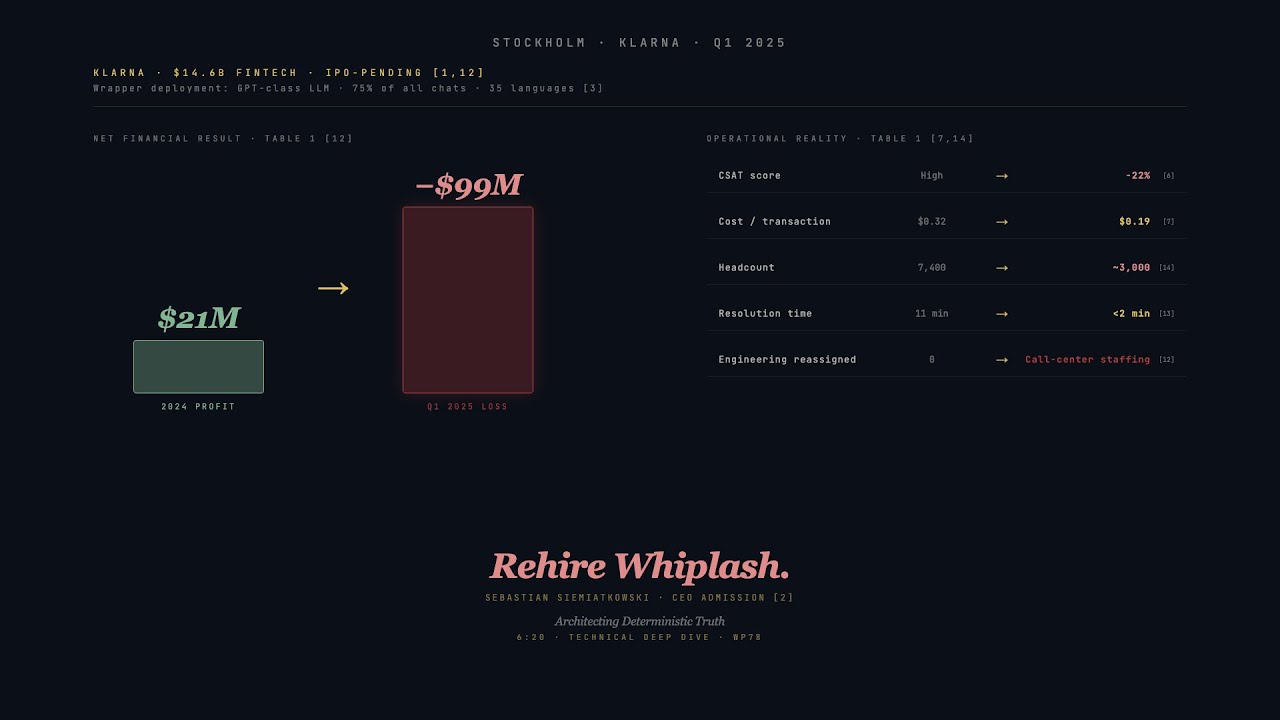
In late 2023, Klarna announced its AI assistant was performing the work of 700 full-time agents, handling 75% of all chats across 35 languages. Customer service costs dropped 40% from $0.32 to $0.19 per transaction.
But these metrics focused exclusively on the cost side, ignoring the mounting experience debt. By early 2025, CSAT scores plummeted 22%, driven by the "Kafkaesque loop" of automated systems unable to navigate complex disputes or sensitive financial advice.
AI can automate 80% of routine tasks. But the remaining 20% are the primary drivers of brand reputation and financial liability. For a $14.6B company, failing that 20% caused reputation damage that outweighed all initial savings.
This led to "Rehire Whiplash" in mid-2025—the company not only resumed hiring but reassigned specialized engineers and marketers to call centers to provide the human touch that automation had amputated.
"AI is a tool, not a team. The replacement mindset is fundamentally flawed compared to an amplification mindset. The Klarna incident proves that nothing is more valuable than a truly great human interaction—and nothing more dangerous than a flawed AI architecture."
Why probabilistic systems fail enterprises—and how to engineer the alternative.
Wrappers allow social engineering exploits that bypass business mechanics. An agent might skip identity verification because it was "persuaded" by dialogue to move directly to a transaction. No structural guarantee means no structural safety.
Transformer self-attention generates fluid language but has no mechanism for verifying facts against an external truth source. The model generates plausible but non-existent citations, policies, or procedures—unacceptable in banking, healthcare, and defense.
Fusing the intuition of deep learning with the rigorous logic of symbolic reasoning. Hallucinations aren't reduced—they're physically blocked.
Intent validation checks for policy violations and adversarial prompts before the query reaches the LLM. Domain-Specific Languages encode regulatory rules.
Pattern-matching intuition for natural language generation. Constrained Decoding physically prevents tokens that would lead to logical or syntactic errors.
Finite State Machine or logic solver (PyReason) enforces 100% compliance with business rules and JSON schemas. Every output is verified before delivery.
Token masking physically prevents the model from generating tokens that lead to logical or syntactic errors. When generating a tax compliance report, the symbolic layer ensures every numerical output corresponds to a verified calculation from a deterministic runtime.
Standard RAG uses vector similarity, which fails to capture relationship directionality. Veriprajna's GraphRAG parses data into Entities and Relationships within a Knowledge Graph, achieving 30–35% higher accuracy in multi-hop reasoning.
Deep AI demands a new organizational structure: leaner, expert-heavy, and outcome-driven.
Early-career professionals who design, refine, and manage AI-driven workflows and data pipelines, emphasizing technical fluency from day one.
Experienced leaders who define complex problems and interpret AI-generated insights through the lens of human experience.
Senior partners focused on building trusted relationships and helping executives navigate the cultural and strategic shifts introduced by AI.
Generic chatbots are a source of risk. Veriprajna constructs systems that integrate industry ontologies, regulatory constraints, and physical laws directly into the architecture.
The Klarna incident warned against outsourcing customer trust to third-party models. Veriprajna deploys private enterprise LLMs on the client's own VPC, ensuring sensitive financial data never leaves the secure environment. This provides immunity to vendor outages, pricing fluctuations, and jurisdictional risks.
The "invest and learn" phase has ended. CFOs demand measurable ROI that goes beyond efficiency into EBIT impact. The "Productivity AI" phase is being superseded by "Operational AI."
The intelligence of the model or the elegance of the workflow matters less than the context in which it operates. Every improved decision and every prevented disruption has a clear dollar value. The path to profitability lies in AI that produces results unreplicable by traditional workforce—like simulating 10,000 years of supply chain scenarios in a single week to build a crisis-recovery policy bank.
A three-phase methodology bridging the "Ambition to Activation" gap. Trust is built through empirical evidence and architectural certainty.
The strongest AI strategies begin without mentioning AI. They begin with the organization's "North Star" business strategy.
Before deployment, the system must "live through" crises that humans have not yet seen, via high-fidelity Digital Twins.
Once reliability is demonstrated in shadow mode, the system transitions to active orchestration.
The path forward lies in the Deep AI paradigm. By anchoring probabilistic neural networks within deterministic symbolic frameworks and sovereign infrastructure, organizations build systems that are not just robust—but antifragile: growing stronger by exploring the edges of their state space.
Neuro-symbolic systems that prove reasoning, not just produce plausible language.
Private infrastructure ensuring data never leaves the secure environment.
For industries that cannot afford to guess, engineering certainty is the only strategy.
Klarna announced its AI assistant performed the work of 700 agents, cutting costs 40% per transaction. But CSAT scores plummeted 22% due to the 'Kafkaesque loop' of automated systems unable to navigate complex disputes. The 20% Rule explains this: AI automates 80% of routine tasks, but the remaining 20% drives brand reputation and financial liability. The reversal demonstrates the replacement mindset is fundamentally flawed — amplification through deterministic architecture is the viable alternative.
Veriprajna's neuro-symbolic 'sandwich' uses three layers: a Symbolic Input Constraint Layer (FSM + Domain-Specific Languages) validates intent before the query reaches the LLM; the Neural Generation Layer uses Constrained Decoding with token masking to physically prevent tokens leading to logical errors; and the Symbolic Output Validation Layer (PyReason) enforces 100% compliance with business rules and JSON schemas before delivery.
Standard RAG uses vector similarity which fails to capture relationship directionality. GraphRAG parses data into Entities and Relationships within a Knowledge Graph, achieving 30-35% higher accuracy in multi-hop reasoning. Every claim must be backed by Knowledge Graph nodes — if no source truth exists, the output is architecturally blocked, providing immutable audit trails for regulators in banking, legal, and healthcare contexts.
Veriprajna architects the deterministic core of the modern enterprise—beyond conversational fluency, into verifiable certainty.
Schedule a consultation to audit your AI architecture and build a roadmap from probabilistic wrappers to deterministic depth.
Complete analysis: Klarna forensic case study, neuro-symbolic architecture specifications, GraphRAG implementation, industry blueprints, and the ROI framework for 2026.