The Architectural Imperative: Beyond API Wrappers in Enterprise-Grade Voice AI
Strategic Analysis of the Quick-Service Restaurant AI Transition
The landscape of the Quick-Service Restaurant (QSR) industry is currently undergoing a fundamental transformation, driven by the dual pressures of labor volatility and a consumer demand for "frictionless" digital experiences.1 At the center of this shift is the deployment of generative artificial intelligence (GenAI) in drive-thru operations, a channel that accounts for 75% to 80% of total sales for major chains.2 However, as evidenced by the high-profile rollout of Wendy's FreshAI between 2024 and 2025, the transition from pilot projects to national scale has revealed a critical gap in the current AI service provider ecosystem.1 Most market participants have adopted what can be described as an "API Wrapper" philosophy—simply connecting standard microphones to third-party Large Language Models (LLMs) like those from OpenAI or Google.4 This approach, while rapid to deploy, has proven insufficient for the high-stakes, high-noise, and highly diverse environment of the drive-thru.6
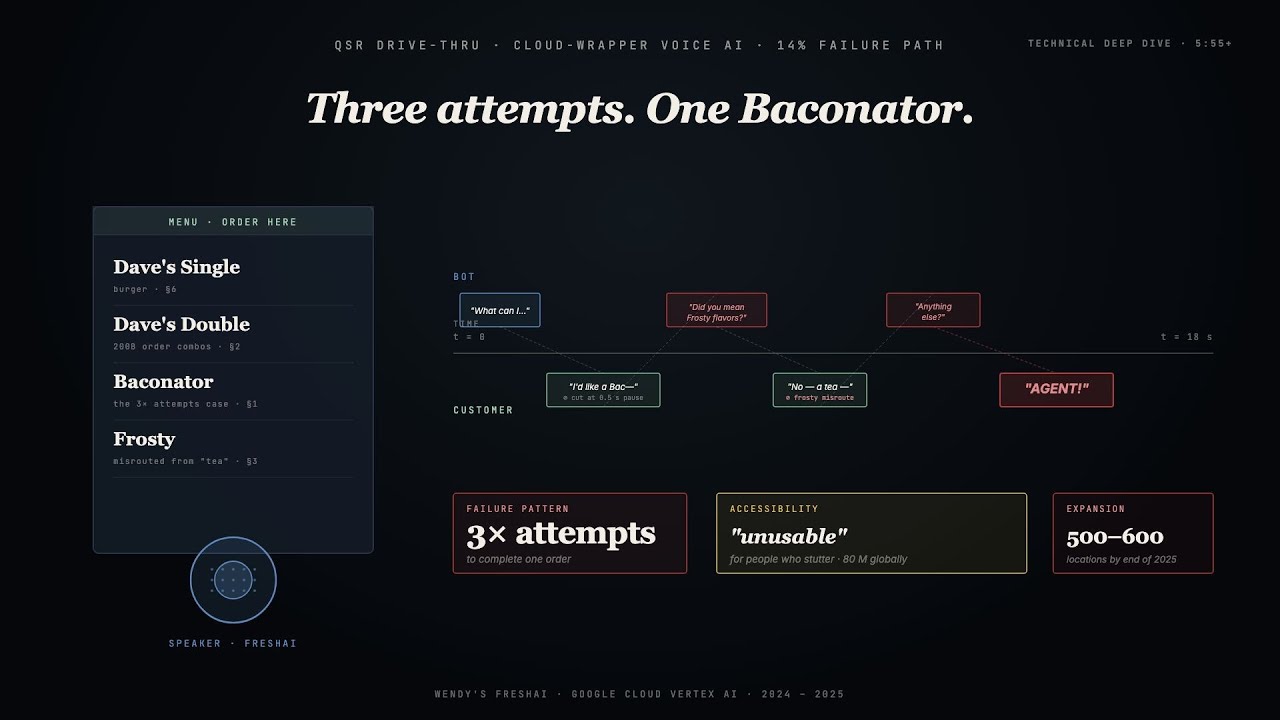
The Wendy's FreshAI case study—where customers report needing three or more attempts to complete an order and where the system is frequently described as "unusable" for individuals with speech disfluencies—serves as a primary data point for the limitations of superficial AI integration.1 Despite these reported failures, the organization is moving forward with an expansion to 500-600 locations by the end of 2025.1 This expansion paradox highlights a disconnect between management-level metrics—such as average check size increases and labor efficiency gains—and the qualitative reality of the customer experience.1 Veriprajna positions itself as the necessary corrective to this trend, offering deep AI solutions that address the underlying physics of acoustics, the complexities of human linguistics, and the architectural requirements of sub-300ms latency.10
The FreshAI Deployment Lifecycle: A Case of Probabilistic Failure
The partnership between Wendy's and Google Cloud, initiated in 2021, was intended to provide a "first-mover advantage" by leveraging Vertex AI and foundational LLMs to streamline the drive-thru.2 The technical promise was significant: a system capable of navigating 200 billion ways to order a Dave's Double and filtering out the ambient noise of an idling vehicle.12 By 2024, the pilot had expanded nationwide, with the company reporting an 86% success rate for orders handled without human intervention.4 However, the remaining 14% represents a significant failure rate in an industry where throughput and accuracy are the primary drivers of brand loyalty.2
The reported customer experiences tell a story that internal metrics often obscure. Users describe a system that is "slow" and "annoying," frequently cutting off customers mid-sentence to suggest unwanted items or failing to understand basic customizations.6 For many, the "automated" experience has become a source of friction rather than its resolution.1 The following table compares the strategic objectives of the FreshAI rollout against the reported consumer realities during the 2024-2025 period.
| Strategic Objective | Reported Consumer Experience | Technical Root Cause |
|---|---|---|
| Frictionless Experience | 3x attempts needed for simple orders.6 | High Word Error Rate (WER) in noise.11 |
| Labor Efficiency | Customers shouting "AGENT" to get a human.1 | Premature endpointing and low confidence thresholds.14 |
| Menu Customization | Difficulty with "no pickle" or "half-sweet" requests.6 | Failure in NLU domain-specific jargon mapping.15 |
| Continuous Learning | Bot suggests Frosty flavors when asked for tea options.13 | Hallucination and poor retrieval-augmented generation (RAG).16 |
| Inclusivity | "Unusable" for people who stutter.1 | Lack of disfluency-aware ASR and VAD.17 |
The decision to expand to 600 locations despite these issues suggests that the organization is optimizing for "Management by Average".1 If the system increases the average check through consistent upselling, the friction experienced by a significant minority of customers—particularly those with accents, disfluencies, or complex orders—is treated as an acceptable externality.1 This perspective ignores the long-term reputational risk and the potential for regulatory intervention under evolving accessibility laws.19
Acoustics and Signal Processing: The VAD Bottleneck
One of the most frequent complaints regarding FreshAI is the bot's tendency to cut off customers mid-sentence or mid-pause.6 This is not a failure of the LLM's reasoning capabilities, but rather a failure of the Voice Activity Detection (VAD) layer.21 In a "Deep AI" architecture, the VAD is the foundational gatekeeper that determines when a user has started speaking and when they have finished their turn.14
The Limitations of Traditional VAD in QSR
Traditional VAD systems, often used in "wrapper" solutions, rely on energy-based thresholds or basic statistical models like Gaussian Mixture Models (GMM).23 These systems are designed for quiet environments with high-quality microphones.23 In a drive-thru, they fail because they cannot distinguish between the energy signature of a human voice and the energy signature of a diesel engine, wind hitting a microphone, or background chatter in the vehicle.7
When a customer pauses for 0.5 seconds to look at the menu—a common behavior in QSR—a basic VAD system interprets this drop in energy as the "end of turn" and sends the incomplete audio fragment to the ASR engine.6 The resulting transcription is nonsensical, leading the bot to respond with irrelevant information or a request for clarification, which in turn frustrates the user.13 The technical challenge is exacerbated by "acoustic chaos": the overlapping sounds of a real-world environment that degrade standard ASR accuracy from 97% in lab settings to unusable levels in the field.11
Veriprajna's Multi-Layered VAD Framework
A robust, enterprise-grade solution requires a multi-layered approach to signal processing. Instead of a binary energy threshold, deep AI solutions employ neural VAD models, such as Silero or Cobra, which are trained to recognize the specific patterns of human speech across diverse frequencies.7 These models provide a probability score (typically 0.7-0.9 for speech) rather than just a volume measurement.7
| VAD Parameter | Standard "Wrapper" Setting | Deep AI (Veriprajna) Specification | Impact on User Experience |
|---|---|---|---|
| Start Detection | >0ms energy spike | 400ms continuous probability 21 | Prevents response to car doors or engine transients.7 |
| Pause Tolerance | 500ms static | 600ms - 1000ms dynamic 7 | Allows for "thoughtful pauses" without being cut off.14 |
| Background Noise | Unfiltered | Spectral Gating (75% removal) 7 | Increases ASR accuracy by providing a cleaner signal.24 |
| Endpointing Logic | Audio-only | Context-aware turn-taking 14 | Uses conversation flow to predict if the turn is over.22 |
By implementing "speculative transcription," where the system begins processing audio at 250ms but waits for a confirmed endpoint at 600ms, a deep AI solution can reduce perceived latency by 350-600ms while simultaneously reducing premature cut-offs.7 This level of signal-level engineering is what separates a professional deployment from a fragile prototype.
Linguistic Diversity and the Challenge of Disfluency
The most significant ethical and technical failure of the FreshAI rollout is its impact on individuals who stutter or have other speech disfluencies.1 Stuttering affects over 80 million people globally and manifests as sound repetitions, prolongations, and blocks.18 Current ASR models are trained almost exclusively on "standard" U.S. English—well-articulated speech with minimal pauses.17 This creates an inherent language bias that marginalizes a significant portion of the population.26
The Character Error Rate (CER) Crisis
For a person who stutters, a drive-thru interaction with an AI can be a source of intense stress and shame.25 When the user experiences a "block"—a silent pause mid-word—the AI's VAD often terminates the recording.1 If the user repeats a sound ("b-b-b-baconator"), a standard ASR model may fail to map this to the correct semantic token, leading to a high Character Error Rate (CER).25 Research indicates that Conformer-based ASR models, while highly efficient on standard speech, see their performance degrade significantly on disordered speech, with some models returning negative BERTScores—indicating a total loss of semantic meaning.17
| Speech Pattern | Impact on Standard ASR | Resulting System Behavior |
|---|---|---|
| Blocks (Silent) | Interpreted as turn-completion. | Bot interrupts mid-word.1 |
| Prolongations | Phoneme distortion. | Misrecognition of items (e.g., "Mmmmilk" as "Silk").17 |
| Repetitions | Token duplication. | Confuses NLU logic; triggers error loops.18 |
| Interjections ("uh", "um") | Increases noise-to-signal ratio. | Slows down processing; increases latency.18 |
Deep AI Mitigation Strategies
Solving for disfluency requires more than just "tuning" a model; it requires a specialized training pipeline. Veriprajna's approach involves fine-tuning self-supervised models (like wav2vec 2.0) on re-annotated disfluent speech datasets.18 This process is augmented by "synthetic disfluency insertion," where fluent transcripts are modified to include blocks and repetitions and then synthesized into audio to provide the model with a diverse range of pathological speech patterns.18
Furthermore, the implementation of "Hybrid ASR models" with modified decoding parameters can improve transcription accuracy for moderate to severe stuttering without requiring the massive computational overhead of retraining a foundational model from scratch.17 This inclusive design is not merely a "nice to have"; it is a prerequisite for operating in a market where 72% of companies are flagging AI failure as a material reputational risk.19
Architectural Paradigms: Edge AI vs. Centralized Clouds
The Wendy's FreshAI system is powered by Google Cloud, meaning that every spoken word must travel from the drive-thru mic, across the public internet to a data center, and back again.2 This centralized architecture is the primary cause of the "sluggish" response times reported by customers.10 In the world of real-time voice, latency is the difference between a natural conversation and a robotic failure.10
The Latency Standard: Sub-300ms
The "gold standard" for real-time voice AI is a response time of less than 300 milliseconds.11 At this speed, the interaction feels immediate and human.11 Once latency exceeds 700-900ms, the conversation begins to break down; by 2 seconds, it feels like a "bad phone call," leading to overlapping speech and mutual interruption.7
Cloud-based AI models, while powerful, face insurmountable thermodynamic and network limits.28 A typical cloud round-trip can consume 100-500ms just in transit, before the model even begins "thinking".27 For a QSR application, this delay is unacceptable.
The Case for Edge AI and Small Language Models (SLMs)
Deep AI solutions prioritize Edge AI—processing data locally on specialized chips (like NVIDIA Orin or specialized TPUs) at the restaurant site.27 This approach offers a 10,000x efficiency advantage and reduces latency to a range of 5-10ms.28
| Feature | Cloud AI (FreshAI Approach) | Edge AI (Veriprajna Approach) | Benefit to QSR |
|---|---|---|---|
| Latency | 100ms - 500ms (Network) 28 | 5ms - 10ms (Local) 28 | Real-time, fluid dialogue.11 |
| Reliability | Depends on constant internet.30 | Offline functionality.31 | System works during outages.29 |
| Data Privacy | Data transmitted to third-party.30 | Local processing; data sovereignty.28 | Prevents session cookie leaks.16 |
| Cost | Recurring cloud API/bandwidth fees.29 | Predictable hardware OpEx.29 | 30-40% lower operational costs.29 |
| Model Size | Massive (LLM) - slow inference.10 | Small, Fine-Tuned (SLM) - 3x faster.10 | Faster throughput; reduced GPU load.10 |
By replacing a general-purpose LLM with a domain-specific Small Language Model (SLM), enterprises can achieve the same business accuracy with a fraction of the computational load.10 An SLM trained on the Wendy's menu doesn't need to know how to write fanfiction; it only needs to know that "Dave's Single" is a burger, not an album title.10 This focus leads to faster inference times and more predictable responses.10
The Regulatory Horizon: ADA, EAA, and Algorithmic Bias
The decision to expand a failing AI system is not only a customer service risk but a significant legal liability. As we enter 2025, governments have shifted from "asking nicely" about AI accessibility to enforcing strict standards.32 The Americans with Disabilities Act (ADA) already prohibits discrimination in public accommodations, and new interpretations specifically target digital barriers for those with speech disabilities.33
CAN-ASC-6.2:2025 and the Inclusion Mandate
A landmark development in early 2025 is the release of CAN-ASC-6.2:2025, the first dedicated accessibility standard for AI systems.20 This standard mandates that people with disabilities be involved in the design, testing, and governance of AI systems.20 It requires that organizations identify and prevent "cumulative harms"—the gradual erosion of autonomy and service quality for marginalized groups.20
| Regulatory Pillar | Requirement | Wendy's FreshAI Gap |
|---|---|---|
| Equitable Access | Performance metrics must be tracked by disability status.20 | High failure rate for disfluent speakers.1 |
| Meaningful Choice | Users must have the option to decline AI for a human.20 | Customers forced to shout "AGENT" to bypass.1 |
| Transparency | Clear explanations of how AI decisions are made.20 | "Black box" behavior in upsell logic.35 |
| Harm Prevention | AI must not Judge users based on physical characteristics.20 | System penalizes slow or repetitive speech.17 |
The European Accessibility Act (EAA), which begins enforcement in June 2025, imposes steep fines and sanctions for businesses that do not meet these digital requirements.32 For a global brand, "retrofitting" a non-compliant AI system across 600 locations can cost five times as much as building it with inclusive design from the outset.32
Operational Integration: Human-in-the-Loop and Turn-Taking Logic
A common mistake in QSR AI deployment is the "replacement" mindset—the idea that the AI should handle the entire transaction without human oversight.9 Veriprajna advocates for an "assistant" model where the AI manages simple, transactional requests while human agents are aided in solving complex problems.9
The Role of Real-Time Safeguards
When a chatbot or voice agent "goes rogue"—hallucinating prices or revealed sensitive data—the damage is public and immediate.16 In August 2025, for example, a major tech company's chatbot revealed live session cookies to researchers after a simple prompt trick.16 In January 2024, a delivery company's bot was famously coaxed into writing poems criticizing its own employer.16
To prevent these incidents, an enterprise-grade solution must include "four lines of defense":
- Pre-Deployment Assurance: Rigorous testing with diverse speaker populations.16
- Real-Time Guardrails: Policy triggers that detect prohibited language or out-of-scope requests.14
- Post-Interaction Monitoring: Continuous audit of failure points to update model guardrails.16
- Escalation Logic: Automatically handing off risky or high-friction queries to human agents before the customer becomes irate.16
Dynamic Turn-Taking
Natural human conversation is a dance of verbal and non-verbal cues.22 We use "um" and "uh" to signal that we are still thinking, and we use pitch changes to signal that we have finished.22 Current drive-thru AI often lacks this "Turn-Taking Logic".22
A deep AI solution integrates linguistic analysis into the endpointing decision.14 If a user says, "I'd like a Baconator and...", the system understands that the conjunction "and" implies the turn is not over, even if there is a 1-second pause.14 Conversely, if a user says "...that's all," the system can respond in under 200ms because the intent is clearly completed.14 This level of conversational intelligence is what reduces the need for the "3x repeat" attempts reported by FreshAI users.6
Material Risk and the Future of AI Governance
The surge in AI adoption has been accompanied by a surge in risk disclosure. From 2023 to 2025, the share of S&P 500 companies reporting AI as a material risk jumped from 12% to 72%.19 Reputational risk is the top concern, followed by cybersecurity and legal compliance.19
For the financial, healthcare, and industrial sectors—and increasingly for retail—the "fail fast" mentality of the tech world is a liability.19 A service breakdown or a biased recommendation can erode brand trust that took decades to build.19 Qualitative data shows that consumers rank AI customer service among the worst for convenience and time savings, with 53% fearing that their personal data is being misused.9
Strategic Implications for the C-Suite
The Wendy's FreshAI incident serves as a warning that implementation failures are considered "highly damaging" for consumer-oriented brands.19 To mitigate these risks, boards and executives must transition from "Pilot Purgatory" to "Governance-Led Deployment".19 This involves:
- Adopting Inclusive Benchmarks: Moving beyond "order accuracy" to include "accuracy across diverse demographics" and "disfluency tolerance".20
- Investing in Edge Infrastructure: Reducing reliance on third-party cloud wrappers to ensure data sovereignty and low latency.28
- Prioritizing Problem-Solving over Cost-Cutting: Using AI to enhance the human experience rather than simply to replace human agents.9
Conclusion: The Path Toward Robust Deep AI
The expansion of Wendy's FreshAI to 600 locations in 2025 represents a critical inflection point for the industry.1 While the system provides clear benefits in terms of upselling and labor metrics, the systemic failure to accommodate linguistic diversity and environmental noise suggests an architecture that is not yet "enterprise-ready".1 The reports of 3x repeat attempts and mid-sentence cut-offs are symptoms of a "wrapper" approach that ignores the underlying technical complexity of real-world voice interaction.6
Veriprajna offers a different path. By focusing on the deep integration of signal processing, Edge-based SLMs, and inclusive ASR design, we provide a solution that is robust, reliable, and compliant with the evolving standards of 2025.10 True innovation in AI is not about who can connect to an API the fastest; it is about who can build a system that understands every customer, every time, regardless of the noise, their accent, or their speech patterns.15
The future of the drive-thru—and of enterprise AI more broadly—lies in moving beyond the probabilistic "best guess" of a general LLM toward the deterministic reliability of a deep AI solution.24 For companies like Wendy's, the choice is clear: either evolve the architecture to match the complexity of the human voice, or risk a multi-million dollar expansion that leaves a significant portion of their customers behind.1 In the high-stakes world of retail automation, there are no shortcuts; there is only the rigorous engineering of resilience.
Works cited
- Wendy's Plans 500-Plus AI-Enhanced Drive-Thru Locations by the ..., accessed February 9, 2026, https://retailwire.com/wendys-ai-drive-thru/
- Wendy's to pilot Google Cloud's generative AI models for drive thru ..., accessed February 9, 2026, https://www.constellationr.com/research/blog/wendys-pilot-google-clouds-generative-ai-models-drive-thru-what-watch
- How Wendy's new AI-powered drive-thru is speeding orders and freeing workers | Google Cloud Blog, accessed February 9, 2026, https://cloud.google.com/transform/wendys-generative-ai-drive-thru-reinvention-worker-freedom
- Wendy's® | Transforming the Ordering Experience: Wendy's FreshAi ..., accessed February 9, 2026, https://www.wendys.com/blog/wendysr-square-deal-blog/transforming-ordering-experience-wendys-freshai-update
- Unveiling the Alibaba Cloud Observability MCP Server: Your AI's Gateway to Cloud Intelligence - Skywork.ai, accessed February 9, 2026, https://skywork.ai/skypage/en/alibaba-cloud-observability-ai-gateway/1978710232358232064
- Wendy's Has Made a Change + Customers Are Furious About It! - Taste of Country, accessed February 9, 2026, https://tasteofcountry.com/wendys-ai-ordering-system/
- Voice AI Problems: 3 Issues That Break Conversation (With Fixes), accessed February 9, 2026, https://10clouds.com/blog/a-i/3-common-problems-you-ll-face-in-your-voice-ai-project/
- Wendy's customers bitter over 'garbage' decision to employ AI bots — but some are relieved, accessed February 9, 2026, https://www.independent.co.uk/life-style/food-and-drink/wendys-ai-bot-drive-thru-freshai-b2700616.html
- AI-Powered Customer Service Fails at Four Times the Rate of Other ..., accessed February 9, 2026, https://www.qualtrics.com/articles/news/ai-powered-customer-service-fails-at-four-times-the-rate-of-other-tasks/
- What Causes Latency in Voice AI? How to Overcome It, accessed February 9, 2026, https://www.gnani.ai/resources/blogs/what-causes-latency-in-voice-ai-how-to-overcome-it
- Latency and Noise Resilience: What Your Voice AI Should Deliver in 2026 - Kapture CX, accessed February 9, 2026, https://www.kapture.cx/blog/latency-and-noise-resilience-what-your-voice-ai-should-deliver/
- Leading Drive-Thru Innovation with Wendy's FreshAi, accessed February 9, 2026, https://www.wendys.com/blog/drive-thru-innovation-wendys-freshai
- the wendy's ai is horrible. : r/wendys - Reddit, accessed February 9, 2026, https://www.reddit.com/r/wendys/comments/1mbvxfi/the_wendys_ai_is_horrible/
- Understanding VAD - Ultravox Docs, accessed February 9, 2026, https://docs.ultravox.ai/noise/understanding-vad
- Generic Automatic Speech Recognition (ASR) Model Challenges, accessed February 9, 2026, https://aiola.ai/blog/generic-asr-models-challenges/
- When Chatbots Go Wrong: The New Risk Landscape in AI Customer Service | EdgeTier, accessed February 9, 2026, https://www.edgetier.com/chatbots-the-new-risk-in-ai-customer-service/
- Automatic Speech Recognition Models for ... - CEUR-WS.org, accessed February 9, 2026, https://ceur-ws.org/Vol-3910/aics2024_p63.pdf
- Inclusive ASR for Disfluent Speech: Cascaded Large ... - ISCA Archive, accessed February 9, 2026, https://www.isca-archive.org/interspeech_2024/mujtaba24_interspeech.pdf
- New Study: 7 in 10 Big US Companies Report AI Risks in Public Disclosures, accessed February 9, 2026, https://www.conference-board.org/press/AI-risks-disclosure-2025
- CAN-ASC-6.2:2025: Accessibility Requirements for AI Systems, accessed February 9, 2026, https://www.barrierbreak.com/how-to-implement-can-asc-6-22025-accessibility-requirements-for-ai-systems/
- Understanding Voice Activity Detection: How VAD Powers Real-Time Voice Systems, accessed February 9, 2026, https://www.osedea.com/insight/understanding-voice-activity-detection-how-vad-powers-real-time-voice-systems
- Voice Activity Detection (VAD) - Retell AI, accessed February 9, 2026, https://www.retellai.com/glossary/voice-activity-detection-vad
- Voice Activity Detection (VAD): The Complete 2026 Guide to Speech Detection - Picovoice, accessed February 9, 2026, https://picovoice.ai/blog/complete-guide-voice-activity-detection-vad/
- What is Voice Activity Detection (VAD) - aiOla AI, accessed February 9, 2026, https://aiola.ai/glossary/vad-voice-activity-detection/
- StutteringSpeech Challenge, accessed February 9, 2026, https://stutteringspeech.org/
- Language bias in ASR: Challenges, consequences, and the path forward - Gladia, accessed February 9, 2026, https://www.gladia.io/blog/asr-language-bias
- Edge AI vs Cloud AI: A Comparative Study of Performance Latency and Scalability - ijrmeet, accessed February 9, 2026, https://ijrmeet.org/wp-content/uploads/2025/03/in_ijrmeet_Mar_2025_RG_24010_04_Edge-AI-vs-Cloud-AI-A-Comparative-Study-of-Performance-Latency-and-Scalability.pdf
- The AI Shadow War: SaaS vs. Edge Computing Architectures - arXiv, accessed February 9, 2026, https://arxiv.org/html/2507.11545v1
- Edge vs Cloud AI: Key Differences, Benefits & Hybrid Future - Clarifai, accessed February 9, 2026, https://www.clarifai.com/blog/edge-vs-cloud-ai
- Edge AI vs. Cloud AI: Real-Time Intelligence vs. Centralized Processing | by Hassaan Idrees, accessed February 9, 2026, https://medium.com/@hassaanidrees7/edge-ai-vs-cloud-ai-real-time-intelligence-vs-centralized-processing-df8c6e94fd11
- Edge AI vs. Cloud AI - IBM, accessed February 9, 2026, https://www.ibm.com/think/topics/edge-vs-cloud-ai
- Accessible Event Content Guide 2025: ADA & EAA Compliance Essentials - Snapsight, accessed February 9, 2026, https://www.snapsight.com/en/blog/navigating-accessible-event-content-requirements-essential-compliance-guide-for-2025/
- ADA Compliance for Websites in 2025: Essential Standards and Best Practices - EqualWeb, accessed February 9, 2026, https://www.equalweb.com/a/44193/11527/ada_compliance_for_websites_in_2025:_essential_standards_and_best_practices
- Guide to Disability Rights Laws | ADA.gov, accessed February 9, 2026, https://www.ada.gov/resources/disability-rights-guide/
- AI REPUTATION RISK MAP | Infinite Global, accessed February 9, 2026, https://infiniteglobal.com/wp-content/uploads/2025/01/Infinite-Global_AI-Reputation-Risk-Map_Oct2024.pdf
- Text-to-Speech Accessibility: A Complete Guide for 2025, accessed February 9, 2026, https://accessibilitychecker.org/blog/text-to-speech-accessibility/
- To my son, Bruno, who at two years old, brought a new and brilliant light into my life. As I explore the systems that will defin - bibis.ir, accessed February 9, 2026, https://download.bibis.ir/Books/Artificial-Intelligence/Programming/2025/Agentic%20Design%20Patterns%20-A%20Hands-On%20Guide%20to%20Building%20Intelligent%20Systems%20(Antonio%20Gull%20)_bibis.ir.pdf
Prefer a visual, interactive experience?
Explore the key findings, stats, and architecture of this paper in an interactive format with navigable sections and data visualizations.
Frequently Asked Questions
Why did Wendy's FreshAI voice AI system fail despite processing two million orders?
Wendy's FreshAI achieved an 86% automation rate but the remaining 14% failure rate caused customers to need 3x attempts for simple orders, with the system cutting off customers mid-sentence and suggesting irrelevant items. The root causes are threefold: energy-based VAD systems that cannot distinguish human speech from engine noise in drive-thru environments, ASR models trained exclusively on standard US English that fail on accented or disfluent speech, and cloud-dependent architecture adding 100-500ms latency that degrades natural conversation flow.
How does edge AI achieve sub-300ms voice response times compared to cloud-based systems?
Edge AI processes data locally on specialized chips like NVIDIA Orin, reducing latency from the cloud's 100-500ms network transit to just 5-10ms local processing, a 10,000x efficiency advantage. By replacing general-purpose LLMs with domain-specific Small Language Models that only need to understand a restaurant's menu rather than general knowledge, enterprises achieve 3x faster inference at 30-40% lower operational costs while maintaining offline functionality during internet outages.
How can voice AI systems be made accessible for people who stutter or have speech disfluencies?
Accessible voice AI requires fine-tuning self-supervised models like wav2vec 2.0 on re-annotated disfluent speech datasets, augmented by synthetic disfluency insertion where fluent transcripts are modified to include blocks and repetitions. The VAD layer must use dynamic pause tolerance of 600-1000ms instead of static 500ms thresholds, and context-aware endpointing that understands conjunctions like 'and' signal incomplete turns. Standard Conformer ASR models return negative BERTScores on disordered speech, making these modifications essential for the 80 million people globally affected by stuttering.
Also Published On
Build Your AI with Confidence.
Partner with a team that has deep experience in building the next generation of enterprise AI. Let us help you design, build, and deploy an AI strategy you can trust.
Veriprajna Deep Tech Consultancy specializes in building safety-critical AI systems for healthcare, finance, and regulatory domains. Our architectures are validated against established protocols with comprehensive compliance documentation.