Beyond API Wrappers in Enterprise-Grade Voice AI
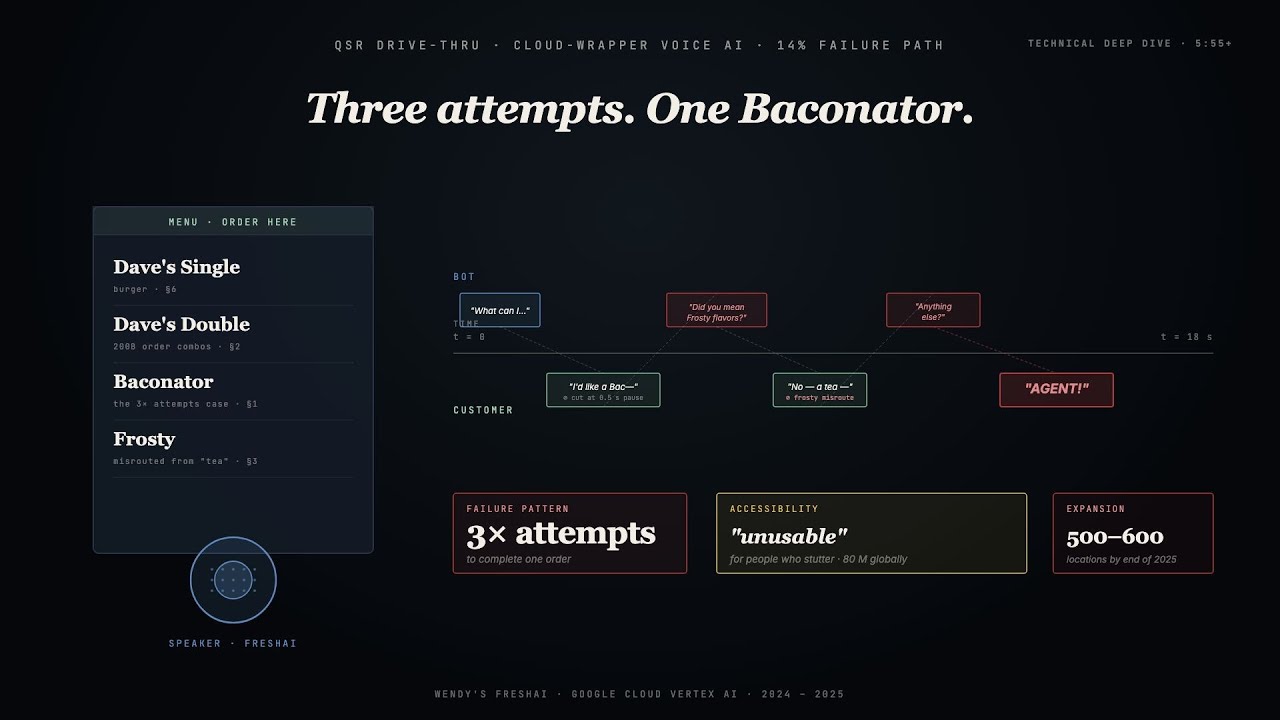
The drive-thru accounts for 75-80% of total QSR sales. Yet current AI deployments are built on fragile "API wrapper" architectures that simply pipe audio to generic cloud LLMs. The result: 3x repeat attempts, mid-sentence cut-offs, and systems that are unusable for 80 million people who stutter.
Veriprajna engineers deep AI solutions that address the underlying physics of acoustics, the complexities of human linguistics, and the architectural requirements of sub-300ms latency — turning voice AI from a fragile prototype into enterprise infrastructure.
Most voice AI vendors connect standard microphones to third-party LLMs and call it innovation. Veriprajna engineers every layer of the stack — from acoustic signal processing to edge inference.
Eliminate the 3x repeat problem. Our multi-layered VAD and domain-specific SLMs deliver first-attempt accuracy even in high-noise drive-thru environments with diverse speakers.
Built-in guardrails prevent hallucination, data leakage, and brand damage. Four lines of defense ensure your AI never "goes rogue" in a customer-facing interaction.
Inclusive by design. Our disfluency-aware ASR and dynamic pause tolerance ensure every customer is understood — regardless of accent, stutter, or speech pattern.
Wendy's FreshAI — powered by Google Cloud — reported an 86% success rate across pilot locations. Yet customers describe a system that is "slow," "annoying," and frequently cuts them off mid-sentence. The remaining 14% represents a catastrophic failure rate in an industry where throughput and accuracy define brand loyalty.
Customers need 3 or more attempts to complete simple orders. The "automated" experience creates friction instead of removing it.
Customers resort to shouting "AGENT" to bypass the AI and reach a human operator.
Difficulty processing "no pickle" or "half-sweet" requests — basic customizations that define the QSR experience.
The bot suggests Frosty flavors when asked for tea options — a hallucination pattern typical of poorly grounded RAG systems.
Described as "unusable" for people who stutter — the system penalizes slow, repetitive, or non-standard speech patterns.
Wendy's is expanding to 500-600 locations by end of 2025 — optimizing for average check size while treating customer friction as an acceptable externality.
"This expansion paradox highlights a disconnect between management-level metrics — such as average check size increases and labor efficiency gains — and the qualitative reality of the customer experience. If the system increases the average check through consistent upselling, the friction experienced by a significant minority of customers is treated as an acceptable externality."
— Veriprajna Strategic Analysis, 2025
The most frequent complaint — being cut off mid-sentence — is not an LLM failure. It's a Voice Activity Detection failure. In "wrapper" solutions, basic energy-threshold VAD cannot distinguish a human voice from a diesel engine, wind, or vehicle chatter.
Instead of a binary energy threshold, we employ neural VAD models that provide probability scores (0.7-0.9 for speech) and context-aware turn-taking logic. Speculative transcription begins at 250ms but waits for confirmed endpoint at 600ms.
Toggle the simulation to see how standard VAD fails on natural speech pauses while Veriprajna's deep VAD handles them correctly.
Prevents false triggers from car doors or engine transients
Allows "thoughtful pauses" without being cut off
Provides cleaner signal for dramatically higher ASR accuracy
Uses conversation flow to predict if the speaker's turn is over
Stuttering affects over 80 million people globally. Current ASR models are trained almost exclusively on "standard" speech — creating inherent bias that marginalizes a significant portion of the population and exposes brands to regulatory risk.
A pause mid-word is interpreted as turn completion. The bot interrupts before the customer finishes.
Extended phonemes cause distortion. "Mmmmilk" may be misrecognized as "Silk" or discarded entirely.
"B-b-b-baconator" creates token duplication that confuses NLU logic and triggers error loops.
"Uh" and "um" fillers increase noise-to-signal ratio, slowing processing and adding latency.
Inclusive design is not merely a "nice to have." Research shows Conformer-based ASR models can return negative BERTScores on disordered speech — indicating total loss of semantic meaning.
With 72% of S&P 500 companies now flagging AI as a material risk, and accessibility laws tightening globally, retrofitting compliance costs 5x more than building it in from the start.
53% of consumers fear their personal data is being misused by AI customer service systems. AI-powered customer service fails at four times the rate of other tasks.
Every spoken word in FreshAI must travel across the public internet to a Google data center and back. This centralized architecture is the primary cause of "sluggish" response times. In real-time voice, latency is the difference between natural and robotic.
Once latency exceeds 700-900ms, conversation breaks down. At 2 seconds, it feels like a "bad phone call."
A general-purpose LLM knows how to write poetry, code, and legal briefs. An SLM trained on the Wendy's menu only needs to know that "Dave's Single" is a burger, not an album title.
This focus delivers 3x faster inference, more predictable responses, and the same business accuracy at a fraction of the computational load.
As we enter 2025, governments have shifted from voluntary AI guidelines to strict enforcement. The decision to expand a failing AI system is not only a customer service risk — it's a significant legal liability.
Share of S&P 500 companies reporting AI as a material risk in public disclosures
Performance metrics must be tracked by disability status. Systems must not penalize users based on physical speech characteristics.
Users must have the option to decline AI interaction for a human alternative without friction or penalty.
Clear explanations of AI decisions required. Systems must not judge users based on physical characteristics.
When a voice agent halluccinates prices, leaks session data, or writes poems criticizing its employer — the damage is public and immediate. Enterprise-grade voice AI requires layered operational safeguards, not a "replacement" mindset.
Rigorous testing with diverse speaker populations before any customer-facing deployment.
• Stress testing across accents, disfluencies, and noise levels
• Red-team adversarial prompting assessments
• Benchmark against demographic equity thresholds
Policy triggers that detect prohibited language, out-of-scope requests, and hallucination patterns in-stream.
• Token-level content filtering with sub-50ms overhead
• Confidence-threshold gates on every response
• Hard blocks on price/promotion hallucination
Continuous audit of failure points to update model guardrails and improve accuracy over time.
• Every interaction logged with confidence scores
• Automated anomaly detection across sessions
• Weekly model drift reports for operations teams
Automatically handing off risky or high-friction queries to human agents before the customer becomes irate.
• Frustration detection via tone and repetition patterns
• Seamless warm handoff with full context transfer
• Human-in-the-loop for complex customizations
Natural conversation is a dance of verbal cues. We use "um" to signal we're still thinking, and pitch changes to signal we're done. Current drive-thru AI lacks this conversational intelligence.
The system begins processing audio at 250ms but waits for a confirmed endpoint at 600ms. This reduces perceived latency by 350-600ms while simultaneously reducing premature cut-offs.
The Wendy's FreshAI incident is a warning: implementation failures are considered "highly damaging" for consumer-oriented brands. Boards and executives must transition from "Pilot Purgatory" to governance-led deployment.
Move beyond "order accuracy" to include accuracy across diverse demographics and disfluency tolerance. Measure what matters for every customer, not just the average.
Reduce reliance on third-party cloud wrappers. Edge processing ensures data sovereignty, low latency, and operational resilience — even when the internet goes down.
Use AI to augment the human experience, not simply to eliminate headcount. The "assistant" model — AI handles transactions, humans solve problems — delivers better outcomes for everyone.
"True innovation in AI is not about who can connect to an API the fastest. It is about who can build a system that understands every customer, every time, regardless of the noise, their accent, or their speech patterns. The future lies in moving beyond the probabilistic 'best guess' of a general LLM toward the deterministic reliability of a deep AI solution."
— Veriprajna, The Architectural Imperative
The most frequent complaint is a Voice Activity Detection (VAD) failure, not an LLM failure. Wrapper solutions use basic energy-threshold VAD that cannot distinguish human speech from diesel engines, wind, or vehicle chatter. A 0ms energy spike triggers premature cut-off. Veriprajna's multi-layered neural VAD provides probability scores (0.7-0.9 for speech), requires 400ms continuous probability for confirmed speech detection, and uses context-aware turn-taking logic that allows 600-1000ms dynamic pause tolerance.
Stuttering affects 80 million people globally, and current ASR models trained on 'standard' speech return negative BERTScores on disordered speech — total semantic loss. Veriprajna's inclusive ASR pipeline uses self-supervised fine-tuning of wav2vec 2.0 on annotated disfluent speech datasets, synthetic disfluency insertion for training data diversity, hybrid ASR decoding with modified parameters for moderate-to-severe stuttering, and dynamic pause tolerance that extends silence thresholds when disfluency patterns are detected in-stream.
Cloud-based voice AI (like FreshAI) incurs 100-500ms latency as every spoken word travels across the public internet to a data center and back. Once latency exceeds 700-900ms, conversation breaks down. Veriprajna's edge AI architecture achieves 5-10ms inference latency using domain-specific Small Language Models on NVIDIA Orin or dedicated TPUs at the edge. This delivers 30-40% lower operational costs, offline capability during internet outages, full data sovereignty, and 3x faster inference with the same business accuracy.
Veriprajna engineers deep AI solutions that address the underlying physics of acoustics, the complexities of human linguistics, and the sub-300ms latency requirements of real-world deployment.
Schedule a technical assessment to evaluate your current voice AI stack and model the performance gains of a deep architecture.
Complete analysis: VAD architecture, inclusive ASR pipeline, edge deployment specs, regulatory compliance framework, and strategic recommendations for enterprise voice AI.