The Architecture of Accountability: Why Enterprise AI Requires Deep Engineering in the Wake of the Eightfold AI Litigation
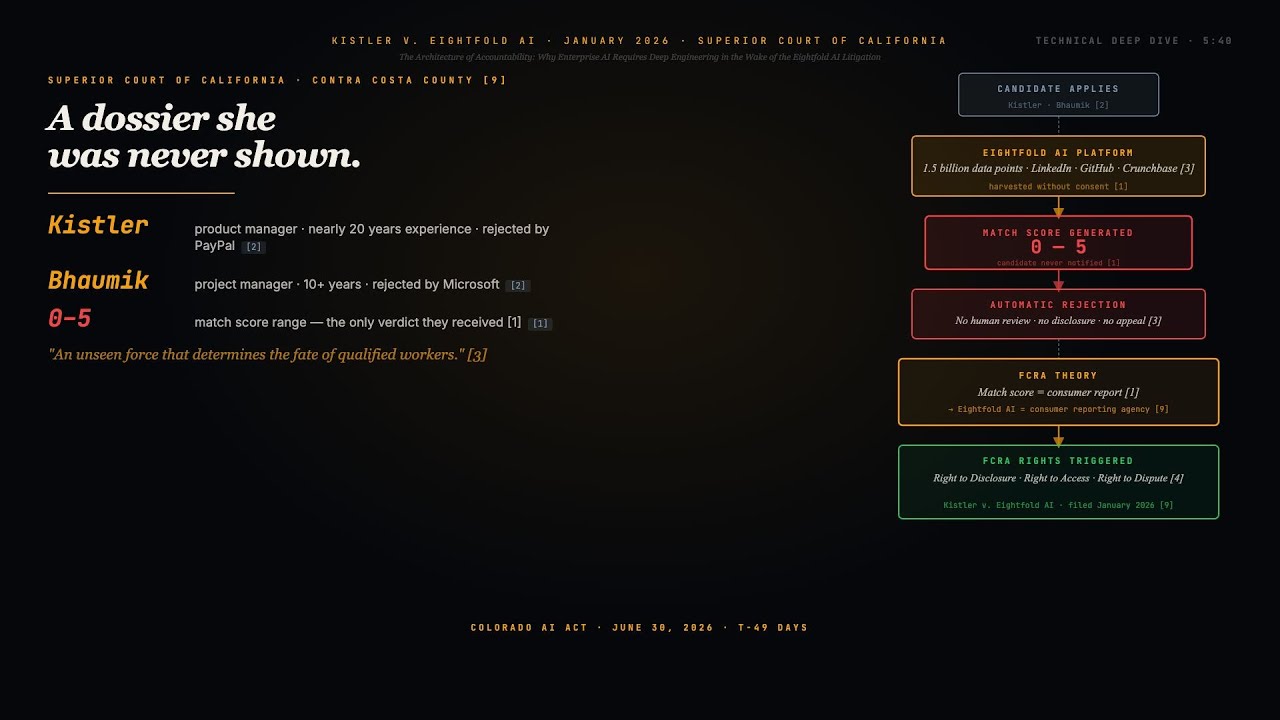
The adoption of artificial intelligence in the corporate sector has reached a defining moment of reckoning. For several years, the "AI gold rush" encouraged the rapid deployment of automated systems, often under the guise of "Talent Intelligence" or "Predictive Analytics," to manage the complexities of global human capital. However, the filing of the landmark class-action lawsuit against Eightfold AI in January 2026—Erin Kistler v. Eightfold AI—has exposed the structural and legal vulnerabilities inherent in these "black box" systems.1 As high-profile organizations including Microsoft, Morgan Stanley, Starbucks, and PayPal face the fallout of utilizing these tools, the industry is witnessing a fundamental shift in how AI is evaluated.3 The litigation highlights a "second accountability gap" where the focus moves from simply preventing biased outcomes to ensuring absolute transparency in data harvesting, scoring mechanisms, and candidate agency.5
At Veriprajna, the philosophy of "Deep AI Solutions" stands in direct opposition to the prevalent "LLM wrapper" culture that often characterizes early-stage AI adoption. While wrappers provide a thin interface over large language models (LLMs) to perform tasks, deep AI solutions integrate deterministic governance, specialized multi-agent architectures, and immutable data provenance into the very core of the software.6 The Eightfold incident serves as a cautionary tale: when AI systems are used to make life-altering decisions regarding employment, housing, or healthcare, they must operate within the bounds of established consumer protection laws like the Fair Credit Reporting Act (FCRA).3 This report explores the technical and regulatory landscape of 2026, offering a roadmap for enterprises to transition from fragile, opaque tools to robust, compliant, and wisdom-driven intelligence systems.
The Eightfold Inflection Point: Anatomy of the January 2026 Lawsuit
The litigation initiated in the Superior Court of California, County of Contra Costa, represents a significant escalation in the legal scrutiny of HR technology.9 Unlike previous lawsuits that focused primarily on algorithmic discrimination—such as the Mobley v. Workday case—the Eightfold filing centers on the violation of consumer reporting laws and the fundamental right of individuals to know how they are being profiled.5 The plaintiffs, Erin Kistler and Sruti Bhaumik, allege that Eightfold AI functions as a "consumer reporting agency" that generates secretive "match scores" used to filter out candidates before a human recruiter ever sees their application.1
Data Harvesting and the Erosion of Consent
The core of the complaint against Eightfold involves the alleged non-consensual harvesting of vast quantities of personal data from the public web, specifically targeting professional networks like LinkedIn, version control platforms like GitHub, and business databases like Crunchbase.3 While Eightfold has officially denied these claims, stating that its platform operates solely on data submitted by candidates or provided by customers, the lawsuit alleges a much more intrusive reality.1 The complaint describes a system that "lurks" in the background of job applications, collecting sensitive information that candidates never intentionally disclosed.1
| Category of Alleged Harvesting | Specific Data Points Targeted | Implications for Candidate Privacy |
|---|---|---|
| Professional Activity | LinkedIn profiles, GitHub commits, job boards.3 | Creation of "shadow profiles" without explicit opt-in.12 |
| Behavioral Signals | Internet usage, device activity, cookies.3 | Profiling based on digital footprint rather than core merit.3 |
| Physical Context | Real-time location data and movement.3 | Potential for proxy discrimination based on geography.12 |
| Scale of Aggregation | 1.5 billion global data points across every industry.3 | Massive-scale profiling akin to a global credit bureau.11 |
The legal theory proposed by the plaintiffs is that this level of data aggregation transforms Eightfold from a mere software vendor into a consumer reporting agency governed by the FCRA.1 Under this framework, any report used to establish a consumer's eligibility for employment is considered a "consumer report," entitling the subject to disclosure, access, and the right to dispute inaccuracies.1 The Eightfold "match scores"—ranging from 0 to 5—are alleged to be these very reports, functioning as an "unseen force" that determines the fate of thousands of qualified workers.1
The Match Score: A Probabilistic Verdict Without Appeal
A critical component of the Eightfold platform is its proprietary "Match Score," which uses deep learning and large language models to predict a candidate's "likelihood of success" in a given role.3 For enterprises like Morgan Stanley and BNY, these scores provide a convenient way to manage massive volumes of applicants.4 However, the lawsuit contends that these scores are often based on "sensitive and often inaccurate" information drawn from opaque third-party sources.1
The plaintiffs' experience illustrates the real-world impact of this opacity. Erin Kistler, a product manager with nearly two decades of experience, and Sruti Bhaumik, a project manager with over ten years of experience, both received automated rejections from roles at PayPal and Microsoft shortly after applying.2 They argue that they were never given the opportunity to review the "secretive dossiers" Eightfold generated about them, nor were they provided with a mechanism to dispute the data that led to their low scores.3 This lack of transparency creates a "dystopian AI-driven marketplace" where individuals are judged by "impersonal blips" and "inaccurate analysis" without any human oversight or recourse.3
Architectural Failure: The Perils of the LLM Wrapper Model
The Eightfold incident highlights a broader technical crisis in the AI industry: the over-reliance on "LLM wrappers" for high-stakes enterprise decisions. At Veriprajna, we define a wrapper as an application that simply presents a customized user interface around a third-party back-end model like GPT-4, Gemini, or Claude.6 While these wrappers are easy to build and offer immediate "vibe-based" results, they fundamentally lack the governance, auditability, and deterministic control required for enterprise-grade solutions.8
The "Mega-Prompt" Trap
Most wrapper-based HR tools utilize what is known as the "mega-prompt" approach. In this pattern, the system crams resumes, job descriptions, internal company policies, and perhaps harvested LinkedIn data into a single, massive prompt.8 The system then "hopes" that the model will execute every task—screening, ranking, and justifying—in one shot.8
| Feature | LLM Wrapper (Mega-Prompt) | Deep AI Solution (Multi-Agent) |
|---|---|---|
| Logic Storage | Buried in natural language prompts.8 | Hard-coded in deterministic workflows.8 |
| Reliability | Tiny wording changes lead to different results.8 | Consistent performance through specialized agents.8 |
| Process Integrity | Models frequently skip required steps.8 | Workflows are enforced by stateful orchestrators.8 |
| Auditability | Opaque "black box" outcomes.8 | Step-by-step logs for every agent's decision.8 |
| Governance | Lacks a formal governance model.8 | Built-in compliance and policy validation.8 |
In the context of candidate scoring, the mega-prompt wrapper is a liability. Because the reasoning process is non-deterministic, the software cannot prove why a candidate received a particular score, nor can it guarantee that it didn't use a prohibited data point (like age or location) buried in the harvested data.8 This is precisely the "opacity" that transforms bias from a fixable error into an unmanageable systemic risk.16
Categories of Architectural Maturity
As organizations mature their AI strategies, they must move away from thin wrappers toward deep integration. Veriprajna categorizes AI maturity into four distinct layers, moving from simple UI enhancements to autonomous, governed ecosystems.17
1. The Interaction Layer (Wrappers): These tools focus on convenience and formatting. They are ideal for quick tests but are "dangerous illusions" in a production environment because they lack control over the underlying reasoning.6
2. The Retrieval Layer (RAG): Retrieval-Augmented Generation allows the AI to query internal databases (like an Applicant Tracking System) to provide more accurate context. This reduces hallucinations but still often relies on a single-pass mega-prompt for the final decision.7
3. The Orchestration Layer (Deep Reasoning): This layer introduces event-driven, stateful orchestration. It treats the LLM not as a "god model" but as a component in a larger system that manages retries, cost controls, and logic flow.15
4. The Governance Layer (Multi-Agent): The highest level of maturity, where specialized agents for planning, execution, and compliance work together. This is the only architecture that can provide the "audit trail" necessary to survive a lawsuit like the one facing Eightfold.8
The 2026 Regulatory Landscape: A Patchwork of Accountability
The Eightfold lawsuit does not exist in a vacuum. It is the leading edge of a massive regulatory shift occurring throughout 2025 and 2026. For global enterprises, compliance is no longer a matter of following one federal guideline; it is about navigating a "patchwork" of state-level AI laws and international frameworks like the EU AI Act.19
The FCRA as a Modern Sword
The most significant legal innovation in the Eightfold case is the application of the 55-year-old Fair Credit Reporting Act to modern AI.9 Historically, the FCRA was used to regulate background check companies and credit bureaus. However, the lawsuit argues that the act's broad definition of "consumer reports" covers any communication from a third party that is used to determine eligibility for "employment purposes".1
If the courts agree with this theory, every AI vendor that scores candidates will be forced to comply with the same standards as a traditional background check firm.1 This includes the "Right to Disclosure" (knowing a report exists), the "Right to Access" (seeing the data), and the "Right to Dispute" (correcting errors).4 Enterprises using these tools must understand that outsourcing the technology does not shift the liability; they remain fully responsible for any bias or lack of transparency introduced by the third-party system.19
Emerging State and Local Statutes
| Jurisdiction | Law / Regulation | Effective Date | Key Mandates for Employers |
|---|---|---|---|
| New York City | Local Law 144.20 | July 2023 | Annual independent bias audits; public disclosure of audit results; candidate notices.20 |
| Illinois | HB 3773 (IHRA Amendment).19 | Jan 1, 2026 | Prohibits AI that "has the effect" of discrimination; mandatory "easily understandable" notices to applicants.19 |
| Texas | TRAIGA.19 | Jan 1, 2026 | Prohibits "intentional unlawful discrimination"; recommends following NIST AI Risk Management Framework.19 |
| California | SB 53 / ADS Regulations.19 | Jan 1, 2026 | Liability applies if disparate impact exists, regardless of intent; strict record retention for 4 years.19 |
| Colorado | Colorado AI Act.19 | June 30, 2026 | Imposes a "duty of care" to protect against algorithmic discrimination; requires routine independent audits.19 |
The 2026 regulatory environment effectively ends the "Move Fast and Break Things" era of AI deployment. Enterprises must now demonstrate "reasonable care" through documented risk assessments, personnel training, and the maintenance of detailed audit trails.19
Deep AI Strategy: The Veriprajna Multi-Agent Framework
To address the "Second Accountability Gap" exposed by the Eightfold litigation, Veriprajna advocates for an architectural shift from "wrappers" to "Specialized Multi-Agent Systems" (MAS).8 In a MAS architecture, the task of evaluating a candidate is not given to a single, opaque model. Instead, it is distributed across a team of specialists, each with a defined role, permission set, and audit log.8
The Anatomy of a Compliant Multi-Agent System
1. The Planning Agent: This agent receives the initial request and determines the required workflow based on current laws and company policy.8 For example, if the applicant is in Illinois, the Planning Agent ensures the "Mandatory Disclosure Agent" executes before any screening begins.19
2. The Data Ingestion & Provenance Agent: Unlike a scraping bot, this agent is
responsible for verifying the lineage of every data point.23 It ensures that only "declared" data (from the candidate's resume) is used for high-stakes scoring, while "inferred" data (from LinkedIn or GitHub) is flagged as "context-only" and never used for final ranking without human approval.19
3. The RAG (Retrieval-Augmented Generation) Agent: This specialist queries authoritative internal sources—such as the specific job requirements and historical hiring patterns—to ensure the AI is grounded in reality, not just "vibe-based" language generation.7
4. The Compliance & Bias Agent: This is a critical safety module. Before any score is finalized, this agent reviews the process logs to ensure no prohibited attributes (like location or university prestige proxies) influenced the outcome.8 If a potential bias is detected, the agent pauses the process and alerts a human reviewer.19
5. The Response & Explainability Agent: Once the process is complete, this agent translates the technical decision into an "easily understandable" explanation for both the recruiter and the candidate, satisfying the transparency requirements of 2026 laws.19
Event-Driven Stateful Orchestration
Deep AI solutions must move away from synchronous "Request-Response" patterns, which often timeout or fail during complex reasoning tasks.15 Veriprajna utilizes an event-driven architecture that ensures reliability and auditability.
● Request & Queue: Every candidate application is placed in a message queue. This allows the orchestrator to manage rate limits and costs effectively.15
● Orchestrator Control: The backend orchestrator explicitly manages the state. It knows that "Step A" (Consent) must be verified before "Step B" (Scoring) can proceed.8
● WebSocket Push: Because deep reasoning can take 30-60 seconds, the system uses WebSockets to push updates to the user interface, ensuring the application feels responsive even when the backend is performing complex compliance checks.15
● Prompt-as-Code: Prompts are treated as first-class software artifacts, enabling versioning, A/B testing, and peer review. This prevents "policy drift" where natural language changes lead to unexpected behaviors.15
Explainable AI (XAI): Solving the "Black Box" Problem
The primary grievance in the Eightfold lawsuit is the "secretive" nature of the match scores.3 To restore trust, enterprises must implement Explainable AI (XAI) techniques that provide a "mathematical bridge" between input data and automated decisions.27
Feature Attribution via SHAP and LIME
Veriprajna integrates post-hoc explainability frameworks directly into the production pipeline. This allows recruiters to see exactly which "features" (skills, certifications, years of experience) contributed most to a candidate's 0-5 score.27
| Technique | Description | Best Use Case in Recruitment |
|---|---|---|
| SHAP (Shapley Additive Explanations) | Based on cooperative game theory; provides mathematically rigorous, consistent feature attribution.29 | Explaining why a candidate was ranked #1 out of 1000; ensuring "fairness" in feature weighting.29 |
| LIME (Local Interpretable Model-agnostic Explanations) | Approximates the complex model with a simple, linear one "locally" around a single candidate.29 | Providing quick, localized insights for a specific rejection; candidate-level dispute resolution.28 |
| Counterfactual Explanations | Provides the "minimal change" needed to alter a decision (e.g., "adding Certification X would increase your score").27 | Providing actionable, transparent feedback to rejected candidates to reduce legal friction.27 |
| Partial Dependence Plots (PDP) | Shows how the score changes as one feature (e.g., years of experience) varies while others are held constant.27 | Detecting non-linear biases, such as "over-weighting" specific elite universities.16 |
The mathematical contribution of a feature to a score can be expressed as its Shapley value, :
Where is the set of all candidate attributes.29 By utilizing these values, a deep AI solution can generate a "Score Summary" that identifies the primary drivers of a ranking (e.g., "+0.8 for Project Management certification," "-0.5 for lack of Python experience").27 This transforms the "secret dossier" into a transparent, defensible document that complies with the FCRA's disclosure requirements.5
Data Provenance: The Shield Against Harvesting Claims
The allegation that Eightfold harvests data from LinkedIn without consent highlights the critical need for "Data Provenance"—the documented trail of data's origin, creation, movement, and dissemination.23 For a deep AI provider like Veriprajna, data provenance is a fundamental requirement for establishing the "trust, reliability, and efficacy" of decisions.23
The Compliance Rating Scheme (CRS) for Datasets
In the 2026 landscape, organizations should avoid "black box" data sources. Instead, they should utilize a Compliance Rating Scheme (CRS) and tools like DatasetSentinel to verify the authenticity of their talent data.24
1. Verification of Origin: The system must answer: "When was this data created? Who created it? Why?".23 If a skill profile was generated by a scraping bot rather than the candidate themselves, it must be flagged.
2. Detection of Unauthorized Modification: Deep AI systems use cryptographic hashing to secure metadata, ensuring that once a resume is ingested, it cannot be altered by a third party without detection.23
3. System Provenance Data: Under laws like California's AB 853, platforms must detect and disclose if metadata (like time, date, and capture device) indicates that content was significantly altered by Generative AI.19 This prevents the AI from "judging" a candidate based on an AI-enhanced version of their history that may be inaccurate.
4. Privacy-Preserving Ingestion: Techniques like anonymization and differential privacy allow the AI to conduct bias testing and score-matching without ever "seeing" protected characteristics like race or gender, creating a "verifiable data custody chain".23
Operationalizing Compliance: A Roadmap for HR and Legal Leadership
The Eightfold litigation serves as a "pivot point" for organizations like Microsoft and Starbucks to re-evaluate their HR technology stacks.11 Veriprajna provides a strategic roadmap to transition from the "Wrapper Era" to the "Accountability Era."
Phase 1: The AI Audit and Inventory
The first step in any mitigation strategy is understanding the current state of "hidden" AI within the organization.13
● Conduct a Comprehensive AEDT Inventory: Work with legal counsel to identify every third-party and in-house tool used for screening, ranking, or selecting candidates.20 Do not assume that a tool isn't "AI" just because the vendor calls it "Talent Intelligence."
● Evaluate Vendor Provenance: Ask vendors detailed questions: What specific data sources are they using? Do they pull information from outside the application? Do they provide scores or rankings?.13
● Review Certification Status: If a vendor is functioning as a consumer reporting agency, ensure they have provided the necessary certifications and that the employer is following proper "adverse action" procedures.13
Phase 2: Implementing "Human-in-the-Loop" Governance
A major risk factor in the Eightfold case is that candidates were rejected by an "unseen force" without human review.1 Deep AI solutions must maintain "meaningful human review" for every high-stakes decision.19
● Treat AI as Input, Not Verdict: HR teams should be trained to treat AI match scores as one signal among many, rather than an absolute verdict.11
● Log Reviewer Rationale: When a recruiter chooses to move a "lower-ranked" candidate forward—or reject a "top-ranked" one—the system must capture the human reasoning. This creates a defensible audit trail and helps calibrate the AI model to match company values.27
● Mandatory Human Overrides: For candidates in specific jurisdictions (like NYC or Illinois), the system should require a human to manually "confirm" any rejection influenced by an automated score.19
Phase 3: The Shift to Explainable Multi-Agent Architecture
The long-term defense against "black box" litigation is the decommissioning of opaque wrappers in favor of specialized, observable architectures.
● De-couple Intent from Execution: Move away from single-pass mega-prompts. Build a service layer where AI logic is isolated, versioned, and testable.15
● Instrument Logging and Versioning: Ensure the organization can reproduce any past decision by storing model versions, input snapshots, and XAI explanation outputs.27
● Implement "Right to Dispute" Workflows: Integrate a candidate portal where applicants can see a summary of the data used to rank them and submit a correction request that is automatically routed to a human recruiter.2
Conclusion: Prajna (Wisdom) Over Wrappers
The litigation facing Eightfold AI is not merely a legal hurdle for one company; it is a signal that the era of "consequence-free" AI experimentation is over.5 For enterprises like Microsoft, PayPal, and Morgan Stanley, the path forward requires a departure from the "black box" model of candidate evaluation.3
At Veriprajna, we believe that "Prajna"—the Sanskrit term for transcendent wisdom—must be the foundation of enterprise AI. Wisdom in this context means moving beyond the "probabilistic guesses" of LLM wrappers and toward deep, engineered solutions that prioritize deterministic control, mathematical explainability, and rigorous data provenance.8
By replacing "secret match scores" with transparent multi-agent orchestration, organizations can build a hiring process that is not only more efficient but also profoundly more human and defensible.5 The lessons of the Eightfold incident are clear: in the dystopian marketplace of 2026, the only way to protect the enterprise is to embrace an architecture of absolute accountability.3 Deep AI is no longer a luxury for the technologically advanced; it is the minimum standard for the ethically responsible.5
Works cited
AI-powered hiring platform Eightfold AI faces lawsuit over hiring data used to rate candidates, accessed February 6, 2026, https://www.hr-brew.com/stories/2026/01/29/ai-powered-hiring-platform-eightfold-ai-faces-lawsuit-over-hiring-data-used-to-rate-candidates
Lawsuit targeting AI dives into job seeker data, accessed February 6, 2026, https://www.staffingindustry.com/news/global-daily-news/lawsuit-targeting-ai-dives-into-job-seeker-data
AI Hiring Nightmare: Eightfold Faces Lawsuit Over Hidden Applicant Scoring | MEXC News, accessed February 6, 2026, https://www.mexc.com/news/535787
AI company faces class action over job-applicant screening - GLI - Global Legal Insights, accessed February 6, 2026, https://www.globallegalinsights.com/news/ai-company-faces-class-action-over-job-applicant-screening/
Eightfold lawsuit reveals the second accountability gap in AI hiring ..., accessed February 6, 2026, https://www.thepeoplespace.com/insights/practice/eightfold-lawsuit-reveals-second-accountability-gap-ai-hiring
Why the Concept of a “Wrapper” with AI is Really Nothing New - IT Specialist, accessed February 6, 2026, https://itspecialist.com/f/why-the-concept-of-%E2%80%9Cwrapper%E2%80%9D-ai-front-ends-are-really-nothing-new
AI Wrapper Applications: What They Are and Why Companies Develop Their Own, accessed February 6, 2026, https://www.npgroup.net/blog/ai-wrapper-applications-development-explained/
The great AI debate: Wrappers vs. Multi-Agent Systems in enterprise AI - Moveo.AI, accessed February 6, 2026, https://moveo.ai/blog/wrappers-vs-multi-agent-systems
Eightfold AI Hiring Platform Lawsuit: FCRA Violations Alleged | 2026 - News and Statistics, accessed February 6, 2026, https://www.indexbox.io/blog/eightfold-ai-faces-lawsuit-over-alleged-hiring-algorithm-violations/
New California Employment Lawsuit Tackles AI Discrimination, accessed February 6, 2026, https://www.lawyersandsettlements.com/legal-news/california_labor_law/new-california-employment-lawsuit-tackles-ai-discrimination-24301.html
Workers challenge 'hidden' AI hiring tools in class action with major regulatory stakes, accessed February 6, 2026, https://www.computerworld.com/article/4121074/workers-challenge-hidden-ai-hiring-tools-in-class-action-with-major-regulatory-stakes.html
Company whose AI hiring tool is used by Microsoft and Paypal sued compiling secretive reports termed 'illegal' - The Times of India, accessed February 6, 2026, https://timesofindia.indiatimes.com/technology/tech-news/company-whose-ai-hiring-tool-is-used-by-microsoft-and-paypal-sued-compiling-secretive-reports-termed-illegal/articleshow/127605819.cms
Job Applicants Sue AI Screening Company for FCRA Violations: 5 ..., accessed February 6, 2026, https://www.fisherphillips.com/en/news-insights/job-applicants-sue-ai-screening-company-for-fcra-violations.html
Eightfold in de VS voor de rechter gedaagd door werkzoekers - RecruitmentMatters, accessed February 6, 2026, https://recruitmentmatters.nl/2026/01/22/eightfold-in-de-vs-voor-de-rechter-gedaagd-door-werkzoekers/
From Wrappers to Workflows: The Architecture of AI-First Apps | by ..., accessed February 6, 2026, https://medium.com/@silverskytechnology/stop-building-wrappers-the-architecture-of-ai-first-apps-a672ede1901b
Navigating AI Bias in Recruitment: Mitigation Strategies for Fair and Transparent Hiring, accessed February 6, 2026, https://www.hackerearth.com/blog/navigating-ai-bias-in-recruitment-mitigation-strategies-for-fair-and-transparent-hiring
Enterprise LLM Architecture: Designing for Scale and Security | SaM Solutions, accessed February 6, 2026, https://sam-solutions.com/blog/enterprise-llm-architecture/
Choosing AI Agent Architecture for Enterprise Systems: Shallow vs ReAct vs Deep, accessed February 6, 2026, https://pub.towardsai.net/shallow-react-or-deep-choosing-the-right-ai-agent-architecture-57e5a2a589a9
Navigating the AI Employment Landscape in 2026: Considerations ..., accessed February 6, 2026, https://www.klgates.com/Navigating-the-AI-Employment-Landscape-in-2026-Considerations-and-Best-Practices-for-Employers-2-2-2026
Critical audit of NYC's AI hiring law signals increased risk for ..., accessed February 6, 2026, https://www.dlapiper.com/en-us/insights/publications/2026/01/critical-audit-of-nyc-ai-hiring-law-signals-increased-risk-for-employers
What is NYC's AI Bias Law and How Does It Impact Firms Using HR Automation?, accessed February 6, 2026, https://www.pivotpointsecurity.com/what-is-nycs-ai-bias-law-and-how-does-it-impact-firms-using-hr-automation/
How to Comply with the NYC Bias Audit Law in 2026: A Comprehensive Guide for Employers, accessed February 6, 2026, https://www.nycbiasaudit.com/blog/how-to-comply-with-the-nyc-bias-audit-law
Exploring Data Provenance: Ensuring Data Integrity and Authenticity - Astera Software, accessed February 6, 2026, https://www.astera.com/type/blog/data-provenance/
Compliance Rating Scheme: A Data Provenance Framework for Generative AI Datasets, accessed February 6, 2026, https://arxiv.org/html/2512.21775v1
AI Document Verification – Enhancing Hiring Security and Compliance - eJobSiteSoftware, accessed February 6, 2026, https://ejobsitesoftware.com/blog/ai-document-verification-enhancing-hiring-security-and-compliance/
"How can we design transparent and explainable AI (XAI) algorithms that ensure the mitigation of bias against specific groups in automated recruitmen? | ResearchGate, accessed February 6, 2026, https://www.researchgate.net/post/How_can_we_design_transparent_and_explainable_AI_XAI_algorithms_that_ensure_the_mitigation_of_bias_against_specific_groups_in_automated_recruitmen
Explainable AI in Hiring: Why Transparency Matters - ZYTHR, accessed February 6, 2026, https://zythr.com/resources/explainable-ai-in-hiring-why-transparency-matters
Explainable AI in Production: SHAP and LIME for Real-Time Predictions - Java Code Geeks, accessed February 6, 2026, https://www.javacodegeeks.com/2025/03/explainable-ai-in-production-shap-and-lime-for-real-time-predictions.html
Let's talk Explainable AI — A Dive into LIME and SHAP | by Lubah Nelson | Medium, accessed February 6, 2026, https://medium.com/@lubah_99345/lets-talk-xai-a-comparative-analysis-of-lime-and-shap-c32b92e65070
Comparative Analysis of Explainable AI Frameworks (LIME and SHAP) in Loan Approval Systems - ResearchGate, accessed February 6, 2026, https://www.researchgate.net/publication/398448773_Comparative_Analysis_of_Explainable_AI_Frameworks_LIME_and_SHAP_in_Loan_Approval_Systems
Prefer a visual, interactive experience?
Explore the key findings, stats, and architecture of this paper in an interactive format with navigable sections and data visualizations.
Frequently Asked Questions
What is the Eightfold AI lawsuit and why does it matter for enterprise AI?
Filed in January 2026, Kistler v. Eightfold AI alleges the company generates secretive 0-5 match scores from 1.5 billion data points harvested without consent from LinkedIn, GitHub, and Crunchbase. The lawsuit argues Eightfold functions as a consumer reporting agency under the FCRA, requiring disclosure, access, and dispute rights. Organizations like Microsoft, Morgan Stanley, and Starbucks face fallout from using these opaque scores.
How does the FCRA apply to modern AI hiring platforms?
The Fair Credit Reporting Act's broad definition of consumer reports covers any third-party communication used to determine employment eligibility. If courts agree that AI match scores constitute consumer reports, every AI vendor scoring candidates must comply with disclosure rights, data access rights, and dispute mechanisms, equivalent to traditional background check firm obligations. Outsourcing technology does not shift liability from the employer.
How do multi-agent systems solve the AI accountability problem in hiring?
Multi-agent systems distribute hiring evaluation across specialized agents: a Planning Agent determines compliance workflows, a Data Provenance Agent verifies data lineage and flags inferred versus declared data, a Compliance Agent checks for prohibited attribute influence, and a Response Agent translates decisions into explainable outputs using SHAP attribution. Event-driven stateful orchestration ensures every step generates auditable logs.
Also Published On
Build Your AI with Confidence.
Partner with a team that has deep experience in building the next generation of enterprise AI. Let us help you design, build, and deploy an AI strategy you can trust.
Veriprajna Deep Tech Consultancy specializes in building safety-critical AI systems for healthcare, finance, and regulatory domains. Our architectures are validated against established protocols with comprehensive compliance documentation.