Why Enterprise AI Requires Deep Engineering in the Wake of the Eightfold AI Litigation
The January 2026 class-action lawsuit against Eightfold AI has exposed the structural vulnerabilities of "black box" hiring tools used by Microsoft, Morgan Stanley, and PayPal. This whitepaper charts the path from fragile LLM wrappers to governed, explainable multi-agent systems.
The January 2026 class-action lawsuit shifts the frontier of AI accountability from preventing biased outcomes to ensuring absolute transparency in data harvesting, scoring, and candidate agency.
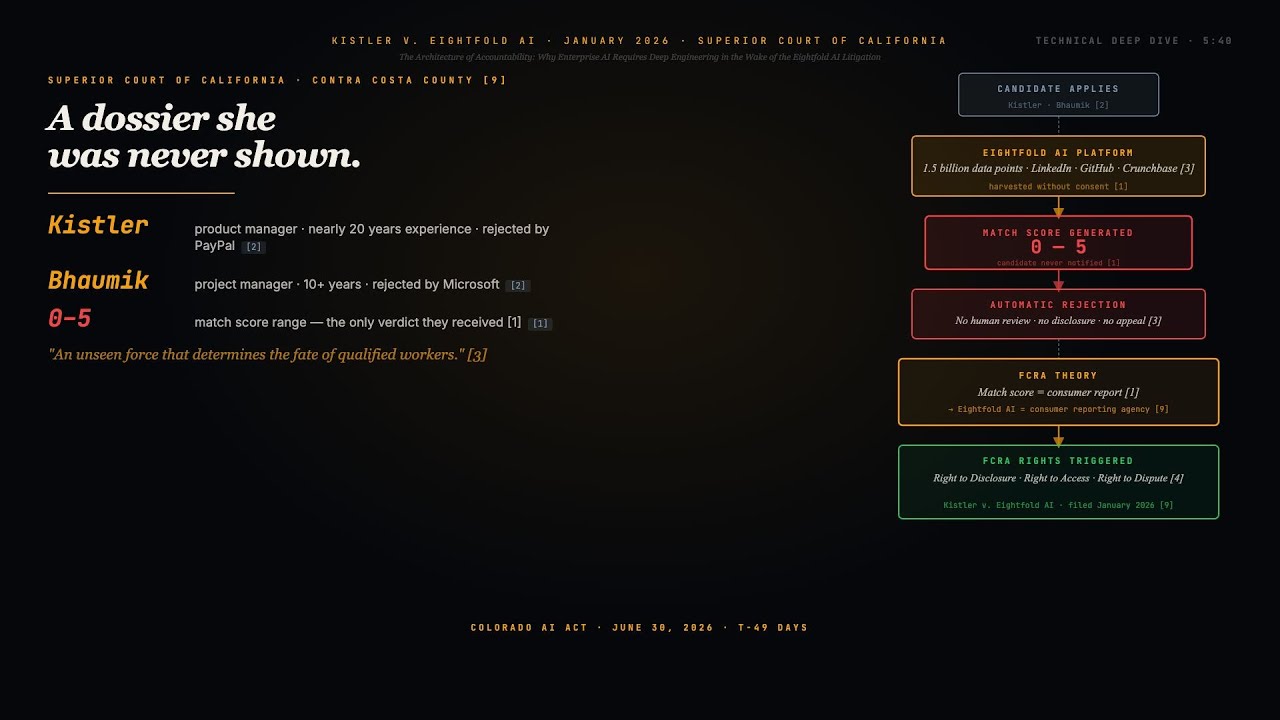
The complaint alleges Eightfold "lurks" behind job applications, harvesting LinkedIn profiles, GitHub commits, location data, and device activity—creating "shadow profiles" from 1.5 billion data points without opt-in.
Eightfold's 0–5 "match score" uses deep learning to predict "likelihood of success." Candidates like Erin Kistler (20 years experience) received auto-rejections with no ability to see or dispute the score.
The plaintiffs argue Eightfold functions as a "consumer reporting agency." If courts agree, every AI vendor scoring candidates must comply with FCRA: Right to Disclosure, Access, and Dispute.
"In the dystopian AI-driven marketplace of 2026, qualified workers are judged by impersonal blips and inaccurate analysis without any human oversight or recourse. The only way to protect the enterprise is to embrace an architecture of absolute accountability."
— Veriprajna Whitepaper Analysis, February 2026
The Eightfold incident highlights a broader crisis: enterprise decisions made by "mega-prompt" LLM wrappers that cannot prove why a candidate received a particular score.
Buried in natural language prompts. Tiny wording changes lead to different results.
Models frequently skip required steps. No enforcement of workflow order.
Opaque "black box" outcomes. Cannot prove why a score was generated.
No formal governance model. Cannot guarantee prohibited data wasn't used.
Hard-coded in deterministic workflows. Consistent, reproducible behavior.
Workflows enforced by stateful orchestrators. Every step is mandatory.
Step-by-step logs for every agent's decision. Full reproducibility.
Built-in compliance and policy validation. Bias agent reviews every decision.
Click each level to explore where your organization stands—and what it takes to reach the governed "Accountability Layer."
A patchwork of state-level AI laws and international frameworks has ended the "Move Fast and Break Things" era. Enterprises must demonstrate "reasonable care" through documented risk assessments and audit trails.
Annual independent bias audits; public disclosure of results; mandatory candidate notices before AEDT use.
Prohibits AI that "has the effect" of discrimination; requires "easily understandable" notices to all applicants.
Prohibits "intentional unlawful discrimination"; recommends following NIST AI Risk Management Framework.
Liability applies if disparate impact exists, regardless of intent; strict record retention for 4 years.
Imposes "duty of care" to protect against algorithmic discrimination; requires routine independent audits.
If courts agree with Eightfold plaintiffs, every AI scoring vendor must comply as a consumer reporting agency.
Outsourcing the technology does not shift the liability. Enterprises remain fully responsible for any bias or lack of transparency introduced by third-party AI systems. The 2026 landscape demands "reasonable care" through documented risk assessments, personnel training, and detailed audit trails.
Instead of a single opaque model, tasks are distributed across specialized agents—each with a defined role, permission set, and audit log.
Determines workflow based on jurisdiction laws and company policy. Routes IL applicants through Mandatory Disclosure first.
Verifies lineage of every data point. "Declared" data for scoring; "inferred" data flagged as context-only.
Queries authoritative internal sources—job requirements, historical patterns—grounding AI in reality, not "vibes."
Reviews process logs for prohibited attributes. Pauses workflow and alerts human reviewer if bias detected.
Translates technical decisions into "easily understandable" explanations for recruiters and candidates.
Every application enters a message queue for managed rate limits and cost control.
Explicitly manages state. Step A (Consent) must verify before Step B (Scoring) proceeds.
Deep reasoning (30-60s) uses WebSockets for live updates. Responsive UI during compliance checks.
Prompts are versioned software artifacts with A/B testing and peer review. No policy drift.
Post-hoc explainability frameworks integrated into production pipelines transform "secret dossiers" into transparent, defensible documents.
Adjust feature weights to see how SHAP-based attribution builds a transparent, defensible score.
A documented trail of data origin, creation, movement, and dissemination establishes the trust, reliability, and efficacy of every automated decision.
The system must answer: "When was this data created? Who created it? Why?" Scraping-bot profiles are flagged and isolated from scoring pipelines.
Cryptographic hashing secures metadata. Once a resume is ingested, it cannot be altered by any third party without detection.
Under laws like California's AB 853, platforms must detect and disclose if metadata indicates content was significantly altered by Generative AI.
Anonymization and differential privacy allow bias testing without exposing protected characteristics—creating a verifiable data custody chain.
Click each phase to explore the transition roadmap for HR and Legal leadership.
Understand the current state of "hidden" AI within the organization.
Ensure meaningful human review for every high-stakes decision.
Decommission opaque wrappers in favor of observable architectures.
Click items to track your organization's readiness. This is for self-assessment purposes only.
The litigation facing Eightfold AI is not merely a legal hurdle for one company; it is a signal that the era of "consequence-free" AI experimentation is over.
At Veriprajna, we believe that Prajna—the Sanskrit term for transcendent wisdom—must be the foundation of enterprise AI. Wisdom means moving beyond the "probabilistic guesses" of LLM wrappers and toward deep, engineered solutions that prioritize deterministic control, mathematical explainability, and rigorous data provenance.
By replacing "secret match scores" with transparent multi-agent orchestration, organizations can build processes that are not only more efficient but also profoundly more human and defensible. In the marketplace of 2026, deep AI is no longer a luxury—it is the minimum standard for the ethically responsible.
The January 2026 class-action alleged that Eightfold AI 'lurked' behind job applications used by Microsoft, Morgan Stanley, and PayPal — harvesting LinkedIn profiles, GitHub commits, location data, and device activity to create 'shadow profiles' from 1.5 billion data points without candidate opt-in. These were fed into a deep learning model that generated secret 0-5 'match scores' predicting likelihood of success. Candidates like Erin Kistler (20 years experience) received auto-rejections with no ability to see, understand, or dispute the score. Plaintiffs argue Eightfold functions as a consumer reporting agency under the Fair Credit Reporting Act, which would mandate rights to disclosure, access, and dispute for all scored candidates.
Instead of a single opaque model, Veriprajna distributes tasks across five specialized agents with defined roles, permission sets, and audit logs: (1) Planning Agent determines workflow based on jurisdiction laws and routes applicants through mandatory disclosure requirements, (2) Data Provenance Agent verifies the lineage of every data point and separates 'declared' data for scoring from 'inferred' data flagged as context-only, (3) RAG Agent queries authoritative internal sources grounding AI in reality rather than probabilistic guesses, (4) Compliance and Bias Agent reviews process logs for prohibited attributes and pauses workflow when bias is detected, (5) Explainability Agent translates technical decisions into easily understandable explanations. All orchestrated through event-driven stateful control with prompt-as-code version management.
Six or more state-level AI laws are taking effect in 2026, ending the experimental era: NYC Local Law 144 requires annual independent bias audits and public disclosure (active since July 2023). Illinois HB 3773 prohibits AI that 'has the effect' of discrimination and requires easily understandable notices (January 2026). Texas TRAIGA prohibits intentional discrimination and recommends NIST AI RMF (January 2026). California SB 53 applies liability for disparate impact regardless of intent with 4-year record retention (January 2026). Colorado AI Act imposes a duty of care with mandatory independent audits (June 2026). The FCRA is being tested through the Eightfold litigation to apply consumer reporting agency rules to AI scoring vendors. Outsourcing technology does not shift liability — enterprises remain fully responsible for third-party AI bias.
Veriprajna architects governed AI systems that survive regulatory scrutiny and earn stakeholder trust.
Schedule a consultation to audit your AI stack for compliance readiness and design a migration roadmap from wrappers to multi-agent governance.
Complete analysis: Eightfold litigation breakdown, multi-agent architecture specs, XAI mathematics, data provenance framework, 2026 regulatory compliance matrix.