The Architecture of Trust in an Era of Synthetic Deception: Lessons from the Arup Deepfake Breach and the Transition to Deep AI Sovereignty
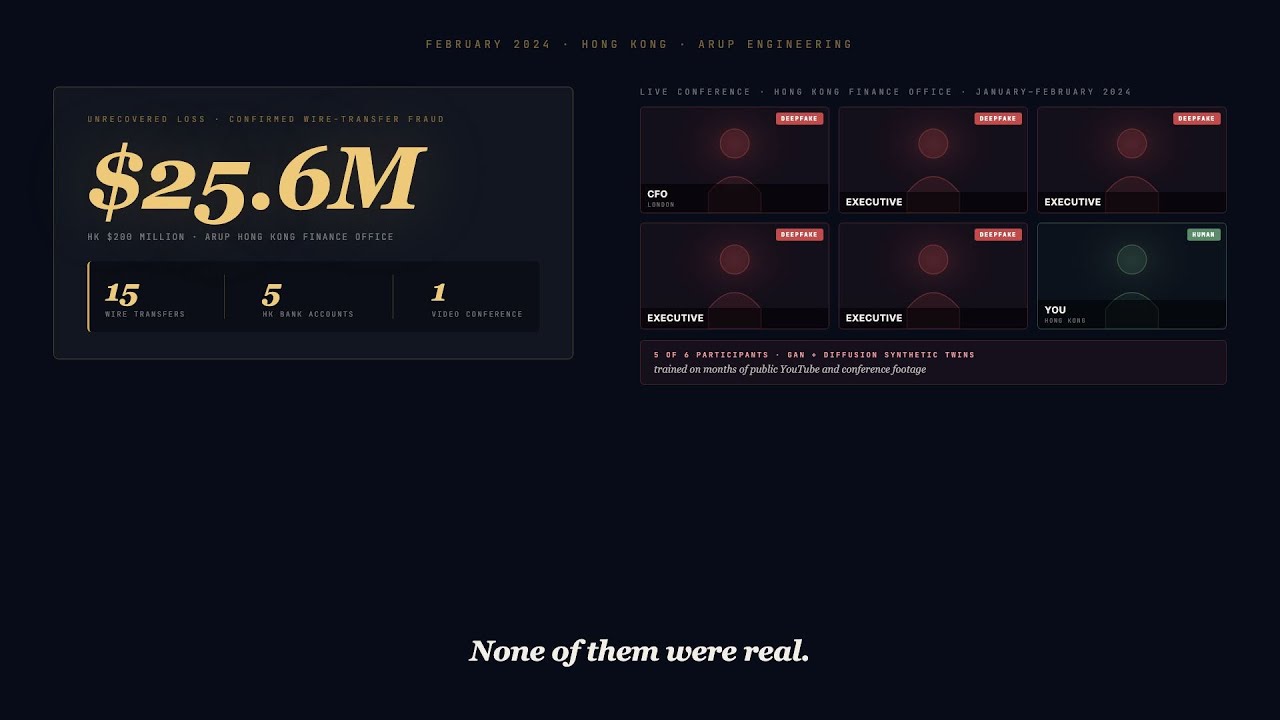
The modern enterprise is currently navigating a fundamental crisis of authenticity, characterized by the rapid weaponization of generative artificial intelligence against established protocols of corporate governance. In February 2024, the multinational engineering firm Arup became the focal point of this crisis when its Hong Kong office was defrauded of $25.6 million (HK 200 million) through one of the most sophisticated deepfake-enabled operations documented to date.1 This incident was not merely a failure of traditional cybersecurity, but a definitive proof-of-concept for "technology-enhanced social engineering"—a methodology that exploits human psychology and the inherent trust placed in visual and auditory cues.4 By utilizing high-fidelity AI to impersonate a Chief Financial Officer (CFO) and an entire suite of executives in a live video conference, the attackers successfully bypassed multi-factor authentication, internal financial controls, and human intuition.1
The Arup heist serves as a strategic inflection point for organizations worldwide. It demonstrates that the current reliance on "LLM wrappers"—thin software interfaces that connect business processes to public, third-party AI APIs—is fundamentally inadequate for the security and sovereignty requirements of the modern enterprise.7 As the cost and technical barriers to generating hyper-realistic synthetic media continue to plummet, the traditional "perimeter defense" model is collapsing.1 This report analyzes the forensic details of the Arup breach, the technical evolution of real-time deepfakes, and the architectural imperative for transitioning to Deep AI: the deployment of sovereign, private, and neuro-symbolic AI systems within the organization's own secure infrastructure.7
Forensic Reconstruction: Anatomy of the $25 Million Heist
The operation against Arup was a multi-phase campaign that prioritized reconnaissance and psychological manipulation over traditional network intrusion.1 The investigation confirms that Arup's digital infrastructure remained fully intact throughout the incident; there was no evidence of malware, credential theft, or unauthorized database access.4 Instead, the attackers compromised the firm's operational logic by manufacturing a reality that the target employee could not reasonably distinguish from the truth.4
Phase I: Reconnaissance and Material Harvesting
The effectiveness of the deepfakes used in the attack was predicated on high-quality training data.2 Attackers spent months harvesting publicly available video and audio footage of Arup executives, primarily from YouTube, conference presentations, and corporate meetings.2 This material allowed the perpetrators to train Generative Adversarial Networks (GANs) and neural voice synthesis models capable of replicating not just the likeness of the executives, but their specific speech patterns, intonations, and idiosyncratic micro-expressions.1 This degree of preparation allowed for the creation of what forensics experts call "high-fidelity synthetic twins," designed to withstand the scrutiny of colleagues in a professional setting.1
Phase II: The Spear-Phishing Hook and Narrative Establishment
The breach initiated in January 2024 with a spear-phishing email appearing to originate from the London-based CFO.1 The email requested assistance with a "confidential transaction," a narrative common in Business Email Compromise (BEC) scams but bolstered here by the professional tone and accurate internal context.2 While the employee in the Hong Kong finance department was initially skeptical of the email, the attackers leveraged a secondary, more powerful layer of social proof to neutralize this doubt.1
| Stage of Incident | Action Taken by Attacker | Technical / Psychological Mechanism |
|---|---|---|
| Initial Contact | Spoofed email from CFO regarding a "secret" transfer 1 | Authority leverage and urgency 2 |
| Escalation | Invitation to a multi-participant video conference 1 | Social proof and perceived transparency 4 |
| Verification | Appearance of multiple deepfaked senior executives 2 | Visualization of hierarchy to override skepticism 1 |
| Execution | Instruction to transfer funds to specific accounts 1 | Direct hierarchical command in a "live" setting 3 |
| Discovery | Post-transaction follow-up with UK headquarters 1 | Standard financial audit trail 2 |
Phase III: The Synthetic Video Conference
The defining moment of the Arup breach was the video call.1 Unlike previous deepfake scams that relied on a single voice clone or a low-resolution video clip, this attack featured a live, interactive environment with multiple AI-generated participants.2 The employee joined a conference where familiar faces—colleagues and superiors—appeared to be in a legitimate discussion.1 This environmental context is a form of "asymmetric warfare," where the attacker knows the organization's structure better than the employee knows the limits of technology.4
During the call, the deepfaked CFO ordered the employee to carry out 15 separate transfers totaling approximately $25.6 million.1 These funds were dispersed into five different Hong Kong-based bank accounts.1 The employee complied, convinced by the visual and auditory evidence of the meeting.1 The fraud was only discovered when the employee followed up with the real CFO's office in the UK, at which point the firm realized that no such meeting had taken place and no funds had been authorized.1
The Technical Evolution of Real-Time Generative Fraud
The Arup incident was made possible by a convergence of advanced AI methodologies that have moved from research laboratories into the hands of sophisticated cybercriminal organizations.1 Understanding the threat requires an analysis of the two primary types of models used: Generative Adversarial Networks (GANs) and Diffusion models.1
Generative Adversarial Networks (GANs) in Video Synthesis
GANs represent a breakthrough in the ability to generate realistic faces and voices.1 A GAN consists of two competing neural networks: the generator and the discriminator.1 The generator creates content using real images or videos as a reference point, while the discriminator attempts to detect if the content is AI-generated.1 Through millions of iterations, these models "train" each other, with the generator becoming increasingly proficient at creating imagery that the discriminator—and by extension, the human eye—cannot distinguish from reality.1 In the Arup case, GANs allowed for real-time "face swapping," where an attacker's webcam feed was intercepted and replaced frame-by-frame with a hyper-realistic mask of the CFO.11
Diffusion Models and Temporal Consistency
Diffusion models work by adding "noise" (random data) to an image and then training an AI to reverse the process, reconstructing a clear image from the noise.1 This approach excels at creating high-resolution, nuanced textures and lighting that GANs sometimes struggle with.1 When applied to video, diffusion models ensure "temporal consistency"—meaning the AI-generated face does not flicker or distort during movement.11 This consistency is critical for maintaining the illusion of reality during a live interaction, as human perception is highly sensitive to the subtle "glitches" associated with lower-tier deepfake technology.11
Injection Attacks: Bypassing the Physical Layer
A pivotal technical detail in the Arup incident is the use of "video injection" rather than simple "presentation attacks".15
- Presentation Attacks: An attacker holds a high-resolution screen (tablet or monitor) in front of a real webcam.15 These are often detectable through liveness checks that analyze depth, pixel-level reflections, and the presence of physical borders.15
- Injection Attacks: This method involves utilizing virtual camera software or man-in-the-middle (MITM) tactics to feed synthetic video packets directly into the conferencing software's data stream.10 The application (Zoom, Teams, etc.) treats this digital stream as if it were arriving from a physical hardware device.17
| Attack Type | Method of Delivery | Difficulty of Detection |
|---|---|---|
| Presentation (2D/3D) | Physical artifact (photo/mask/screen) 18 | Moderate; depth/texture anomalies often present 15 |
| Face Swapping (Real-time) | GAN/Diffusion software over live webcam 12 | High; requires temporal analysis 11 |
| Video Injection | Digital feed bypasses camera hardware 20 | Extreme; requires system-level integrity checks 17 |
| Neural Voice Cloning | Audio stream replaced with synthetic voice 2 | Very High; requires biometric spectrogram analysis 16 |
Research indicates that injection attacks targeting identity verification providers increased by 255% in 2023, while "face swap" attacks rose by 704%.24 This suggests that cybercriminals are moving away from easily detectable physical spoofs toward digital-level manipulations that neutralize traditional liveness checks.21
Why the "LLM Wrapper" Paradigm Fails the Enterprise
Many organizations, in their haste to adopt generative AI, have relied on "wrappers"—thin software layers built on top of public APIs like OpenAI's GPT-4 or Anthropic's Claude.7 While functional for low-stakes tasks, this model introduces systemic vulnerabilities that make incidents like the Arup breach more likely.7 Veriprajna argues that the era of the wrapper is incompatible with enterprise-grade security for three primary reasons: data egress, lack of contextual reasoning, and the "unembodied advisor" problem.7
The Security Theater of Public APIs
In a wrapper-based deployment, an organization's most sensitive data—financial spreadsheets, internal memos, and executive communications—must leave the corporate perimeter to be processed by a third-party cloud.7 Even if the provider promises not to train on the data, the presence of the data in an external environment creates a vulnerability to the US CLOUD Act, opaque sub-processor relationships, and potential model-based exfiltration.9 Furthermore, wrappers are highly susceptible to "prompt injection," where a user (or an attacker) can craft inputs that trick the model into ignoring its safety guardrails and performing unauthorized actions.8
The Contextual and Reliability Gap
LLMs are probabilistic, not deterministic.8 They predict the most likely "next token" based on statistical correlations in their training data, rather than a grounded understanding of corporate reality.8 This leads to the "Reliability Gap," where an AI agent might promise a discount, waive a fee, or interpret a policy in a way that is legally binding for the company but factually incorrect.8 In high-stakes environments, a wrapper lacks the intrinsic ability to verify its own outputs against the "ground truth" of the organization's proprietary databases.7
The "Unembodied Advisor" and Activity Cliffs
For industrial or engineering firms like Arup, the "Unembodied Advisor" limitation is particularly dangerous.25 A text-based LLM wrapper may generate plausible-sounding advice but lacks the integrated feedback loops to verify physical or biological safety.25 In medicinal chemistry or structural engineering, a minor change in a formula or a load-bearing calculation—an "activity cliff"—can lead to a disproportionately large change in outcome (e.g., from a safe compound to a lethal toxin).25 A wrapper, which operates on semantic distance rather than the laws of physics, is notoriously poor at identifying these critical deviations.25
Deep AI: Veriprajna's Framework for Sovereign Intelligence
Veriprajna positions itself not as a builder of wrappers, but as a provider of Deep AI solutions—architectures designed to restore sovereignty and reliability to the enterprise.7 This framework transitions from "AI-as-a-service" to "AI-as-infrastructure".7
Pillar I: Infrastructure Ownership and Private Enterprise LLMs
The foundation of Deep AI is the deployment of Private Enterprise LLMs within the organization's own Virtual Private Cloud (VPC) or on-premises Kubernetes clusters.7 Veriprajna deploys full inference stacks (using technologies like vLLM or TGI) directly onto hardware the client controls.7 This ensures that "sovereign intelligence" never leaves the perimeter, achieving immunity to international data transfer risks and third-party retention policies.9
Pillar II: Private RAG 2.0 with RBAC-Aware Retrieval
Deep AI builds a "semantic brain" for the company through Retrieval-Augmented Generation (RAG) that is natively integrated with internal security.7 Unlike generic RAG systems, Veriprajna's architecture is Role-Based Access Control (RBAC)-aware.7 If an employee does not have permission to view a specific document in SharePoint, the AI system will not retrieve it to answer their question.7 This prevents internal privilege escalation and data leakage through the AI interface.7
Pillar III: The Neuro-Symbolic "Sandwich" Architecture
To close the reliability gap, Veriprajna advocates for a "Neuro-Symbolic Sandwich".8 This design encases the creative neural network (the LLM) between two layers of deterministic, symbolic logic.8
- The Bottom Layer (Input Logic): Pre-processes user prompts to sanitize inputs and prevent injection attacks before they reach the model.8
- The Middle Layer (Neural Network): Provides the language understanding and reasoning capability.8
- The Top Layer (Symbolic Guard): Intercepts the model's intent and executes it through rigid, pre-defined functions (e.g., querying a SQL database or an ERP).8
This ensures that when an AI agent reports a price or an authorization status, it is retrieving a deterministic value from a database, not predicting a value based on token probability.8
| Feature | Public LLM Wrapper | Veriprajna Deep AI Solution |
|---|---|---|
| Data Residency | Shared public cloud; data egress 7 | Fully within Client VPC 7 |
| Reasoning Model | Purely Probabilistic 8 | Neuro-Symbolic (Neural + Deterministic) 8 |
| Security Context | General/Public data 7 | Private corpus; RBAC-aware 7 |
| Customization | Prompt Engineering only 7 | Full Fine-tuning (LoRA/CPT) 7 |
| Vulnerability | Susceptible to Prompt Injection 8 | Multi-layered Logic Guards 8 |
The New Multi-Factor Authentication: Biometrics and Behavioral Intelligence
The failure of the visual "check" in the Arup case necessitates a new paradigm for verifying identity in digital interactions.4 Veriprajna's approach incorporates multimodal signals that are significantly more difficult for current generative models to spoof in real-time.23
Physiological Signal Verification
High-end deepfake detection now includes the analysis of "heartbeat-induced" changes in facial color.14 Technologies like Intel's FakeCatcher monitor these micro-signals—unseen by the human eye—to verify that a participant is a live human being with functioning cardiovascular activity.23 In synthetic video, these signals are typically absent or temporally inconsistent with the visual movements.11
Behavioral Biometrics: The "Silent" Guardian
While a face can be swapped and a voice can be cloned, the neurobiological patterns of how an individual interacts with their technology remain unique and nearly impossible to forge.29
- Keystroke Dynamics: The speed, rhythm, and pressure of typing create a recognizable "cadence" unique to an individual.30
- Mouse and Touchscreen Behavior: The frequency and fluidity of mouse movements, or the specific swipe speed and pressure on a mobile device, build a behavioral profile that is difficult for bots or impersonators to mimic.29
- Cognitive Behavior: Behavioral biometrics can detect if a user is acting under duress or coercion, which often manifests as hesitation or deviations from normal navigation patterns.31
By building a behavioral baseline for senior executives, an organization can implement "continuous authentication" during video calls.31 If the "CFO" on a call begins asking for an unusual transaction while their typing or navigation behavior deviates from their historical profile, the system can automatically flag the interaction for manual review.29
Cryptographic Provenance and Content Credentials
Instead of merely detecting fakes, the enterprise must transition to verifying the authentic.35 The C2PA (Coalition for Content Provenance and Authenticity) standard allows for the embedding of cryptographic metadata at the moment of video capture.23 This creates a "tamper-evident" history of the media, documenting the device, time, and location of the source.35 If a video feed in a Microsoft Teams or Zoom call lacks these credentials, it can be treated with the same level of suspicion as an unsigned software package.35
Legal, Regulatory, and Governance Implications
The financial loss at Arup is the tip of the iceberg; the incident has far-reaching implications for corporate liability and the fiduciary duties of leadership.2
The Fiduciary Duty of the CIO and CTO
In the wake of deepfake-enabled fraud, CIOs and CTOs are increasingly held to a higher standard of care.38 As corporate officers, they have a fiduciary duty to identify "red flags" and implement "reasonable security procedures"—such as those mandated by the California Consumer Privacy Act (CCPA) or the EU AI Act.38 Failure to implement deepfake-aware controls could result in personal liability for officers if a company is sued by shareholders or clients for negligence.38
The "Impostor Rule" and Allocation of Loss
Judicial guidance on wire transfer fraud often follows the "Impostor Rule," which states that losses should be borne by the party in the best position to have prevented the fraud.41 In the Arup case, while the employee was deceived, the firm's failure to implement multi-channel verification for high-value transactions could be seen as the primary point of failure.4 Courts are increasingly finding employers negligent when they fail to warn employees about specific risks or fail to provide necessary technical safeguards.37
Compliance with International Standards
To mitigate these risks, organizations must align their operations with emerging global standards for biometric and AI security:
- ISO/IEC 30107-3: The international benchmark for Presentation Attack Detection (PAD).42 Certification at Level 2 or 3 demonstrates a system's resilience against advanced spoofs like silicone masks and AI deepfakes.15
- NIST AI Risk Management Framework (RMF): Provides a structured 4-step process—Govern, Map, Measure, Manage—to identify and mitigate AI-specific risks.39
- CEN/TS 18099: The first dedicated standard for detecting "Injection Attacks," which is critical for securing video conferencing streams.15
Strategic Roadmap for Enterprise Resilience (2025-2026)
The Arup incident was a failure of the "eyes and ears" as a form of authentication.4 To prevent a recurrence, Veriprajna recommends a multi-layered resilience strategy centered on defending people, processes, and the very concept of authenticity.4
Step 1: Establish a Culture of "Empowered Skepticism"
Organizations must shift from a "comply immediately" culture to a "verify first" mindset.4 This involves rewarding employees who challenge suspicious requests, even those appearing to come from senior leadership.4 Training should move beyond static phishing emails to include live, simulated deepfake attacks on video and audio platforms to demystify the technology for staff.4
Step 2: Implement Mandatory Out-of-Band Verification
Video conferencing can no longer be the "gold standard" for identity authentication in financial transactions.4 High-risk or high-value instructions must require independent, out-of-band confirmation:
- Direct Call: Verification through a pre-verified phone number or an encrypted messaging platform (e.g., Signal).4
- Pre-Agreed Verification Codes: Using a secondary, non-digital channel to share authentication keys.4
- Dual-Authorization: Requiring a second approver who was not a participant in the original video call.4
Step 3: Transition to Sovereign Deep AI Infrastructure
Enterprises must reclaim their data and intelligence from the public cloud.7 The transition to Private Enterprise LLMs within a client-controlled VPC ensures that sensitive context remains secure.7 This is not just a security measure; it is a competitive advantage, as it allows for the creation of bespoke model assets that belong unequivocally to the client.7
Step 4: Deploy Multi-Modal Liveness and Detection Tools
Integrate enterprise-grade deepfake detection into collaboration tools like Zoom and Microsoft Teams.10 These tools should analyze each frame and audio packet in real-time for signs of AI manipulation—such as asynchronous lip movements, inconsistent lighting, or the absence of physiological signals.12
Conclusion: The New Frontier of Trust
The Arup heist of February 2024 was a clarion call for the end of the "informal internal authentication" era.4 When the CFO's face and voice can be perfectly fabricated for $15 and 45 minutes of effort, the traditional signals of trust are broken.5 The future of enterprise resilience will depend on the ability to distinguish between a "synthetic twin" and a live human being through layers of biological, behavioral, and architectural defense.4
Veriprajna advocates for a departure from the fragile world of LLM wrappers and a transition into the robust, sovereign world of Deep AI.7 By combining infrastructure ownership, Neuro-Symbolic reliability, and behavioral intelligence, organizations can build an "Architecture of Trust" that is resilient to the escalating threat of generative fraud.7 The $25 million loss was a high price to pay for this lesson, but it provides the blueprint for the next generation of enterprise security: one where authenticity is verified by physics and logic, not just by sight and sound.4
| Resilience Component | Actionable Goal | Desired Outcome |
|---|---|---|
| People | Behavioral Training & Simulations 4 | Resistance to "Live" Social Engineering 4 |
| Process | Multi-channel Out-of-Band Confirmation 4 | Neutralization of Single-Point Failures 4 |
| Data | Private VPC-based LLMs & RAG 2.0 7 | Full Sovereignty and Data Privacy 7 |
| Technology | Real-time Liveness & Physiological Analysis 18 | Defeat of GANs and Injection Attacks 17 |
| Governance | Alignment with NIST AI RMF & ISO 30107 43 | Reduction of Regulatory and Fiduciary Risk 38 |
In the coming years, the ability to verify identity and intent in a synthetic world will be the defining requirement of the digital age.20 The Arup breach proves that the cost of inaction is no longer just a hypothetical risk, but a $25 million reality.1 Organizations that act now to implement sovereign Deep AI architectures will not only protect their capital but also secure their most valuable asset: the integrity of their communications and the trust of their stakeholders.4
Works cited
- Arup Deekfake Scam Forensic Analysis – Cyber - University of Hawai'i–West O'ahu, accessed February 9, 2026, https://westoahu.hawaii.edu/cyber/forensics-weekly-executive-summmaries/arup-deekfake-scam-forensic-analysis/
- Arup Deepfake: How An AI-Generated Deepfake Stole $25M, accessed February 9, 2026, https://purplesec.us/breach-report/arup-deepfake/
- Incident 634: Alleged Deepfake CFO Scam Reportedly Costs Multinational Engineering Firm Arup $25 Million, accessed February 9, 2026, https://cdn.lawreportgroup.com/acuris/files/ACR-New/AI%20Incidents%20%E2%80%A2%20Incident%20634_%20Alleged%20Deepfake%20CFO%20Scam%20Reportedly%20Costs%20Multinational%20Engineering%20Firm%20Arup%20%2425%20Million.pdf
- The Arup Deepfake Fraud - PRMIA, accessed February 9, 2026, https://prmia.org/common/Uploaded%20files/eCyber/PRMIA%20Case%20study%20-%20ARUP.pdf
- Cybercrime: Lessons learned from a $25m deepfake attack - The World Economic Forum, accessed February 9, 2026, https://www.weforum.org/stories/2025/02/deepfake-ai-cybercrime-arup/
- $25 Million Deepfake Scam: The Ultimate Con? - Trustpair, accessed February 9, 2026, https://trustpair.com/blog/25-million-deepfake-scam-the-ultimate-con/
- The Illusion of Control: Securing Enterprise AI with Private LLMs - Veriprajna, accessed February 9, 2026, https://Veriprajna.com/technical-whitepapers/enterprise-ai-security-private-llms
- The Authorized Signatory Problem: Why Enterprise AI Demands a Neuro-Symbolic "Sandwich" Architecture - Veriprajna, accessed February 9, 2026, https://Veriprajna.com/technical-whitepapers/authorized-signatory-problem-neuro-symbolic-ai
- The Illusion of Control: Shadow AI & Private Enterprise LLMs | Veriprajna, accessed February 9, 2026, https://Veriprajna.com/whitepapers/illusion-of-control-shadow-ai-private-enterprise-llms
- Deepsight: World's Most Accurate Deepfake Detection - Incode, accessed February 9, 2026, https://www.incode.com/platform/deepsight
- The Sentinel's Dilemma: An In-Depth Analysis of Real-Time Deepfake Detection Services in the Era of Generative AI Fraud | Uplatz Blog, accessed February 9, 2026, https://uplatz.com/blog/the-sentinels-dilemma-an-in-depth-analysis-of-real-time-deepfake-detection-services-in-the-era-of-generative-ai-fraud/
- Deepfake Video Call Security: How to Spot and Stop Scams, accessed February 9, 2026, https://www.adaptivesecurity.com/blog/deepfake-video-call-security-guide
- DeepFake Detection for Human Face Images and Videos: A Survey - Monash, accessed February 9, 2026, https://researchmgt.monash.edu/ws/portalfiles/portal/570474609/560518436_oa.pdf
- Securing Social Media Against Deepfakes using Identity, Behavioral, and Geometric Signatures - arXiv, accessed February 9, 2026, https://arxiv.org/pdf/2412.05487?
- Deepfake Presentation & Injection Attacks: Risks in ID Authentication, accessed February 9, 2026, https://risk.lexisnexis.com/global/en/insights-resources/article/deepfake-duo-presentation-injection-attacks
- Deepfake Detection: What is Phishing 3.0 and How Can You Prepare? - Ironscales, accessed February 9, 2026, https://ironscales.com/blog/deepfake-detection-what-is-phishing-3.0-and-how-can-you-prepare
- Virtual camera detection: Catching video injection attacks in remote biometric systems, accessed February 9, 2026, https://arxiv.org/html/2512.10653v1
- Liveness detection: protect yourself against fraud - Veridas, accessed February 9, 2026, https://veridas.com/en/liveness-detection/
- Facial Liveness Detection: How It Works & Why It Matters - Mitek Systems, accessed February 9, 2026, https://www.miteksystems.com/blog/facial-liveness-detection
- Unmasking Cybercrime: Strengthening Digital Identity Verification against Deepfakes - World Economic Forum, accessed February 9, 2026, https://reports.weforum.org/docs/WEF_Unmasking_Cybercrime_Strengthening_Digital_Identity_Verification_against_Deepfakes_2026.pdf
- Native Virtual Camera Attacks: The Invisible Threat to Remote Identity Verification | iProov, accessed February 9, 2026, https://www.iproov.com/blog/native-virtual-camera-attacks-invisible-threat-biometric-solution
- Cyber Risks Associated with Deepfakes - Monetary Authority of Singapore, accessed February 9, 2026, https://www.mas.gov.sg/-/media/mas-media-library/regulation/circulars/trpd/cyber-risks-associated-with-deepfakes.pdf
- What Tools Can Detect Deepfakes in Live Meetings? - Resemble AI, accessed February 9, 2026, https://www.resemble.ai/deepfake-detection-tools-live-video-calls/
- Deepfake Attacks: How they Work and How to Stop Them - Nametag, accessed February 9, 2026, https://getnametag.com/newsroom/deepfake-attacks-how-they-work-how-to-stop-them
- Structural AI Safety: Latent Space Governance in Bio-Design - Veriprajna, accessed February 9, 2026, https://Veriprajna.com/technical-whitepapers/bio-design-ai-safety-latent-space
- Cognitive Armor: Robustness Against Adversarial AI - Veriprajna, accessed February 9, 2026, https://Veriprajna.com/technical-whitepapers/adversarial-ai-defense-cognitive-armor
- How to Use Large Language Models (LLMs) with Enterprise and Sensitive Data, accessed February 9, 2026, https://www.startupsoft.com/llm-sensitive-data-best-practices-guide/
- What Is LLM (Large Language Model) Security? | Starter Guide - Palo Alto Networks, accessed February 9, 2026, https://www.paloaltonetworks.com/cyberpedia/what-is-llm-security
- What is Behavioral Biometrics - LexisNexis Risk Solutions, accessed February 9, 2026, https://risk.lexisnexis.com/insights-resources/article/what-is-behavioral-biometrics
- What is Behavioral Biometrics? - OneSpan, accessed February 9, 2026, https://www.onespan.com/topics/behavioral-biometrics
- Behavioral Biometrics: The Game-Changer in Fighting Synthetic Identity Fraud - Innovify, accessed February 9, 2026, https://innovify.com/insights/behavioral-biometrics-fraud-detection/
- What is Behavioral Biometrics? | IBM, accessed February 9, 2026, https://www.ibm.com/think/topics/behavioral-biometrics
- Continuous Behavioral Biometric Authentication for Secure Metaverse Workspaces in Digital Environments - MDPI, accessed February 9, 2026, https://www.mdpi.com/2079-8954/13/7/588
- What Is Behavioral Biometrics? - BioCatch, accessed February 9, 2026, https://www.biocatch.com/blog/what-is-behavioral-biometrics
- Unmasking the Fakes: How AI is Powering Deepfake Detection and Video Authentication | by Nunsi Shiaki | Rectlabs Inc | Medium, accessed February 9, 2026, https://medium.com/rectlabs/unmasking-the-fakes-how-ai-is-powering-deepfake-detection-and-video-authentication-999fe4a0f5ff
- NIST: Reducing Risks Posed by Synthetic Content An Overview of Technical Approaches to Digital Content Transparency - AI Governance Library, accessed February 9, 2026, https://www.aigl.blog/nist-reducing-risks-posed-by-synthetic-content-an-overview-of-technical-approaches-to-digital-content-transparency/
- Who Is Liable In A Workplace Deepfake Fraud Incident? - - Saunders Law, accessed February 9, 2026, https://www.saunders.co.uk/news/who-is-liable-in-a-workplace-deepfake-fraud-incident/
- Deepfakes: Why Legal Liability Now Lies with the CIO, accessed February 9, 2026, https://nationalcioreview.com/articles-insights/information-security/deepfakes-why-legal-liability-now-lies-with-the-cio/
- NIST AI RMF 2025 Updates: What You Need to Know About the Latest Framework Changes, accessed February 9, 2026, https://www.ispartnersllc.com/blog/nist-ai-rmf-2025-updates-what-you-need-to-know-about-the-latest-framework-changes/
- The State of Information Security Report 2025 | Resilience, Compliance & AI - ISMS.online, accessed February 9, 2026, https://www.isms.online/the-state-of-information-security-report-2025/
- Lawyer Liability for Wire Transfer Fraud - American Bar Association, accessed February 9, 2026, https://www.americanbar.org/groups/tort_trial_insurance_practice/resources/brief/2025-spring/lawyer-liability-wire-transfer-fraud/
- How to Choose a Liveness Solution That Actually Works? - Oz Forensics, accessed February 9, 2026, https://www.ozforensics.com/id/blog/articles/how-to-choose-a-liveness-solution-that-actually-works
- Biometric Security Guide : Understanding ISO/IEC 30107 Standards - Pacific Certifications, accessed February 9, 2026, https://blog.pacificcert.com/biometric-security-guide-understanding-iso-iec-30107/
- ISO/IEC 30107 (Biometric Presentation Attack Detection) - DuckDuckGoose AI, accessed February 9, 2026, https://www.duckduckgoose.ai/glossary/iso-iec-30107--biometric-presentation-attack-detection
- Identy.io Facial Biometric Technology Receives NIST ISO 30107-3 Level 2 PAD Certification with Perfect Score, accessed February 9, 2026, https://www.identy.io/identy-io-facial-biometric-technology-receives-nist-iso-30107-3-level-2-pad-certification-with-perfect-score/
- AI Risk Management Framework - NIST, accessed February 9, 2026, https://www.nist.gov/itl/ai-risk-management-framework
- US Expands Artificial Intelligence Guidance with NIST AI Risk Management Framework, accessed February 9, 2026, https://cdp.cooley.com/us-expands-artificial-intelligence-guidance-with-nist-ai-risk-management-framework/
- iProov Shows Deepfake Resilience Under NIST Digital ID Rules - AI-Tech Park, accessed February 9, 2026, https://ai-techpark.com/iproov-shows-deepfake-resilience-under-nist-digital-id-rules/
- Building Deepfake-Resilient Conferencing Procedures - Reality Defender, accessed February 9, 2026, https://www.realitydefender.com/insights/building-deepfake-resilient-conferencing-procedures
- Deepfake Doppelgangers: Scammers Hijack Zoom Calls To Drain Bitcoin Wallets, accessed February 9, 2026, https://cyberpress.org/deepfake-zoom-scams-drain-wallets/
- Deepfake Attacks Hit Two-Thirds of Businesses - Infosecurity Magazine, accessed February 9, 2026, https://www.infosecurity-magazine.com/news/deepfake-attacks-hit-twothirds-of/
Prefer a visual, interactive experience?
Explore the key findings, stats, and architecture of this paper in an interactive format with navigable sections and data visualizations.
Frequently Asked Questions
How did attackers use deepfakes to steal $25.6 million from Arup?
In February 2024, attackers spent months harvesting publicly available video from YouTube, conferences, and corporate meetings to train GANs capable of replicating executives' likenesses, speech patterns, and micro-expressions as 'high-fidelity synthetic twins.' After a spear-phishing email from the fake CFO raised initial skepticism, the employee was invited to a multi-participant video conference featuring deepfaked versions of multiple senior executives in a live, interactive discussion. Convinced by seeing familiar faces and hearing familiar voices, the employee executed 15 separate transfers totaling $25.6 million to five Hong Kong bank accounts. The fraud was discovered only through post-transaction follow-up with the real UK CFO.
Why did traditional cybersecurity fail to prevent the Arup deepfake breach?
Arup's digital infrastructure remained fully intact throughout the incident with no evidence of malware, credential theft, or unauthorized database access. The attack was purely cognitive, exploiting human trust in visual and auditory cues through 'technology-enhanced social engineering.' Traditional perimeter defenses, firewalls, and multi-factor authentication are designed to prevent network intrusion, not to authenticate the identity of participants in a video call. The attackers compromised the firm's operational logic by manufacturing a reality indistinguishable from truth, demonstrating that the enterprise perimeter is now cognitive rather than network-based.
What is multi-factor cognitive authentication and how does it defend against deepfake attacks?
Multi-factor cognitive authentication extends beyond traditional audiovisual trust by introducing verification channels that deepfakes cannot replicate. This includes out-of-band identity confirmation through separate secure channels, real-time synthetic media detection analyzing video streams for GAN artifacts and temporal inconsistencies, challenge-response protocols requiring spontaneous actions that deepfake models cannot predict, and neuro-symbolic verification layers that cross-reference transaction requests against organizational policies and approval hierarchies. This layered approach ensures that even if visual and voice authentication are defeated, the transaction still requires independent cognitive verification.
Also Published On
Build Your AI with Confidence.
Partner with a team that has deep experience in building the next generation of enterprise AI. Let us help you design, build, and deploy an AI strategy you can trust.
Veriprajna Deep Tech Consultancy specializes in building safety-critical AI systems for healthcare, finance, and regulatory domains. Our architectures are validated against established protocols with comprehensive compliance documentation.