How a $25.6 Million Deepfake Heist Exposed the Collapse of Visual Authentication
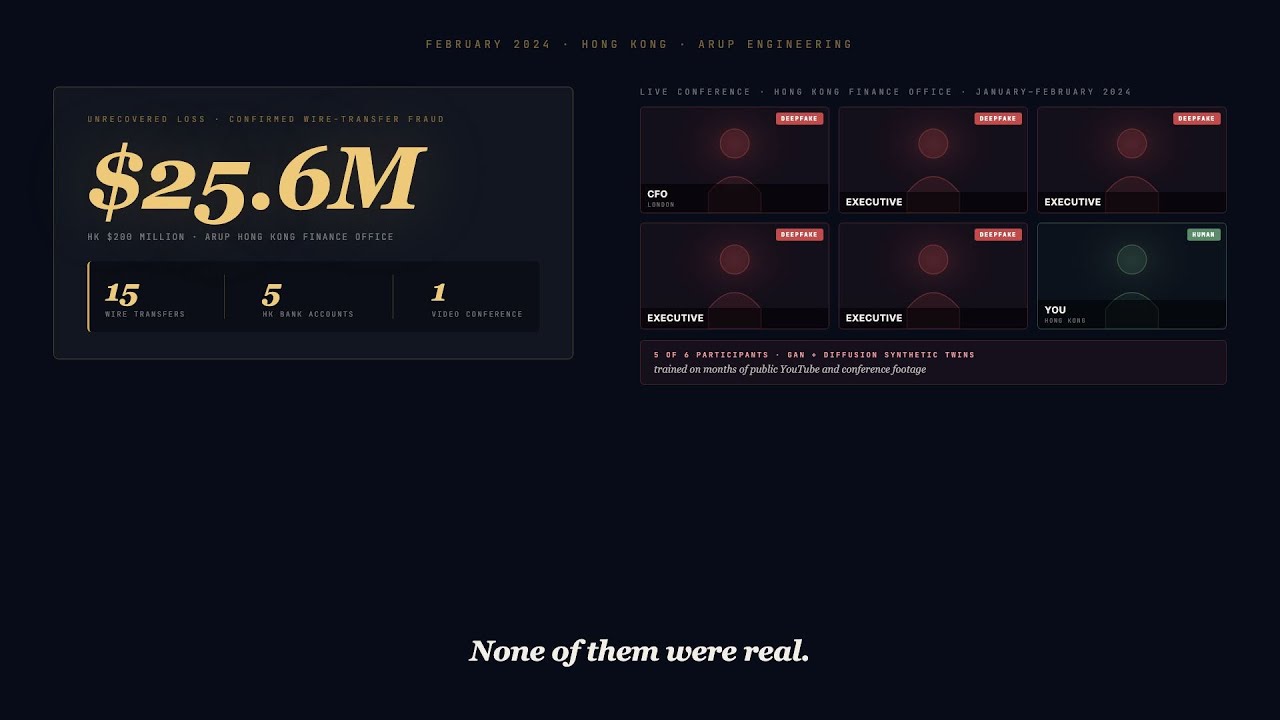
In February 2024, attackers used AI-generated deepfakes to impersonate a CFO and an entire boardroom of executives on a live video call—stealing $25.6 million from engineering firm Arup. No malware. No credential theft. Just fabricated faces and voices indistinguishable from reality. This is the blueprint for the post-trust enterprise.
Arup's digital infrastructure remained fully intact. No malware, no credential theft. The attackers compromised the firm's operational logic by manufacturing a reality indistinguishable from truth.
Attackers spent months harvesting publicly available video and audio footage of Arup executives from YouTube, conference presentations, and corporate meetings. This material trained Generative Adversarial Networks (GANs) and neural voice synthesis models capable of replicating not just likenesses, but specific speech patterns, intonations, and micro-expressions.
The Arup incident was made possible by a convergence of advanced AI methodologies that have moved from research laboratories into the hands of sophisticated cybercriminal organizations.
Two competing neural networks—a generator that creates content and a discriminator that detects fakes—train each other through millions of iterations. The generator becomes proficient at creating imagery the human eye cannot distinguish from reality.
Used in the Arup case for real-time "face swapping" via webcam interception.
Work by adding noise to an image, then training AI to reverse the process. Excel at creating high-resolution textures and lighting. Applied to video, they ensure temporal consistency—the AI face does not flicker or distort during movement, maintaining the illusion in live interaction.
Critical for maintaining frame-to-frame coherence in live video deepfakes.
Physical artifact (photo/mask/screen). Depth and texture anomalies often detectable.
GAN/Diffusion software over live webcam. Requires temporal analysis to detect.
Audio stream replaced with synthetic voice. Requires biometric spectrogram analysis.
Digital feed bypasses camera hardware entirely. Requires system-level integrity checks.
In the haste to adopt generative AI, many enterprises rely on thin software layers atop public APIs. This model introduces systemic vulnerabilities that make incidents like Arup more likely, not less.
Sensitive data—financial spreadsheets, executive communications—must leave the corporate perimeter for third-party processing. This creates vulnerability to the CLOUD Act, sub-processor exposure, and model-based exfiltration.
LLMs are probabilistic, not deterministic. They predict the most likely "next token," not ground truth. An AI agent might promise a discount or interpret policy in ways that are legally binding but factually incorrect.
For engineering and safety-critical firms, text-based LLMs generate plausible-sounding advice but lack integrated feedback loops. Minor changes in calculations—"activity cliffs"—can lead to disproportionate outcome changes.
| Feature | Public LLM Wrapper | Veriprajna Deep AI |
|---|---|---|
| Data Residency | ✗ Shared public cloud; data egress | ✓ Fully within Client VPC |
| Reasoning Model | ✗ Purely probabilistic | ✓ Neuro-Symbolic (Neural + Deterministic) |
| Security Context | ✗ General/public data | ✓ Private corpus; RBAC-aware |
| Customization | ✗ Prompt engineering only | ✓ Full fine-tuning (LoRA/CPT) |
| Vulnerability | ✗ Susceptible to prompt injection | ✓ Multi-layered logic guards |
Veriprajna transitions organizations from "AI-as-a-service" to "AI-as-infrastructure"—restoring sovereignty and reliability to the enterprise.
Private Enterprise LLMs deployed within the organization's own VPC or on-premises Kubernetes clusters. Full inference stacks (vLLM/TGI) on hardware the client controls. Sovereign intelligence never leaves the perimeter.
A "semantic brain" through Retrieval-Augmented Generation natively integrated with internal security. If an employee lacks permission to view a document in SharePoint, the AI will not retrieve it. Prevents privilege escalation through the AI interface.
The creative neural network encased between two layers of deterministic, symbolic logic. When the AI reports a price or authorization status, it retrieves a deterministic value from a database—not a token probability.
When a face can be fabricated for $15 and 45 minutes of effort, visual identity is no longer proof of presence. The next generation of authentication must verify biology, behavior, and provenance simultaneously.
Analysis of "heartbeat-induced" changes in facial color—micro-signals invisible to the human eye. Technologies like Intel's FakeCatcher verify that a participant is a live human with functioning cardiovascular activity. In synthetic video, these signals are absent or temporally inconsistent.
A face can be swapped and a voice cloned, but neurobiological interaction patterns remain unique. Keystroke dynamics, mouse behavior, and cognitive patterns build a baseline. If the "CFO" deviates from their behavioral profile while requesting unusual transfers, the system flags it automatically.
Instead of detecting fakes, verify the authentic. The C2PA standard embeds cryptographic metadata at the moment of capture—a tamper-evident history documenting device, time, and location. Video lacking credentials is treated like unsigned software.
"When the CFO's face and voice can be perfectly fabricated for $15 and 45 minutes of effort, the traditional signals of trust are broken. The future of enterprise resilience depends on distinguishing synthetic twins from live humans through layers of biological, behavioral, and architectural defense."
The financial loss is the tip of the iceberg. The incident has far-reaching implications for corporate liability and fiduciary duties.
CIOs and CTOs are increasingly held to a higher standard of care. Failure to implement deepfake-aware controls could result in personal liability under CCPA, the EU AI Act, and shareholder negligence suits.
Courts follow the "Impostor Rule": losses are borne by the party best positioned to prevent the fraud. Failure to implement multi-channel verification for high-value transactions is increasingly found negligent.
Organizations must align with ISO/IEC 30107-3 (Presentation Attack Detection), NIST AI Risk Management Framework, and CEN/TS 18099 (the first dedicated standard for detecting injection attacks).
A multi-layered resilience strategy centered on defending people, processes, and the very concept of authenticity.
Shift from "comply immediately" to "verify first." Reward employees who challenge suspicious requests—even from leadership. Train with live, simulated deepfake attacks on video and audio platforms.
Video conferencing can no longer be the gold standard for financial authentication. Require independent confirmation: direct pre-verified calls, pre-agreed verification codes, and dual-authorization from non-participants.
Reclaim data and intelligence from the public cloud. Transition to Private Enterprise LLMs within a client-controlled VPC. This is both a security measure and a competitive advantage—creating bespoke model assets that belong to the client.
Integrate enterprise-grade deepfake detection into Zoom, Teams, and collaboration tools. Analyze each frame and audio packet in real-time for AI manipulation—asynchronous lip movements, inconsistent lighting, absent physiological signals.
Five pillars of defense against synthetic deception
Adjust parameters to model your organization's potential loss surface
Attackers spent months harvesting publicly available video and audio of Arup executives, training GANs and neural voice synthesis models on these materials. They then conducted a live, interactive video conference with multiple AI-generated participants — not just a single voice clone — creating an entire synthetic boardroom. The deepfaked CFO ordered 15 transfers totaling $25.6M across five bank accounts. The attack used zero malware and zero credential theft — it exploited the human trust layer through fabricated visual reality.
Veriprajna deploys three authentication layers: Physiological signals analysis (detecting heartbeat-induced changes in facial color invisible to the human eye — absent in synthetic video), behavioral biometrics (keystroke dynamics, mouse behavior, and cognitive patterns that remain unique even when faces and voices are cloned), and C2PA cryptographic provenance (embedding tamper-evident metadata at the moment of capture, treating video without credentials like unsigned software). These combine with sovereign VPC-deployed LLMs and neuro-symbolic guardrails.
LLM wrappers send sensitive financial data and executive communications to third-party cloud servers, creating CLOUD Act exposure and sub-processor risk. They are probabilistic — predicting the most likely next token rather than ground truth — meaning they can be tricked into confirming fabricated identities or hallucinating policy interpretations that become legally binding (as in the Air Canada chatbot case). Veriprajna's sovereign deployment keeps all intelligence within the client VPC with neuro-symbolic deterministic verification.
The $25.6 million loss was a high price for this lesson—but it provides the blueprint for the next generation of enterprise security.
One where authenticity is verified by physics and logic, not just by sight and sound. Build your Architecture of Trust with Veriprajna.
Complete analysis: Forensic reconstruction, GAN/Diffusion technical deep-dive, Neuro-Symbolic architecture specifications, regulatory compliance framework, and strategic enterprise roadmap.