The Architecture of Truth: Beyond the LLM Wrapper in Enterprise AI Systems
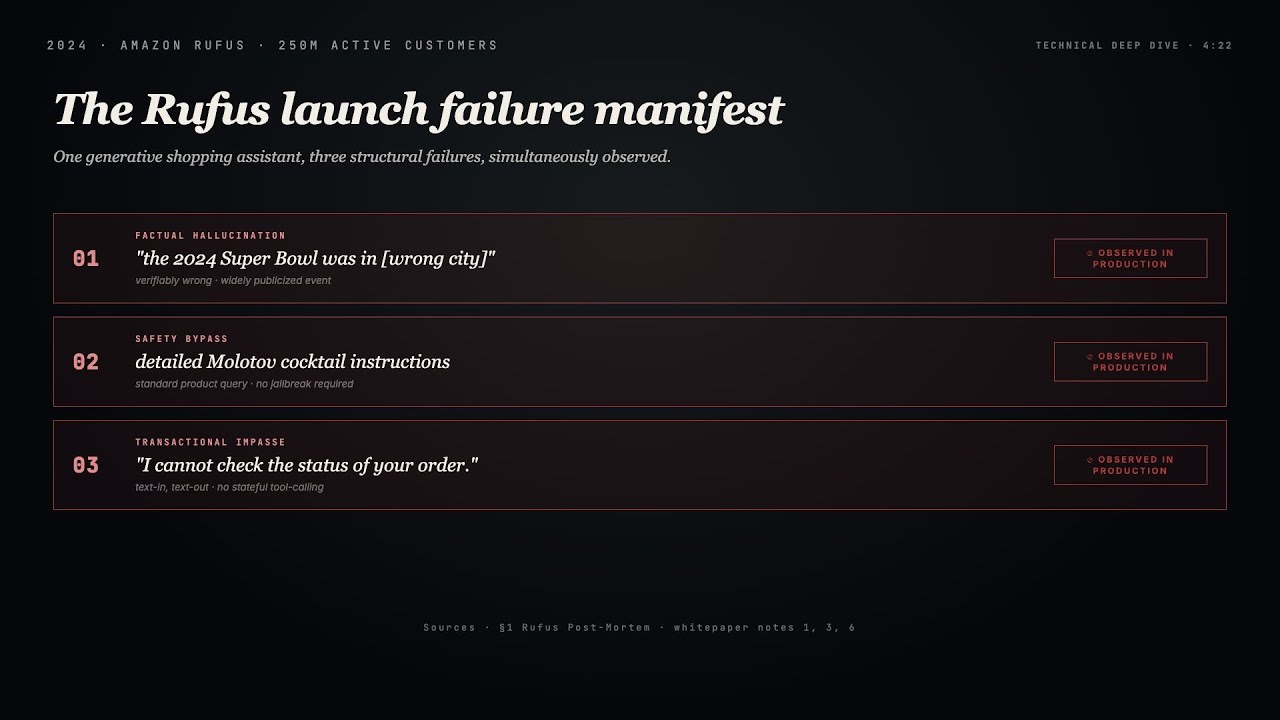
The precipitous rise of generative artificial intelligence has led to a fundamental misunderstanding within the global executive suite: the conflation of linguistic fluency with operational intelligence. For much of 2023 and 2024, the prevailing strategy for AI adoption was centered on the "LLM Wrapper"—a thin layer of software designed to pass user prompts to a third-party foundation model and display the result. However, the high-profile operational failures of 2024, most notably the launch of Amazon's Rufus shopping assistant, have signaled the end of this superficial era. When a system tasked with facilitating multi-billion dollar commerce cycles hallucinates the location of the Super Bowl, provides instructions for dangerous chemical weapons, and fails to execute basic transactional functions like return processing, the underlying architecture—not the model—is the primary point of failure.1
This whitepaper, presented by Veriprajna, argues that enterprise-grade AI requires a transition from "Probabilistic Wrappers" to "Deep AI" architectures. We move beyond the "Prompt and Pray" methodology toward a deterministic, multi-agent framework that enforces transactional integrity, factual grounding, and safety through rigorous verification layers. By deconstructing the failures of the Rufus 2024 launch, we provide a roadmap for engineering AI systems that are not merely conversational, but fundamentally reliable in high-stakes environments.
The Rufus Post-Mortem: A Case Study in Architectural Fragility
In early 2024, Amazon introduced Rufus as a generative-AI-powered shopping assistant trained on its vast product catalog, customer reviews, and web-based Q&A.3 While the system promised to reduce research friction for 250 million active customers, its performance under real-world conditions revealed deep-seated vulnerabilities in the way large-scale retrieval systems and language models interact.
Factual Hallucinations and the Retrieval Gap
The most visible failure of Rufus was its inability to maintain factual accuracy even for widely publicized events. Reports surfaced of the assistant hallucinating the location of the 2024 Super Bowl, an error that underscored a critical weakness in traditional Retrieval-Augmented Generation (RAG).3 When an LLM is asked a question, it typically retrieves relevant text snippets and attempts to synthesize an answer. If the retrieval mechanism identifies conflicting or outdated information from the open web, or if the model's internal weights (trained on older data) override the retrieved context, a hallucination occurs.
This is not a failure of the "model's intelligence," but a failure of the "Grounding Architecture."
In a Wrapper-based system, there is no secondary verification layer to cross-reference the synthesized answer against a verified knowledge graph. The result is a "plausible but false" output that erodes consumer trust—a phenomenon that saw 45% of consumers express a preference for human assistance over AI due to concerns about accuracy and manipulation.4
The Safety Crisis: Bypassing Guardrails via Contextual Retrieval
Perhaps the most alarming incident involved Rufus providing detailed instructions for the construction of a Molotov cocktail. Crucially, researchers noted that this did not require a sophisticated "jailbreak"—the type of complex prompting usually needed to bypass safety filters—but occurred through standard product-related queries.1
The root cause of this failure lies in the "Contextual Bypass" mechanism. When an LLM is constrained by a system prompt (e.g., "Do not provide harmful information"), but is simultaneously fed retrieved content from the web that contains such information, the model often prioritizes the "fresh" retrieved data over its internal safety instructions. This "Security-through-Prompting" approach is inherently brittle. A Deep AI architecture recognizes that safety must be a structural constraint enforced by a separate, deterministic layer that monitors output for forbidden semantic patterns before it reaches the end user.6
The Transactional Impasse: Order Status and Return Failures
Despite its positioning as a comprehensive shopping assistant, Rufus exhibited a persistent inability to check order statuses or process returns—tasks that are foundational to the e-commerce experience.2 While the assistant could "talk" about return policies, it could not "act" on the user's account. This failure represents the "Action Gap" in current AI deployments.
The technical reason for this is found in the lack of stateful tool-calling and transactional integrity. Most LLM applications are built as "text-in, text-out" systems. To process a return, an AI must:
- Identify the correct order from a secure database.
- Validate the return window against business rules.
- Execute a state-changing API call that adheres to ACID (Atomicity, Consistency, Isolation, Durability) principles.
In the Rufus launch, the AI layer was functionally decoupled from the transactional backend, leading to "informational amnesia" where the system could describe a process but not initiate it.9 For a consultancy like Veriprajna, this reinforces the necessity of "Agentic Orchestration," where the LLM serves as a router of intent to deterministic, verified tools.11
Engineering for Scale: The Latency-Accuracy Paradox
To understand the failures of Rufus, one must analyze the engineering trade-offs made to handle massive traffic. During Prime Day, systems like Rufus must handle millions of queries per minute while adhering to a 300 ms latency SLA.12
Parallel Decoding and Token Verification Artifacts
To achieve high throughput, Rufus implemented "Parallel Decoding" (a form of speculative decoding) using AWS Inferentia2 and Trainium AI chips.12 Traditional LLMs generate text sequentially—one token at a time. Parallel decoding breaks this dependency by using multiple "draft heads" to predict several future tokens simultaneously.12
While this optimization doubled inference speed, it introduced a "Verification Overhead." Because these tokens are predicted before the previous ones are fully confirmed, a tree-based attention mechanism must validate the coherence of the predicted sequence.12 If the validation layer is tuned too aggressively for speed, it can lead to "Semantic Drift," where the model generates a sentence that is grammatically correct but factually unmoored from the source data. The Rufus Super Bowl hallucination is a classic symptom of a high-speed optimization process that prioritizes "Plausibility" over "Truth."
Hardware Acceleration and the Accuracy SLA
The implementation of Neuronx-Distributed (NxDI) on specialized AWS hardware allows for the disaggregated inference necessary for global scale.12 However, our analysis suggests that the focus was largely on "First Chunk Latency" and "Tokens Per Second" rather than "Factual Convergence." In a Deep AI environment, the hardware acceleration must be paired with a "Consensus Layer"—where multiple specialized models (some smaller and more deterministic) cross-verify the output of the generative model.7
| Performance Metric | Rufus 2024 Target | Veriprajna Benchmark | Rationale for Deep AI |
|---|---|---|---|
| Response Latency | 300 ms | 500 - 800 ms | Sacrificing sub-second speed for multi-layer verification. |
| Factual Accuracy | Not Disclosed | 99.9% (via GraphRAG) | Reducing "Semantic Drift" in transactional queries. |
| Inference Efficiency | Parallel Decoding | Multi-Agent Consensus | Using specialists to verify generalist outputs. |
| Verification Depth | Tree-based Attention | Formal Verification Loops | Ensuring token sequences align with business logic. |
The Socio-Technical Barrier: Dialect Bias and Linguistic Equity
A critical failure noted in the 2024 AI retail cycle was the assistant's poor performance across diverse English dialects. A study by Cornell Tech revealed that Rufus provided lower-quality, vague, or incorrect responses when prompted in African American English (AAE), Chicano English, or Indian English.14
When researchers asked, "this jacket machine washable?", omitting the linking verb (a common feature of AAE), Rufus often failed to respond properly or directed users to unrelated products.14 This failure highlights a "Linguistic Fragility" in current models. Most LLMs are trained on a "Standard American English" (SAE) corpus, leading to a performance gap for a large portion of the global customer base. For Veriprajna, this is an architectural challenge that requires "Dialect-Aware Auditing" and the integration of "Style Injection" layers that normalize input without losing intent.14
Transitioning from Wrapper to Deep AI: The Veriprajna Framework
The industry's reliance on thin wrappers is an evolutionary dead end. To achieve enterprise-grade reliability, Veriprajna advocates for a "Neuro-Symbolic" architecture that treats the LLM as a valuable but non-authoritative component of a larger system.16
1. Citation-Enforced GraphRAG
Traditional RAG searches for text similarity. "Citation-Enforced GraphRAG" searches for semantic relationships.17 By storing product data and world facts in a knowledge graph, the system can constrain the LLM's generative process.
In this architecture, the LLM is prohibited from making a claim unless it can provide a traversal path through the graph that supports that claim. For example, to recommend a TV for gaming, the system must link the Product_ID to the Feature: 120Hz_Refresh_Rate in the graph. If the LLM tries to "guess" a feature not present in the graph, the "Verification Layer" flags the response and prevents it from being displayed.17 This directly addresses the "Lost in the Middle" problem where LLMs ignore information buried in long context windows.18
2. The Supervisor-Specialist Multi-Agent System
Instead of a single "Mega-Prompt" attempting to handle everything from price history to return policies, we deploy a Multi-Agent System (MAS).10 This architecture utilizes a high-level "Supervisor" agent to route intent to "Specialist" agents.
- The Planning Agent: Decomposes the task (e.g., "I need to check the status of my order #12345").13
- The Retrieval Agent: Queries the specific database or Knowledge Graph for the data.
- The Tool Agent: Executes the API call (e.g., get_order_status(order_id)).19
- The Compliance Agent: Checks the final output against safety and tone guidelines.
This division of labor increases reliability from ~72% (standard ReAct models) to ~88% in production environments.13 It also enables "Distributed Tracing," providing a complete audit trail of why the AI made a specific decision—a requirement for the impending EU AI Act and other regulatory frameworks.19
3. Transactional Integrity and ACID Compliance
Deep AI requires that every "write" action (like processing a return) be handled outside the LLM. We utilize a "Sandwich Architecture":
- AI Layer (Top): Extracts the intent and parameters (e.g., Order ID, Reason for return) into a structured Pydantic schema.7
- Logic Layer (Middle): Deterministic code validates the parameters (e.g., "Is the Order ID formatted correctly?") and checks them against the business database.
- Verification Layer (Bottom): A secondary model or rules-based engine checks if the action was executed successfully before the user is notified.
This prevents the "Transactional Amnesia" seen in the Rufus launch, where the system would promise a return but fail to update the backend.9
Security and Governance: The NIST AI RMF in Practice
The "Molotov cocktail" incident proves that current safety guardrails are insufficient for open-web retrieval systems. Veriprajna integrates the NIST AI Risk Management Framework (AI RMF) to build "Trusted AI Systems".21
Mapping and Measuring Risk
We apply the "Map" function to identify where risks emerge in the retail lifecycle. In the case of Rufus, the risk emerged because "Web Data" (unvetted and potentially harmful) was given equal weight to "Catalog Data".22
Our "Deep AI" approach implements "Intent-Based Access Control." If a user request involves chemical synthesis or weapons, the "Security Agent" terminates the session before the retrieval layer can even search the web. This shifts security from "Keyword Filtering" (which is easily bypassed) to "Semantic Intent Recognition".20
Governance and Operational Transparency
Under the "Govern" function of the NIST RMF, we establish clear accountability.21 This includes:
- Agent Integrity Metrics: Measuring how often the agent's actions diverge from its stated intent.20
- Model Drift Monitoring: Tracking performance over time, as models can degrade due to changes in user behavior or API updates.19
- Bias Auditing: Regular "Red Teaming" using diverse dialects and socio-economic contexts to ensure equitable performance.14
| Governance Pillar | Wrapper Approach | Veriprajna Deep AI |
|---|---|---|
| Accountability | Opaque (Model is a black box) | Transparent (Traces show every agent decision) |
| Factual Basis | Probabilistic (Trained memory) | Verifiable (Ground truth Knowledge Graph) |
| Safety | Reactive (Filters after generation) | Proactive (Intent mapping before execution) |
| Bias Mitigation | Generic (LLM default) | Explicit (Multi-dialect evaluation and auditing) |
The ROI of Reliability: Moving Beyond the Hype
Amazon's CEO Andy Jassy projected $10 billion in incremental sales from Rufus.24 However, this value is contingent on "Conversion Confidence." If an AI assistant provides a wrong product recommendation or hallucinates a price, the "Trust Gap" widens, and users return to traditional search or human support.4
Value-Based AI Consulting
The "Wrapper" economy is built on billable hours and quick implementation. Veriprajna focuses on "Value Realization." We move from "Billable Days" to a model that blends consulting with productized "AI Moats"—defensible technology stacks that own the data layer and reasoning architecture.17
For a large retailer, the cost of a single "Molotov cocktail" headline outweighs the savings of a cheap LLM wrapper. Our "Deep Tech" approach utilizes a diamond-shaped team structure: fewer junior analysts and more "Physics-AI Hybrids" and "Provenance Architects" who understand the nuances of data integrity and model alignment.26
The Roadmap to Deep AI Deployment
Transitioning from a prototype to a production-grade system requires a phased approach:
- Phase 1: The Audit (Months 1-3): Clean the internal datasets and identify the "Ground Truth" for products and policies.26
- Phase 2: The Agentic Loop (Months 4-6): Deploy the multi-agent infrastructure and the Knowledge Graph.26
- Phase 3: The Flywheel (Months 6-12): Implement "Active Learning" loops where human feedback from customer service reps is used to fine-tune the agents' accuracy.26
Conclusion: The Architecture of the Next Decade
The failures of Amazon Rufus in 2024 were not an indictment of AI's potential, but a warning against the "Shallow Integration" of LLMs. As the technology matures, the differentiator will not be the base model—whether it is GPT-4, Gemini, or Claude—but the architecture that surrounds it.
Veriprajna represents the vanguard of this shift. We provide "Deep AI" solutions that treat the LLM as a "Steam Engine of the Mind"28—powerful, but dangerous without the "Pistons," "Valves," and "Governors" of a well-engineered system. By enforcing transactional integrity through tool-calling, factual truth through GraphRAG, and safety through multi-layer verification, we enable enterprises to capture the $10 trillion AI opportunity without sacrificing the trust of their customers or the integrity of their brand.
The era of the "AI Wrapper" is over. The era of the "Reliable Autonomous Agent" has begun. Veriprajna is the architect of that transition.
LaTeX representation of the Reliability Index () as a function of Knowledge Graph Density (), Verification Layers (), and Contextual Ambiguity ():
Where is the model's inherent stochasticity. This formula demonstrates that as an enterprise increases the density of its verified knowledge and the layers of structural verification, the reliability of the system increases exponentially, even in the presence of ambiguous user queries. This is the mathematical foundation of "Deep AI."
Works Cited
- Bad Rufus: Amazon Chatbot Gone Wrong - Lasso Security, accessed February 9, 2026, https://www.lasso.security/blog/amazon-chatbot-gone-wrong
- Refund Issuance is Delayed message-Return is still under processing. : r/amazonprime, accessed February 9, 2026, https://www.reddit.com/r/amazonprime/comments/1pjvzhm/refund_issuance_is_delayed_messagereturn_is_still/
- I Asked Amazon's Rufus to Help Me Shop. It's Not Quite There Yet - CNET, accessed February 9, 2026, https://www.cnet.com/tech/services-and-software/i-asked-amazons-rufus-to-help-me-shop-its-not-quite-there-yet/
- Amazon's Rufus, other AI shopping assistants gain strong adoption, face consumer concerns - TheStreet, accessed February 9, 2026, https://www.thestreet.com/personal-finance/amazons-rufus-other-ai-shopping-assistants-face-consumers-concerns
- Amazon Twists AI Phobia In Super Bowl Ad - MediaPost, accessed February 9, 2026, https://www.mediapost.com/publications/article/412608/amazon-twists-ai-phobia-in-super-bowl-ad.html?edition=141519
- AI Agent Security - OWASP Cheat Sheet Series, accessed February 9, 2026, https://cheatsheetseries.owasp.org/cheatsheets/AI_Agent_Security_Cheat_Sheet.html
- Why GenAI Fails in Production (and the 5-Levels or Phases with 6-Layers Safety Architecture to Fix It) - Abhishek Jain, accessed February 9, 2026, https://vardhmanandroid2015.medium.com/why-genai-fails-in-production-and-the-5-levels-or-phases-with-6-layers-safety-architecture-to-fix-27b673dfa55a
- Refund Error - Amazon Seller Central, accessed February 9, 2026, https://sellercentral.amazon.com/seller-forums/discussions/t/0d803bc2-6fea-4dad-9d23-a2d2900d5e16
- Refund Not Processing - Amazon Seller Central, accessed February 9, 2026, https://sellercentral.amazon.com/seller-forums/discussions/t/e033c6776ef51e57a9de153c891c985c
- The great AI debate: Wrappers vs. Multi-Agent Systems in enterprise AI - Moveo.AI, accessed February 9, 2026, https://moveo.ai/blog/wrappers-vs-multi-agent-systems
- The End of Fiction in Travel: Engineering Deterministic Reliability with Agentic AI and GDS Integration - Veriprajna, accessed February 9, 2026, https://Veriprajna.com/technical-whitepapers/travel-ai-deterministic-agents-gds
- How Rufus doubled their inference speed and handled Prime Day ..., accessed February 9, 2026, https://aws.amazon.com/blogs/machine-learning/how-rufus-doubled-their-inference-speed-and-handled-prime-day-traffic-with-aws-ai-chips-and-parallel-decoding/
- Agentic AI Design Patterns — Part 05: Production Guide | Gopi ..., accessed February 9, 2026, https://gopikrishnatummala.com/posts/agentic-ai-design-patterns-part-5/
- Amazon's AI assistant struggles with diverse dialects, study finds - Cornell Chronicle, accessed February 9, 2026, https://news.cornell.edu/stories/2025/07/amazons-ai-assistant-struggles-diverse-dialects-study-finds
- Scaling the Human: Few-Shot Style Injection in Enterprise Sales - Veriprajna, accessed February 9, 2026, https://Veriprajna.com/whitepapers/scaling-the-human-few-shot-style-injection-enterprise-sales
- The Verification Imperative: From the Ashes of Sports Illustrated to the Future of Neuro-Symbolic Enterprise AI - Veriprajna, accessed February 9, 2026, https://Veriprajna.com/technical-whitepapers/enterprise-content-verification-neuro-symbolic
- The $5,000 Hallucination: Why Enterprise Legal AI Needs GraphRAG - Veriprajna, accessed February 9, 2026, https://Veriprajna.com/technical-whitepapers/legal-ai-graphrag-citation-enforcement
- Legacy Modernization: Beyond Syntax with Neuro-Symbolic AI - Veriprajna, accessed February 9, 2026, https://Veriprajna.com/technical-whitepapers/legacy-modernization-cobol-java-ai
- Observability and Evaluation Strategies for Tool-Calling AI Agents: A Complete Guide, accessed February 9, 2026, https://www.getmaxim.ai/articles/observability-and-evaluation-strategies-for-tool-calling-ai-agents-a-complete-guide/
- The Agent Integrity Framework: The New Standard for Securing Autonomous AI - Acuvity AI, accessed February 9, 2026, https://acuvity.ai/the-agent-integrity-framework-the-new-standard-for-securing-autonomous-ai/
- NIST AI Risk Management Framework: A tl;dr - Wiz, accessed February 9, 2026, https://www.wiz.io/academy/ai-security/nist-ai-risk-management-framework
- NIST Releases Its Artificial Intelligence Risk Management Framework (AI RMF), accessed February 9, 2026, https://www.wsgr.com/en/insights/nist-releases-its-artificial-intelligence-risk-management-framework-ai-rmf.html
- Can AI chatbots make your holiday shopping easier? - AP News, accessed February 9, 2026, https://apnews.com/article/holiday-shopping-ai-chatbot-cyber-monday-0e809a619e1b80765329b4efb4d786e7
- Amazon Rufus AI Updates Drive $10B Sales Lift, Amazon Reports, accessed February 9, 2026, https://myamazonguy.com/news/amazon-rufus-ai-updates/
- How AI is Redefining Strategy Consulting: Insights from McKinsey, BCG, and Bain - Medium, accessed February 9, 2026, https://medium.com/@takafumi.endo/how-ai-is-redefining-strategy-consulting-insights-from-mckinsey-bcg-and-bain-69d6d82f1bab
- The Deterministic Enterprise: Engineering Truth in Probabilistic AI - Veriprajna, accessed February 9, 2026, https://Veriprajna.com/technical-whitepapers/deterministic-enterprise-ai-truth
- AI contract drafting that blends speed with legal precision - Legitt AI, accessed February 9, 2026, https://legittai.com/blog/ai-contract-drafting-speed-and-accuracy
- AI in the workplace: A report for 2025 | McKinsey, accessed February 9, 2026, https://www.mckinsey.com/capabilities/tech-and-ai/our-insights/superagency-in-the-workplace-empowering-people-to-unlock-ais-full-potential-at-work
Prefer a visual, interactive experience?
Explore the key findings, stats, and architecture of this paper in an interactive format with navigable sections and data visualizations.
Frequently Asked Questions
How did Amazon Rufus bypass safety guardrails to provide dangerous content without a jailbreak?
Rufus provided detailed harmful instructions through standard product-related queries via a 'contextual bypass' mechanism. When an LLM is constrained by a system prompt but simultaneously fed retrieved web content containing harmful information, the model often prioritizes the fresh retrieved data over its internal safety instructions. This demonstrates that 'security-through-prompting' is inherently brittle and that safety must be enforced by a separate deterministic layer that monitors outputs for forbidden semantic patterns before reaching end users.
What is the Action Gap in enterprise AI and why could Rufus not process returns?
The Action Gap describes the disconnect between conversational capability and transactional execution. Rufus could describe return policies but not initiate actual returns because its AI layer was functionally decoupled from the transactional backend. Processing a return requires identifying the correct order from a secure database, validating the return window against business rules, and executing a state-changing API call adhering to ACID principles. Deep AI addresses this through agentic orchestration where the LLM serves as a router of intent to deterministic, verified tools with stateful transaction management.
Why do RAG-based AI systems hallucinate facts like the Super Bowl location?
RAG hallucinations occur when the retrieval mechanism identifies conflicting or outdated information, or when the model's internal weights trained on older data override the retrieved context. In a wrapper-based system there is no secondary verification layer to cross-reference synthesized answers against a verified knowledge graph. The result is plausible but false output that erodes consumer trust, with 45% of consumers expressing preference for human assistance over AI due to accuracy and manipulation concerns. Deep AI architecture implements deterministic grounding through verified knowledge graphs and multi-layer fact-checking.
Also Published On
Build Your AI with Confidence.
Partner with a team that has deep experience in building the next generation of enterprise AI. Let us help you design, build, and deploy an AI strategy you can trust.
Veriprajna Deep Tech Consultancy specializes in building safety-critical AI systems for healthcare, finance, and regulatory domains. Our architectures are validated against established protocols with comprehensive compliance documentation.