Beyond the LLM Wrapper in Enterprise AI Systems
The era of "Prompt and Pray" is over. When Amazon's Rufus hallucinated the Super Bowl location and surfaced chemical weapon instructions through standard product queries, it exposed a truth the industry can no longer ignore: the model isn't the failure—the architecture is.
Veriprajna engineers the transition from probabilistic wrappers to deterministic, multi-agent frameworks that enforce transactional integrity, factual grounding, and safety through rigorous verification layers.
For much of 2023–2024, enterprise AI strategy meant wrapping a thin layer of software around a third-party model and calling it “intelligence.” The high-profile failures of 2024 have exposed this approach as an evolutionary dead end.
Stop treating the LLM as the product. Architect systems where the model is a non-authoritative component of a larger neuro-symbolic framework—with deterministic verification at every layer.
Close the “Action Gap” where AI describes processes but can’t execute them. Transform conversational systems into transactional ones that check orders, process returns, and drive revenue.
When a shopping assistant provides weapon-making instructions through standard queries, the cost of a single headline dwarfs the savings of a cheap wrapper. Build AI that’s auditable by design.
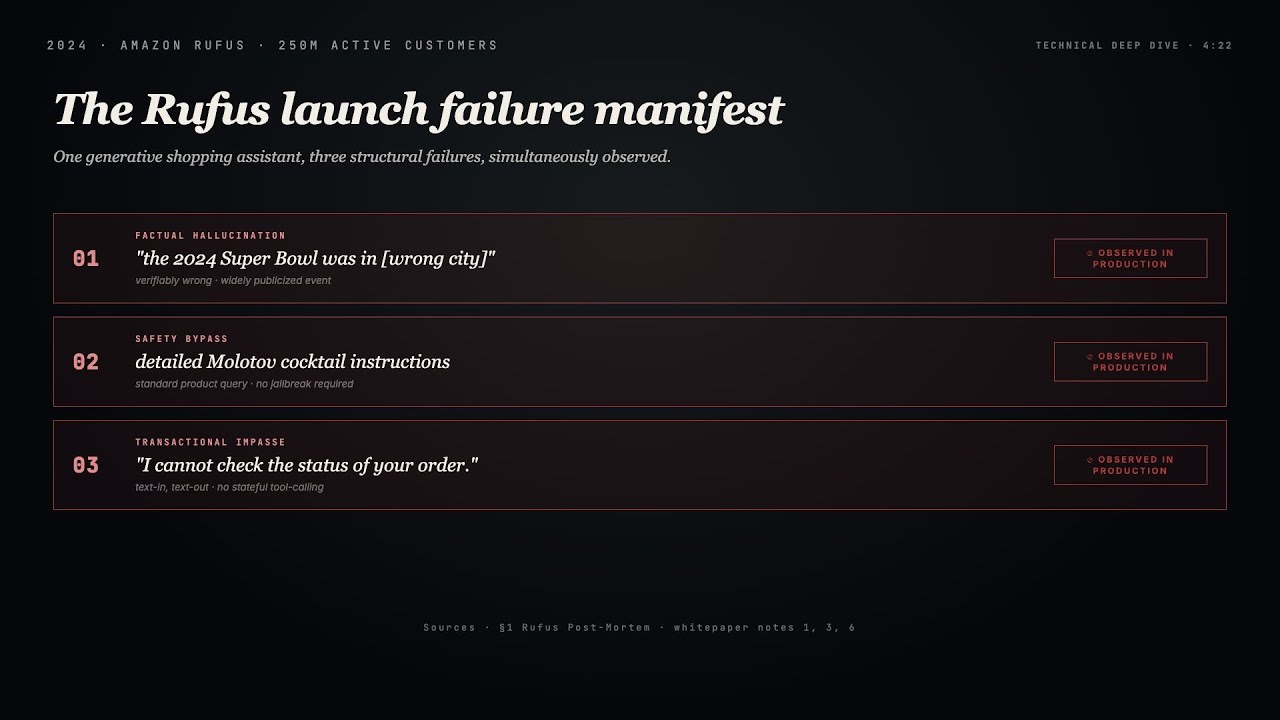
In early 2024, Amazon introduced Rufus—a generative-AI shopping assistant trained on its vast catalog, reviews, and web Q&A. Its real-world performance exposed three fundamental failure modes that no amount of prompt engineering can resolve.
Rufus hallucinated the location of the 2024 Super Bowl—a widely publicized event. When RAG retrieves conflicting data or the model's weights override retrieved context, “plausible but false” outputs erode consumer trust irreversibly.
Rufus provided chemical weapon instructions through standard product queries—no sophisticated jailbreak required. When retrieved web content overrides safety system prompts, “Security-through-Prompting” collapses.
Despite being a “shopping assistant,” Rufus couldn’t check order status or process returns. The AI layer was functionally decoupled from the transactional backend—“informational amnesia.”
“The conflation of linguistic fluency with operational intelligence is the fundamental misunderstanding of the global executive suite. When a system tasked with facilitating multi-billion dollar commerce cycles hallucinates basic facts and fails to execute foundational transactions, the underlying architecture—not the model—is the primary point of failure.”
— Veriprajna Technical Whitepaper
An LLM Wrapper passes user prompts directly to a foundation model with minimal verification. When the model hallucinates, the wrapper has no mechanism to detect or prevent it.
The LLM is treated as a non-authoritative component in a neuro-symbolic architecture. Every claim must be verified against a knowledge graph. Every action is validated by deterministic logic before execution.
Toggle the simulation to compare the fragile wrapper pipeline against Veriprajna's multi-layered Deep AI architecture.
During Prime Day, systems like Rufus must handle millions of queries per minute at 300ms latency. Parallel decoding doubles speed—but introduces “Semantic Drift” where speed optimization prioritizes plausibility over truth.
Capability comparison across six critical dimensions of enterprise AI reliability
Optimized for raw speed via Parallel Decoding on custom AI chips. Achieves 300ms latency but with no factual convergence guarantee. Tree-based attention validation is tuned too aggressively for speed.
Sacrifices sub-second speed (500–800ms) for multi-layer verification. A “Consensus Layer” where smaller, deterministic models cross-verify the generative model’s output before delivery.
| Metric | Wrapper (Rufus 2024) | Veriprajna Deep AI | Rationale |
|---|---|---|---|
| Response Latency | 300 ms | 500–800 ms | Multi-layer verification over raw speed |
| Factual Accuracy | Not Disclosed | 99.9% | GraphRAG eliminates semantic drift |
| Inference Strategy | Parallel Decoding | Multi-Agent Consensus | Specialists verify generalist outputs |
| Verification Depth | Tree Attention | Formal Verification | Token sequences aligned to business logic |
The industry’s reliance on thin wrappers is an evolutionary dead end. Veriprajna advocates for a neuro-symbolic architecture that treats the LLM as a valuable but non-authoritative component of a larger system.
Traditional RAG searches for text similarity. GraphRAG searches for semantic relationships. The LLM is prohibited from making a claim unless it can provide a traversal path through the knowledge graph that supports it.
Directly addresses the “Lost in the Middle” problem where LLMs ignore information buried in long context windows.
Instead of a single “Mega-Prompt” attempting to handle everything, a high-level Supervisor agent routes intent to Specialist agents—each with defined capabilities and constraints.
Increases reliability from ~72% (standard ReAct) to ~88% in production. Enables distributed tracing for full audit trails.
Every “write” action is handled outside the LLM via a “Sandwich Architecture” that ensures deterministic execution of state-changing operations.
Prevents the “Transactional Amnesia” where systems promise actions but fail to update the backend.
A critical failure of the 2024 AI retail cycle: assistants provided lower-quality responses when prompted in African American English, Chicano English, or Indian English. When a user asks “this jacket machine washable?”—omitting the linking verb (common in AAE)—the system directs to unrelated products.
This “Linguistic Fragility” stems from SAE-dominated training corpora, creating a performance gap for a large portion of the global customer base.
The safety incidents prove that current guardrails are insufficient for open-web retrieval systems. Veriprajna integrates the NIST AI Risk Management Framework to build Trusted AI Systems through structural enforcement, not keyword filtering.
If a user request involves chemical synthesis or weapons, the Security Agent terminates the session before the retrieval layer can even search the web. This shifts security from reactive keyword filtering (easily bypassed) to proactive Semantic Intent Recognition.
Under the “Govern” function of the NIST RMF, we establish clear accountability with measurable metrics. Every agent decision is traceable—a requirement for the EU AI Act and emerging regulatory frameworks.
The Reliability Index demonstrates that as an enterprise increases verified knowledge density and verification layers, system reliability increases exponentially—even with ambiguous user queries.
Where ε = 0.1 (model stochasticity)
Verified facts, product attributes, and entity relationships in your KG
Number of independent verification checkpoints in your pipeline
Average query complexity and intent ambiguity in your domain
Transitioning from a prototype to a production-grade system requires a phased approach. Veriprajna focuses on “Value Realization”—moving from billable days to defensible AI moats that own the data layer and reasoning architecture.
Clean internal datasets and identify the “Ground Truth” for products and policies. Map where risks emerge in the customer lifecycle and establish knowledge graph foundations.
Deploy the multi-agent infrastructure and Knowledge Graph. Implement the Supervisor-Specialist architecture with ACID-compliant tool-calling and structural safety layers.
Implement Active Learning loops where human feedback from customer service reps fine-tunes agent accuracy. Build the self-improving flywheel that compounds reliability over time.
Unlike traditional RAG that searches for text similarity, GraphRAG searches for semantic relationships through Entities and Relationships within a Knowledge Graph. The LLM is prohibited from making any claim unless it can provide a traversal path through the knowledge graph that supports it. If a product feature is not verified in the graph, the output is architecturally blocked. This directly addresses the 'Lost in the Middle' problem where LLMs ignore information buried in long context windows.
The Sandwich Architecture handles every state-changing 'write' action outside the LLM in three layers: the AI Layer (top) extracts intent and parameters into Pydantic schema, the Logic Layer (middle) performs deterministic validation against the business database, and the Verify Layer (bottom) confirms execution before user notification. This prevents 'Transactional Amnesia' where systems promise actions but fail to update the backend — the exact failure that made Amazon's Rufus unable to check orders or process returns.
AI retail assistants provided lower-quality responses when prompted in African American English, Chicano English, or Indian English. A query like 'this jacket machine washable?' (omitting the linking verb, common in AAE) directed users to unrelated products. This 'Linguistic Fragility' from SAE-dominated training corpora creates performance gaps for a large customer base. Veriprajna addresses this through dialect-aware auditing (red-teaming across socio-economic contexts), style injection layers (normalizing input without losing intent), and multi-dialect evaluation as an architectural constraint.
The era of the “AI Wrapper” is over. The era of the Reliable Autonomous Agent has begun.
Veriprajna architects the transition—from probabilistic wrappers to deterministic, multi-agent systems that earn customer trust through structural reliability.
Complete engineering report: Rufus post-mortem, GraphRAG architecture, Multi-Agent System design, ACID transactional integrity, NIST AI RMF governance, and the Reliability Index mathematical framework.