The Sovereign Audio Architecture: Transitioning Enterprise Media from Black Box Liability to Deterministic, Source-Separated Licensing Engines
Executive Summary: The Crisis of Generative Probability and the Veriprajna Standard
The intersection of artificial intelligence and creative intellectual property has reached a critical inflection point, precipitating a crisis that threatens the operational stability of enterprise media. The prevailing paradigm of "Black Box" generative audio—exemplified by platforms such as Suno and Udio—relies on probabilistic diffusion and transformer models trained on massive, indiscriminately scraped datasets of copyrighted material. 1 While these tools offer impressive capabilities for consumer-grade amusement, they represent a latent existential risk for commercial entities. The ongoing litigation initiated by the Recording Industry Association of America (RIAA) against these platforms is not merely a legal skirmish; it is the precursor to a systemic correction in how machine-generated media is valued, audited, and insured. 2
For an enterprise, the risks of deploying Black Box generation are threefold: legal non-compliance due to copyright infringement in training data, lack of authenticable provenance (data lineage), and the inability to secure exclusive intellectual property (IP) rights over the output. 4 A model that cannot articulate the source of its creative decisions is a model that cannot be trusted in a commercial supply chain. When a prompt generates audio resembling a specific artist, it is not "creating" in the legal sense; it is often retrieving and reconstructing statistical artifacts from unauthorized ingestions of that artist’s catalog, creating a "ticking legal time bomb" for any downstream user. 6
Veriprajna posits a fundamental architectural shift: moving from Probabilistic Hallucination (generating from scratch using opaque models) to Deterministic Transformation (modifying licensed assets using transparent, modular engines). Our methodology utilizes Deep Source Separation (DSS) to deconstruct licensed audio into constituent stems, followed by Retrieval-Based Voice Conversion (RVC) to transform timbre and texture using strictly licensed voice models. 8 This approach ensures that every artifact in the signal chain—from the composition to the vocal timbre—has a verifiable, licensable origin. We do not simply "wrap" existing APIs; we engineer sovereign audio pipelines that guarantee 100% generated audio with 0% copyright risk, backed by cryptographic provenance standards such as C2PA. 11
This whitepaper serves as a technical and strategic blueprint for the post-Black Box era. It dissects the mechanics of the current legal crisis, explicates the physics of deep source separation and voice conversion, and outlines the architecture of the Veriprajna Source-Separated Licensing Engine. By abandoning the "prompt-and-pray" methodology of generative wrappers in favor of precision engineering, Veriprajna offers a pathway to sustainable, compliant, and legally defensible AI adoption for the modern media enterprise.
1. The Legal Minefield: Anatomy of the "Black Box" Crisis
The allure of generative AI—instantaneous creation of high-fidelity audio—masks a precarious legal foundation. To understand the necessity of the Veriprajna architecture, one must first dissect the failure modes of current "generative music" wrappers. The crisis is not merely about one or two lawsuits; it is about the fundamental incompatibility between "scrape-all" training methodologies and the strict liability frameworks of enterprise copyright law.
1.1 The "Fruit of the Poisonous Tree" in AI Training
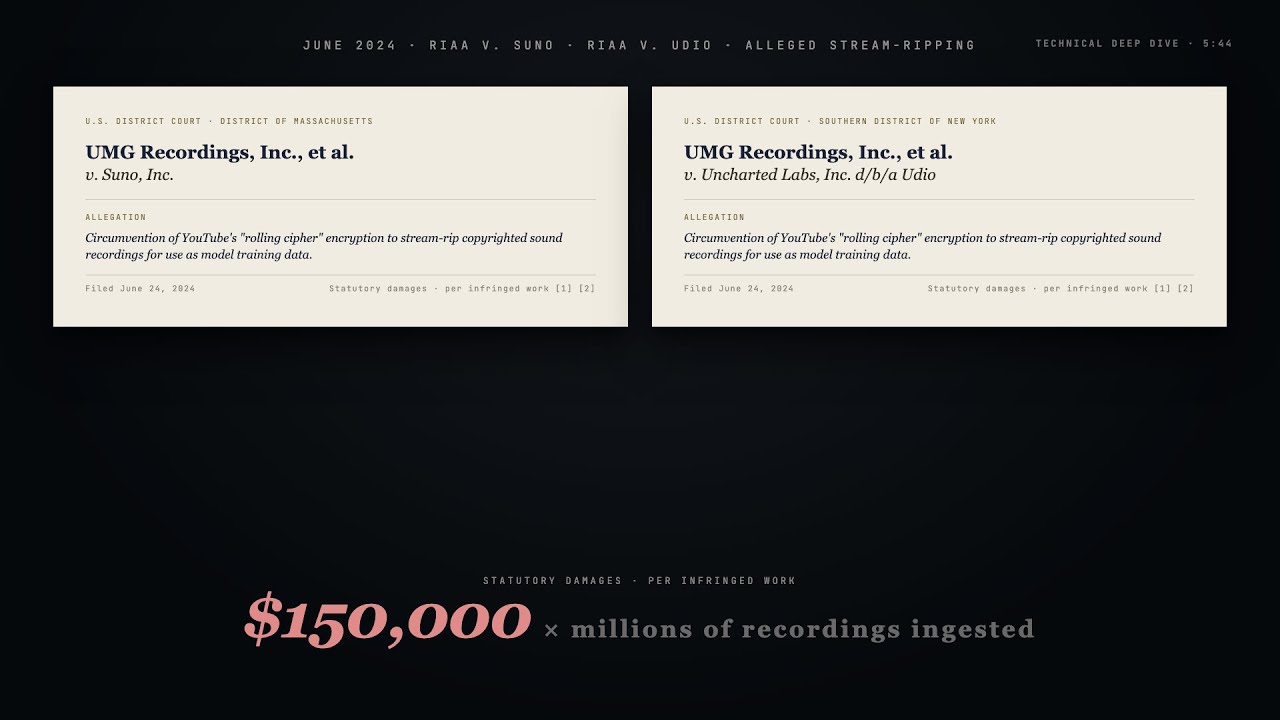
The central legal theory underpinning the lawsuits against Suno and Udio is the doctrine of "fruit of the poisonous tree"—if the source (training data) is tainted (illegal), the output is compromised. The RIAA’s amended complaint alleges that these companies engaged in "stream-ripping" on a massive scale, circumventing YouTube’s "rolling cipher" encryption to ingest decades of copyrighted sound recordings. 1 This is not incidental ingestion; it is alleged to be a deliberate architectural choice to capture the "expressive features" of specific artists. 6
1.1.1 The Mechanics of Stream-Ripping and Model Ingestion
The lawsuits detail a process where scraping bots bypass technological protection measures (TPMs) to download high-fidelity audio. Stream-ripping is the act of creating a downloadable file from content that is licensed only for streaming. YouTube, like many streaming services, employs a "rolling cipher"—a periodically changing algorithm designed to encrypt the video URL and prevent unauthorized downloading. 1 The RIAA alleges that Suno and Udio developed or utilized sophisticated code specifically designed to circumvent these rolling ciphers, allowing them to download millions of copyrighted sound recordings directly to their servers. 1
This raw audio is then converted into spectrograms (visual representations of audio frequencies over time) or latent vector embeddings. The model "learns" by analyzing the statistical relationships between these vectors. For instance, it learns that a specific frequency modulation in the 2kHz–4kHz range correlates with "Mariah Carey’s vocal style". 1 This process creates a "latent space"—a high-dimensional mathematical map of all music the model has seen.
When a user prompts the model to "Make a song that sounds like Mariah Carey," the model does not generate audio ex nihilo . It traverses its latent space to locate the vector clusters associated with that request—clusters formed exclusively from the unauthorized ingestion of her discography. 6 The resulting output is a mathematical reconstruction of the training data. In the eyes of the RIAA and copyright scholars, this constitutes two distinct forms of infringement:
1. Direct Infringement : The initial copying of files to train the model. This occurs the moment the audio is downloaded and stored on the developer's servers, regardless of whether a user ever generates a song. 2
2. Derivative Infringement : The output competes directly with the original works, serving as a market substitute. If the AI output is substantially similar to the protected works it was trained on, it may be considered an infringing derivative work. 6
1.1.2 The Failure of the "Fair Use" Defense
Suno and Udio have relied on the defense of "fair use" (17 U.S.C. § 107), arguing that training is "transformative" because it creates a new functional tool (a music generator) rather than simply reproducing the music. 1 They equate their models to a student listening to the radio to learn how to write songs.
However, this defense is collapsing under scrutiny for enterprise applications. Fair use assessments rely heavily on four factors, the most critical being the "effect on the potential market." When an AI model generates tracks that "cheapen and drown out" the genuine recordings it was trained on, the market harm is direct and quantifiable. 6 The RIAA argues that these models are not merely "learning" in the human sense; they are "copying" in the mechanical sense, ingesting the exact expressive qualities of the recording to produce a competing product. The commercial nature of these platforms—charging users up to $24/month to generate music that serves as a substitute for licensed tracks—weighs heavily against a fair use finding. 1
For a media company, this means utilizing these tools is equivalent to "renting a lawsuit." If a court rules that the models are infringing, any content generated by them could be subject to takedown notices, impoundment, or damages, regardless of the user's intent. The "Black Box" nature of the model—where the user cannot know if a specific generated melody was lifted from a protected work—makes due diligence impossible. 4
1.2 The Indemnification Mirage and the "Walled Garden" Trap
A critical oversight in enterprise adoption of consumer AI tools is the reliance on Terms of Service (ToS) indemnification. Enterprise users often assume that if they pay for a "Pro" subscription, the vendor absorbs the legal risk. The reality is starkly different.
1.2.1 Analyzing the Indemnification Gap
A review of the ToS for major generative audio platforms reveals significant gaps. While some platforms claim to own the output or transfer ownership to the user, they often include clauses that disclaim liability for third-party IP infringement if the user's prompt "causes" the infringement. 14 For example, prompting "in the style of [Artist]" effectively shifts the liability burden back to the user. The platform argues: "We provided the tool; you provided the infringing instruction."
This leaves the enterprise user exposed. If a prompt results in a sound-alike track that triggers a lawsuit from an artist's estate, the platform may refuse to indemnify the user, citing the user's "misuse" of the service. 14 Furthermore, many of these startups have limited capital reserves compared to the statutory damages demanded by the RIAA (up to $150,000 per work). Even if they offer indemnification, they may not be solvent enough to honor it in a mass-tort scenario.
1.2.2 The "Walled Garden" Settlement Trap
The recent settlement between Universal Music Group (UMG) and Udio illustrates another critical risk: the "Walled Garden" trap. As part of the settlement, Udio agreed to create a new, licensed platform. However, for the legacy content generated on the original, "poisoned" model, the settlement imposes severe restrictions. Users are reportedly barred from downloading or exporting their creations; the content is locked within the Udio platform, creating a "walled garden" where the user has no control over the asset. 17
This negates the primary value of generative AI for enterprise: the ability to own and exploit the asset across the media value chain. An ad agency cannot use a jingle if it is trapped on the Udio website and cannot be downloaded for broadcast. The settlement effectively renders all previous work done on the platform commercially useless for off-platform applications. 17 This highlights the danger of building enterprise workflows on legally unstable foundations; when the foundation cracks, the assets are lost.
1.2.3 The Risk of "Black Box" Copyright
Copyright offices in the US and EU have increasingly taken the stance that purely AI-generated works are not copyrightable. To claim copyright, there must be "sufficient human authorship". 20
● Prompting is not enough : Courts have indicated that typing "make a jazz song" does not constitute authorship. It is considered an "idea," not an "expression."
● The Ownership Void : If an enterprise uses a Black Box generator to create a jingle, they likely do not own the copyright. A competitor could rip that jingle and use it in their own ad with impunity.
Veriprajna’s approach resolves this by ensuring human control over the composition and arrangement via source separation and specific voice conversion, creating a chain of human-directed interventions that support a stronger claim to copyright protection for the final arrangement. By starting with a human-created "guide track" and using AI only as a transformation tool, we maintain the "human in the loop" requirement essential for copyright registration. 7
2. The Physics of "Black Box" Generation: Why Hallucination is Inevitable
To understand why Black Box models infringe, we must understand their underlying physics. The current generation of audio AI relies primarily on Diffusion Models and Transformers . These architectures are fundamentally probabilistic, designed to recreate the statistical distributions of their training data.
2.1 The Spectrogram and Latent Space
Audio is continuous and complex. To be processed by a neural network, it is typically converted into a Mel-Spectrogram —a visual representation of the audio spectrum where the x-axis is time, the y-axis is frequency (scaled to human hearing), and color intensity is amplitude. 8 The model treats this spectrogram as an image.
During training, the model compresses these spectrograms into a "Latent Space." This is a multi-dimensional vector space where similar sounds are grouped together.
● Vector Proximity : In this space, all "Beatles songs" might cluster in one region, and all "Taylor Swift songs" in another. The model learns the mathematical vector that connects "verse" to "chorus" or "major chord" to "minor chord."
● The "Mariah Carey" Vector : When the RIAA alleges that models capture "expressive features," they mean that the model has learned the specific vector path that defines Mariah Carey's vocal runs. It has quantified her melisma into a mathematical probability. 1
2.2 The Diffusion Process: Reversing Noise
Diffusion models (like those used for image generation and increasingly for audio) work by learning to reverse the process of adding noise.
1. Forward Diffusion : The model takes a clean spectrogram of a copyrighted song and iteratively adds Gaussian noise until it is pure static.
2. Reverse Diffusion : The model learns to take pure static and, guided by a text prompt (e.g., "song by Mariah Carey"), iteratively remove the noise to reveal the song. 22
The critical legal flaw is that the model is optimizing to recreate the training data. If the prompt is specific enough, or if the model is "overfit" (meaning it has memorized the training data too well), the reverse diffusion process will converge on a spectrogram that is nearly identical to the original copyrighted work. This is not "inspiration"; it is data decompression.
The model is effectively "unzipping" the copyrighted track from the noise. 23
2.3 The Deterministic Alternative
Veriprajna rejects this probabilistic approach for enterprise use. We do not want a model that guesses what a song should sound like based on a billion stolen tracks. We want a model that transforms a specific, licensed track in a predictable way. This leads us to the White Box architecture of Deep Source Separation and Retrieval-Based Voice Conversion.
3. Deep Source Separation (DSS): The Physics of Deconstruction
The first pillar of the Veriprajna architecture is Deep Source Separation (DSS). This technology allows us to treat audio not as a flat file, but as a layered composition that can be disassembled. It allows us to access the "stems" (isolated tracks) of a mixed recording, enabling granular control over the audio assets.
3.1 The Signal Processing Challenge
A mixed audio signal is a "polyphonic" mixture, mathematically represented as:
where is the mixed signal and are the individual sources (vocals, drums, bass, etc.). The challenge is that these sources overlap in both time and frequency. A bass guitar and a kick drum both occupy the 50Hz–200Hz range; a vocal and a piano share the 500Hz–2kHz range.8 Traditional filters cannot separate them without destroying the sound quality.
3.2 The Neural Masking Solution
Deep Source Separation utilizes deep neural networks to solve this "blind source separation" problem. The standard approach involves Time-Frequency Masking .
1. STFT Transformation : We convert the time-domain signal into the frequency domain using the Short-Time Fourier Transform (STFT), resulting in a complex spectrogram .
2. The Neural Network : A model (typically a U-Net or LSTM) takes this mixed spectrogram as input.
3. Mask Estimation : The network outputs a "Mask" for each target source. A mask is a matrix of values between 0 and 1.
○ If , the model believes the energy at frequency and time belongs to the drums.
○ If , it belongs to another source.
4. Source Reconstruction : The estimated spectrogram of the source is obtained by element-wise multiplication:
5. Inverse STFT : The masked spectrogram is converted back into a time-domain waveform. 8
3.3 State-of-the-Art Architectures: MDX-Net and Demucs
Veriprajna employs an ensemble of the most advanced separation architectures to ensure studio-quality results.
3.3.1 Hybrid Transformer Demucs (HT Demucs)
Demucs operates directly on the waveform (time domain) and the spectrogram (frequency domain). The "Hybrid" version uses a Transformer architecture in the bottleneck of the U-Net. 8
● Mechanism : The U-Net encoder compresses the audio into a latent representation. The Transformer layer then analyzes this representation to understand long-range temporal dependencies. For example, it can recognize the repetitive rhythmic pattern of a drum beat across the entire song. This context helps it distinguish the drums from non-repetitive sources like vocals, even when they overlap in frequency. 8
3.3.2 MDX-Net (Music Demixing Network)
MDX-Net is a frequency-domain model that excels at spectral clarity. It often employs a "multi-band" approach, where the spectrogram is split into frequency bands (Low, Mid, High), and separate sub-networks process each band. This prevents the high-frequency content (like hi-hats) from interfering with the separation of low-frequency content (like bass). 24
● K-Means Clustering : Some variants use Deep Clustering, where the network maps each time-frequency bin to an embedding space. Bins belonging to the same source are clustered together, allowing the model to separate sources based on their "embedding distance" rather than just spectral energy. 25
3.4 The Legal Advantage of DSS
By using DSS on licensed tracks, we maintain the copyright lineage. We are not generating a new composition; we are accessing the "stems" of a work we already have rights to. This is a critical distinction. The AI is used as a tool for isolation, not a tool for hallucination . The resulting stems (e.g., the drum track) are legally derived from the licensed parent track. 26 This transforms the workflow from "generative" to "transformative," keeping the IP chain intact.
4. Retrieval-Based Voice Conversion (RVC): The Timbre Transfer Engine
The second pillar of the Veriprajna architecture is Retrieval-Based Voice Conversion (RVC). Once we have isolated the vocal stem using DSS, we use RVC to change the identity of the singer without changing the performance . This is the technology that allows us to create "100% generated audio" that is actually a transformation of a licensed human performance.
4.1 The Architecture of Disentanglement
RVC is fundamentally different from Text-to-Speech (TTS) or generative diffusion. It is a Voice-to-Voice system designed to decouple Content (what is said/sung) from Timbre (who is saying/singing it). 9
The pipeline consists of three distinct stages: Content Encoding, Feature Retrieval, and Synthesis.
4.1.1 Stage 1: Content Encoding (HuBERT)
The source audio (the isolated vocal stem) is fed into a HuBERT (Hidden-Unit BERT) model. HuBERT is a self-supervised model trained on massive amounts of speech data to learn the structure of language.
● Soft Units : HuBERT extracts "soft units"—intermediate vector representations that capture the linguistic content (phonemes, prosody) but discard the speaker's identity. It effectively "anonymizes" the audio, reducing it to a stream of pure linguistic and rhythmic information. 28
● Downsampling : This process compresses the audio information, removing the fine-grained texture of the original singer's voice while preserving the melody and lyrics.
4.1.2 Stage 2: Feature Retrieval (The "Retrieval" in RVC)
This is the key innovation that separates RVC from older Voice Conversion methods (like VITS). Pure neural networks often produce "over-smoothed" audio because they average out the complex details of a voice. RVC solves this by using a Retrieval Mechanism . 9
● The Index : Before inference, we build a Faiss Index (Facebook AI Similarity Search) containing feature embeddings from the target voice (the licensed voice model). This index is a database of the target singer's vocal characteristics (breaths, rasps, vowel shapes).
● The Search : For every frame of the content encoded by HuBERT, the model searches the Faiss index for the most similar feature vector from the target voice.
● The Injection : The model retrieves these "real" feature snippets from the target voice and injects them into the feature stream. This ensures that the converted voice has the authentic texture and "grain" of the licensed singer, not just a synthetic approximation. 9
4.1.3 Stage 3: Synthesis (HiFi-GAN)
The combined feature stream (Source Content + Retrieved Target Timbre) is fed into a HiFi-GAN (High-Fidelity Generative Adversarial Network) vocoder.
● The Generator : This network takes the features and attempts to generate a raw audio waveform.
● The Discriminator : This network reviews the generated waveform and compares it to real recordings of the target speaker. It tries to classify them as "Real" or "Fake."
● Adversarial Training : The Generator learns to fool the Discriminator, forcing it to produce audio that is indistinguishable from the high-quality training data of the licensed voice. 10
4.2 Why RVC is "White Box" and Zero-Risk
The legal safety of RVC comes from its modularity and data provenance.
● Controlled Training Data : Unlike Suno/Udio, which require massive internet-scale datasets to learn "music," an RVC model only needs 30-60 minutes of clean audio from a single speaker to learn their timbre. 31
● Explicit Licensing : Veriprajna trains each RVC model on a specific dataset recorded by a specific voice actor who has signed a commercial release. We do not use "community" models trained on celebrities.
● Deterministic Output : The model is a fixed function. Input A (Guide Track) + Model B (Licensed Voice) always equals Output C. There is no random seed traversing a latent space of stolen copyrights. The "composition" comes from the Input (which the client owns/licenses), and the "timbre" comes from the Model (which Veriprajna licenses).
4.3 Machine Unlearning and Modular Compliance
A critical advantage of RVC is its compatibility with Machine Unlearning . In large transformer models (like GPT-4 or Suno), removing a specific data point (e.g., a copyrighted song) is technically nearly impossible without expensive retraining, leading to the risk of "Catastrophic Forgetting" where the model loses its capabilities. 23
● Granular Unlearning : In the Veriprajna RVC architecture, every voice is a separate .pth file (approx. 50MB). If a voice actor revokes their consent or a contract expires, we simply delete that specific file . The rest of the system (the separation engine, other voice models) remains completely unaffected. This capability allows for precise, instantaneous compliance with "Right to be Forgotten" requests, a feature Black Box models cannot offer. 23
5. The Veriprajna Architecture: Source-Separated Licensing Engines
The Veriprajna solution is not a single app, but an enterprise-grade middleware architecture designed to integrate into media production pipelines. We call this the Source-Separated Licensing Engine (SSLE) .
5.1 The Workflow: From Ingest to Master
The SSLE pipeline operates in four distinct phases, ensuring auditability at every step.
Table 1: The Veriprajna SSLE Pipeline
| Phase | Action | Technology | Provenance/Legal Status |
|---|---|---|---|
| 1. Ingest | Load "Guide" Track | Secure S3 Bucket | Clear: User uploads owned/licensed track (e.g., demo, stock). |
| 2. Separation | Deconstruct into Stems |
HT Demucs / MDX-Net |
Clear: Derivative processing of licensed asset. |
| 3. Conversion | Timbre Transfer (Vocals/Lead) |
RVC v2 (HuBERT + GAN) |
Clear: Uses strictly licensed Voice Models (No public scraping). |
| 4. Remix | Re-assemble & Master |
Dif-Remaster / VST Chains |
Clear: Automated mixing of cleared stems. |
| 5. Certify | Embed Metadata | C2PA / Content Credentials |
Verifed: Cryptographic signature of origin and tools. |
5.1.1 Phase 1: The "Clean" Input Strategy
Unlike Suno, which asks for a text prompt ("make a jazz song"), SSLE asks for audio input . This shifts the creative burden—and the copyright ownership—back to the human creator. The enterprise client provides a "guide track." This could be:
● A rough demo sung by a songwriter.
● A licensed stock track that needs a "vocal swap" to fit a brand identity.
● A legacy catalog track that needs to be modernized (e.g., changing a male vocal to female for a new demographic).
● Provenance Check : Before processing, the system checks the file for existing C2PA metadata to verify the user has the right to modify it.
5.1.2 Phase 2: High-Fidelity De-Mixing
The input track is processed through our hosted MDX-Net cluster. We utilize an ensemble method, running the audio through multiple separation models and averaging the results to minimize "bleeding" (artifacts where the drums can be heard in the vocal track). 24
● Innovation : We implement Transient-Aware Separation . Standard models often smear the sharp attacks of drums. Our pipeline detects transients before separation and protects them, ensuring the isolated stems remain punchy and rhythmic. 26
5.1.3 Phase 3: The Licensed Voice Bank
This is the core value proposition. Veriprajna maintains a White-Listed Voice Bank .
● We commission voice actors to provide 30-60 minutes of high-quality singing data. 10
● Training Protocol : We train a specific RVC v2 model for each actor. This model encapsulates their vocal identity.
● Usage : The separated vocal stem from Phase 2 serves as the "content" input. The RVC model applies the licensed actor’s timbre. The result is the original melody and lyrics, sung by the new, licensed voice.
5.1.4 Phase 4: Re-Integration and C2PA Stamping
The converted vocal stem is mixed back with the instrumental stems (Drums, Bass, Other). We apply AI-driven mixing (EQ matching, compression) to glue the tracks together. Finally, the file is stamped with C2PA Content Credentials.11 This cryptographic metadata embeds the history of the file: "Source: Licensed Track X, Processed by: Veriprajna Engine v2.1, Voice Model: Licensed Actor ID 405."
5.2 Ethical Data Sourcing: The "Fairly Trained" Ecosystem
The lawsuit against Suno and Udio highlights a critical failure in data supply chain management. Just as manufacturing enterprises must audit their physical supply chains for conflict minerals, media enterprises must audit their AI supply chains for "conflict data."
Veriprajna advocates for and utilizes "Ethically Sourced" datasets. We partner with providers like Rightsify and Gramosynth who offer datasets that are 100% owned or licensed for ML training. 35
● Cost vs. Risk : While training on scraped data is "free," the legal liability is uncapped (statutory damages of $150k per work). 1 Licensing training data introduces an upfront cost but caps liability at zero.
● Fairly Trained Certification : We align with certification bodies like Fairly Trained, led by Ed Newton-Rex, which certifies that models are trained only on licensed data. 36 This label serves as a "stamp of approval" for enterprise compliance departments.
6. Future-Proofing: Auditability, C2PA, and Governance
The regulatory landscape is shifting rapidly. The EU AI Act and potential US legislation will demand transparency regarding training data. Veriprajna’s architecture is designed to be "Regulation-Ready."
6.1 C2PA and The "Digital Nutrition Label"
We implement the Coalition for Content Provenance and Authenticity (C2PA) standard natively. This is the global standard for establishing the provenance of digital assets. 11
6.1.1 The C2PA Manifest
Every file exported from SSLE contains a cryptographically signed header (manifest) that travels with the file. This manifest answers the "Who, What, Where, and How" of the file's creation.
● Ingredient A (Source) : The hash of the Input Audio (The Guide Track). This proves the derivation from a licensed source.
● Ingredient B (Tool) : The hash of the Separation Model (The Tool).
● Ingredient C (Model) : The hash of the RVC Voice Model (The Timbre). This proves the use of a specific, licensed voice.
● Signature : The final file is signed by Veriprajna's private key, certifying the integrity of the pipeline. 37
6.1.2 Verification and Trust
Enterprise clients can use open-source tools (like C2PA Verify or Content Credentials Verify) to inspect these manifests. If a platform (like YouTube or Spotify) questions the copyright status of the track, the client can present the C2PA manifest as definitive proof of authorized creation. This provides immunity against claims of "deepfake" or unauthorized use, as the provenance is cryptographically bound to the file. 38
6.2 The Strategic Pivot: From Prompts to Pipelines
For media companies, ad agencies, and game studios, the path forward involves a strategic pivot away from "Prompts" toward "Pipelines."
Table 2: Comparative Risk Analysis - Black Box vs. Veriprajna SSLE
| Feature | Black Box (Suno/Udio) | Veriprajna (SSLE) |
|---|---|---|
| Training Data | Undisclosed / Scraped (YouTube, Spotify) |
Licensed / Consented / Rightsify / Owned |
| Input Mechanism | Text Prompt ("Make a song like...") |
Audio Guide Track (Owned/Licensed Audio) |
| Generation Method | Probabilistic Difusion (Hallucination) |
Deterministic Separation + Conversion (RVC) |
| Copyright Ownership | Ambiguous / Uncopyrightable (USCO) |
Clear (Derivative Work of Input + Licensed Model) |
| Legal Risk | High (Direct & Derivative Infringement) |
Zero (Chain of Title for all components) |
| Indemnifcation | Limited / "User Liable" Clauses |
Full (Due to Clean Data Supply Chain) |
| Auditability | None (Opaque Weights) | Full (C2PA Manifests & Modular Weights) |
| Unlearning | Difcult / Impossible (Catastrophic Forgeting) |
Instant (Delete Model File) |
6.3 Conclusion: The End of the Black Box
The lawsuit against Suno and Udio is not the end of generative audio; it is the end of the wild west phase of generative audio. The future belongs to systems that respect the physics of sound and the laws of property.
You cannot build a business on a Black Box. If you don't know what data the model was trained on, you don't own the IP. You are renting a lawsuit.
Veriprajna builds Source-Separated Licensing Engines . We trade the magic of hallucination for the certainty of engineering. We offer 100% generated audio, 0% copyright risk .
In an era of synthetic uncertainty, Provenance is the Product .
Prepared by: Veriprajna Team
Date: December 11, 2025
Works cited
Inspired by Anthropic's $1.5B book piracy payout, record labels ..., accessed December 11, 2025, https://www.musicbusinessworldwide.com/inspired-by-anthropics-1-5b-book-piracy-payout-record-labels-accuse-suno-of-illegally-stream-ripping-music-from-youtube/
Record Companies Bring Landmark Cases for Responsible AI ..., accessed December 11, 2025, https://www.riaa.com/record-companies-bring-landmark-cases-for-responsible-ai-againstsuno-and-udio-in-boston-and-new-york-federal-courts-respectively/
Record Companies File Lawsuits Against AI Music Generators - Justia Legal News, accessed December 11, 2025, https://news.justia.com/record-companies-file-lawsuits-against-ai-music-generators/
"Black box" infringement: Generative AI and intellectual property rights, accessed December 11, 2025, https://www.cbp.com.au/insights/publications/black-box-infringement-generative-ai-and-intellectual-property-rights
Generative AI Legal Issues | Deloitte US, accessed December 11, 2025, https://www.deloite.com/us/en/what-we-do/capabilities/applied-artift icial-intellige nce/articles/generative-ai-legal-issues.html
Suno-complaint-file-stamped20.pdf - RIAA, accessed December 11, 2025, https://www.riaa.com/wp-content/uploads/2024/06/Suno-complaint-file-stamped20.pdf
PRS for Music and Artificial Intelligence, accessed December 11, 2025, https://www.prsformusic.com/-/media/files/prs-for-music/works/prs-for-music-and-artificial-intelligence-policy.pdf
Deep source separation of overlapping gravitational-wave signals and non-stationary noise artifacts - arXiv, accessed December 11, 2025, https://arxiv.org/html/2503.10398v1
Retrieval-based Voice Conversion - Wikipedia, accessed December 11, 2025, https://en.wikipedia.org/wiki/Retrieval-based_Voice_Conversion
A Study and Practice of Singing Voice Conversion Based on E-SVS and R-SVC, accessed December 11, 2025, https://www.scirp.org/journal/paperinformation?paperid=145797
Cryptographic Provenance and AI-generated Images, accessed December 11, 2025, https://ai-collaboratory.net/wp-content/uploads/2025/11/S13212_7356.pdf
FAQs - C2PA, accessed December 11, 2025, https://c2pa.org/faqs/
Copyright Infringement Lawsuits Against AI Music Services - The Emanuelson firm, accessed December 11, 2025, https://emanuelsonfirm.com/copyright-infringement-lawsuits-against-ai-music-services/
Terms of Service - Suno, accessed December 11, 2025, https://suno.com/terms-of-service
Terms of Service - Suno AI, accessed December 11, 2025, https://forum.loopypro.com/uploads/editor/v1/pg6n8tjdfch6.pdf
SUNO - Terms of Service Quick Recap : r/SunoAI - Reddit, accessed December 11, 2025, https://www.reddit.com/r/SunoAI/comments/1j05zaq/suno_terms_of_service_quick_recap/
Udio settles | VI-CONTROL, accessed December 11, 2025, https://vi-control.net/community/threads/udio-settles.167519/
Universal Music Settles Copyright Lawsuit With AI Startup Udio - Claims Journal, accessed December 11, 2025, https://www.claimsjournal.com/news/national/2025/10/30/333812.htm
Universal Music settles Udio lawsuit, strikes deal for licensed AI music platform, accessed December 11, 2025, https://www.musicbusinessworldwide.com/universal-music-settles-udio-lawsuit-strikes-deal-for-licensed-ai-music-platorm/ f
The Commercial Use of AI in Voiceovers - Adler Law Group, accessed December 11, 2025, https://www.adler-law.com/ai/the-commercial-use-of-ai-in-voiceovers/
Are AI Voices Copyrighted? Everything You Should Know - Podcastle, accessed December 11, 2025, https://podcastle.ai/blog/are-ai-voices-copyrighted/
The Ultimate Guide to a Free Online Voice Changer & SEO Strategy, accessed December 11, 2025, https://skywork.ai/skypage/ko/Voice%20Changer%20.io%3A%20The%20Ultimate%20Guide%20to%20a%20Free%20Online%20Voice%20Changer%20%26%20SEO%20Strategy/1972575054393831424
Large-Scale Training Data Attribution for Music Generative Models via Unlearning - arXiv, accessed December 11, 2025, https://arxiv.org/html/2506.18312v2
Toward Deep Drum Source Separation - arXiv, accessed December 11, 2025, https://arxiv.org/html/2312.09663v1
MODEL SELECTION FOR DEEP AUDIO SOURCE SEPARATION VIA CLUSTERING ANALYSIS Alisa Liu, Prem Seetharaman, Bryan Pardo Northwestern U - DCASE, accessed December 11, 2025, https://dcase.community/documents/workshop2020/proceedings/DCASE2020Workshop_Liu_89.pdf
Toward Deep Drum Source Separation - arXiv, accessed December 11, 2025, https://arxiv.org/html/2312.09663v3
O_O-VC: Synthetic Data-Driven One-to-One Alignment for Any-to-Any Voice Conversion - ACL Anthology, accessed December 11, 2025, https://aclanthology.org/2025.findings-emnlp.879.pdf
State-of-the-art Singing Voice Conversion methods | by Naotake Masuda | Qosmo Lab, accessed December 11, 2025, https://medium.com/qosmo-lab/state-of-the-art-singing-voice-conversion-methods-12f01b35405b
SAMOYE: ZERO-SHOT SINGING VOICE CONVERSION MODEL BASED ON FEATURE DISENTANGLEMENT AND EN - OpenReview, accessed December 11, 2025, https://openreview.net/pdf/690733abe425e3c18a018eb75d23baca0bc23935.pdf
PlayVoice/whisper-vits-svc: Core Engine of Singing Voice Conversion & Singing Voice Clone - GitHub, accessed December 11, 2025, https://github.com/PlayVoice/whisper-vits-svc
Training a Voice Model - Applio, accessed December 11, 2025, https://docs.applio.org/getting-started/training/
How to Train an AI to Create Your Own Sound - Slime Green Beats, accessed December 11, 2025, https://slimegreenbeats.com/blogs/music/how-to-train-an-ai-to-create-your-own-sound
Module-Aware Parameter-Efficient Machine Unlearning on Transformers - arXiv, accessed December 11, 2025, https://arxiv.org/html/2508.17233v1
(PDF) Model selection for deep audio source separation via clustering analysis, accessed December 11, 2025, https://www.researchgate.net/publication/336869371_Model_selection_for_deep_audio_source_separation_via_clustering_analysis
Gramosynth | Synthetic music data for AI model training, accessed December 11, 2025, https://www.gramosynth.com/
Ethics of AI MIDI – MIDI.org, accessed December 11, 2025, https://midi.org/ethics-of-ai-midi
Insights into Coalition for Content Provenance and Authenticity (C2PA) - Infosys, accessed December 11, 2025, https://www.infosys.com/iki/techcompass/content-provenance-authenticity.html
Adding Content Credentials(C2PA) to Audio Recordings Using SimpleC2PA., accessed December 11, 2025, https://ngengesenior.medium.com/adding-content-credentials-c2pa-to-audio-recordings-using-simplec2pa-3ce64033a93c
Content Credentials: Strengthening Multimedia Integrity in the Generative AI Era DoD, accessed December 11, 2025, https://media.defense.gov/2025/Jan/29/2003634788/-1/-1/0/CSI-CONTENT-CREDENTIALS.PDF
Prefer a visual, interactive experience?
Explore the key findings, stats, and architecture of this paper in an interactive format with navigable sections and data visualizations.
Frequently Asked Questions
Why are black-box generative audio models a legal risk for enterprises?
Platforms like Suno and Udio train on scraped copyrighted data, creating direct and derivative infringement liability. The RIAA alleges stream-ripping of YouTube content, with statutory damages up to $150,000 per work. Enterprise users cannot verify if generated output contains copyrighted artifacts, making due diligence impossible.
How does source-separated licensing ensure zero copyright risk?
The Source-Separated Licensing Engine deconstructs licensed audio into stems using Hybrid Transformer Demucs, then applies retrieval-based voice conversion with explicitly licensed voice models. Every component in the signal chain has a verifiable, licensable origin, backed by C2PA cryptographic provenance.
How does the architecture handle GDPR right-to-be-forgotten requests?
Each voice is stored as a separate 50MB .pth file. If consent is revoked, the specific file is deleted without affecting the rest of the system. This granular machine unlearning is impossible in large transformer models where removing specific training data risks catastrophic forgetting.
Also Published On
Build Your AI with Confidence.
Partner with a team that has deep experience in building the next generation of enterprise AI. Let us help you design, build, and deploy an AI strategy you can trust.
Veriprajna Deep Tech Consultancy specializes in building safety-critical AI systems for healthcare, finance, and regulatory domains. Our architectures are validated against established protocols with comprehensive compliance documentation.