From Black Box Liability to Deterministic, Source-Separated Licensing Engines
The era of "prompt-and-pray" AI audio is over. Black Box generative models trained on scraped copyrighted data represent a ticking legal time bomb for enterprise media companies. The RIAA lawsuits against Suno and Udio aren't just litigation—they're a systemic correction.
Veriprajna engineered a fundamental architectural shift: White Box transformation using Deep Source Separation and Retrieval-Based Voice Conversion. Every component has verifiable, licensable origins. 100% generated audio. 0% copyright risk.
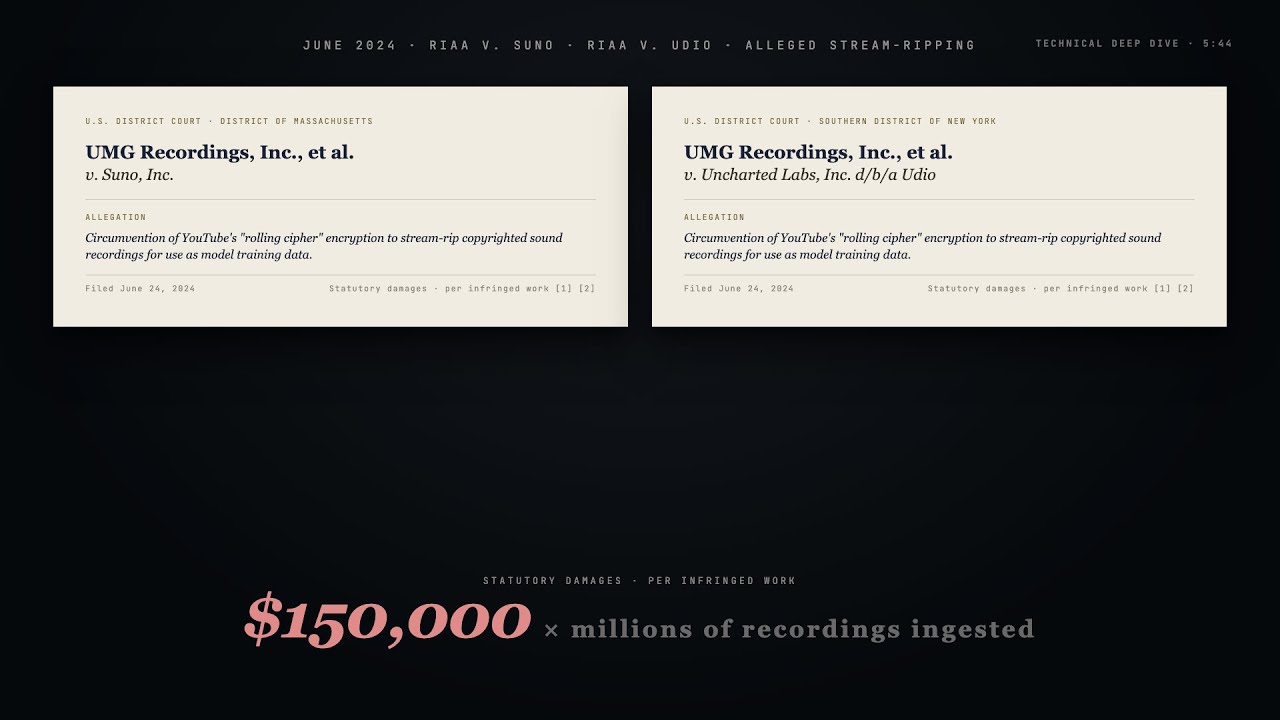
Generative AI platforms like Suno and Udio face RIAA lawsuits alleging massive copyright infringement through unauthorized stream-ripping. Using these tools in commercial workflows creates three forms of enterprise liability.
The initial copying of copyrighted files to train the model constitutes infringement the moment audio is downloaded—regardless of whether output is ever generated. Models trained on scraped YouTube/Spotify data inherit this "poisoned tree."
When a prompt generates audio "in the style of [Artist]," the model traverses latent space clusters formed from that artist's unauthorized catalog. The output is a mathematical reconstruction serving as a market substitute for the original.
US/EU copyright offices require "sufficient human authorship." Pure AI-generated works are not copyrightable. Typing a prompt ≠ authorship. Your competitor can legally rip your AI jingle with impunity—you have no protection.
"You cannot build a business on a Black Box. If you don't know what data the model was trained on, you don't own the IP. You are renting a lawsuit."
— Veriprajna Technical Whitepaper, December 2025
Black Box models generate from scratch using probabilistic diffusion trained on opaque, scraped datasets. White Box systems transform licensed assets using deterministic, auditable processes.
Veriprajna's Source-Separated Licensing Engine (SSLE) combines two breakthrough technologies: Deep Source Separation to deconstruct audio, and Retrieval-Based Voice Conversion to transform timbre.
Neural networks solve the "blind source separation" problem—deconstructing a mixed audio signal into isolated stems (vocals, drums, bass, other) using time-frequency masking.
Voice-to-voice system that decouples Content (what is sung) from Timbre (who sings it). Transforms the vocal stem without changing melody or lyrics.
Five-phase deterministic transformation with cryptographic provenance at every step
C2PA (Coalition for Content Provenance and Authenticity) provides cryptographic proof of content origin. Every file exported from SSLE contains a signed manifest answering "Who, What, Where, and How."
| Feature | Black Box (Suno/Udio) | Veriprajna (SSLE) |
|---|---|---|
| Training Data |
Undisclosed / Scraped
YouTube, Spotify
|
Licensed / Consented
Rightsify, Owned datasets
|
| Input Mechanism | Text Prompt ("Make a song like...") | Audio Guide Track (Owned/Licensed) |
| Generation Method |
Probabilistic Diffusion
Hallucination from latent space
|
Deterministic Transformation
DSS + RVC
|
| Copyright Ownership |
Ambiguous / Uncopyrightable
US Copyright Office stance
|
Clear Derivative Work
Input + Licensed Model
|
| Legal Risk |
HIGH
Direct & Derivative Infringement
|
ZERO
Chain of title for all components
|
| Indemnification |
Limited / "User Liable" Clauses
|
Full (Clean Data Supply Chain)
|
| Auditability | None (Opaque Weights) |
Full C2PA Manifests
|
| Machine Unlearning |
Difficult / Impossible
Catastrophic forgetting
|
Instant (Delete Model File)
Modular .pth files
|
The Strategic Pivot: From Prompts to Pipelines
For media companies, ad agencies, and game studios, the path forward requires abandoning "prompt-and-pray" for engineered pipelines with deterministic outcomes and cryptographic auditability.
Any enterprise deploying AI-generated audio in commercial workflows faces existential legal risk. Veriprajna SSLE is designed for organizations that cannot afford litigation exposure.
Universal Music Group's settlement with Udio reportedly bars users from downloading legacy content generated on the "poisoned" model. Assets are locked on-platform—commercially useless for broadcast/distribution.
When the foundation cracks, your assets are lost. Don't build enterprise workflows on legally unstable ground.
Black box AI audio platforms create three forms of liability: direct infringement (copying copyrighted files to train the model constitutes infringement at the moment of download), derivative infringement (prompts 'in the style of [Artist]' produce mathematical reconstructions from unauthorized catalog traversal), and copyright void (pure AI-generated works are uncopyrightable under US/EU law, so competitors can legally copy your AI-generated audio). Statutory damages reach $150,000 per work infringed.
The SSLE pipeline has five deterministic phases: (1) Ingest a guide track with clear copyright ownership, (2) Deep Source Separation using HT Demucs/MDX-Net to deconstruct into stems (vocals, drums, bass, other), (3) Retrieval-Based Voice Conversion using licensed voice actors (only 30-60 minutes of audio needed), (4) AI-driven mixing reassembly, and (5) C2PA certification with cryptographic provenance. Every artifact in the signal chain has verifiable, licensable origin.
Every file exported from SSLE contains a C2PA (Coalition for Content Provenance and Authenticity) signed manifest documenting: source audio cryptographic hash (SHA-256), separation model identity (HT Demucs version), voice model hash (licensed actor ID), and Veriprajna's private key signature certifying pipeline integrity. This enables YouTube, Spotify, and legal teams to verify authenticity instantly. Machine unlearning is also simplified — deleting a modular .pth voice model file instantly removes that voice from the system.
You cannot build a business on a Black Box. Veriprajna builds Source-Separated Licensing Engines—trading the magic of hallucination for the certainty of engineering.
100% generated audio. 0% copyright risk.
Complete 17-page engineering report: Legal analysis, DSS/RVC architectures, SSLE pipeline specs, C2PA implementation, EU regulatory alignment, comprehensive citations.