Beyond the Mirror: Engineering Fairness and Performance in the Age of Causal AI
Executive Manifesto: The End of "Culture Fit" and the Rise of Causal Intelligence
The enterprise recruitment landscape stands at a precipice. For decades, the industry has relied on a fragile combination of human intuition and crude pattern recognition, masking systemic inefficiencies under the guise of "culture fit." This nebulous term, often championed as the glue of organizational cohesion, has mutated into a mechanism for exclusion. In practice, "culture fit" is frequently a sanitized code for homophily—the human tendency to hire individuals who mirror our own backgrounds, sociodemographic traits, and cultural signifiers. We hire who we know, or rather, who reminds us of who we know. This is not merely an ethical lapse; it is a strategic failure that stifles innovation and homogenizes thought.
As the industry pivots toward Artificial Intelligence to solve this human bottleneck, we face a new and more dangerous threat: the automation of bias. The market is currently flooded with "AI-powered" recruitment tools that are little more than "wrappers"—thin interfaces built atop general-purpose Large Language Models (LLMs). These tools, while fluent and efficient, are fundamentally predictive engines trained on the open internet and historical data. They ask the wrong question: "Based on history, will this person get hired?" By answering this, they merely automate the prejudices of the past, scaling the "hiring people like me" syndrome into a high-velocity algorithmic redline.
Veriprajna rejects this "wrapper" philosophy. We assert that true enterprise intelligence requires a fundamental paradigm shift from Predictive AI to Causal AI . We do not build models that imitate human recruiters. We build Structural Causal Models (SCMs) that simulate alternative realities to ensure fairness. We ask: "Will this person perform well?" and, crucially, "If this candidate were from a different demographic group, would our prediction change?"
This whitepaper outlines the Veriprajna approach to Counterfactual Fairness . It details how we move beyond simple correlation to engineer models that are mathematically blind to protected attributes. We explore the failure of "Fairness through Unawareness," the risks of Imitation Learning, and the rigorous mechanics of penalizing models during training to excise bias. In an era of increasing regulation—from NYC Local Law 144 to the EU AI Act—this is not just a technological upgrade; it is a compliance necessity and a moral imperative. We do not automate the bias. We engineer the fairness.
Part I: The Human Bottleneck – Deconstructing the
"Culture Fit" Trap
1.1 The Sociology of Homophily: Why We Hire Ourselves
To understand why standard recruitment fails, one must first understand the cognitive architecture of the human recruiter. Recruitment is a decision-making process performed under conditions of extreme uncertainty. Faced with a stack of resumes and limited time, the human brain relies on heuristics—mental shortcuts—to assess potential. The most pervasive and damaging of these heuristics is homophily, a sociological concept defined as the tendency of individuals to associate and bond with similar others. 1
Homophily is the scientific basis for the "old boys' network." It explains why a hiring manager might unconsciously upgrade a candidate who played the same sport, attended a rival university, or uses specific cultural vernacular. In social network theory, "similarity breeds attraction". 2 This is not necessarily an act of explicit malice; it is a mechanism of cognitive ease. Familiarity reduces the perceived risk of a hire. If a candidate "feels like us," the recruiter assumes they will "act like us" and "succeed like us."
However, within the enterprise, this psychological comfort blanket creates what researchers call "homophily traps". 3 When minority groups within an organization fall below a critical mass—often cited around 25%—homophilic hiring practices by the majority effectively lock them out of structural opportunities. The majority hires the majority, reinforcing the demographic status quo.
| Aspect | Description | Impact on Recruitment |
|---|---|---|
| Choice Homophily | Ties formed due to individual preferences for similar others. |
Hiring managers select candidates with shared hobbies or backgrounds.3 |
| Induced Homophily | Ties formed due to exposure within homogeneous environments (e.g., schools, workplaces). |
Recruitment from specifc "feeder schools" replicates the demographic of those schools.3 |
| Structural Balance | The psychological pressure to maintain consistent, non-conficting relationships. |
Hiring "disruptive" diverse talent is avoided to maintain artifcial harmony.2 |
The operational cost of this bias is significant. "Culture fit" becomes a mechanism for groupthink . Organizations where artificial harmony is prioritized over diverse perspectives often lack the friction necessary for innovation. Research indicates that while "culture fit" correlates with comfort, "culture add"—hiring individuals who challenge innate assumptions—is associated with enhanced innovation performance. 4
1.2 The "Hiring People Like Me" Syndrome
The "Hiring People Like Me" syndrome is the operational manifestation of homophily. It is the reason why a hiring manager might view a candidate who plays lacrosse as "disciplined" and "strategic," while viewing a candidate with a different, unfamiliar hobby as neutral or irrelevant. 6 The bias is subtle. It is rarely as explicit as "I hire only men." It is phrased as, "I hire people who are 'go-getters'," where the definition of "go-getter" is unconsciously calibrated to the behaviors of the hiring manager's own demographic group. 7
This bias extends to Linguistic Mirroring . Research shows that candidates who use similar vocabulary, sentence structures, or emotional tones to the interviewer are rated significantly higher, regardless of the content of their answers. 5 This phenomenon, known as Perceptual Congruence, suggests that interviewers often conflate "communication skills" with "speaks like me". 8 A candidate from a different socioeconomic or cultural background, who may be equally competent but uses a different linguistic register, is penalized for a "lack of polish."
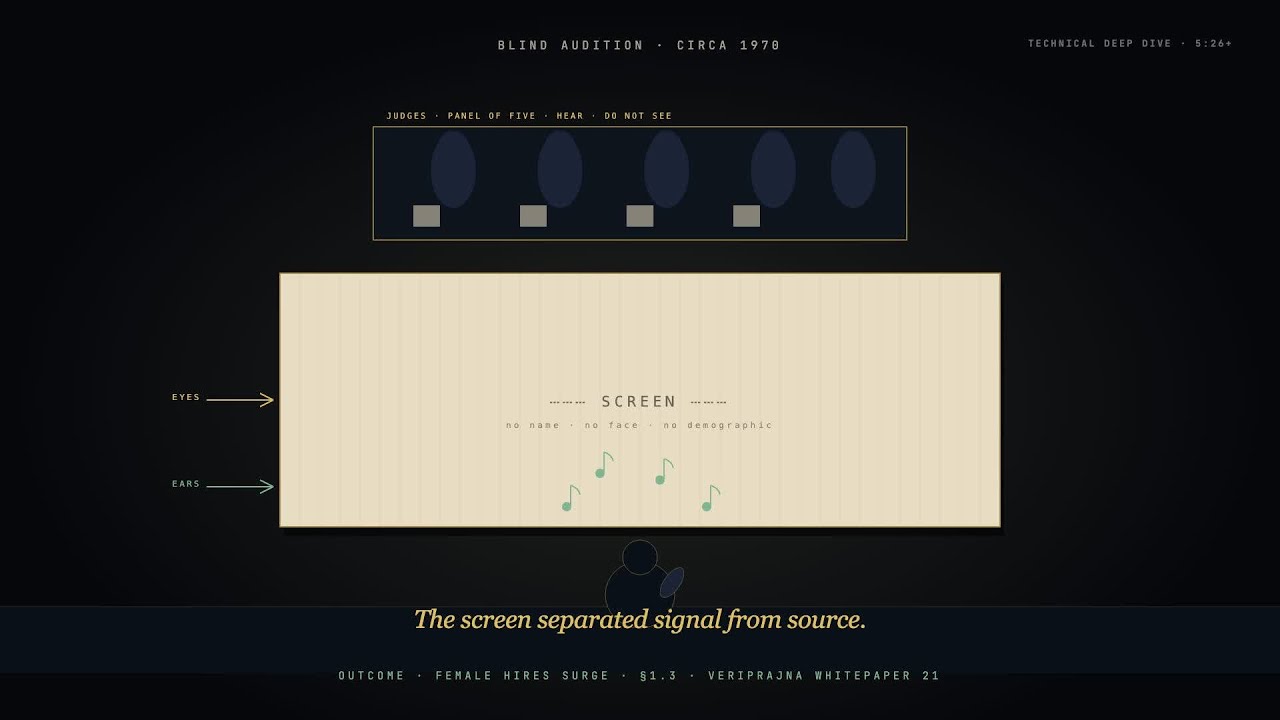
1.3 The "Blind Audition" Paradigm
The most powerful counter-argument to "culture fit" hiring comes from the world of classical music. In the 1970s, major symphony orchestras were dominated by men. The prevailing belief was that women lacked the "lung power" or "temperament" for certain instruments. This was a classic case of cognitive bias influencing evaluation.
To combat this, orchestras introduced Blind Auditions, where musicians played behind a screen. The judges could hear the music—the causal driver of performance—but could not see the musician—the protected attribute . 9 The results were dramatic: the hiring of female musicians surged. The screen forced the judges to evaluate the output (the sound) rather than the source (the person).
This analogy is central to the Veriprajna philosophy. In the digital age, we cannot physically put every candidate behind a screen. However, we can build AI that acts as a mathematical screen . Standard AI, as we will see, fails to do this. It acts as a transparent window, allowing all the biases of the past to seep into the predictions of the future. Veriprajna's Causal Models are the digital equivalent of the blind audition screen, separating the signal of performance from the noise of demographics. 9
Part II: The False Prophecy – Why Predictive AI and "Wrappers" Fail
2.1 The Mechanism of Historical Bias
The first generation of AI in recruitment—Predictive AI—was built on a flawed premise: Imitation Learning . The goal was to train a machine to mimic the decisions of human recruiters. Developers would feed the model ten years of historical hiring data and ask it to predict "Who gets hired?"
The fatal flaw here is Historical Bias . 11 If an organization has historically hired mostly men for technical roles, the data will show a strong statistical correlation between "male-coded traits" (e.g., specific sports, fraternities, vocabulary) and "hiring success." A standard machine learning model, designed to maximize accuracy, will latch onto these correlations. It does not understand why men were hired; it simply observes that they were . 13
If the human recruiters of the past were biased (which, due to homophily, they were), the AI becomes a "bias capsule." It crystallizes and scales those prejudices, applying them with ruthless efficiency to every new applicant. This is not artificial intelligence; it is automated stagnation . 14
2.2 The Amazon Cautionary Tale
The dangers of this approach were laid bare in 2018, when it was revealed that Amazon had to scrap an internal AI recruiting tool. The system was trained on a decade of resumes submitted to the company. Because the tech industry is historically male-dominated, the training data was heavily skewed.
The AI, acting as a correlation engine, learned to penalize resumes that included the word "women's," such as "women's chess club captain". 14 It downgraded graduates of two all-women's colleges. Crucially, the programmers did not explicitly code the AI to be sexist. The AI found that "being male" was a strong predictor of "being hired" in the past data. It effectively automated the "hiring people like me" syndrome of the previous decade's human recruiters. 13
This case study illustrates the fundamental limitation of Predictive AI : To be accurate to the past is to be unfair to the future. If the definition of "accuracy" is "predicting the human decision," then a "good" AI is necessarily a biased one.
2.3 The "LLM Wrapper" Illusion
In the wake of the Generative AI boom, a new class of tools has emerged: "LLM Wrappers." These applications sit on top of public models like GPT-4 or Claude, using them to parse resumes and rank candidates. While these tools offer impressive fluency, they introduce severe, uncontrollable risks into the enterprise hiring stack.
2.3.1 Internet-Scale Bias
LLMs are trained on the open internet—a dataset that contains the sum total of human bias, stereotypes, and prejudice. When a wrapper sends a resume to an LLM, it activates these latent biases. Research from the University of Washington found that LLMs significantly favor names associated with white men over Black men or women, even when qualifications are identical. 16
In resume screening simulations, white-associated names were preferred 85% of the time . 17 In some iterations, Black male names were never ranked first. 12 The model associates "white-sounding" names with "competence" based on the statistical patterns of the internet text it consumed. A wrapper cannot easily "turn off" this bias because it is baked into the model's fundamental understanding of language.
2.3.2 Hallucinations and Reliability
LLMs are probabilistic token predictors, not logic engines. They are designed to produce plausible-sounding text, not factual truth. In the context of resume screening, this leads to hallucinations . 18 An LLM might infer that a candidate has a specific skill simply because that word appears near other relevant words in the document, or it might invent a degree to make the candidate's profile "flow" better. 19
This lack of reliability is fatal for enterprise compliance. If a candidate is rejected based on a hallucinated lack of skill, or hired based on a hallucinated qualification, the organization faces significant legal and reputational risk. 20
2.3.3 The "Black Box" Problem
Finally, LLM wrappers lack Explainability . If a hiring manager asks, "Why did the AI rank Candidate A over Candidate B?", the wrapper can only generate a post-hoc rationalization. It cannot explain the mathematical weightings that led to the decision because the LLM itself is a "black box" neural network with billions of parameters. 20 In jurisdictions like the EU or NYC, where "Right to Explanation" is becoming law, this opacity is non-compliant.
Part III: The Paradigm Shift – From Correlation to Causation
3.1 The Failure of Correlation in HR
To solve the bias problem, we must abandon the reliance on correlation. In HR analytics, correlations are often spurious and misleading.
● Correlation: "Candidates who play lacrosse tend to be high performers."
● Causality: "Does playing lacrosse cause high performance?"
Almost certainly not. Lacrosse is a proxy for socioeconomic status. Wealthier families can afford lacrosse equipment and camps; wealthier families also send children to elite universities; elite universities provide networks that lead to high-status jobs. 6 If an AI model uses "lacrosse" as a feature, it is not selecting for athletic discipline; it is selecting for wealth. It is engaging in Algorithmic Redlining . 22
Standard ML models cannot distinguish between a proxy (lacrosse) and a cause (grit). They treat both as predictive features. Veriprajna's Causal AI is designed to tell the difference.
3.2 Imitation Learning vs. Outcome-Based Learning
We must also shift the target of our learning algorithms.
● Imitation Learning (Standard AI): The model predicts "Will this person get hired?" It imitates the human gatekeeper. If the gatekeeper is biased, the model is biased. 23
● Outcome-Based Learning (Veriprajna): The model predicts "Will this person perform well?" It looks at objective business outcomes—retention, sales quotas, code quality, customer satisfaction. 25
By training on outcomes, we bypass the biased filter of the recruiter. If "diverse candidates" historically performed well but were rarely hired, an Outcome-Based model will learn to value them, whereas an Imitation model would learn to ignore them.
3.3 The Ladder of Causation
Veriprajna's technology is built on Judea Pearl's "Ladder of Causation," a hierarchy of reasoning capabilities that separates simple statistics from true intelligence. 27
| Level | Action | Question | AI Type |
|---|---|---|---|
| 1. Association | Seeing | "What is likely to happen?" |
Standard ML / Wrappers |
| 2. Intervention | Doing | "What happens if I change X?" |
A/B Testing |
| 3. Counterfactuals | Imagining | "What would have happened if X was |
Veriprajna Causal AI |
Standard AI is stuck at Level 1. It sees patterns. Veriprajna operates at Level 3. We use Structural Causal Models (SCMs) to imagine alternative realities. This capability allows us to answer the ultimate fairness question: "If this candidate were male instead of female, would the prediction change?" . 28
Part IV: Deep Dive – Counterfactual Fairness and Engineering Bias Removal
4.1 Defining Counterfactual Fairness
Counterfactual Fairness is not a vague ethical guideline; it is a rigorous mathematical constraint. A decision is defined as counterfactually fair if the probability of a specific outcome (e.g., being hired) is the same in the actual world as it would be in a "counterfactual world" where the individual belonged to a different demographic group, holding all other non-demographic causal factors constant. 29
Formally, for a predictor , protected attribute (e.g., gender), and observable attributes :
In plain English: The model's prediction for a candidate should not change if we magically toggled their gender from Male to Female, while keeping their innate skills () and true qualifications exactly the same. This is the mathematical implementation of the "Blind Audition" screen. 30
4.2 The "Glass Box" Architecture: Structural Causal Models (SCMs)
To implement this, Veriprajna builds Structural Causal Models . Unlike "black box" neural networks, an SCM is a transparent graph that maps the cause-and-effect relationships between variables.
● The Problem with Proxies: In a standard dataset, "Zip Code" might correlate with "Race." A standard model will use Zip Code to discriminate.
● The SCM Solution: We map the paths.
○ Path A: Zip Code Commute Time Retention (Legitimate Causal Path).
○ Path B: Zip Code Demographics Historical Bias (Spurious Path).
Using the SCM, we can mathematically "block" Path B while keeping Path A. We tell the model: "You may use Zip Code only insofar as it predicts Commute Time, but you are penalized if you use it to infer Race" . 29 This nuance—distinguishing between a legitimate business factor and a discriminatory proxy—is impossible with standard correlation-based algorithms.
4.3 The Mechanism: Penalizing the Model
How do we enforce this fairness during training? We employ a technique known as Adversarial Debiasing or Penalized Training . 33
During the training phase, the AI is optimized against a dual objective function:
1. Performance Loss: Maximize the accuracy of predicting the job outcome (e.g., Retention).
2. Fairness Penalty (The Adversary): Minimize the ability to predict the protected attribute (e.g., Race) from the model's internal representation.
We introduce a "Fairness Penalty" term into the model's loss function. If the model begins to rely on features that act as proxies for race (like "lacrosse" or specific "zip codes"), the adversary detects that it can now guess the candidate's race. This triggers the penalty, increasing the "cost" of the model's current state.
To minimize the total loss, the model is forced to "unlearn" the connection between the proxy and the outcome. It must find other features—like skills, experience, or test scores—that predict performance without revealing demographics. Think of it as training a dog to fetch a newspaper. If the dog fetches the paper (predicts performance) but tears it (uses bias), we do not give it a treat. Eventually, the dog learns to fetch the paper without tearing it. Similarly, our model learns to predict performance without relying on the crutch of demographic proxies. 34
4.4 Simulation and Stress-Testing
Before any model is deployed, Veriprajna subjects it to Counterfactual Simulation . We generate thousands of "synthetic twins" for real candidates.
● Scenario: Take a real candidate resume (Male).
● Counterfactual: Generate a copy of the resume, changing the name to a female-associated name and swapping pronouns, but leaving all skills and dates identical.
● Test: Feed both to the model.
If the scores diverge, the model fails the audit. We iterate the penalization process until the scores for the twins converge. This proactive stress-testing ensures that the model is robust not just against the training data, but against the infinite variations of the real world. 17
Part V: The Regulatory Landscape – Compliance as a Feature
5.1 NYC Local Law 144: The Bellwether
The regulatory environment for AI in hiring is shifting rapidly from "guidelines" to strict legal mandates. The most significant of these is NYC Local Law 144, which came into effect in 2023. This law prohibits the use of "Automated Employment Decision Tools" (AEDT) unless they have been subject to an independent bias audit within the last year. 37
The law specifically mandates the calculation of Impact Ratios : comparing the selection rate of protected groups against the most selected group. If a tool selects men at 80% and women at 40%, the impact ratio is 0.5.
● The Risk: Many "black box" vendors are failing these audits because they cannot control how their models weight different features. They are scrambling to "patch" bias after the fact.
● The Veriprajna Advantage: Our models are Audit-Ready by Design . Because we train with a fairness penalty that is mathematically stricter than the law's "impact ratio" requirements, our models naturally satisfy compliance. We provide the "Glass Box" documentation that auditors require, showing exactly how proxies were blocked. 38
5.2 The EU AI Act: High-Risk Classification
The European Union's AI Act classifies recruitment AI as "High Risk," creating a tier of regulation comparable to medical devices. 40 This imposes strict obligations regarding:
● Data Governance: Ensuring training data is representative and error-free.
● Human Oversight: The ability for humans to understand and intervene.
● Accuracy and Robustness: Resistance to errors and biases.
"Wrapper" solutions that rely on third-party APIs (like OpenAI) face an existential crisis here. The data processing happens on external servers, and the "black box" nature of LLMs makes it nearly impossible to guarantee the "absence of bias" required by the Act. 20 Veriprajna's custom-built, private-cloud Causal Models offer the data sovereignty and robust audit trails necessary for GDPR and EU AI Act compliance.
5.3 Legal Defense and Algorithmic Recourse
Beyond specific AI laws, biased hiring violates fundamental anti-discrimination statutes (like the Civil Rights Act in the US). If a rejected candidate sues, a company using a standard AI has no defense other than "the computer said so."
A company using Veriprajna offers Algorithmic Recourse. We can present the Causal Graph in court: "We rejected this candidate because of Factor X (Skills gap), and we can prove mathematically that Factor Y (Race) had zero weight in the decision." This transparency transforms AI from a liability into a shield.28
Part VI: Redefining Success – The Science of Quality of Hire
6.1 Moving Beyond Vanity Metrics
Traditional HR metrics are obsessed with efficiency: "Time to Fill" and "Cost per Hire." These are vanity metrics. A recruiter can fill a role in 24 hours with a candidate who is a poor fit and leaves in 90 days. The cost of that "bad hire" is often 1.5x to 2x their annual salary.43 Veriprajna focuses on the only metric that matters: Quality of Hire (QoH).
6.2 The Feedback Loop
Our system does not stop at the hiring decision. We integrate post-hire data back into the model to create a continuous learning loop.
● Retention Data: Did the employee stay for >18 months?. 43
● Performance Data: Did they meet their KPIs? Did they receive high performance ratings?. 44
● Cultural Add: Did their presence improve team output?
This feedback loop is critical. If the model predicts a candidate is a "High Performer," but they churn in 3 months, the Causal Model updates. It asks: "What causal factor did we miss?" Perhaps the candidate was overqualified (and thus bored), or perhaps the "commute time" variable has a stronger causal weight on retention than previously thought. This allows the model to get smarter over time, shifting from "Imitating Recruiter Preferences" to "Optimizing Business Value". 45
6.3 Case Studies in Outcome-Based Hiring
The shift to outcome-based data delivers tangible ROI.
● Retention Modeling: In a case study involving employee attrition, causal inference identified that "lack of training opportunities" was the true causal driver of churn, not "salary." This allowed the company to intervene with training programs (a low-cost solution) rather than across-the-board raises (a high-cost solution), reducing churn by 23.9%. 45
● Diversity & Speed: Companies like Unilever and Hilton, which shifted to data-driven, outcome-based hiring models, reported reducing time-to-hire by up to 90% while simultaneously increasing the diversity of their intake. 46 This proves that fairness and efficiency are not mutually exclusive; they are correlated outcomes of a well-engineered system.
6.4 The ROI of Fairness
Fairness is often viewed as a "tax" on performance—a compromise one makes for ethics. Veriprajna proves the opposite. By removing the bias of "culture fit," we expand the talent pool to include high-performers that competitors are ignoring. This is the "Moneyball" principle applied to HR. Standard recruiters overvalue "pedigree" (Ivy League degrees) just as baseball scouts overvalued "batting average." Causal AI finds the "on-base percentage" of HR—the undervalued skills that actually drive winning outcomes. 48
Part VII: Implementation Strategy for the Enterprise
7.1 The "Walk, Run, Fly" Roadmap
Transitioning from standard recruiting to Causal AI is a journey. Veriprajna recommends a phased approach:
Phase 1: The Audit (Walk) We begin by analyzing your historical data. We run a "Bias Audit" on your past hiring decisions to identify existing homophily traps. We map the "Impact Ratios" of your current process. This establishes a baseline and often reveals immediate opportunities for improvement.40
Phase 2: Shadow Mode (Run) We deploy the Causal AI model alongside your human recruiters. The AI does not make decisions; it simply generates scores and recommendations in the background. We then compare the AI's "Outcome Predictions" against the humans' "Hiring Decisions."
Gap Analysis: Where did the AI recommend a candidate the humans rejected? We track those candidates (if hired elsewhere) or review their profiles to identify the bias (e.g., "The AI liked him because of his skills, the human rejected him because of his school"). 49
Phase 3: Human-in-the-Loop (Fly) Once calibrated, the AI is empowered to assist. It provides a "Fairness Score" and an "Explanation" for every candidate. The human recruiter retains the final decision rights (maintaining HITL compliance), but they must document their reasoning if they choose to overrule the AI's evidence-based recommendation. This "nudge" architecture significantly reduces bias without removing human agency.50
7.2 Data Readiness & Synthetic Augmentation
Causal AI requires robust data. A common challenge is that minority groups are underrepresented in historical data, making it hard to model their outcomes. Veriprajna addresses this with Synthetic Data Generation. We use Generative Adversarial Networks (GANs) to create "synthetic candidates"—data points that mimic the statistical properties of real minority candidates but are privacy-safe. This augments the dataset, ensuring the model has enough examples to learn fair decision boundaries for all demographic groups.52
7.3 Change Management
The biggest hurdle to adoption is often cultural. Hiring managers trust their gut. They believe they are good judges of character. We position Causal AI not as a replacement, but as a Decision Support Tool. It is a "bias check," similar to a spell-checker. It does not write the book for you, but it ensures you don't make avoidable errors. We frame the technology as a way to "uncover hidden talent," appealing to the competitive nature of hiring managers rather than accusing them of bias.53
Conclusion: The Future is Causal
The era of "move fast and break things" in HR technology must end. When we break things in recruitment, we break livelihoods, we entrench inequality, and we expose our organizations to massive legal risk. The first generation of AI—Predictive AI—was a mirror. It reflected our own biases back at us, magnified by the power of automation. It taught us that if we simply "imitate" the past, we are doomed to repeat it.
The next generation— Causal AI —is a lens. It allows us to see through the fog of "culture fit" and "affinity bias" to the true causal drivers of human potential. It allows us to ask the uncomfortable questions— "Would we have hired her if she were male?" —and empowers us to fix the answer.
Veriprajna is not an API wrapper company. We are a deep-tech solution provider building the infrastructure for a fair and meritocratic future of work. We believe that fairness is not just a compliance box to check; it is the ultimate competitive advantage. By engineering fairness into the code, we stop automating the past and start building the future.
Don't automate the bias. Engineer the fairness.
Veriprajna Deep AI Solutions for the Enterprise.
[Contact us for a confidential bias audit of your hiring stack]
Works cited
Identification of Homophily and Preferential Recruitment in Respondent-Driven Sampling - PMC - NIH, accessed December 11, 2025, https://pmc.ncbi.nlm.nih.gov/articles/PMC5860647/
"How Networks Form: Homophily, Opportunity, and Balance" in: Emerging Trends in the Social and Behavioral Sciences, accessed December 11, 2025, http://emergingtrends.stanford.edu/files/original/21f098453b0014aaa845cd5d6f8692e1c6ea267c.pdf
Stronger together? The homophily trap in networks - arXiv, accessed December 11, 2025, https://arxiv.org/html/2412.20158v2
Science Behind a Good Cultural Fit - Chapman & Co. Leadership Institute, accessed December 11, 2025, https://www.ccoleadership.com/resources/insight/the-science-behind-a-good-cultural-fit
LSE Business Review: Should you hire for culture fit?, accessed December 11, 2025, https://eprints.lse.ac.uk/116202/1/businessreview_2022_05_05_should_you_hire_for_culture.pdf
Claims AI can boost workplace diversity are 'spurious and dangerous' | Hacker News, accessed December 11, 2025, https://news.ycombinator.com/item?id=33203590
Ask HN: How to optimize your career for happiness? - Hacker News, accessed December 11, 2025, https://news.ycombinator.com/item?id=29614095
Culture fit may not be what most hiring managers think it is, study finds - Haas News, accessed December 11, 2025, https://newsroom.haas.berkeley.edu/research/culture-fit-may-not-be-what-most-hiring-managers-think-it-is-study-finds/
Blind scouting: using artificial intelligence to alleviate bias in selection ResearchGate, accessed December 11, 2025, https://www.researchgate.net/publication/389431980_Blind_scouting_using_artifcial_intelligence_to_alleviate_bias_in_selection
TIME TO DECIDE: A STUDY OF EVALUATIVE DECISION-MAKING IN MUSIC PERFORMANCE - - RCM Research Online, accessed December 11, 2025, https://researchonline.rcm.ac.uk/id/eprint/460/1/Waddell%20PhD%202018.pdf
accessed December 11, 2025, https://research.aimultiple.com/ai-bias/#:~:text=Historical%20bias%3A%20Occurs%20when%20AI,represent%20the%20real%2Dworld%20population.
Bias in AI: Examples and 6 Ways to Fix it - Research AIMultiple, accessed December 11, 2025, https://research.aimultiple.com/ai-bias/
Amazon's sexist hiring algorithm could still be better than a human - IMD Business School, accessed December 11, 2025, https://www.imd.org/research-knowledge/digital/articles/amazons-sexist-hiring-algorithm-could-still-be-beter-than-a-human/t
Algorithmic Bias in Hiring: Ensuring Fair and Ethical Recruitment with AI - Ignite HCM, accessed December 11, 2025, https://www.ignitehcm.com/blog/algorithmic-bias-in-hiring-ensuring-fair-and-ethical-recruitment-with-ai
Algorithmic Bias: AI and the Challenge of Modern Employment Practices - UC Law SF Scholarship Repository, accessed December 11, 2025, https://repository.uclawsf.edu/cgi/viewcontent.cgi?article=1272&context=hastings_business_law_journal
People mirror AI systems' hiring biases, study finds | UW News, accessed December 11, 2025, https://www.washington.edu/news/2025/11/10/people-mirror-ai-systems-hiring-biases-study-finds/
AI tools show biases in ranking job applicants' names according to perceived race and gender | UW News, accessed December 11, 2025, https://www.washington.edu/news/2024/10/31/ai-bias-resume-screening-race-gender/
Hallucination (artificial intelligence) - Wikipedia, accessed December 11, 2025, https://en.wikipedia.org/wiki/Hallucination_(artificial_intelligence)
AI Hallucinations in HRIS: Why Verification Matters and How to Keep Your AI on Track, accessed December 11, 2025, https://letscatapult.org/ai-hallucinations-in-hris-why-verification-maters-and-hotw-to-keep-your-ai-on-track/
Seven limitations of Large Language Models (LLMs) in recruitment technology Textkernel, accessed December 11, 2025, https://www.textkernel.com/learn-support/blog/seven-limitations-of-llms-in-hr-tech/
AI in Recruitment: The Potential Risks and Rewards for Employers - Matheson, accessed December 11, 2025, https://www.matheson.com/insights/ai-in-recruitment-the-potential-risks-and-rewards-for-employers/
Algorithmic Redlining: How AI Bias Works & How to Stop It | IntuitionLabs, accessed December 11, 2025, https://intuitionlabs.ai/articles/algorithmic-redlining-solutions
Imitation learning considered unsafe? - LessWrong, accessed December 11, 2025, https://www.lesswrong.com/posts/whRPLBZNQm3JD5Zv8/imitation-learning-considered-unsafe
[2404.19456] A Survey of Imitation Learning Methods, Environments and Metrics arXiv, accessed December 11, 2025, https://arxiv.org/abs/2404.19456
How Competency and Outcome-Based Learning Drive Success in Higher Education, accessed December 11, 2025, https://ace.edu/blog/how-competency-and-outcome-based-learning-drive-success-in-higher-education/
What's Predictive Hiring Analytics ? Definition & Examples | Go Perfect, accessed December 11, 2025, https://www.goperfect.com/blog/predictive-hiring-analytics
Why Causal AI is the Next Big Leap in AI Development - Kanerika, accessed December 11, 2025, https://kanerika.com/blogs/causal-ai/
Why Causal AI? | causaLens, accessed December 11, 2025, https://causalai.causalens.com/why-causal-ai/
Counterfactual fairness | The Alan Turing Institute, accessed December 11, 2025, https://www.turing.ac.uk/research/research-projects/counterfactual-fairness
Counterfactual Fairness - NIPS papers, accessed December 11, 2025, http://papers.neurips.cc/paper/6995-counterfactual-fairness.pdf
Counterfactual Fairness - arXiv, accessed December 11, 2025, https://arxiv.org/pdf/1703.06856
Counterfactual Fairness - Microsoft Research, accessed December 11, 2025, https://www.microsoft.com/en-us/research/video/counterfactual-fairness/
(PDF) Penalizing Unfairness in Binary Classification - ResearchGate, accessed December 11, 2025, https://www.researchgate.net/publication/334078316_Penalizing_Unfairness_in_Binary_Classification
Penalizing Unfairness in Binary Classification - arXiv, accessed December 11, 2025, https://arxiv.org/pdf/1707.00044
Adversarial Debiasing Methods → Area → Sustainability, accessed December 11, 2025, https://lifestyle.sustainability-directory.com/area/adversarial-debiasing-methods/
How Carta uses machine learning to create market-driven compensation benchmarks, accessed December 11, 2025, https://carta.com/product-updates/compensation-bands/
Automated Employment Decision Tools (AEDT) - DCWP - NYC.gov, accessed December 11, 2025, https://www.nyc.gov/site/dca/about/automated-employment-decision-tools.page
HR Tech Compliance: Everything You Need to Know about NYC Local Law 144 Warden AI, accessed December 11, 2025, https://www.warden-ai.com/resources/hr-tech-compliance-nyc-local-law-144
NYC Local Law 144 Compliance: AI Hiring Guide - FairNow, accessed December 11, 2025, https://fairnow.ai/guide/nyc-local-law-144/
Part 2 NYC Law 144 & EU AI Act: The Compliance Trap Catching Thousands of Companies, accessed December 11, 2025, https://www.edligo.net/hr-tech-ai/series-ai-law-talent-part-2-nyc-law-144-eu-ai-act-the-compliance-trap-catching-thousands-of-companies/
AI-Optimized, CX-Driven: High-Volume Hiring for Sales, Retention, Support and Operations - ToKnowPress, accessed December 11, 2025, https://toknowpress.net/submission/index.php/ijmkl/article/download/225/148/1082
Algorithmic Bias Explained - The Greenlining Institute, accessed December 11, 2025, https://greenlining.org/wp-content/uploads/2021/04/Greenlining-Institute-Algorithmic-Bias-Explained-Report-Feb-2021.pdf
How to Measure Quality of Hire: Track These 7 Data Points to Measure Quality of Hire Today, accessed December 11, 2025, https://fama.io/post/how-to-measure-quality-of-hire
How to Measure Quality of Hire: 7 Key Metrics That Reveal Hiring Success - Phyllo, accessed December 11, 2025, https://www.getphyllo.com/post/how-to-measure-quality-of-hire-7-key-metrics-that-reveal-hiring-success
The Counterfactual–Dialectical Optimization Framework: A Prescriptive Approach to Employee Attrition Management with Empirical Validation - MDPI, accessed December 11, 2025, https://www.mdpi.com/2078-2489/16/12/1053
Predictive Analytics in Recruitment: How To Use It To Strengthen Your Hiring Process, accessed December 11, 2025, https://www.aihr.com/blog/predictive-analytics-in-recruitment/
AI in Recruitment: How Predictive Analytics is Shaping Hiring Strategies - Staffing iQuasar, accessed December 11, 2025, https://staffing.iquasar.com/blogs/ai-in-recruitment-how-predictive-analytics-is-shaping-hiring-strategies/
iQ Skills Based White Paper (No Summary), accessed December 11, 2025, https://cdn.prod.website-files.com/66faf00d56a48e77cefd573f/6911b8d9cdcc652e189e25a8_iQ%20Skills%20Based%20White%20Paper%20(No%20Summary).pdf
Can Predictive Hiring Analytics Replace Interviews? - FX31 Labs, accessed December 11, 2025, https://fx31labs.com/predictive-hiring-vs-interviews/
Shaping the Future of Recruitment: - Rutgers School of Management and Labor Relations |, accessed December 11, 2025, https://smlr.rutgers.edu/sites/default/files/Documents/Faculty-Staff-Docs/Shaping_the_Future_of_Recruitment_Report_Rutgers.pdf
Collaborative Intelligence in Sequential Experiments: A Human-in-the-Loop Framework for Drug Discovery | Information Systems Research - PubsOnLine, accessed December 11, 2025, https://pubsonline.informs.org/doi/10.1287/isre.2024.1154
Algorithmic Equity Playbook: Fair AI in Recruitment & HR - V2Solutions, accessed December 11, 2025, https://www.v2solutions.com/whitepapers/ai-recruitment-bias-playbook/
How Data Bias Impacts AI Accuracy and Business Decisions - Kellton, accessed December 11, 2025, https://www.kellton.com/kellton-tech-blog/how-data-bias-impacts-ai-accuracy-and-business-decisions
Prefer a visual, interactive experience?
Explore the key findings, stats, and architecture of this paper in an interactive format with navigable sections and data visualizations.
Frequently Asked Questions
How does Causal AI differ from predictive AI in recruitment?
Predictive AI asks 'will this person get hired?' — imitating historical recruiter decisions and scaling their biases. Causal AI asks 'will this person perform well?' using Structural Causal Models that distinguish legitimate performance predictors from discriminatory proxies like zip code or university pedigree, training on business outcomes rather than past hiring patterns.
What is counterfactual fairness in hiring AI?
Counterfactual fairness is a mathematical constraint ensuring that a hiring prediction remains identical whether the candidate belongs to one demographic group or another, holding all non-demographic causal factors constant. It asks: 'If this candidate's gender changed, would the prediction change?' — implementing a digital blind audition screen.
Why do LLM wrapper recruitment tools introduce bias?
LLM wrappers are trained on internet-scale data containing systemic biases. Research shows they prefer white-associated names 85% of the time in resume screening, suffer from hallucinations that fabricate qualifications, and operate as unexplainable black boxes — making them non-compliant with NYC Local Law 144 and the EU AI Act's high-risk classification for recruitment systems.
Also Published On
Build Your AI with Confidence.
Partner with a team that has deep experience in building the next generation of enterprise AI. Let us help you design, build, and deploy an AI strategy you can trust.
Veriprajna Deep Tech Consultancy specializes in building safety-critical AI systems for healthcare, finance, and regulatory domains. Our architectures are validated against established protocols with comprehensive compliance documentation.