Engineering Fairness and Performance in the Age of Causal AI
The enterprise recruitment landscape stands at a precipice. For decades, "culture fit" has masked systemic bias as organizational cohesion. Standard AI tools don't solve this—they automate it.
Veriprajna rejects the "wrapper" philosophy. We build Structural Causal Models that ask: "Will this person perform well?" and crucially, "If this candidate were from a different demographic group, would our prediction change?"
"Culture fit" is frequently a sanitized code for homophily—the human tendency to hire individuals who mirror our own backgrounds, traits, and cultural signifiers.
Homophily is the tendency of individuals to associate with similar others. In recruitment, this manifests as "hiring people like me"—favoring candidates who share sports, schools, or cultural vernacular.
Candidates who use similar vocabulary and sentence structures to interviewers are rated significantly higher, regardless of content quality—conflating "communication skills" with "speaks like me."
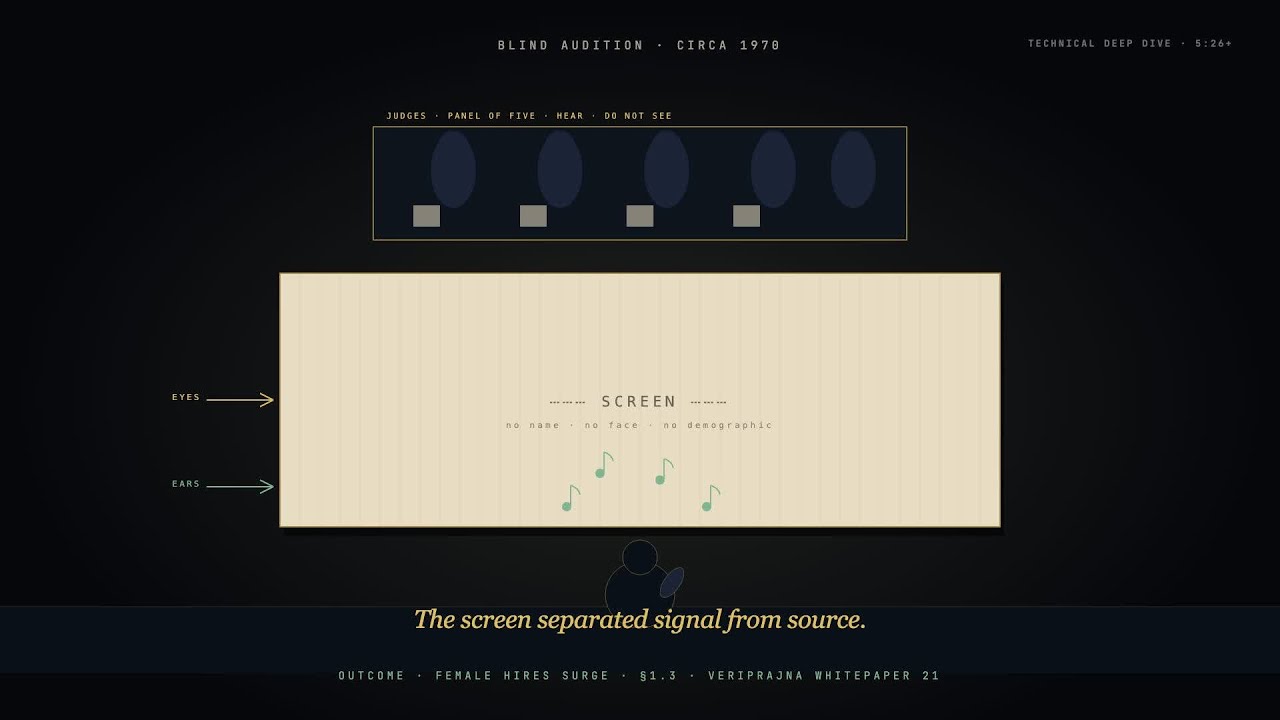
Symphony orchestras introduced screens to hide musicians during auditions. The result? Female hiring surged. The screen forced evaluation of output (sound) vs. source (person).
Experience how Veriprajna's Causal AI evaluates candidates. Change demographic attributes—if the score changes, the model is biased. Our system maintains identical scores, proving counterfactual fairness.
The market is flooded with "AI-powered" recruitment tools that are mere wrappers atop LLMs. They automate the prejudices of the past.
Predictive AI asks: "Who got hired?" If past recruiters were biased (they were, due to homophily), AI crystallizes those prejudices. To be accurate to the past is to be unfair to the future.
LLMs trained on the open internet contain the sum total of human bias. UW research found LLMs favor white-associated names 85% of the time. Black male names were never ranked first in some iterations.
LLM wrappers lack explainability. Cannot answer: "Why ranked A over B?" In EU/NYC jurisdictions with "Right to Explanation" laws, this opacity is non-compliant.
Standard AI is stuck at Level 1 (seeing patterns). Veriprajna operates at Level 3 (imagining alternative realities).
Seeing
Question: "What is likely to happen?"
Observes correlations in data. Cannot distinguish causation from spurious patterns.
Doing
Question: "What happens if I change X?"
Tests interventions. Can manipulate variables to observe effects.
Imagining
Question: "What would have happened if X was different?"
Simulates alternative realities. The foundation of fairness.
"While a human operator can clearly see a black tray on a belt, the machine vision system effectively sees nothing. This is a failure of physics that no amount of computer vision contrast adjustment or prompt engineering can resolve. One cannot enhance a signal that was never captured."
Similarly in recruitment: You cannot train AI to be fair using biased data. You must engineer fairness through causal modeling.
Unlike "black box" neural networks, SCMs are transparent graphs that map cause-and-effect relationships between variables.
In standard datasets, "Zip Code" correlates with "Race." A predictive model uses Zip Code to discriminate. This is Algorithmic Redlining.
We map causal paths. We block spurious paths while preserving legitimate business factors.
Maximize accuracy of predicting job outcome (retention, performance ratings, quota achievement).
Minimize ability to predict protected attribute (race, gender) from model's internal representation.
If the model relies on proxy features (like "lacrosse" or specific "zip codes"), an adversary detects it can now guess the candidate's demographics. This triggers a penalty.
To minimize total loss, the model is forced to "unlearn" the connection. It finds other features—skills, experience, test scores—that predict performance without revealing demographics.
The regulatory environment is shifting from "guidelines" to strict legal mandates. Veriprajna's models are audit-ready by design.
Prohibits "Automated Employment Decision Tools" (AEDT) unless subject to independent bias audit within the last year.
Classifies recruitment AI as "High Risk"—comparable to medical devices. Strict obligations on data governance, human oversight, and bias resistance.
If a rejected candidate sues, a company using standard AI has no defense other than "the computer said so."
"Our model ranked you lower, but we cannot explain why or prove it wasn't based on your protected attributes."
"We rejected based on Factor X (skills gap). We can prove mathematically that Factor Y (race) had zero weight. Here's the causal graph."
Traditional HR metrics focus on "Time to Fill" (vanity metrics). Veriprajna optimizes for Quality of Hire—the only metric that matters.
Industry average: 15-20% for bad hires
Standard recruiters overvalue "pedigree" (Ivy League degrees) just as baseball scouts overvalued "batting average." Causal AI finds the undervalued skills that actually drive winning outcomes.
Narrow talent pool → Higher cost per hire → Same familiar profiles → Groupthink
Expanded pool → Hidden high-performers → Diverse perspectives → Innovation advantage
Transitioning from standard recruiting to Causal AI is a journey. Veriprajna's phased approach ensures smooth adoption.
We analyze your historical hiring data. Run bias audit to identify existing homophily traps. Map impact ratios. Establish baseline.
Deploy Causal AI alongside human recruiters. AI generates scores in background. Compare AI predictions vs. human decisions. Gap analysis.
AI provides Fairness Score + Explanation. Human retains final decision but must document if overruling evidence-based recommendation.
The biggest hurdle is cultural. Hiring managers trust their gut. We position Causal AI not as replacement, but as a "bias check"—similar to a spell-checker.
AI doesn't write the book; it ensures you don't make avoidable errors. Augments human judgment.
Appeal to competitive nature: "Find high-performers your competitors are missing" vs. "You're biased."
Human retains final decision. AI provides recommendation + explanation. HITL compliance maintained.
Counterfactual fairness operates at Level 3 of Judea Pearl's Ladder of Causation — the level of 'imagining.' It asks: 'If this candidate were from a different demographic group, would the prediction change?' Using Structural Causal Models, the system simulates alternative realities where only the protected attribute (race, gender) is changed while all causal performance factors (skills, experience, test scores) remain constant. If the hiring score changes, the model has learned a biased pathway and triggers a fairness penalty. Veriprajna achieves 99% counterfactual fairness scores, meaning demographics have zero causal weight in predictions.
LLM wrappers fail at three levels: First, they inherit internet-scale bias from training data — University of Washington research found LLMs favor white-associated names 85% of the time, with Black male names never ranked first in some iterations. Second, predictive models trained on historical hiring data crystallize past homophily bias (Amazon's AI penalized 'women's chess club' and downgraded all-women's college graduates). Third, LLMs are black boxes that cannot explain 'Why ranked A over B?' — violating NYC Local Law 144 and EU AI Act Article 13 transparency requirements. They operate only at Level 1 of causation (seeing patterns), unable to distinguish correlation from causation.
Adversarial debiasing uses a dual objective function: one component maximizes accuracy of predicting job outcomes (retention, performance), while the other minimizes the ability to predict protected attributes (race, gender) from the model's internal representations. If the model relies on proxy features like 'zip code' or 'lacrosse' that correlate with demographics, an adversary detects it can guess the candidate's protected attributes and triggers a penalty. The model is forced to 'unlearn' these proxy connections and find genuinely causal features — skills, experience, test scores — that predict performance without revealing demographics. The SCM also maps and blocks specific causal pathways: the legitimate path (Zip Code → Commute Time → Retention) is preserved while the discriminatory path (Zip Code → Demographics → Bias) is severed.
Veriprajna builds Structural Causal Models that are mathematically blind to protected attributes—the digital equivalent of the blind audition screen.
Schedule a confidential bias audit of your hiring stack. See where homophily traps exist and how Causal AI can expand your talent pool.
Complete engineering deep-dive: Structural Causal Models, Adversarial Debiasing mathematics, NYC Law 144 compliance framework, EU AI Act requirements, comprehensive case studies with 53 academic citations.