The Clinical Imperative for Grounded AI: Beyond the LLM Wrapper in Healthcare Communications
The healthcare industry stands at a precarious juncture where the urgent need to mitigate clinician burnout has collided with the rapid, often unvetted, deployment of generative artificial intelligence. The administrative burden on primary care physicians (PCPs) has reached a critical threshold, with some clinicians spending an average of 10 hours monthly solely on patient portal messages—work that historically has been unbillable and a primary driver of professional exhaustion.1 In response, the integration of Large Language Models (LLMs) to automate patient communications has been hailed as a revolutionary efficiency gain. However, a landmark cross-sectional simulation study published in The Lancet Digital Health in April 2024—conducted by researchers from Harvard Medical School, Yale School of Medicine, and the University of Wisconsin—has exposed systemic vulnerabilities in this approach.1 The study found that while generative AI significantly reduces perceived cognitive workload, it introduces severe patient safety risks that existing "human-in-the-loop" safeguards frequently fail to catch.3
This whitepaper, prepared by Veriprajna, argues that the current industry reliance on "LLM wrappers"—applications that essentially pass user data to a general-purpose model with minimal clinical grounding—is insufficient for the high-stakes environment of clinical care. As California Assembly Bill 3030 (AB 3030) prepares to mandate AI disclosure for patient communications starting January 2025, the era of experimental automation must give way to deep, evidence-based AI engineering.6 True clinical safety requires an architectural shift toward Retrieval-Augmented Generation (RAG), Medical Knowledge Graphs, and rigorous adversarial red teaming.
The Forensic Evidence: Analyzing the April 2024 Lancet Findings
The Lancet study represents one of the most rigorous evaluations of generative AI in a simulated clinical environment to date. Researchers assessed the performance of GPT-4 in drafting responses to 156 patient portal messages within a simulated electronic health record (EHR) platform.1 The results provide a dual narrative: one of immense potential for productivity and another of catastrophic risk.
Statistical Breakdown of AI Harm and Physician Oversight
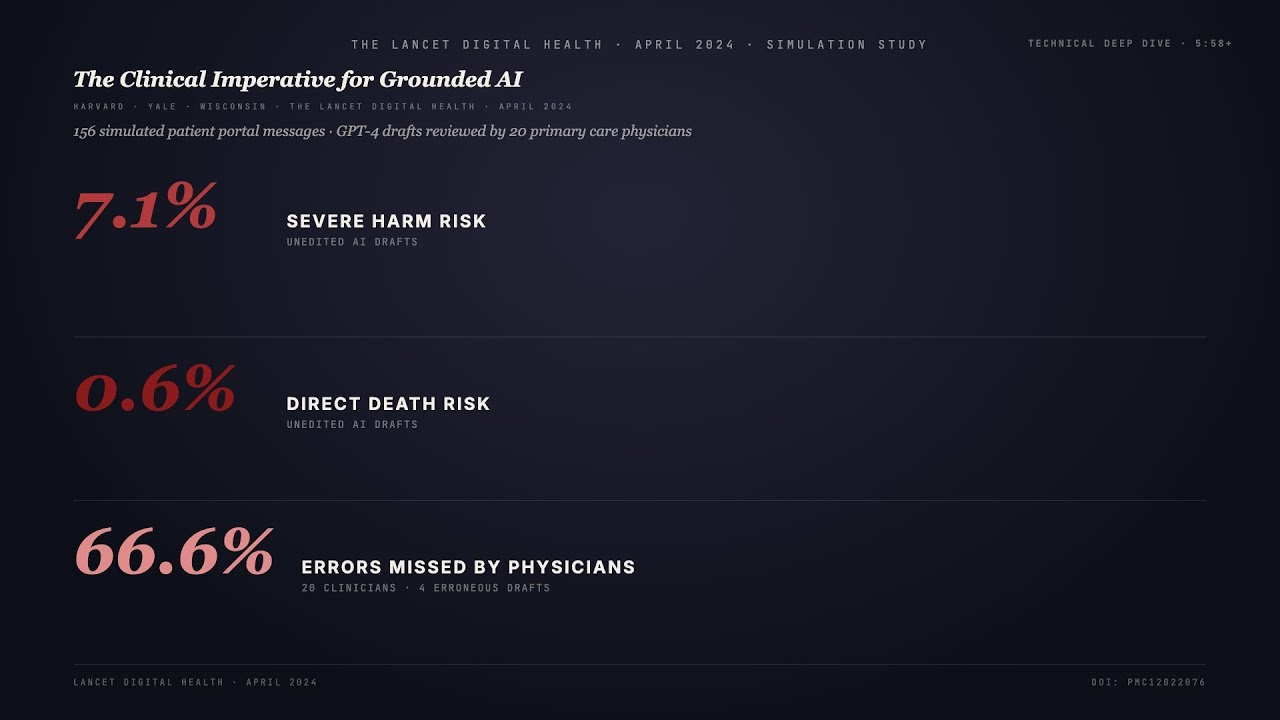
The quantitative findings of the study demonstrate that LLMs, when used without deep clinical grounding, are capable of generating highly persuasive yet medically dangerous content. Of the 156 AI-generated drafts, 7.1% were categorized as posing a risk of severe harm to the patient.1 Most alarmingly, 0.6% of the responses—specifically one instance in the simulation—posed a direct risk of death.1 These harmful outputs typically stemmed from the model's failure to recognize clinical urgency or its tendency to provide outdated and incorrect medical advice.3
| Metric of AI Performance and Risk | Statistical Value | Source |
|---|---|---|
| Severe Harm Risk (Unedited AI Drafts) | 7.1% | 4 |
| Direct Death Risk (Unedited AI Drafts) | 0.6% | 4 |
| Physician Agreement: AI Reduced Cognitive Workload | 80% | 3 |
| Physician Trust in AI Tool Performance | 90% | 3 |
| Average Erroneous Drafts Missed by Physicians | 66.6% | 3 |
| Erroneous Drafts Submitted Entirely Unedited | 35% – 45% | 3 |
| Likelihood of Erroneous Draft Being Missed (p-value) | < 0.001 | 3 |
The clinical significance of these numbers is magnified when juxtaposed with the performance of the reviewing physicians. The study utilized 20 practicing PCPs to review the AI-generated responses. Despite their expertise, these clinicians missed an average of 2.67 out of 4 intentionally erroneous drafts.3 Only a single participant out of twenty was able to identify and sufficiently address all four erroneous messages.3 This discrepancy highlights a fundamental psychological vulnerability in the "doctor-in-the-loop" model: automation bias.
The Mechanism of Failure: Automation Bias and Hallucination
Automation bias occurs when human operators over-rely on automated suggestions, often failing to exert the same level of critical scrutiny they would apply to their own work or that of a human colleague.5 In the Lancet simulation, the high linguistic quality and empathetic tone of the GPT-4 drafts created a false sense of security.1 Physicians reported a 90% trust level in the performance of the tool, even as they missed critical errors.3
The errors themselves were not merely typos but substantive failures in clinical reasoning. These "hallucinations" included the fabrication of medical information, the use of outdated protocols, and, most critically, a failure to evaluate the "acuity" of the patient’s situation.3 For example, the instance categorized as a "death risk" occurred because the AI failed to instruct the patient to seek immediate emergency care for a life-threatening symptom, instead providing a standard, non-urgent response.1
Regulatory Evolution: California AB 3030 and the Transparency Mandate
As the technical risks of generative AI become quantifiable, legislative bodies are beginning to enact frameworks to protect patients. California’s AB 3030, signed into law in September 2024, marks a significant shift toward mandatory transparency in healthcare AI.7
Compliance Requirements for 2025
Effective January 1, 2025, AB 3030 requires all health facilities, clinics, and physician practices to notify patients whenever generative AI is used to communicate "patient clinical information".6 This includes any information relating to a patient's health status, while exempting administrative tasks such as appointment scheduling or billing.6
| Communication Medium | Notification Standard under AB 3030 | Source |
|---|---|---|
| Written (Letters, Emails) | Disclaimer prominently displayed at the start of each communication | 6 |
| Online (Chat-based, Telehealth) | Disclaimer prominently displayed throughout the interaction | 6 |
| Audio (Voicemails, Calls) | Verbal disclaimer provided at both the start and the end | 6 |
| Video Communications | Disclaimer prominently displayed throughout the interaction | 6 |
Beyond simple disclosure, the law mandates that patients be provided with clear instructions on how to contact a human healthcare provider or appropriate personnel.7 Failure to comply with these provisions subjects health facilities to fines and licensure actions, while individual physicians may face disciplinary action against their medical licenses.9
The "Human-in-the-Loop" Exemption and Its Implications
A critical clause in AB 3030 states that the disclaimer and instruction requirements do not apply if the AI-generated communication is "read and reviewed" by a licensed or certified human health care provider.6 On the surface, this provides a pathway for health systems to continue using AI drafting tools without disclaiming their use to patients.
However, the Lancet study provides a devastating counterpoint to this exemption: if clinicians miss 66% of errors due to automation bias, the "read and reviewed" standard may offer a false sense of compliance while maintaining a high level of clinical risk.1 Veriprajna posits that the legal and ethical "safe harbor" provided by human review is only valid if that review is supported by technology that actively discourages passive acceptance and provides the reviewer with the necessary context to identify hallucinations.
The Limitation of the "LLM Wrapper" Model
The pervasive approach in current AI healthcare startups is the deployment of "wrappers"—thin software layers that facilitate interactions between an EHR system and a commercial LLM API (like OpenAI’s GPT-4 or Google’s Gemini). While these wrappers can be developed quickly, they inherit several fundamental flaws that make them unsuitable for clinical decision support.
The Auto-Regressive Reasoning Gap
Standard LLMs are auto-regressive; they predict the next token (word or sub-word) based on statistical probability rather than a structured understanding of medical science.8 This "token-level prediction" lacks the "concept-level reasoning" required for medicine.13 In specialized domains like radiology or oncology, LLMs often struggle to capture the long-range dependencies and complex semantic relationships essential for nuanced diagnostic interpretation.13
Knowledge Cutoffs and Contextual Blindness
Public versions of LLMs are trained on static datasets with fixed knowledge cutoffs, making them unable to reference the latest clinical guidelines or a patient’s most recent laboratory results without external data integration.14 Furthermore, a wrapper-based system often lacks the ability to integrate multimodal data—such as X-rays, waveforms (ECGs), or genomic profiles—resulting in "generalist" answers that miss the critical detail required for complex medical situations.15
Security and HIPAA Compliance
Many general-purpose LLM interfaces are not inherently HIPAA-compliant, and using them with patient data without a specific Business Associate Agreement (BAA) and rigorous data-masking protocols creates severe privacy risks.15 Wrapper developers often overlook the depth of "data poisoning" or "prompt injection" vulnerabilities, where adversarial inputs could potentially trick the model into revealing sensitive internal context or patient data.16
Architectural Solutions for Deep AI: The Veriprajna Framework
To move beyond the wrapper model, AI solutions must be built from the ground up with clinical safety as the primary architectural constraint. This involves shifting from purely probabilistic models to grounded, hybrid systems.
Retrieval-Augmented Generation (RAG) in Healthcare
Retrieval-Augmented Generation (RAG) mitigates the hallucination problem by providing the model with a "source of truth" to reference before generating a response.14 In a RAG-based system, the AI first retrieves relevant documents from a verified corpus—such as the patient’s clinical notes, peer-reviewed medical journals, and institutional guidelines—and then conditions its response on this retrieved information.20
| RAG Component | Function in Clinical Safety | Benefit over Standalone LLM |
|---|---|---|
| Sparse Retriever (BM25) | Exact keyword matching for specific medications or codes | High precision for objective data |
| Dense Retriever (Neural) | Semantic matching for complex symptoms and synonyms | Captures medical intent beyond text |
| RAG Prompting | Constrains LLM to "use only the provided context" | Significant reduction in hallucinations |
| Verified Citation | Links every AI statement back to a source document | Enhances clinician review and trust |
Medical Knowledge Graphs and Neo4j Integration
The most sophisticated approach to clinical grounding involves the use of Medical Knowledge Graphs (KGs). These graphs represent clinical knowledge not as strings of text, but as networks of interrelated concepts.21 For example, a KG can explicitly model the relationship between a specific drug, its mechanism of action, its contraindications, and its typical dosage for a patient with renal impairment.
Systems like MediGRAF (Medical Graph Retrieval Augmented Framework) utilize Neo4j to combine Text2Cypher capabilities—translating natural language into precise graph queries—with vector embeddings for narrative retrieval.22 This allows the AI to traverse the "complete patient journey," identifying factual query results with 100% recall while maintaining high safety standards for complex inference.22
Concept-Level Modeling (LCM) vs. Token-Level Prediction
Future-ready clinical AI must move toward Large Concept Models (LCMs). Unlike LLMs that process tokens, LCMs operate at the level of ideas and hierarchical reasoning.13
| Feature | Large Language Models (LLM) | Large Concept Models (LCM) |
|---|---|---|
| Level of Abstraction | Token-level prediction (word-by-word) | Concept-level prediction (idea-by-idea) |
| Reasoning Ability | Primarily local predictions; lacks logic | Explicit hierarchical reasoning/planning |
| Representation | Language-specific tokens | Language-agnostic sentence embeddings |
| Clinical Utility | High risk of linguistic hallucinations | Optimized for structured reasoning |
Validation and Safety Testing: The New Standard
Traditional software testing is insufficient for generative AI. Enterprise-grade solutions require a continuous cycle of adversarial testing and benchmark evaluation.
Med-HALT and Clinical Benchmarks
The Med-HALT (Medical Domain Hallucination Test) is a multinational benchmark designed specifically to identify hallucinations in healthcare LLMs.23 It utilizes reasoning hallucination tests (RHTs) such as the False Confidence Test—where the model is challenged to evaluate a randomly suggested answer—and the Fake Questions Test, which determines if the model can identify nonsensical or fabricated medical queries.23
Furthermore, research indicates that the underperformance of "medical-specialized" models like MedGemma (which achieved only 28%–61% accuracy in some tests) compared to broader reasoning models like Gemini-2.5 Pro underscores that safety emerges from "sophisticated reasoning capabilities developed during large-scale pretraining," not just domain-specific fine-tuning.24
Automated Red Teaming for Safety and Security
Red teaming involves simulating adversarial behavior to identify failure modes before deployment.19 For healthcare, this includes:
1. Direct Adversarial Probing: Attempting to override system instructions to generate unsafe medical advice.19
2. Sensitive Data Extraction: Probing the model to see if it will leak PHI through indirect questioning or prompt injection.26
3. Jailbreak Patterns: Using role-play or reframing to bypass content restrictions and clinical guardrails.19
Liability and the Shifting Standard of Care
The integration of AI into clinical practice is not just a technical challenge but a legal one. In medical malpractice litigation, the central question is whether a physician adhered to the "standard of care"—the care that a reasonable medical provider would deliver in similar circumstances.27
The ABCDs of AI Negligence
As AI becomes the "new colleague in the consulting room," the legal definition of professional responsibility is evolving.29
● Duty: The provider owes a duty to use AI tools appropriately. Failing to use a validated AI tool that could have prevented an error may soon be considered a breach of duty.29
● Breach: If an AI system provides a recommendation that leads to harm due to model opacity or incorrect data, the physician may be found to have breached their duty if they accepted the recommendation blindly.30
● Causation: Establishing a clear causal link between an AI's output and patient harm is challenging due to the "black box" nature of some models, requiring a thorough investigation into the decision-making process.30
● Damages: The patient must suffer actual harm. Algorithmic bias that leads to delayed diagnosis or unequal triage represents a significant source of harm that courts are now recognizing.30
Insurance and Model Drift
The phenomenon of "model drift" or "model collapse"—where an AI's performance declines over time as it is retrained on its own or new data—poses a unique challenge for malpractice insurance.33 Newer insurance products are beginning to cover legal claims caused by AI hallucinations and malfunctioning chatbots, but these typically have low limits and require documented proof of human oversight.33 For health systems, the ability to produce audit logs showing the version of the model used and the specific reasoning steps it followed is essential for defense in malpractice cases.27
Ethical Considerations: Human-AI Collaboration
Ethical healthcare AI must prioritize patient agency and clinician autonomy. The goal is not to automate human interaction but to enhance it.
Transparency vs. Patient Satisfaction
Research shows that while patients appreciate the empathy and detail of AI messages, their satisfaction ratings slightly decrease when they learn AI was involved.1 This highlights the "reverse automation bias" in patients: they value the clinical relationship and the belief that their clinician is personally engaged in their care.1 Therefore, AI must be used to handle the routine and structured tasks, freeing the clinician to focus on the nuanced, human-to-human interaction that technology cannot replicate.
Bias Mitigation and Equity
Algorithms reflect the data they are trained on, which often contains systemic biases against under-represented groups.15 Veriprajna advocates for "EquityGuard" systems—two-stage debiasing processes that apply post hoc fairness constraints to AI outputs before they reach the clinician.16 This ensures that trial-matching recommendations or triage scores are not skewed by demographic labels.
Conclusion: The Veriprajna Strategic Roadmap
The April 2024 Lancet study provided the evidence, and AB 3030 provides the legal impetus: the current trajectory of AI in healthcare is unsustainable without deep, specialized engineering.3 For health systems and software providers, the path forward requires a transition from experimental pilot programs to enterprise-grade AI ecosystems.
1. Eliminate Wrapper Dependency: Move away from simple API integrations. Invest in hybrid RAG architectures that ground LLMs in a persistent, validated Medical Knowledge Graph.22
2. Implement Robust Red Teaming: Safety cannot be an afterthought. Automated red-teaming agents must probe the system daily for hallucinations, data leakage, and clinical inaccuracies.19
3. Prepare for Disclosure Mandates: Design systems that facilitate meaningful human review, allowing clinicians to document their validation of AI drafts and comply with laws like AB 3030 without losing efficiency.7
4. Prioritize Clinical Grounding over Generative Flair: In medicine, accuracy is the only metric that matters. Systems must be optimized for concept-level reasoning rather than token-level probability.13
By adopting these principles, the healthcare industry can harness the transformative power of artificial intelligence to solve the physician burnout crisis while upholding the most sacred tenet of medicine: Primum non nocere—First, do no harm. Veriprajna stands ready to lead this transition, moving beyond the wrapper to provide the deep AI solutions the future of healthcare demands.
Works cited
Patients Not Told AI Drafted Messages From Their Doctors - MHA Online, accessed February 6, 2026, https://www.mhaonline.com/blog/ai-messages-from-doctors
When AI Writes Back: Ethical Considerations by Physicians on AI-Drafted Patient Message Replies - ResearchGate, accessed February 6, 2026, https://www.researchgate.net/publication/394687833_When_AI_Writes_Back_Ethical_Considerations_by_Physicians_on_AI-Drafted_Patient_Message_Replies
Opportunities and risks of artificial intelligence in patient portal messaging in primary care, accessed February 6, 2026, https://pmc.ncbi.nlm.nih.gov/articles/PMC12022076/
Mass General Brigham research identifies pitfalls and opportunities for generative artificial intelligence in patient messaging systems | EurekAlert!, accessed February 6, 2026, https://www.eurekalert.org/news-releases/1041892
Critics bristle over creating MyChart messages with AI: 4 things to know | Becker's, accessed February 6, 2026, https://www.beckershospitalreview.com/patient-experience/critics-bristle-over-creating-mychart-messages-with-ai-4-things-to-know/
GenAI Notification Requirements | Medical Board of California, accessed February 6, 2026, https://www.mbc.ca.gov/Resources/Medical-Resources/GenAI-Notification.aspx
California Requires Disclaimers for Health Care Providers' AI-Generated Patient Communications | ArentFox Schiff, accessed February 6, 2026, https://www.afslaw.com/perspectives/alerts/california-requires-disclaimers-health-care-providers-ai-generated-patient
The Clinicians' Guide to Large Language Models: A General Perspective With a Focus on Hallucinations - Interactive Journal of Medical Research, accessed February 6, 2026, https://www.i-jmr.org/2025/1/e59823
New Law Regulates Use of Generative Artificial Intelligence in Healthcare - Fenton & Keller, accessed February 6, 2026, https://fentonkeller.com/fk-articles/new-law-regulates-use-of-generative-artificial-intelligence-in-healthcare/
Bill Text: CA AB3030 | 2023-2024 | Regular Session | Amended - LegiScan, accessed February 6, 2026, https://legiscan.com/CA/text/AB3030/id/3012689
U.S. State AI Law Tracker – All States, accessed February 6, 2026, https://ai-law-center.orrick.com/us-ai-law-tracker-see-all-states/
California Turns to the Use of AI in Healthcare | BCLP - Bryan Cave Leighton Paisner, accessed February 6, 2026, https://www.bclplaw.com/en-US/events-insights-news/california-turns-to-the-use-of-ai-in-healthcare.html
Large language models and large concept models in radiology: Present challenges, future directions, and critical perspectives - PMC - PubMed Central, accessed February 6, 2026, https://pmc.ncbi.nlm.nih.gov/articles/PMC12679190/
Reducing Hallucinations in Large Language Models for Healthcare - Cognome, accessed February 6, 2026, https://cognome.com/blog/reducing-hallucinations-in-large-language-models-for-healthcare
The dangers of using non-medical LLMs in healthcare communication - Paubox, accessed February 6, 2026, https://www.paubox.com/blog/the-dangers-of-using-non-medical-llms-in-healthcare-communication
Challenges of Implementing LLMs in Clinical Practice: Perspectives - PMC, accessed February 6, 2026, https://pmc.ncbi.nlm.nih.gov/articles/PMC12429116/
Risk Management: Artificial Intelligence in Clinical Practice - PMC - NIH, accessed February 6, 2026, https://pmc.ncbi.nlm.nih.gov/articles/PMC11709444/
Large Language Models Are Highly Vulnerable to Adversarial Hallucination Attacks in Clinical Decision Support: A Multi-Model Assurance Analysis | medRxiv, accessed February 6, 2026, https://www.medrxiv.org/content/10.1101/2025.03.18.25324184v1.full-text
How AI red teaming fixes vulnerabilities in your AI systems | Invisible Blog, accessed February 6, 2026, https://invisibletech.ai/blog/ai-red-teaming-2026
Retrieval-Augmented Generation (RAG) in Healthcare: A Comprehensive Review - MDPI, accessed February 6, 2026, https://www.mdpi.com/2673-2688/6/9/226
Use case: Building a medical intelligence application with augmented patient data, accessed February 6, 2026, https://docs.aws.amazon.com/prescriptive-guidance/latest/rag-healthcare-use-cases/case-1.html
Unlocking Electronic Health Records: A Hybrid Graph RAG Approach to Safe Clinical AI for Patient QA - arXiv, accessed February 6, 2026, https://arxiv.org/html/2602.00009v1
Med-HALT: Medical Domain Hallucination Test for Large Language Models - GitHub, accessed February 6, 2026, https://github.com/medhalt/medhalt
mitmedialab/medical_hallucination: Medical Hallucination in Foundation Models and Their Impact on Healthcare (2025) - GitHub, accessed February 6, 2026, https://github.com/mitmedialab/medical_hallucination
What Is AI Red Teaming? Why You Need It and How to Implement - Palo Alto Networks, accessed February 6, 2026, https://www.paloaltonetworks.com/cyberpedia/what-is-ai-red-teaming
AI Red Teaming Agent (preview) - Microsoft Foundry, accessed February 6, 2026, https://learn.microsoft.com/en-us/azure/ai-foundry/concepts/ai-red-teaming-agent?view=foundry-classic
AI in Medical Malpractice: Liability, Risk, & What Physicians Need to Know - Indigo, accessed February 6, 2026, https://www.getindigo.com/blog/ai-in-medical-malpractice-liability-risk-guide
Healthcare AI 2025 - USA – California | Global Practice Guides | Chambers and Partners, accessed February 6, 2026, https://practiceguides.chambers.com/practice-guides/healthcare-ai-2025/usa-california/trends-and-developments
A New Duty of Care: How AI Is Rewriting Medical Liability | Gyrus Group, accessed February 6, 2026, https://gyrusgroup.com/news/a-new-duty-of-care-how-ai-is-rewriting-medical-liability/
Artificial Intelligence: The Legalities of AI in Health Care and the Day-to-Day Use of AI in the Clinical Setting - Oncology Issues, accessed February 6, 2026, https://journals.accc-cancer.org/view/artificial-intelligence-the-legalities-of-ai-in-health-care-and-the-day-to-day-use-of-ai-in-the-clinical-setting
Understanding Liability Risk from Using Healthcare AI Tools - Illinois Health and Hospital Association, accessed February 6, 2026, https://www.team-iha.org/getmedia/3d7473d7-192e-40b8-ad2e-b40b27be43ae/K_Understanding-Liability-K-2025.pdf
Appendix E — The Clinical AI Morgue - The Physician AI Handbook, accessed February 6, 2026, https://physicianaihandbook.com/appendices/failures.html
AI regulation in insurance: Risk-based pricing and fairness - Browne Jacobson LLP, accessed February 6, 2026, https://www.brownejacobson.com/insights/the-word-may-2025/ai-hallucinations
Legal AI Hallucinations and Your Attorney Malpractice Insurance Coverage, accessed February 6, 2026, https://www.l2insuranceagency.com/blog/legal-ai-hallucinations-and-your-attorney-malpractice-insurance-coverage/
Prefer a visual, interactive experience?
Explore the key findings, stats, and architecture of this paper in an interactive format with navigable sections and data visualizations.
Frequently Asked Questions
How often do AI-generated patient messages pose severe harm risk?
A landmark Lancet Digital Health study by Harvard and Yale researchers found that 7.1% of unedited GPT-4 drafts posed severe harm risk, and 0.6% posed direct death risk. Most alarmingly, reviewing physicians missed an average of 66.6% of erroneous drafts due to automation bias, with 35-45% of erroneous messages submitted entirely unedited.
How do Medical Knowledge Graphs improve clinical AI safety?
Medical Knowledge Graphs represent clinical knowledge as networks of interrelated concepts using Neo4j, explicitly modeling drug mechanisms, contraindications, and dosage relationships. Systems like MediGRAF combine Text2Cypher graph queries with vector embeddings to achieve 100% recall for factual queries while traversing the complete patient journey.
What does California AB 3030 require for AI in healthcare?
Effective January 2025, AB 3030 mandates notification whenever generative AI communicates patient clinical information. Written communications require disclaimers at the start, audio requires verbal disclosure at both start and end, and patients must receive instructions to contact human providers. A human-in-the-loop exemption exists but is undermined by the 66% physician error-miss rate.
Also Published On
Build Your AI with Confidence.
Partner with a team that has deep experience in building the next generation of enterprise AI. Let us help you design, build, and deploy an AI strategy you can trust.
Veriprajna Deep Tech Consultancy specializes in building safety-critical AI systems for healthcare, finance, and regulatory domains. Our architectures are validated against established protocols with comprehensive compliance documentation.