Beyond the LLM Wrapper in Healthcare Communications
A landmark simulation study found that AI-drafted patient messages carry a 7.1% severe harm rate—and physicians miss two-thirds of those errors. The "human-in-the-loop" safety net is failing.
This whitepaper examines the forensic evidence, the regulatory response (California AB 3030), and the architectural shift required—from LLM wrappers to RAG-grounded, knowledge-graph-backed clinical AI.
Primary care physicians spend an average of 10 hours monthly on unbillable patient portal messages. AI promises relief—but the cure may be worse than the disease.
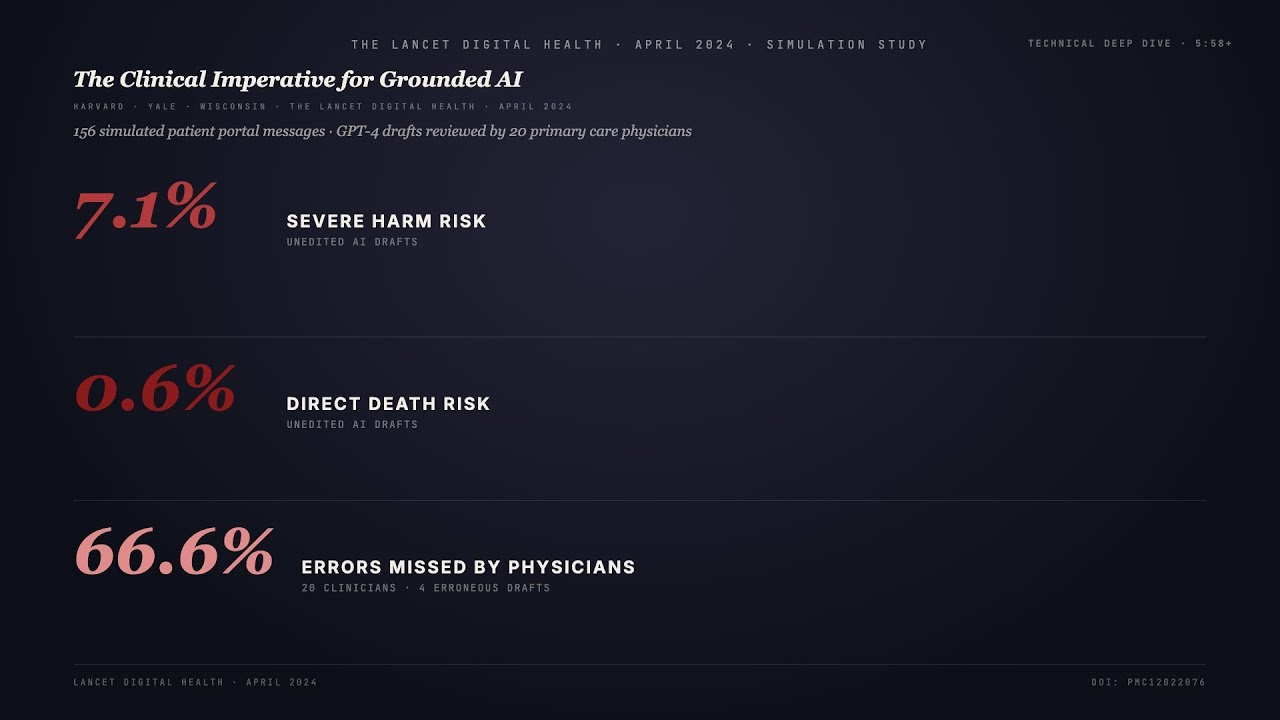
A cross-sectional simulation across Harvard, Yale, and Wisconsin assessed GPT-4 drafts for 156 patient portal messages in a simulated EHR. Of unedited outputs, 7.1% posed severe harm and 0.6% posed direct death risk.
Twenty practicing PCPs reviewed the AI-generated drafts. On average, clinicians missed 2.67 out of 4 intentionally erroneous messages. Only one physician out of twenty caught all four errors.
Despite these failures, 90% of physicians reported trusting the AI tool's performance. 80% agreed it reduced their cognitive workload. High linguistic quality created a false sense of security.
"The high linguistic quality and empathetic tone of the AI drafts created a false sense of security. Physicians reported 90% trust even as they missed critical errors. This is automation bias—and in medicine, it can be lethal."
Automation bias occurs when human operators over-rely on automated suggestions, failing to apply the same critical scrutiny they would to their own work. In the clinical simulation, physicians didn't just miss errors—they actively submitted harmful drafts unedited.
The errors weren't typos. They were substantive failures in clinical reasoning: fabrication of medical information, outdated protocols, and critically, failure to evaluate the acuity of the patient's condition. One instance instructed a patient to wait instead of seeking emergency care for a life-threatening symptom.
Effective January 2025, AB 3030 requires all health facilities to notify patients whenever generative AI is used to communicate clinical information. The era of silent AI drafting is over.
AB 3030 exempts communications that are "read and reviewed" by a licensed provider from the disclosure requirement. On paper, this provides a pathway for health systems to use AI drafting without disclaimers.
However, the evidence is devastating: if clinicians miss 66% of errors due to automation bias, the "read and reviewed" standard offers a false sense of compliance while maintaining high clinical risk. The legal and ethical safe harbor is only valid if the review is supported by technology that actively discourages passive acceptance.
The pervasive approach—thin software layers that pass EHR data to a commercial LLM API—inherits fundamental flaws that make them unsuitable for clinical decision support.
Standard LLMs predict the next token based on statistical probability—not structured understanding of medical science. This "token-level prediction" lacks the concept-level reasoning medicine demands.
LLMs are trained on static datasets with fixed cutoffs—unable to reference the latest clinical guidelines or a patient's most recent lab results without external integration. They lack multimodal data fusion.
General-purpose LLMs are not inherently HIPAA-compliant. Without rigorous BAA agreements and data-masking, wrapper architectures expose patient data to prompt injection and data poisoning attacks.
To move beyond the wrapper model, AI solutions must be built from the ground up with clinical safety as the primary architectural constraint.
RAG mitigates hallucination by providing the model with a verified source of truth before generating a response. The AI first retrieves relevant documents—clinical notes, peer-reviewed journals, institutional guidelines—then conditions its response on this retrieved information.
Knowledge Graphs represent clinical knowledge not as strings of text but as networks of interrelated concepts. A KG explicitly models relationships between drugs, mechanisms, contraindications, and dosage adjustments for specific patient conditions.
Future-ready clinical AI must move toward Large Concept Models. Unlike LLMs that process tokens, LCMs operate at the level of ideas and hierarchical reasoning—optimized for the structured thinking medicine demands.
| Feature | LLM | LCM |
|---|---|---|
| Abstraction | Token-level | Concept-level |
| Reasoning | Local prediction | Hierarchical planning |
| Representation | Language-specific | Language-agnostic |
| Clinical Fit | High hallucination risk | Structured reasoning |
Traditional software testing is insufficient for generative AI. Enterprise-grade solutions require continuous adversarial testing using frameworks like Med-HALT (Medical Domain Hallucination Test) alongside automated red teaming.
LLM Wrapper vs. Veriprajna Grounded AI across critical healthcare dimensions
As AI becomes the "new colleague in the consulting room," the legal definition of professional responsibility is evolving alongside the technology.
The provider owes a duty to use AI tools appropriately. Failing to use a validated AI tool that could have prevented an error may soon be considered a breach of duty.
If an AI system provides a recommendation that leads to harm due to model opacity or incorrect data, the physician may be found in breach if they accepted the recommendation blindly.
Establishing a causal link between AI output and patient harm is challenging due to "black box" opacity, requiring thorough investigation into the decision-making process.
Algorithmic bias leading to delayed diagnosis or unequal triage represents a significant source of harm that courts are now beginning to recognize.
"Model drift" or "model collapse"—where an AI's performance degrades over time as it is retrained—poses a unique challenge for malpractice insurance. Newer insurance products are beginning to cover claims caused by AI hallucinations, but typically require documented proof of human oversight.
For health systems, the ability to produce audit logs showing the exact model version used and the specific reasoning steps followed is essential for defense in malpractice cases.
Ethical healthcare AI must prioritize patient agency and clinician autonomy. The goal is not to automate human interaction but to enhance it—handling routine and structured tasks so clinicians can focus on the nuanced, human-to-human care technology cannot replicate.
Research shows that while patients appreciate the empathy and detail of AI messages, their satisfaction slightly decreases when they learn AI was involved. Patients value the belief that their clinician is personally engaged in their care.
Mapping clinical communication tasks by complexity and risk
The evidence is clear and the legal impetus is set. The path forward requires a transition from experimental pilot programs to enterprise-grade AI ecosystems.
Move away from simple API integrations. Invest in hybrid RAG architectures that ground LLMs in a persistent, validated Medical Knowledge Graph—ensuring every claim has provenance.
Safety cannot be an afterthought. Automated red-teaming agents must probe the system daily for hallucinations, data leakage, and clinical inaccuracies—using Med-HALT benchmarks as the standard.
Design systems that facilitate meaningful human review—allowing clinicians to document their validation of AI drafts and comply with laws like AB 3030 without losing efficiency.
In medicine, accuracy is the only metric that matters. Systems must be optimized for concept-level reasoning rather than token-level probability. The right answer matters infinitely more than a well-written wrong one.
Primum non nocere—First, do no harm.
By adopting these principles, the healthcare industry can harness the transformative power of AI to solve the physician burnout crisis while upholding the most sacred tenet of medicine.
A cross-sectional simulation across Harvard, Yale, and Wisconsin assessed GPT-4 drafts for 156 patient portal messages in a simulated EHR. Of unedited AI outputs, 7.1% posed severe harm and 0.6% posed direct death risk — including one instance instructing a patient to wait rather than seek emergency care for a life-threatening symptom. When 20 practicing PCPs reviewed these drafts, they missed an average of 2.67 out of 4 intentionally erroneous messages (66.6% miss rate). Only one physician out of twenty caught all four errors. Most critically, 35-45% of physicians submitted harmful drafts completely unedited, while 90% reported trusting the AI tool's performance and 80% felt it reduced their workload. This demonstrates that high linguistic quality creates a false sense of security — automation bias that is lethal in clinical settings.
Veriprajna's deep clinical AI replaces the LLM wrapper passthrough model with four integrated components: (1) Retrieval-Augmented Generation using hybrid sparse (BM25 for exact medication and code matching) and dense (neural for semantic symptom matching) retrievers, with every AI statement linked back to a source document via verified citations. (2) Medical Knowledge Graphs built on Neo4j that model relationships between drugs, mechanisms, contraindications, and dosage adjustments as structured networks, queryable through Text2Cypher for precise graph queries and vector embeddings for narrative context, with 100% factual recall across patient journeys. (3) Concept-Level Modeling (LCM architecture) operating at the level of ideas and hierarchical reasoning rather than token-level prediction. (4) Adversarial validation using Med-HALT benchmarks and automated red teaming including direct probing, PHI extraction testing, and jailbreak pattern detection.
Effective January 2025, AB 3030 requires all health facilities to notify patients whenever generative AI is used to communicate clinical information. Requirements vary by medium: written communications (letters, emails, portal messages) must display an AI disclaimer at the start of each message with instructions for contacting a human provider. Online communications (chat, telehealth) require persistent AI disclaimers throughout the entire interaction. Audio communications require verbal disclaimers at both start and end. Video communications require visible disclaimers for the full session duration. While AB 3030 exempts communications 'read and reviewed' by a licensed provider, the evidence is devastating — if clinicians miss 66% of errors due to automation bias, this exemption provides a false safe harbor while maintaining high clinical risk. Systems must actively discourage passive acceptance, not merely claim human oversight.
Veriprajna stands ready to lead the transition from experimental wrappers to deep, evidence-based clinical AI. Let us assess your current architecture and chart the path to patient-safe automation.
Schedule a consultation to evaluate your AI safety posture, identify hallucination risks, and design a compliant, grounded architecture.
Complete analysis: Lancet study forensics, AB 3030 compliance guide, RAG architecture specs, Med-HALT benchmarking methodology, Knowledge Graph integration blueprint, and liability framework.