Beyond Syntax: The Imperative for Neuro-Symbolic AI and Ontology-Driven Phenotyping in Clinical Trial Recruitment
1. The Economic and Clinical Crisis of Recruitment Failure
The pharmaceutical industry stands at a precarious intersection of unprecedented scientific capability and unsustainable operational inefficiency. While the mechanisms of drug discovery have been revolutionized by high-throughput screening, generative biology, and computational chemistry, the machinery of clinical validation remains tethered to archaic processes that threaten the economic viability of modern therapeutics. The "Eroom's Law" phenomenon—the observation that drug discovery is becoming slower and more expensive over time, inversely proportional to improvements in transistor density—is not a failure of science, but a failure of process. 1 At the heart of this operational crisis lies the persistent inability to efficiently identify and recruit eligible patients for clinical trials.
Contemporary analysis indicates that the vast majority of clinical trials—approximately 80%—fail to meet their enrollment timelines. 2 This statistic is not merely a metric of delay; it is a quantifier of lost innovation and deferred hope. When recruitment stalls, the entire drug development pipeline seizes, creating a cascading failure that impacts financial returns, regulatory approval timelines, and, most critically, patient access to life-saving therapies. The industry’s current approach to this bottleneck, often characterized by the deployment of generic PDF parsers and "Ctrl+F" keyword matching, represents a fundamental misunderstanding of the problem. We are attempting to cure cancer with syntax, when the cure lies in semantics.
1.1 The Financial Calculus of Latency
Time is the single most expensive resource in the pharmaceutical ecosystem. In an industry governed by patent exclusivity windows, every day lost in clinical development is a day deducted from the period of peak revenue generation. The financial impact of trial delays extends far beyond the immediate operational burn rate; it erodes the net present value (NPV) of the asset and fundamentally alters the return on investment (ROI) profile of the research portfolio.
Research conducted by the Tufts Center for the Study of Drug Development (CSDD) provides a stark and rigorous quantification of this cost. While historical estimates from the 1990s often cited a broad range of $600,000 to $8 million per day of delay, updated analyses refined for the 2024-2025 economic landscape provide a more precise and alarming picture. The value of a single day of delay in drug development is now estimated at approximately $800,000 in lost prescription sales for an average high-performing asset. 4
However, this average masks the extreme volatility present in high-value therapeutic areas. For blockbuster indications in oncology, cardiovascular disease, or hematology, the cost of latency is significantly higher. Niche oncology therapies, which often target specific genetic markers and require precise patient matching, face intense competitive pressure. A delay of mere months can result in a "second-to-market" entry, potentially costing billions in lost market share over the product's lifecycle. 5
The operational costs alone—the direct expense of keeping trial sites open, monitoring data, and maintaining CRO contracts—add roughly $40,000 per day for Phase II and III trials. 4 Yet, the true cost is the opportunity cost. In competitive indications like non-small cell lung cancer (NSCLC) or acute myeloid leukemia (AML), multiple assets often race toward the same regulatory finish line. The first entrant typically captures the majority of the market share and establishes the standard of care. Being second, due to recruitment delays, renders an otherwise scientifically superior drug commercially inviable.
Table 1: The Financial Impact of Clinical Trial Delays by Therapeutic Area
| Therapeutic Area | Median Lost Sales per Day of Delay (2023 USD) |
Operational Complexity Factor |
|---|---|---|
| Cardiovascular | $1.4 Million | High (Large cohorts, complex monitoring) |
| Hematology | $1.3 Million | High (Specialized sites, rare phenotypes) |
| Oncology | $840,000 | Very High (Genetic screening, complex exclusions) |
| Central Nervous System | Variable | Moderate to High (Subjective endpoints) |
Data derived from Tufts CSDD Impact Report and associated financial analyses. 4
This financial reality creates an imperative for efficiency that cannot be met by manual processes or generic automation. The difference between a trial that enrolls on time and one that delays for six months is often the difference between a profitable asset and a write-off.
1.2 The Operational Bottleneck: The Screening Failure Funnel
The recruitment crisis is not defined solely by a lack of patients, but by the inefficiency of the screening funnel. The industry does not suffer from a shortage of disease prevalence; it suffers from a shortage of identifiable eligibility. It is estimated that 37% of research sites under-enroll, and a staggering 11% fail to enroll a single patient . 3 This inefficiency is largely driven by high screen failure rates, where patients are identified as potential candidates based on superficial criteria but are ultimately rejected after expensive and time-consuming manual review.
The cost of a screen failure is significant, averaging roughly $1,200 per failure across the industry. 3 This cost accounts for the time of site coordinators, the expense of preliminary testing, and the administrative burden of processing the patient's data. When automated systems produce high volumes of false positives—patients who appear eligible based on keywords but are ineligible based on clinical logic—they clog the recruitment funnel.
This phenomenon creates a "denial of service" attack on clinical research sites. Site coordinators, already overburdened by administrative tasks, are flooded with lists of "potential matches" generated by low-fidelity AI tools. If a tool delivers 100 candidates but only 5 are truly eligible, the coordinator will quickly lose trust in the system and revert to manual methods. This paradox—that more automation can lead to less efficiency—is a direct result of the "precision gap" in current matching technologies.
Furthermore, the growing complexity of trial protocols exacerbates this issue. Modern protocols are no longer simple lists of inclusion and exclusion criteria. They are complex logical structures containing dozens of conditional clauses, temporal dependencies (e.g., "No prior exposure to Drug X within 6 months unless context Y"), and intricate biomarker requirements. Human recruiters, fatigued by high volumes of EHR data, and generic AI parsers, lacking temporal and ontological reasoning, struggle to apply these criteria consistently. 6
1.3 The Human and Ethical Imperative
Beyond the financial metrics lies the ethical imperative of clinical research. Delays in recruitment translate directly to delays in regulatory approval. For patients with progressive conditions such as metastatic cancer, neurodegenerative diseases, or rare genetic disorders, a six-month delay in a trial start-up or enrollment phase is not a statistic; it is a life-altering span of time. It can mean the difference between accessing a potentially curative therapy and receiving palliative care. 7
The current standard of care for recruitment involves manually scanning PDF medical records or using rudimentary "Ctrl+F" keyword searches to find patients. This approach is inherently biased against complex patients. It favors those with simple, clearly documented histories and excludes those whose eligibility is buried in unstructured notes or complex conditional logic. By failing to accurately identify eligible patients, we are not only delaying drugs; we are denying access.
This whitepaper argues that the solution to this crisis requires a fundamental shift in how we process clinical data. We must move from stochastic text processing to Ontology-Driven Phenotyping . We must replace the probability of the LLM with the certainty of the logic solver. Veriprajna positions itself at the vanguard of this transition, leveraging Neuro-Symbolic AI to bridge the gap between the unstructured language of care and the rigorous logic of research.
2. The Failure of Syntax: Why PDF Parsers and Generic AI Miss the Mark
The pharmaceutical industry has attempted to solve the recruitment bottleneck with Natural Language Processing (NLP) for over a decade. However, early efforts have largely relied on syntax-based approaches —keyword matching, regular expressions, and boolean search strings—or, more recently, probabilistic generation via Large Language Models (LLMs) like GPT-4 or Claude. Both approaches, while technically distinct, share a common failure mode in the context of clinical trials: they lack Semantic Precision .
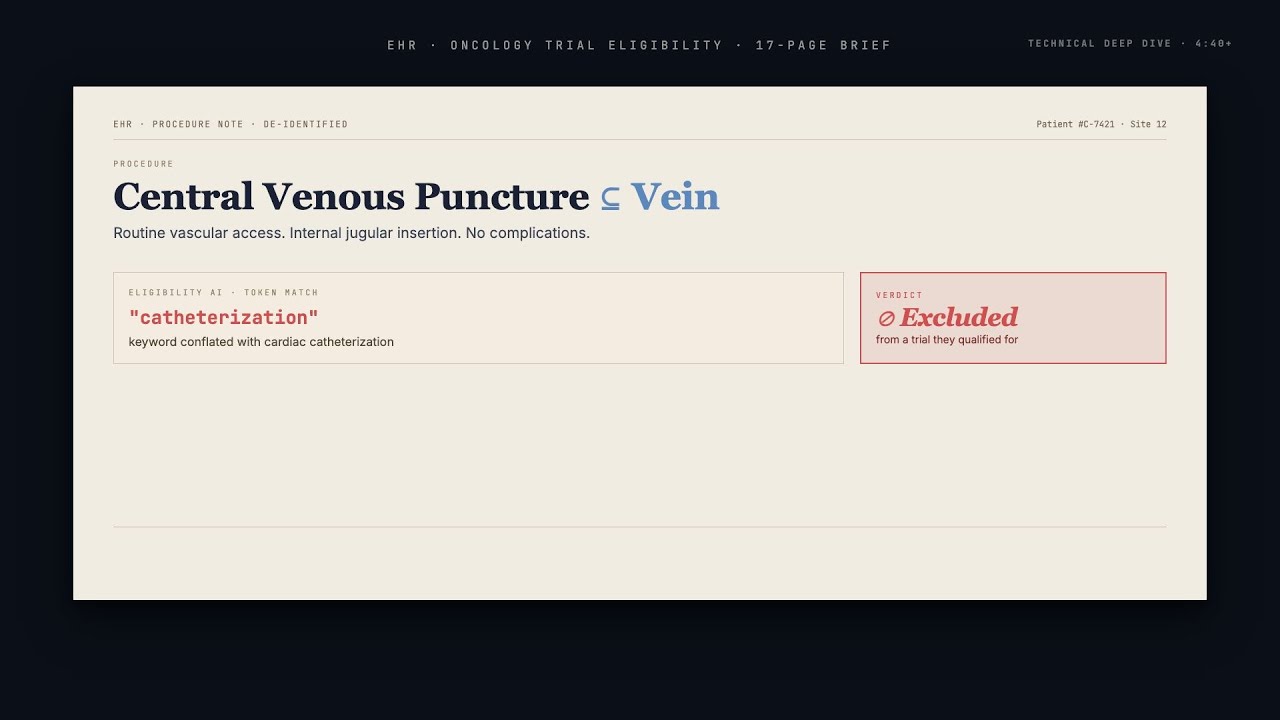
2.1 The "Cardiac Catheterization" vs. "Central Venous Puncture" Fallacy
To understand the profound failure of syntax-based matching, we must examine a specific clinical scenario that highlights the lack of ontological grounding in generic AI. This example is not a corner case; it represents a class of errors that pervades automated recruitment systems.
Consider a clinical trial protocol for a novel anticoagulant that explicitly lists "Cardiac Catheterization" as an exclusion criterion. The medical rationale is sound: cardiac catheterization involves passing a catheter into the heart chambers or coronary arteries to evaluate function or treat blockage. 9 It is a high-risk, invasive cardiac procedure that implies recent cardiovascular instability, making the patient unsuitable for the trial's safety profile.
Now, consider a patient whose Electronic Health Record (EHR) contains a physician's note describing a "Central Venous Puncture" (often for the placement of a Central Venous Catheter or CVC). This procedure involves accessing a major vein (internal jugular, subclavian, or femoral) to administer medication, fluids, or monitor central venous pressure. 11 While invasive, it is a vascular access procedure, often performed at the bedside in intensive care, and is fundamentally distinct from cardiac catheterization in anatomical target, physiological impact, and risk profile.
The Failure Mode of Generic AI:
1. Keyword Conflation: A standard keyword matching algorithm—or a poorly prompted LLM operating on vector similarity—scans the patient's record. It identifies terms like "catheter," "venous," "puncture," and potentially "cardiac" (if the CVC was placed in a Cardiac Care Unit or CCU).
2. Vector Proximity: In the high-dimensional latent space of a generic embedding model, "Cardiac Catheterization" and "Central Venous Catheterization" are positioned closely together. Both are medical procedures; both involve catheters; both involve the vascular system. The generic model, lacking a rigid medical ontology, conflates the two based on thematic similarity.
3. False Exclusion: The AI concludes that the patient has undergone the excluded heart-related procedure. It tags the patient as ineligible.
4. Result: An eligible patient is lost to the trial. The site coordinator never sees this patient, or worse, sees a false rejection and loses confidence in the tool.
This is not a hypothetical error. Recent studies evaluating AI models for trial matching have identified specific failure modes where models incorrectly conclude that "cardiac catheterization is the same as a central venous puncture," leading to wrongful exclusion. 2 This error stems from a lack of ontological distinction ; the AI knows the words are related, but it does not know how they are distinct.
2.2 The Limitations of Probabilistic LLMs in High-Stakes Decision Making
The advent of Generative AI has led some to believe that "better prompts" will solve this issue. However, Large Language Models suffer from inherent structural limitations when applied to the deterministic requirements of clinical trial protocols. In high-stakes healthcare environments, the "black box" nature of neural networks presents three critical barriers:
1. Lack of Determinism: LLMs are probabilistic engines designed to predict the next likely token. They are not logic engines. An LLM might correctly identify a patient as eligible on one run and ineligible on the next, based on slight variations in the prompt, the temperature setting, or the surrounding context window. Clinical trials require 100% reproducible audit trails ; regulators must know exactly why a patient was included or excluded. 13
2. Inability to Verify Truth (The Hallucination Problem): LLMs do not verify facts against a ground truth database unless explicitly architected to do so. If a patient note is ambiguous, an LLM may hallucinate a diagnosis to fill the gap, "inventing" a comorbidity that excludes the patient or, more dangerously, inventing a clearance that includes an ineligible patient.
3. Privacy Leaks and Governance: Sending unstructured patient data to public model APIs raises significant HIPAA/GDPR concerns. While enterprise instances exist, the fundamental architecture of massive parameters interacting with private health data requires strict privacy-preserving architectures that wrapper APIs often fail to provide. 13
The "hot take" driving Veriprajna's philosophy is grounded in this reality: the industry is attempting to solve a logic problem (eligibility) with a probability tool (LLMs). The solution requires moving from probability to provability.
3. Ontology-Driven Phenotyping: The SNOMED CT Advantage
To resolve the failure of syntax and the risks of probability, Veriprajna advocates for and implements Ontology-Driven Phenotyping . This approach fundamentally shifts the task from reading words to mapping standardized medical concepts. We utilize SNOMED CT (Systematized Nomenclature of Medicine -- Clinical Terms), the world's most comprehensive multilingual clinical healthcare terminology, to provide the "ground truth" for our AI. 15
3.1 The Power of the Hierarchy (Is-A Relationships)
SNOMED CT is not merely a dictionary; it is a poly-hierarchical ontology structured as a directed acyclic graph (DAG). Concepts are linked by logical relationships, most notably the Is-A (subtype) relationship. This structure allows the AI to understand granularity, inheritance, and anatomical context in a way that flat keyword lists cannot.
Returning to the "Cardiac Catheterization" example, a SNOMED-aware system understands the following distinct hierarchies:
Hierarchy A: The Exclusion Target
● Concept: Cardiac catheterization (procedure)
○ Parent: Procedure on heart (procedure) ○ Parent: Invasive procedure (procedure) ○ Child: Coronary angiography (procedure) ○ Child: Left heart catheterization (procedure) 18
Hierarchy B: The Patient Event
● Concept: Central venous catheterization (procedure)
○ Parent: Catheterization of vein (procedure) 19
○ Parent: Insertion of vascular catheter (procedure)
○ Child: Insertion of peripherally inserted central catheter (procedure)
The Reasoning Engine: When the protocol excludes "Cardiac Catheterization," the Ontology-Driven AI does not look for the words "cardiac" or "catheter." It performs a semantic query on the graph: Is the patient's procedure (SCTID: 392230005) a subtype of the exclusion criteria (SCTID: 41976001)? The SNOMED hierarchy answers NO . The concepts exist on different branches of the procedure tree (Heart vs. Vein). The AI deterministically rules the patient eligible regarding this criterion. 2 This logic holds even if the doctor wrote "Central Line Placement" or "CVC Insertion," because the entity extraction layer maps all those synonyms to the correct SCTID before the logic check occurs.
3.2 Solving the Synonymy and Granularity Problem
Medical documentation is rife with synonyms, abbreviations, and varying levels of granularity. A doctor might write "Heart Cath," "Angio," "Coronary Angiography," or "LHC" (Left Heart Cath). A keyword search needs to be hard-coded with every possible variation, and it will still miss novel phrasings.
SNOMED CT handles this via Synonymy and Concept Permanence . The concept Coronary artery disease is automatically mapped to "CAD," "Coronary arteriosclerosis," "Arteriosclerotic heart disease," and dozens of other variants. 20 Our AI extracts the concept ID (SCTID), not the string. Once the text is converted to an SCTID, the ambiguity vanishes. The matching is performed concept-to-concept, not word-to-word.
Furthermore, SNOMED CT allows for Post-Coordination, where concepts can be refined by attributes. For example, a "Left kidney stone" is not just a string; it is the concept Kidney stone refined by the laterality attribute Left. 22 This allows the AI to match against protocols that specify laterality or severity (e.g., "Exclude patients with bilateral kidney disease") with mathematical precision.
3.3 Constructing the Computational Phenotype
By aggregating these SCTIDs from the unstructured text, we construct a "computational phenotype" of the patient. This phenotype is a structured set of codes representing the patient's exact clinical state, distinguishing between:
● Diagnosis (Disorder): e.g., Malignant tumor of lung
● Procedure: e.g., Lobectomy of lung
● Finding: e.g., Mass in lung
This distinction is crucial. A "Finding" of a mass is not the same as a "Diagnosis" of cancer. A keyword search for "lung mass" might exclude a patient from a healthy volunteer study, or include them in a cancer trial erroneously. Ontology-driven phenotyping respects the distinction between a suspected condition and a confirmed diagnosis. 16
4. The Logic of Exclusion: Deontic Reasoning in Eligibility Criteria
While SNOMED CT handles the what (the medical concepts), Deontic Logic handles the how (the rules of engagement). Clinical trial criteria are rarely simple boolean statements (Presence/Absence). They are complex normative statements governing what is Obligatory (must have), Permitted (can have), or Forbidden (must not have). 24
4.1 The Complexity of "Unless": Parsing Exception Clauses
A major failure point for generic AI is the "Exception Clause." Trial protocols frequently include exclusion criteria that are conditional. Consider the following standard exclusion criterion in oncology trials:
"Exclude patients with hypertension, unless it is well-controlled on stable medication for at least 3 months."
A keyword matcher sees "hypertension" and excludes the patient. A standard boolean filter might see "hypertension = TRUE" and exclude. Both result in the loss of an eligible patient who has the disease but meets the criteria for participation.
Deontic Logic Parsing: Veriprajna's AI parses this sentence using Deontic operators:
● Prohibition (): Having Hypertension ().
● Exception/Permission (): Hypertension () AND Controlled () AND Stable ().
The logic formulation becomes a conditional function:
Our AI then parses the temporal constraints ("at least 3 months") and the clinical status ("controlled" defined by BP < 140/90 mmHg or stable medication history). 26 It identifies patients who have the disease but possess the deontic permission to participate.
4.2 Handling "Not X unless Y": Contradictory Clinical States
Another common pattern involves contradictory clinical states or prior therapies.
"Patients must not have received prior chemotherapy, unless it was neoadjuvant
therapy completed > 6 months ago."
Here, the AI must simultaneously verify:
1. Event: Chemotherapy administration (typically an exclusion).
2. Context (Intent): Was it neoadjuvant? (Requires understanding the intent of the therapy).
3. Temporal: Did it end > 6 months prior to Date_Current?
We implement this using Temporal Ensemble Logic (TEL), a specialized form of temporal logic that allows the system to model the trial timeline and place patient events within valid observation windows. 28 The system creates a timeline of the patient's history, marks the chemotherapy event, checks its attribute (neoadjuvant), and measures the delta against the reference date. This rigorous logical parsing rescues eligible patients that keyword searches discard due to the mere mention of "chemotherapy" in their history.
4.3 Why "Start Matching Patients" Means Deontic Logic
The tagline "Stop matching words. Start matching patients" refers specifically to this capability. We interpret the eligibility state of the patient, not just the presence of terms in their record. By modeling the rights and obligations of the protocol (e.g., the right to participate given specific conditions), we align the AI with the ethical and scientific intent of the study design. 14
This approach transforms the recruitment process from a "search" task—finding strings in a database—to a "reasoning" task—evaluating a patient's state against a set of logical rules. This is the fundamental difference between a document search engine and a clinical decision support system.
5. Architecture of a Neuro-Symbolic Engine
To deliver this solution, Veriprajna employs a Neuro-Symbolic AI Architecture . This is not a theoretical academic construct; it is a pragmatic engineering choice that combines the best of two AI paradigms to ensure reliability, explainability, and accuracy in a regulated industry.
5.1 The Neuro-Symbolic Stack
Our architecture follows a "Type 2" or "Type 4" Neuro-Symbolic integration model, where a neural system (LLM) acts as the perception layer, and a symbolic system (Knowledge Graph/Logic Solver) acts as the reasoning layer. 30 This separation of concerns allows us to leverage the linguistic flexibility of LLMs while curbing their stochastic tendencies with rigid logic.
Layer 1: Neural Perception (The Reader)
● Function: Ingests unstructured data (PDFs, handwritten notes, scanned labs, physician narratives).
● Technology: Transformer-based LLMs (e.g., customized GPT-4, Llama 3, or domain-specific BioBERT variants).
● Role: The LLM does not make the final eligibility decision. Its sole job is Entity Extraction and Normalization . It reads "pt complains of chest pain" and identifies the entity Chest pain.
● Novelty: We use "Concept-Aware Decoding" where the LLM is constrained to output valid SNOMED CT preferred terms or IDs, reducing hallucination at the source. 13
Layer 2: The Semantic Bridge (The Mapper)
● Function: Maps extracted entities to the Enterprise Knowledge Graph.
● Technology: Vector databases coupled with Ontology Lookups and Graph Databases (e.g., Neo4j).
● Role: Converts the text entity Chest pain to the specific SCTID: 29857009. It disambiguates terms based on context (e.g., distinguishing "Cold" the virus from "Cold" temperature) using the graph structure and adjacent nodes.
Layer 3: Symbolic Reasoning (The Thinker)
● Function: Executes the eligibility logic against the structured phenotype.
● Technology: Probabilistic Logic Networks (PLN) or First-Order Logic solvers (e.g., Prolog-style reasoners) integrated with the Knowledge Graph. 33
● Role: This layer applies the Deontic Logic rules. It checks the Is-A relationships in SNOMED (e.g., "Is CVC a subtype of Cardiac Cath?"). It calculates temporal durations. It is deterministic —given the same inputs, it will always output the same eligibility result, providing the auditability required by the FDA and EMA. 13
5.2 The "Green Area" of Logic
As described in neuro-symbolic literature, we insert a logic module (often visualized as a "green area" in architectural diagrams) inside the processing loop. When the system encounters a complex query like "Is the patient eligible based on exclusion criteria 4?", the LLM does not hallucinate an answer. Instead, it delegates the query to the Symbolic Reasoner. The Reasoner computes the answer based on facts and rules (e.g., Patient_Has_Hypertension AND Medication_Is_Stable), and returns the result to the LLM for natural language synthesis. 33
This hybrid approach ensures that the "reasoning" is mathematically sound, while the "interface" remains conversational and accessible to clinicians.
Table 2: Comparison of AI Approaches for Clinical Trials
| Feature | Standard LLM (Wrapper API) |
Neuro-Symbolic AI (Veriprajna) |
|---|---|---|
| Data Processing | Probabilistic Token Prediction |
Deterministic Logic + Neural Extraction |
| Unknown Terms | Hallucinates or Misses | Flags for Human Review (Opaque vs. Transparent) |
| Reasoning | Surface-level correlations | Multi-hop reasoning via Knowledge Graph |
| Explainability | "Black Box" (Cannot cite source logic) |
Fully Auditable Trace (Logic Proofs) |
| Accuracy | ~63-87% (variable) | >95% (near-human or superhuman)13 |
| Privacy | High risk of data leakage | Logic processed locally/securely |
Comparison grounded in performance metrics from recent studies evaluating AI in healthcare. 2
6. Knowledge Graph RAG (GraphRAG): The Context Engine
To support the Neuro-Symbolic architecture, Veriprajna utilizes Graph Retrieval-Augmented Generation (GraphRAG) . While traditional RAG retrieves document chunks based on vector similarity, GraphRAG retrieves information based on relationships, enabling the system to "connect the dots" across the entire patient record and external medical knowledge. 35
6.1 Why Vectors Are Not Enough
In a standard Vector RAG system, if a researcher searches for "side effects of Drug A," the system retrieves document chunks containing the string "Drug A." However, clinical trial protocols often exclude patients based on classes of drugs or mechanisms of action.
Example: A trial protocol excludes "Any drug interacting with CYP3A4 enzymes." A patient is taking "Drug B."
● Vector RAG Failure: If the patient's EHR mentions "Drug B" but does not explicitly state "Drug B is a CYP3A4 inhibitor," a vector search may fail to retrieve the relevant context. The patient might be wrongly included.
● GraphRAG Solution: The Knowledge Graph contains the triple: (Drug B) --[inhibits]--> (CYP3A4). When checking the exclusion criteria, GraphRAG traverses the graph. It identifies Drug B as a prohibited substance even if the text does not say so explicitly . 32
This capability is essential for modern "umbrella" or "basket" trials that rely on complex biomarker and pharmacological interactions. GraphRAG allows the system to perform multi-hop retrieval, traversing from Patient -> Drug -> Mechanism -> Exclusion Criteria, ensuring that no hidden exclusionary factor is missed.
6.2 The "Second Brain" for Pharma
This architecture turns the recruitment platform into a "Second Brain" for researchers. 38 It allows for complex, natural language queries that require reasoning over the data structure, such as: "Find patients who have a history of cardiomyopathy but have not received anthracyclines."
The system understands via the graph that "Doxorubicin" is-an anthracycline. It can correctly exclude patients who took Doxorubicin, ensuring safety and protocol adherence, while including patients who took other, non-anthracycline agents. This level of semantic interoperability allows for dynamic cohort building and feasibility analysis that far outstrips the capabilities of traditional query builders.
7. Implementation Strategy: From Theory to Enterprise
Veriprajna does not offer a simple "plug-and-play" API but a deep integration strategy. Implementing Ontology-Driven Phenotyping requires a deliberate transformation of data infrastructure to ensure that the AI is fed with high-quality, structured data and that its outputs are integrated into the clinical workflow.
7.1 Integration with CDISC and FHIR
Our system is designed to interoperate with the existing clinical data standards that form the backbone of the pharmaceutical industry.
● Input: We ingest data via HL7 FHIR (Fast Healthcare Interoperability Resources) resources. We parse Patient, Condition, Procedure, and MedicationAdministration resources to populate the knowledge graph.
● Output: We map phenotypes directly to CDISC SDTM (Study Data Tabulation Model) standards, specifically the IE (Inclusion/Exclusion) domain. 39 This means that the recruitment data generated by our system is not just a list of names; it is structured regulatory data, ready for submission and analysis from Day 1. This reduces the burden of data cleaning and reconciliation downstream.
7.2 The Human-in-the-Loop (HITL) Workflow
We advocate for Augmented Intelligence, not full automation. The goal is to scale the expert clinician, not replace them. The Neuro-Symbolic output includes a "Confidence Score" and a "Reasoning Trace" for every decision.
● High Confidence (Deterministic): If the logic is clear and the data is unambiguous (e.g., specific SCTID match), the system can auto-match or auto-exclude.
● Low Confidence (Ambiguous Text): If the logic is fuzzy or the text is unclear (e.g., "possible history of..."), the system flags the case for human review. Crucially, it highlights the specific criteria and the relevant text snippet that caused the ambiguity. This "pre-digested" view reduces the time a clinician needs to review a chart by up to 40%. 2
7.3 Data Privacy and Governance
By utilizing a modular neuro-symbolic architecture, Veriprajna addresses the paramount concern of data privacy. We can keep patient data within the hospital's secure firewall (the "Symbolic" layer and the graph). The "Neural" layer (LLM) can be deployed as a local, open-source model (e.g., Llama 3 fine-tuned for medical extraction) within the secure enclave, or it can be used only for de-identified text processing. 40 This ensures that Protected Health Information (PHI) is never exposed to public APIs or used to train external models, ensuring compliance with GDPR, HIPAA, and institutional governance policies.
8. Conclusion: Stop Matching Words, Start Matching Patients
The bottleneck in drug discovery is no longer the science; it is the syntax. We are attempting to navigate the complexities of human biology and clinical trial protocols using tools designed for document search. This mismatch results in billions of dollars in lost value, inefficient trial operations, and, most importantly, delayed hope for patients waiting for new therapies.
The "Central Venous Puncture" vs. "Cardiac Catheterization" error is not a glitch; it is a symptom of semantic blindness. By adopting Ontology-Driven Phenotyping, grounded in SNOMED CT, governed by Deontic Logic, and powered by Neuro-Symbolic AI, we can cure this blindness.
Veriprajna offers a path away from the fragility of probability and toward the robustness of logic. We enable pharmaceutical enterprises to find the right patients, for the right trials, at the right time—not by guessing, but by reasoning.
#Pharma #ClinicalTrials #HealthTech #AI #DrugDiscovery #NeuroSymbolicAI #SNOMEDCT
Key Takeaways for the Enterprise
● Financial Impact: Eliminating recruitment delays can save $800,000+ per day in lost opportunity costs for high-value assets.
● Technical Superiority: Neuro-Symbolic AI creates auditable, deterministic reasoning trails that generic LLMs cannot provide, essential for regulatory compliance.
● Semantic Precision: SNOMED CT integration prevents false exclusions by understanding medical hierarchies (Is-A relationships) and distinguishing between distinct procedures.
● Logical Rigor: Deontic Logic correctly parses complex "unless" and "except" clauses in trial protocols, rescuing eligible patients that boolean logic discards.
● Strategic Advantage: GraphRAG enables "Second Brain" capabilities, connecting patient data to broader pharmacological knowledge graphs for superior matching and multi-hop reasoning.
About Veriprajna
Veriprajna is a specialized AI software consultancy dedicated to solving the hardest problems in biopharma through Deep AI solutions. We move beyond wrapper APIs to build neuro-symbolic architectures that understand the language of medicine.
Works cited
AI Innovations in Clinical Trials: Speeding Drug Development - IntuitionLabs, accessed December 10, 2025, https://intuitionlabs.ai/pdfs/ai-innovations-in-clinical-trials-speeding-drug-development.pdf
AI model matches patients to trials almost as ... - Fierce Biotech, accessed December 10, 2025, https://www.fiercebiotech.com/cro/ai-model-matches-patients-clinical-trials-fast-human-only-slight-dip-accuracy
What clinical trial statistics tell us about the state of research today - Antidote.me, accessed December 10, 2025, https://www.antidote.me/blog/what-clinical-trial-statistics-tell-us-about-the-state-of-research-today
Quantifying the Value of a Day of Delay in Drug Development | Tufts CSDD | White Papers, accessed December 10, 2025, https://csdd.tufs.edu/sites/default/ft iles/2025-02/Aug2024%20Day%20of%20Dela y%20White%20Paper%20Final.pdf?1763577702
The Cost of Delay: Quantifying the Financial Impact of Inefficient Clinical Trial Start-Up - Blog, accessed December 10, 2025, https://blog.td2inc.com/quantifying-the-financial-impact-of-inefficient-clinical-trial-start-up
How to Avoid Costly Clinical Research Delays - MESM Ltd, accessed December 10, 2025, https://www.mesm.com/blog/tips-to-help-you-avoid-costly-clinical-research-delays/
AI's Symbiotic Impact on Drug Development and Patient Experience in Global Pharma and Biotech - Eglobalis, accessed December 10, 2025, https://www.eglobalis.com/ais-symbiotic-impact-on-drug-development-and-patient-experience-in-global-pharma-and-biotech/
Why Time Is The Most Expensive Resource In Clinical Trials—And How To Make Every Second Count - Leapcure, accessed December 10, 2025, https://blog.leapcure.com/why-time-is-the-most-expensive-resource-in-clinical-trials-and-how-to-make-every-second-count/
2020 AHA/ACC Key Data Elements and Definitions for Coronary Revascularization: A Report of the American College of Cardiology/American Heart Association Task Force on Clinical Data Standards (Writing Committee to Develop Clinical Data Standards for Coronary Revascularization) | Circulation: Cardiovascular Quality and Outcomes - American Heart Association Journals, accessed December 10, 2025, https://www.ahajournals.org/doi/10.1161/HCQ.0000000000000059
coronary artery disease - efo - EMBL-EBI, accessed December 10, 2025, https://www.ebi.ac.uk/efo/EFO_0001645
Femoral Vein Morphometry in Children - Clinics in Surgery, accessed December 10, 2025, https://www.clinicsinsurgery.com/open-access/femoral-vein-morphometry-in-children-9466.pdf
Clinical validation of the diagnosis adverse location of peripherally inserted central catheter in neonatology - ResearchGate, accessed December 10, 2025, https://www.researchgate.net/publication/394290075_Clinical_validation_of_the_diagnosis_adverse_location_of_peripherally_inserted_central_catheter_in_neonatology
Neuro-symbolic AI for auditable cognitive information extraction from medical reports - PMC, accessed December 10, 2025, https://pmc.ncbi.nlm.nih.gov/articles/PMC12638795/
Ethics in Digital Health: a deontic accountability framework - ResearchGate, accessed December 10, 2025, https://www.researchgate.net/profile/Zoran-Milosevic-3/publication/338253522_Ethics_in_Digital_Health_A_Deontic_Accountability_Framework/links/60684b5c299bf1252e24e182/Ethics-in-Digital-Health-A-Deontic-Accountability-Framework.pdf
UNIVERSIDADE FEDERAL DE MINAS GERAIS ESCOLA DE CIÊNCIA DA INFORMAÇÃO PROGRAMA DE PÓS-GRADUAÇÃO EM GESTÃO & ORGANIZAÇ ResearchGate, accessed December 10, 2025, https://www.researchgate.net/profile/Jeanne-Emygdio/publication/361670001_INTEROPERABILIDADE_SEMANTICA_ORIENTADA_POR_ONTOLOGIA_PARA_A_CIENCIA_DA_INFORMACAO_a_metodologia_Onto4All-Interoperability_como_resultado_de_estudo_de_caso_no_dominio_de_energia/links/62bf12083d26d6389e899f87/INTEROPERABILIDADE-SEMANTICA-ORIENTADA-POR-ONTOLOGIA-PARA-A-CIENCIA-DA-INFORMACAO-a-metodologia-Onto4All-Interoperability-como-resultado-de-estudo-de-caso-no-dominio-de-energia.pdf
cohort identification from free-text clinical notes using - Carolina Digital Repository, accessed December 10, 2025, https://cdr.lib.unc.edu/downloads/9p290k671
Aligning an administrative procedure coding system with SNOMED CT open.trinetx, accessed December 10, 2025, https://open.trinetx.com/wp-content/uploads/sites/2/2020/06/OPS-SNOMED-FINAL1.pdf
37.22 Left heart cardiac cath - ICD-9-CM Vol. 3 Procedure Codes, accessed December 10, 2025, https://www.findacode.com/icd-9/37-22-left-heart-cardiac-catheterization-icd-9-procedure-code.html
392230005 - Browse Code Systems - NIH, accessed December 10, 2025, https://vsac.nlm.nih.gov/context/cs/codesystem/SNOMEDCT/version/2020-03/code/392230005/info
coronary artery disease [EFO:0001645](Polygenic Trait) - PGS Catalog, accessed December 10, 2025, https://www.pgscatalog.org/trait/EFO_0001645/
Coronary artery disorder (Concept Id: C1956346) - NCBI, accessed December 10, 2025, https://www.ncbi.nlm.nih.gov/medgen/365486
The CORE Problem List Subset of SNOMED CT - National Library of Medicine, accessed December 10, 2025, https://www.nlm.nih.gov/research/umls/Snomed/core_subset.html
Fundamentals of Clinical Data Science - OAPEN Library, accessed December 10, 2025, https://library.oapen.org/bitstream/handle/20.500.12657/22918/1007243.pdf
Deontic Logic - Stanford Encyclopedia of Philosophy, accessed December 10, 2025, https://plato.stanford.edu/entries/logic-deontic/
Ten Philosophical Problems in Deontic Logic - ICR, accessed December 10, 2025, https://icr.uni.lu/leonvandertorre/papers/normas07b.pdf
NCT03574363 | Phase 2b Study of KBP-5074 in Subjects With Uncontrolled Hypertension and Advanced Chronic Kidney Disease | ClinicalTrials.gov, accessed December 10, 2025, https://clinicaltrials.gov/study/NCT03574363
Characteristics of Populations Excluded From Clinical Trials Supporting Intensive Blood Pressure Control Guidelines - NIH, accessed December 10, 2025, https://pmc.ncbi.nlm.nih.gov/articles/PMC8174340/
Temporal Ensemble Logic for Integrative Representation of the Entirety of Clinical Trials - DROPS, accessed December 10, 2025, https://drops.dagstuhl.de/storage/00lipics/lipics-vol355-time2025/LIPIcs.TIME.2025.13/LIPIcs.TIME.2025.13.pdf
Excluding People With Disabilities From Clinical Research: Eligibility Criteria Lack Clarity And Justification | Health Affairs, accessed December 10, 2025, https://www.healthafairs.org/doi/10.1377/hlthaff .2022.00520f
Type 4 neuro-symbolic AI system with explicit mapping. This figure... ResearchGate, accessed December 10, 2025, https://www.researchgate.net/figure/Type-4-neuro-symbolic-AI-system-with-explicit-mapping-This-figure-shows-a-structure_fig11_381230747
The Emerging Field of Neuro-Symbolic AI: An Introduction - Ultralytics, accessed December 10, 2025, https://www.ultralytics.com/blog/an-introduction-to-the-emerging-field-of-neuro-symbolic-ai
Understanding GraphRAG: How Does It Compare with RAG? - Charter Global, accessed December 10, 2025, https://www.charterglobal.com/what-is-graphrag/
Avoiding LLM Hallucinations: Neuro-symbolic AI and other Hybrid AI approaches, accessed December 10, 2025, https://www.cotacapital.com/knowledge-base/avoiding-llm-hallucinations-neuro-symbolic-ai-and-other-hybrid-ai-approaches/
Explainable Diagnosis Prediction through Neuro-Symbolic Integration - PMC NIH, accessed December 10, 2025, https://pmc.ncbi.nlm.nih.gov/articles/PMC12150699/
Graph RAG: Frameworks, Tools & Use Cases Explained - Chitika, accessed December 10, 2025, https://www.chitika.com/graph-based-retrieval-augmented-generation/
What Is GraphRAG? - Neo4j, accessed December 10, 2025, https://neo4j.com/blog/genai/what-is-graphrag/
GraphRAG: Practical Guide to Supercharge RAG with Knowledge Graphs LearnOpenCV, accessed December 10, 2025, https://learnopencv.com/graphrag-explained-knowledge-graphs-medical/
Pharma Knowledge Management: Building a "Second Brain" with AI | IntuitionLabs, accessed December 10, 2025, https://intuitionlabs.ai/articles/pharma-knowledge-management-second-brain
CDASHIG v2.0 - CDISC, accessed December 10, 2025, https://www.cdisc.org/standards/foundational/cdash/cdashig-v2-0
Am I eligible? Natural Language Inference for Clinical Trial Patient Recruitment: the Patient's Point of View - arXiv, accessed December 10, 2025, https://arxiv.org/html/2503.15718v1
Prefer a visual, interactive experience?
Explore the key findings, stats, and architecture of this paper in an interactive format with navigable sections and data visualizations.
Frequently Asked Questions
Why do generic AI tools wrongly exclude eligible clinical trial patients?
Generic AI uses vector similarity that places 'cardiac catheterization' and 'central venous puncture' close together because both involve catheters and vessels. Without SNOMED CT ontology grounding, the AI cannot distinguish that these procedures exist on different branches of the procedure hierarchy — one targeting the heart and one targeting veins. This semantic blindness produces false exclusions, losing eligible patients and costing $1,200 per screen failure.
How does Deontic Logic handle complex trial eligibility exception clauses?
Trial protocols contain conditional exclusions like 'Exclude patients with hypertension unless well-controlled on stable medication for 3 months.' Deontic Logic models this as a Prohibition with a Permission exception, creating a formal function: eligible if no hypertension OR (hypertension AND controlled AND stable). The system then verifies temporal constraints and clinical status against structured patient data, rescuing eligible patients that boolean keyword filters discard.
Why is neuro-symbolic AI more accurate than LLMs for clinical trial matching?
LLMs are probabilistic and non-deterministic — producing different eligibility results across runs and hallucinating diagnoses to fill ambiguous records. Neuro-symbolic AI separates perception (LLM extracts entities constrained to SNOMED CT codes) from reasoning (symbolic logic solver evaluates eligibility deterministically). This produces auditable reasoning traces with over 95% accuracy and full FDA/EMA compliance, versus the 63-87% variable accuracy of standalone LLMs.
Also Published On
Build Your AI with Confidence.
Partner with a team that has deep experience in building the next generation of enterprise AI. Let us help you design, build, and deploy an AI strategy you can trust.
Veriprajna Deep Tech Consultancy specializes in building safety-critical AI systems for healthcare, finance, and regulatory domains. Our architectures are validated against established protocols with comprehensive compliance documentation.