How Neuro-Symbolic AI and Ontology-Driven Phenotyping Save $800K Per Day
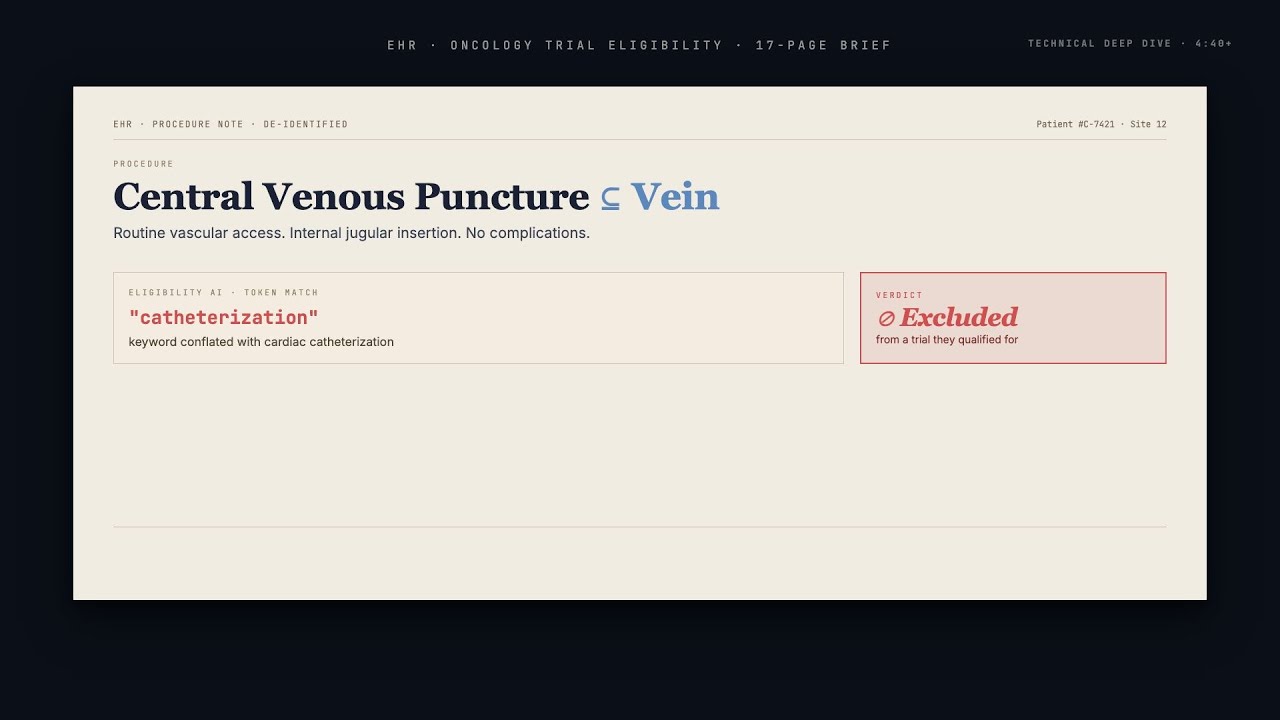
80% of clinical trials fail to meet enrollment timelines, costing the pharmaceutical industry billions. The problem isn't a lack of patients—it's semantic blindness. Generic AI tools confuse "cardiac catheterization" with "central venous puncture," excluding eligible patients and clogging recruitment funnels.
Veriprajna's Neuro-Symbolic AI replaces probabilistic guesswork with deterministic logic, achieving >95% accuracy through SNOMED CT ontologies and deontic reasoning—transforming syntax into semantics.
Clinical trial delays are not operational inconveniences—they are humanitarian catastrophes wrapped in financial disasters.
Time is the single most expensive resource in pharma. Every day lost in clinical development erodes the Net Present Value (NPV) of assets and deducts from patent exclusivity windows.
High screen failure rates create a "denial of service" attack on clinical sites. When AI delivers 100 candidates but only 5 are eligible, coordinators lose trust and revert to manual methods.
For patients with metastatic cancer or neurodegenerative diseases, a 6-month delay isn't a statistic—it's the difference between accessing a curative therapy and receiving palliative care.
| Therapeutic Area | Median Lost Sales/Day | Operational Complexity |
|---|---|---|
| Cardiovascular | $1.4 Million | High (Large cohorts, complex monitoring) |
| Hematology | $1.3 Million | High (Specialized sites, rare phenotypes) |
| Oncology | $840,000 | Very High (Genetic screening, complex exclusions) |
| Central Nervous System | Variable | Moderate to High (Subjective endpoints) |
Data: Tufts Center for the Study of Drug Development (CSDD), 2024
The industry attempts to solve a logic problem (eligibility) with a probability tool (LLMs). This is not a glitch—it's a fundamental architectural mismatch.
A trial excludes "Cardiac Catheterization" (invasive heart procedure to evaluate coronary arteries). A patient's record mentions "Central Venous Puncture" (vascular access procedure for a CVC line—fundamentally distinct in anatomy, risk, and indication).
"This is not a hypothetical error. Recent studies evaluating AI models for trial matching have identified specific failure modes where models incorrectly conclude that 'cardiac catheterization is the same as a central venous puncture,' leading to wrongful exclusion."
— Veriprajna Technical Whitepaper, Citing Peer-Reviewed Research
LLMs are probabilistic engines that predict the next token. They might classify a patient as eligible on one run and ineligible on the next due to temperature/prompt variations.
Clinical trials require 100% reproducible audit trails for FDA/EMA compliance.
LLMs don't verify facts against ground truth. If a patient note is ambiguous, the model may "invent" a diagnosis to fill gaps—including or excluding patients based on fabricated data.
You cannot enhance a signal that was never captured.
Sending unstructured patient data to public model APIs raises HIPAA/GDPR concerns. Black-box architectures fail to provide privacy-preserving guarantees.
Regulatory compliance requires secure, auditable processing.
Standard keyword systems match text strings. They see "catheter" and trigger false positives. Ontology-driven systems understand medical hierarchies—distinguishing between heart procedures and vascular access based on semantic relationships.
SNOMED CT is a poly-hierarchical ontology with 350,000+ medical concepts linked by Is-A relationships. Veriprajna queries the graph structure to determine if a patient's procedure is a subtype of an exclusion criterion—providing mathematical certainty.
Toggle the visualization to see how ontology reasoning prevents false exclusions.
SNOMED CT is not a dictionary—it's a directed acyclic graph (DAG) with 350,000+ concepts linked by semantic relationships. This structure enables provable medical reasoning.
When the protocol excludes "Cardiac Catheterization," the Ontology-Driven AI performs a semantic query on the graph: Is the patient's procedure (SCTID: 392230005) a subtype of the exclusion criteria (SCTID: 41976001)?
This logic holds even if the doctor wrote "Central Line Placement," "CVC Insertion," or "PICC Line"—all synonyms map to the same SCTID before the logic check occurs.
Medical documentation is rife with synonyms and abbreviations. A doctor might write "Heart Cath," "Angio," "Coronary Angiography," or "LHC."
SNOMED CT Solution: All variants automatically map to the same concept ID (SCTID). Matching is performed concept-to-concept, not word-to-word.
SNOMED CT allows concepts to be refined by attributes like laterality, severity, or temporal context—enabling precise matching.
Example: "Left kidney stone" = Kidney stone + Laterality: Left
While SNOMED CT handles the what (medical concepts), Deontic Logic handles the how (rules of engagement). Trial criteria are complex normative statements defining what is Obligatory, Permitted, or Forbidden.
Result: Patient with well-controlled hypertension on stable meds for 6 months is WRONGLY EXCLUDED.
Simple boolean logic cannot parse exception clauses or temporal constraints.
Result: Patient with controlled hypertension on stable meds is CORRECTLY ELIGIBLE.
We interpret the eligibility state of the patient, not just the presence of terms in their record. By modeling the rights and obligations of the protocol, we align the AI with the ethical and scientific intent of the study design. This transforms recruitment from a "search" task into a "reasoning" task.
Veriprajna employs a "Type 2/4" Neuro-Symbolic integration: neural systems handle perception (reading unstructured text), symbolic systems handle reasoning (eligibility logic). This separation ensures linguistic flexibility without stochastic risk.
Ingests unstructured data: PDFs, handwritten notes, scanned labs, physician narratives.
The LLM does NOT make eligibility decisions. It reads "pt complains of chest pain" and identifies the entity.
Maps extracted entities to the Enterprise Knowledge Graph using SNOMED CT.
Converts "Chest pain" to SCTID: 29857009. Disambiguates terms using graph context.
Executes eligibility logic against structured phenotype with deterministic results.
Checks Is-A relationships, calculates temporal durations. 100% reproducible—same inputs always produce same output.
| Feature | Standard LLM (Wrapper API) | Neuro-Symbolic AI (Veriprajna) |
|---|---|---|
| Data Processing | Probabilistic Token Prediction | Deterministic Logic + Neural Extraction |
| Unknown Terms | Hallucinates or Misses | Flags for Human Review (Transparent) |
| Reasoning | Surface-level correlations | Multi-hop reasoning via Knowledge Graph |
| Explainability | "Black Box" (Cannot cite source logic) | Fully Auditable Trace (Logic Proofs) |
| Accuracy | ~63-87% (variable) | >95% (near-human or superhuman) |
| Privacy | High risk of data leakage | Logic processed locally/securely |
Traditional RAG retrieves document chunks by vector similarity. GraphRAG retrieves information based on relationships—enabling multi-hop reasoning across the entire patient record and external medical knowledge.
Vector similarity cannot infer relationships not explicitly stated in retrieved chunks.
GraphRAG performs multi-hop retrieval: Patient → Drug → Mechanism → Exclusion Criteria
This architecture transforms the recruitment platform into a "Second Brain" for researchers—enabling complex, natural language queries that require reasoning over data structures:
This level of semantic interoperability enables dynamic cohort building and feasibility analysis that far outstrips traditional query builders.
See the financial impact of eliminating recruitment delays and reducing screen failures with Neuro-Symbolic AI.
Average delay from recruitment inefficiencies
False positives from generic AI tools ($1,200 each)
Every week saved in enrollment translates to earlier regulatory submission and extended market exclusivity—preserving millions in peak revenue.
High-precision matching reduces coordinator burnout. Sites trust the system and engage more actively, accelerating enrollment velocity.
Deterministic audit trails and explainable logic satisfy FDA/EMA requirements—de-risking regulatory review and reducing query cycles.
Veriprajna doesn't offer "plug-and-play" APIs. We provide deep integration strategies that transform data infrastructure for sustained competitive advantage.
We ingest data via FHIR resources (Patient, Condition, Procedure, MedicationAdministration) to populate the knowledge graph with standardized clinical data.
We map phenotypes directly to CDISC SDTM (Study Data Tabulation Model), specifically the IE (Inclusion/Exclusion) domain—generating regulatory-ready data from Day 1.
We advocate for Augmented Intelligence, not full automation. The goal is to scale the expert clinician, not replace them.
If logic is clear and data is unambiguous (specific SCTID match), the system can auto-match or auto-exclude.
If logic is fuzzy or text is unclear ("possible history of..."), the system flags for human review with highlighted criteria and relevant text—reducing review time by up to 40%.
By utilizing a modular neuro-symbolic architecture, Veriprajna addresses paramount data privacy concerns. Patient data stays within the hospital's secure firewall.
Knowledge graph and logic engine run within secure enclave—no PHI exposure.
Open-source LLMs (Llama 3 fine-tuned) deployed locally or used for de-identified text only.
Zero PHI sent to public APIs. Full institutional governance alignment.
Eliminating recruitment delays saves $800K+ per day in lost opportunity costs for high-value assets. For blockbuster indications, savings reach $1.3-1.4M/day.
Neuro-Symbolic AI creates auditable, deterministic reasoning trails that generic LLMs cannot provide—essential for FDA/EMA regulatory compliance.
SNOMED CT integration prevents false exclusions by understanding medical hierarchies (Is-A relationships) and distinguishing between distinct procedures at the ontological level.
Deontic Logic correctly parses complex "unless" and "except" clauses in trial protocols, rescuing eligible patients that boolean logic discards.
GraphRAG enables "Second Brain" capabilities, connecting patient data to broader pharmacological knowledge graphs for superior matching and multi-hop reasoning.
Modular architecture keeps PHI within secure enclaves. Zero data leakage to public APIs. Full HIPAA/GDPR compliance.
The bottleneck in drug discovery is no longer the science—it's the syntax. Veriprajna offers a path from the fragility of probability to the robustness of logic.
We enable pharmaceutical enterprises to find the right patients, for the right trials, at the right time—not by guessing, but by reasoning.
Generic AI tools suffer from semantic blindness — they confuse clinically distinct procedures because vector embeddings place related medical terms close together regardless of meaning. For example, they conflate 'cardiac catheterization' (invasive heart procedure) with 'central venous puncture' (vascular access for CVC line), incorrectly excluding eligible patients. Standard LLMs achieve only 63-87% accuracy versus over 95% with ontology-driven approaches.
SNOMED CT ontology maps medical text to standardized concept IDs (SCTIDs) and uses hierarchical Is-A queries to determine relationships. Instead of keyword matching, the system queries whether CVC (SCTID:392230005) is a subtype of Cardiac Catheterization (SCTID:41976001) — returning FALSE because they occupy different ontological branches (Heart vs Vein), correctly ruling the patient eligible.
According to Tufts CSDD 2024 data, enrollment delays cost $800K to $1.4M per day depending on therapeutic area — cardiovascular assets lose $1.4M/day, hematology $1.3M/day, and oncology $840K/day. Each screen failure costs $1,200, and with 37% of sites under-enrolling and 11% failing to enroll anyone, the cumulative financial impact reaches billions annually.
Veriprajna's Neuro-Symbolic AI doesn't just improve accuracy—it fundamentally changes how pharmaceutical enterprises identify eligible patients.
Schedule a consultation to explore how Ontology-Driven Phenotyping can eliminate recruitment bottlenecks for your trials.
Complete technical report: Neuro-Symbolic architecture, SNOMED CT implementation, Deontic Logic formalization, GraphRAG methodology, CDISC/FHIR integration, privacy-preserving design, and 40 peer-reviewed citations.