The Deterministic Enterprise: Engineering Truth in the Age of Probabilistic AI
1. The Bifurcation of Artificial Intelligence
1.1 The Wrapper Economy vs. Deep Tech Engineering
The contemporary landscape of corporate artificial intelligence is currently undergoing a profound schism, dividing into two distinct operational methodologies that, while sharing a common terminological lineage, diverge fundamentally in their architectural integrity and industrial utility. On one side of this divide lies the "Wrapper Economy," characterized by the rapid proliferation of lightweight applications that serve as interface layers—or "wrappers"—atop general-purpose Large Language Models (LLMs). These systems thrive on the accessibility of stochastic token prediction, offering immediate, albeit superficial, utility in tasks requiring conversational fluency, basic code generation, and broad-spectrum knowledge retrieval. They are engines of plausibility, designed to produce outputs that are statistically likely rather than factually immutable. 1
On the opposing side lies the domain of "Deep Tech" or "Deep AI," the operational territory of Veriprajna. This domain is defined not by the probabilistic assembly of language but by the rigorous architecturalization of constraints derived from physical laws, mathematical logic, and verifiable provenance. For the deep enterprise—organizations responsible for the safety of energy storage systems, the integrity of intellectual property, or the reliability of autonomous infrastructure—the probabilistic nature of standard generative AI represents an unacceptable liability. In these high-stakes environments, an answer that is 99% plausible but 1% physically impossible is not merely an error; it is a catastrophe waiting to manifest as a thermal runaway event or an insurmountable copyright litigation. 3
The limitations of the wrapper approach become glaringly apparent when applied to non-textual domains. An LLM, having "read" millions of chemistry textbooks, might hallucinate a molecular structure that violates valency rules because it predicts tokens, not electron densities. Similarly, a diffusion model trained on the open internet might generate audio that statistically resembles a copyrighted work because it lacks an inherent concept of ownership or provenance. 5 The wrapper hides the model's stochastic nature behind a user interface; the Deep AI solution exposes the model to an "Oracle of Truth"—a validation layer grounded in ab initio physics or cryptographic audit trails—before the user ever sees the result. 6
1.2 The Deterministic Imperative in Critical Infrastructure
The central thesis of Veriprajna’s methodology is the "Deterministic Imperative." This principle posits that in enterprise applications where the cost of failure is non-trivial, the generative capabilities of neural networks must be strictly subservient to deterministic validation mechanisms. We do not use AI to "guess" the answer; we use AI to "propose" candidates from a vast, high-dimensional search space, which are then adjudicated by immutable rules.
This whitepaper explores this imperative through two rigorous technical case studies that mirror the bifurcated challenges of the modern enterprise: the physical and the legal. First, we examine the deployment of Google DeepMind’s Graph Networks for Materials Exploration (GNoME) paired with Density Functional Theory (DFT) validation. This workflow moves materials science from Edisonian trial-and-error to high-throughput active learning, specifically to engineer thermally stable battery electrolytes that prevent catastrophic thermal runaway. 8 Second, we analyze the use of Deep Source Separation (Demucs) and Retrieval-Based Voice Conversion (RVC) to construct copyright-safe, legally auditable audio generation pipelines, solving the "black box" IP risks inherent in diffusion-based media generation. 10
In both instances, the unifying architectural philosophy is the rejection of unconstrained "black box" generation in favor of "white box" engineering. Whether calculating the convex hull of a crystal structure or tracing the spectral provenance of a vocal track, Veriprajna delivers AI that is accountable to the laws of thermodynamics and the laws of intellectual property.
2. The Physics of Failure: Thermal Runaway and Material Stability
2.1 The Thermodynamic Precipice of Energy Storage
To understand the necessity of AI-driven material discovery, one must first appreciate the precipice upon which modern energy storage operates. The electrification of transport and grid infrastructure relies heavily on Lithium-ion (Li-ion) chemistries, which, despite their ubiquity, possess a volatile thermodynamic profile. The fundamental failure mode of these systems is thermal runaway, a self-propagating exothermic cascade that transforms a battery pack into a chaotic thermal event in milliseconds. 12
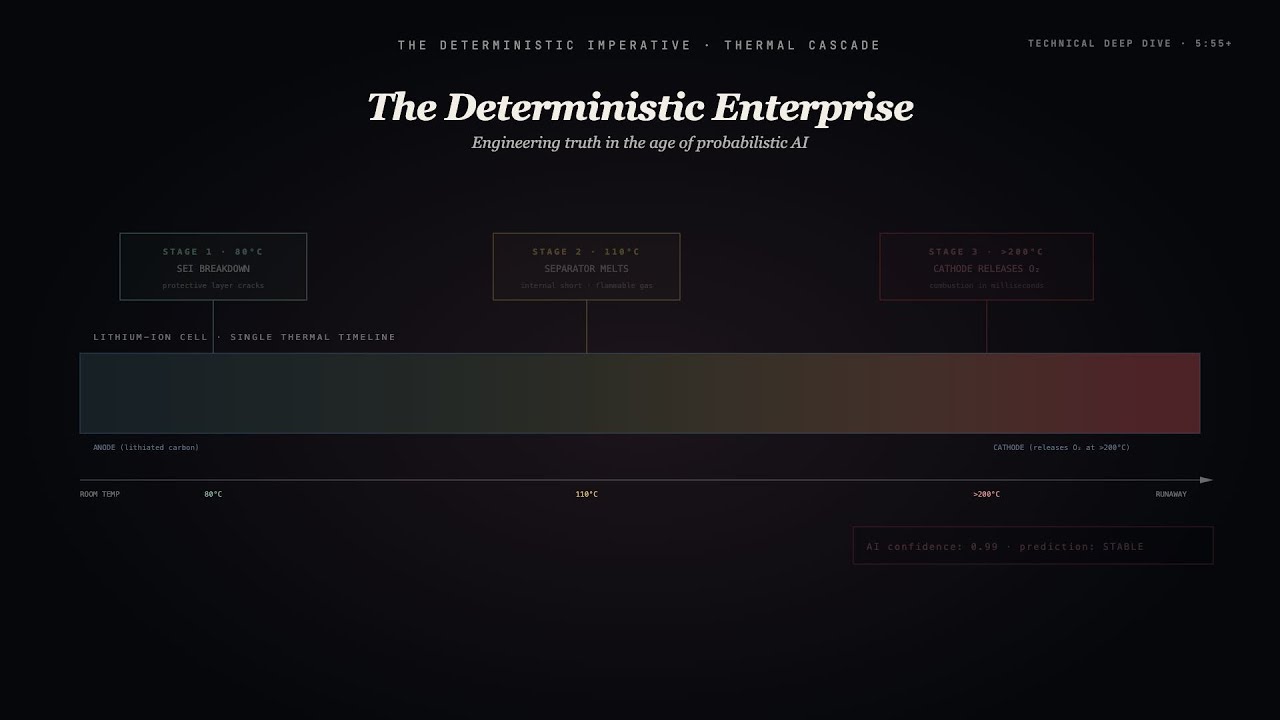
Thermal runaway is not a random accident; it is a deterministic sequence of chemical failures triggered when a cell exceeds specific temperature thresholds. Understanding these thresholds is critical for designing electrolytes that can withstand the extreme conditions of next-generation operation.
Table 1: The Thermodynamic Cascade of Thermal Runaway
| Stage | Temperature (∘C) | Mechanism of Failure |
Chemical Implication |
|---|---|---|---|
| Stage 1 (Onset) | $80^\circ100^\circQ_{exo}$). | ||
| Stage 2 (Trigger) | $110^\circ135^\circ$C | Separator Melting & Electrolyte Breakdown |
The polymer separator (PE/PP) loses structural integrity, causing an Internal Short Circuit (ISC). The electrolyte begins to decompose into fammable gases. |
| Stage 3 (Runaway) |
C | Cathode Decomposition & Combustion |
The cathode latice collapses, releasing oxygen. Oxygen combines with fammable electrolyte gases and heat to cause massive combustion. |
The electrolyte serves as the critical vector in this cascade. Traditional liquid electrolytes, typically Lithium Hexafluorophosphate () dissolved in carbonate solvents (EC/DMC), are chemically unstable at elevated temperatures. They act as the fuel source in the Stage 3 combustion event. 13 To prevent thermal runaway, particularly in high-voltage or high-temperature applications, the industry must transition to electrolytes with significantly higher Decomposition Energies —materials that remain thermodynamically stable well beyond the $200^\circ$C threshold.
2.2 The Edisonian Bottleneck
Historically, discovering such materials has been a process of "Edisonian" trial-and-error. Researchers hypothesize a crystal structure based on chemical intuition, synthesize it in a laboratory, and test its properties. This process is punishingly slow, often taking months to validate a single candidate. The chemical space of possible inorganic crystals is estimated to contain $10^{100}$ combinations, making exhaustive experimental search impossible. 9
Furthermore, human intuition is biased toward known structures. We tend to explore modifications of existing families (e.g., Garnets or Perovskites) rather than venturing into entirely novel compositional spaces. This bias restricts the discovery of "out-of-distribution" materials that might offer superior stability or ionic conductivity. 9
The limitations of this manual approach have necessitated a shift toward High-Throughput Computational Screening . However, traditional computational methods, while faster than physical synthesis, are still limited by the computational cost of simulation. A single Density Functional Theory (DFT) calculation to determine the energy of a crystal can take hundreds of CPU hours. To screen millions of candidates, we need an accelerator: a mechanism to predict stability instantly, reserving expensive DFT validation only for the most promising candidates. This is the role of the Graph Neural Network.
3. Architecting Discovery: GNoME and the Graph Neural Network
3.1 From Language to Lattice: The GNN Advantage
While LLMs process linear sequences of text, materials are defined by 3D geometry and topology. A molecule is not a string of characters; it is a constellation of atoms interacting through quantum mechanical forces. Representing a crystal structure as a text string (e.g., SMILES) often loses critical spatial information, such as bond angles and lattice periodicity.
Veriprajna utilizes GNoME (Graph Networks for Materials Exploration), a state-of-the-art architecture developed by Google DeepMind. GNoME treats materials as graphs, where atoms are nodes and chemical bonds are edges. 14
● Nodes (): Represent atoms, encoding features like atomic number, electronegativity, and atomic radius.
● Edges (): Represent interatomic connections, encoding bond distances and angles.
● Message Passing: The network operates by passing "messages" between neighboring nodes. An atom updates its internal state based on the states of its neighbors. This allows the network to learn the "local chemical environment" of every atom in the crystal.
Crucially, GNoME is designed to be -equivariant . In physics, the properties of a material (like its energy) should not change if you rotate the crystal in space. Standard neural networks do not inherently understand this symmetry; they must be taught it via massive data augmentation. GNoME's architecture enforces this symmetry mathematically, ensuring that the model's predictions are consistent with physical laws regardless of the coordinate system used. 9
3.2 The Dual-Pipeline Generative Strategy
GNoME employs two distinct pipelines to generate candidate structures, ensuring both depth (exploiting known families) and breadth (exploring novel chemistry) 9 :
3.2.1 The Structural Pipeline
This pipeline focuses on Symmetry-Aware Partial Substitutions (SAPS) . It takes known stable crystal structures from databases like the Materials Project (MP) or the Inorganic Crystal Structure Database (ICSD) and proposes intelligent substitutions.
● Mechanism: If a crystal of Magnesium Oxide () is stable, the model might hypothesize that replacing Magnesium with Calcium () or Strontium ()—elements in the same column of the periodic table—might also yield a stable structure.
● Utility: This pipeline is excellent for optimizing known families of electrolytes (e.g., finding a doped variant of a Garnet structure that has slightly better thermal stability).
3.2.2 The Compositional Pipeline
This pipeline is more radical. It generates random chemical formulas based on charge neutrality rules (e.g., ) and uses the neural network to predict the most likely stable crystal lattice for that composition.
● Mechanism: It does not start with a template. It starts with a stoichiometry and uses an active learning approach to "relax" the atoms into a low-energy configuration.
● Utility: This pipeline discovers entirely new classes of materials that human intuition might miss, including complex quaternary and quinary compounds. 9
3.3 The Probabilistic Prediction of Stability
For every candidate structure generated, GNoME predicts its Formation Energy (). This is the energy required to assemble the crystal from its constituent elements in their standard states.
Where is the total energy of the crystal, is the number of atoms of element , and is the chemical potential of element . However, a low formation energy is necessary but not sufficient for stability. A material is only stable if it is thermodynamically competitive against all other possible phases. This requires calculating the Convex Hull .
4. The Oracle of Physics: Density Functional Theory & Active Learning
4.1 The Convex Hull Formalism
The Convex Hull represents the lower bound of energy for a given compositional space. Imagine a plot where the x-axis is the composition (e.g., the ratio of Lithium to Oxygen) and the y-axis is the formation energy. The stable materials form a "hull" or envelope at the bottom of this plot. Any material that lies above this hull is unstable; it will spontaneously decompose into the materials that are on the hull to lower the total system energy. 16
The critical metric for Veriprajna’s workflow is the Decomposition Energy (), also known as the "Distance to Hull" ().
● Stable (): The material is on the hull. It is the thermodynamic ground state.
● Metastable ($0 < E_{hull} \le 50$ meV/atom): The material is slightly higher in energy but may be kinetically trapped. These are often synthesizable and useful (e.g., diamond is metastable carbon; graphite is stable).
● Unstable ( meV/atom): The material is highly likely to decompose. In a battery, this decomposition releases heat, contributing to thermal runaway. 17
GNoME predicts this value, but as a neural network, its prediction is probabilistic. To trust the result for a safety-critical electrolyte, we must validate it using Density Functional Theory (DFT) .
4.2 The DFT Validation Layer
DFT is a quantum mechanical modeling method used to investigate the electronic structure of many-body systems. It approximates the solution to the Schrödinger equation, allowing us to calculate the electron density and total energy of a crystal with high precision. It is the "Oracle" that grounds the AI’s hallucinations in physical reality. 8
Veriprajna utilizes a tiered DFT validation strategy to balance accuracy and computational cost:
Table 2: DFT Functional Hierarchy in Veriprajna Workflow
| Functional Tier | Methodology | Computational Cost |
Application |
|---|---|---|---|
| Tier 1: ML Force Fields |
MACE / Nequip Potentials |
Low (Minutes) | Initial relaxation of GNoME candidates. Filters out obvious geometric failures.8 |
| Tier 2: PBE (GGA) | Perdew-Burke-Ernz erhof |
Medium (Hours) | High-throughput screening. Good for general trends but ofen under-binds oxides.19 |
| Tier 3: r²SCAN (Meta-GGA) |
Regularized SCAN | High (Days) | Final validation. accurately predicts latice constants and formation energies for strongly bound systems. Essential for voltage prediction.9 |
| Tier 4: DFT+U | Hubbard U Correction |
Very High | Applied to transition metals (Mn, Co, Ni) to correct for self-interaction errors in d-orbitals.8 |
4.3 The Active Learning Flywheel
The integration of GNoME and DFT is not a linear pipeline; it is a cyclic Active Learning Loop . This "flywheel" effect is what distinguishes Deep Tech from static modeling. 6
1. Generation: GNoME generates 10,000 candidate electrolyte structures.
2. Uncertainty Quantification: The model predicts and an associated uncertainty metric. We select candidates that are either predicted to be very stable (Exploitation) or where the model is highly uncertain (Exploration).
3. DFT Oracle: The selected batch (e.g., 500 structures) is sent to the HPC cluster for r²SCAN DFT calculation.
4. Ground Truth Feedback: The true energies calculated by DFT are fed back into the GNoME training set.
5. Retraining: The GNN updates its weights. It learns, for instance, that "phosphate tetrahedra distorted in this specific way are actually unstable," correcting its internal physics model.
6. Iteration: The cycle repeats.
Through this process, the "Hit Rate" (the percentage of proposed materials that turn out to be stable) improves dramatically. While traditional random search might have a hit rate of <1%, and standard ML ~50%, GNoME-driven active learning achieves hit rates exceeding 80% . 9 This efficiency allows Veriprajna to explore millions of candidates to find the "needle in the haystack": an electrolyte that is solid, highly conductive, and thermodynamically stable at 200°C.
5. The Legal Void: Generative Audio and IP Risk
5.1 The Black Box Problem in Media
While the physical sciences battle thermodynamic instability, the creative industries face a crisis of legal instability. The rapid adoption of Generative AI for media—images, video, and audio—has outpaced the development of copyright jurisprudence, creating a hazardous environment for enterprise adopters.
The core of the problem lies in the architecture of "Black Box" generative models (e.g., Latent Diffusion Models). These systems are trained on massive, unstructured datasets scraped from the open internet, containing billions of copyrighted works. When a user prompts such a model, it does not "retrieve" a specific file; it traverses a high-dimensional latent space to synthesize a new artifact that minimizes a loss function against the prompt.
This process creates Provenance Obfuscation . The generated output is a mathematical amalgamation of the training data.
● Unconscious Plagiarism: The model may "overfit" and reproduce a recognizable melody, riff, or vocal timbre from its training set. If a generated audio track contains a 4-bar loop identical to a Beatles song, the user is liable for infringement, even if the infringement was unintentional. 5
● The "Clean Data" Fallacy: Even if a model provider claims "fair use," the legal standing of training on copyrighted data is currently being litigated (e.g., Andersen v. Stability AI, New York Times v. OpenAI ). An enterprise using these tools risks having their assets invalidated if the courts rule against the model providers. 22
For a global advertising agency or a film studio, this risk is non-negotiable. They cannot use a generated soundtrack if they cannot prove its chain of title. They require "White Box" AI : systems where every component of the output can be traced to a verified, licensed source.
5.2 The Need for Auditable Architectures
Veriprajna rejects the "generate from noise" paradigm for enterprise media. Instead, we architect Retrieval-Augmented Generation (RAG) for Audio . Just as RAG in text allows an LLM to cite its sources, RAG in audio allows us to construct new soundscapes from specific, licensed audio stems.
This approach shifts the workflow from Alchemy (mysterious generation) to Engineering (assembly of known parts). It relies on two key technologies: Deep Source Separation (to deconstruct existing licensed libraries) and Retrieval-Based Voice Conversion (to reconstruct new performances).
6. Deconstructing Sound: Deep Source Separation
6.1 The Value of the Back-Catalog
Most large media enterprises possess vast archives of owned or licensed content—broadcast archives, music libraries, sound effect repositories. However, this content is often "locked" in mixed formats (stereo WAV/MP3). A generic "rock song" track is useful, but the isolated drum track or the isolated bass line within it would be far more valuable for remixing and new production.
To unlock this value, Veriprajna utilizes Deep Source Separation, specifically the Demucs architecture. Demucs allows us to separate a mixed audio file into its constituent "stems" (Vocals, Drums, Bass, Other) with near-studio quality. 11
6.2 Demucs Architecture: The U-Net and Hybrid Transformers
Demucs represents the state-of-the-art in waveform-based source separation. Its architecture is a sophisticated evolution of the Convolutional Neural Network (CNN).
6.2.1 The U-Net Structure
At its core, Demucs employs a U-Net architecture.
● Encoder: A series of convolutional layers that progressively downsample the audio waveform. This increases the number of channels (features) while reducing the temporal resolution. It compresses the audio into a high-dimensional "latent representation" that captures the semantic essence of the sound (e.g., "this is a kick drum").
● Decoder: A mirror image of the encoder. It uses transposed convolutions (deconvolutions) to upsample the latent representation back into a raw waveform.
● Skip Connections: Critical for audio fidelity. These connections directly link layers in the encoder to corresponding layers in the decoder. They allow high-frequency details (which are often lost in the deep bottleneck) to bypass the compression and be preserved in the output. 11
6.2.2 The Hybrid Transformer (v4)
The latest iteration, Hybrid Transformer Demucs (htdemucs), addresses a key limitation of pure CNNs: their limited "receptive field." A CNN only looks at a small window of audio at a time. It might struggle to distinguish between a rhythmic bass synth and a steady drum beat if the pattern spans several seconds.
To solve this, Demucs v4 inserts a Transformer Encoder at the bottleneck of the U-Net.
● Self-Attention: The Transformer uses self-attention mechanisms to analyze the entire sequence of the latent representation. It can "look back" in time to understand the repetitive structure of the music, allowing it to better separate rhythmic elements.
● Cross-Domain Processing: Uniquely, Hybrid Demucs processes the audio in two domains simultaneously: the Time Domain (waveform) and the Frequency Domain (spectrogram). The Transformer fuses information from both, allowing the model to leverage the precise timing of the waveform and the spectral clarity of the spectrogram. 25
6.3 Creating the "Clean Stem" Database
Veriprajna applies Demucs to the client's verified IP archive. We process thousands of hours of mixed audio, separating them into isolated stems. These stems are then indexed not just by metadata, but by their audio features (timbre, pitch, rhythm). This creates a massive, copyright-safe dataset of "Lego blocks" that can be retrieved and reassembled. 27
7. Reconstructing Provenance: RVC and Vector Retrieval
7.1 Speech-to-Speech: The RVC Paradigm
With a database of clean, licensed stems, we can now generate new content. For voice and dialogue, we utilize Retrieval-Based Voice Conversion (RVC) . Unlike Text-to-Speech (TTS), which generates audio from text (and often sounds robotic or hallucinates prosody), RVC is a Speech-to-Speech pipeline. It takes an input audio recording (e.g., a creative director reading a script on their phone) and transforms the timbre to match a target voice, while preserving the original performance's intonation and rhythm. 10
7.2 The HuBERT Feature Extractor
The first step in RVC is to separate the "content" of the speech from the "speaker identity." We use HuBERT (Hidden Unit BERT), a self-supervised model.
● HuBERT analyzes the input audio and extracts "soft units"—feature vectors that represent the phonemes and prosody.
● Crucially, HuBERT is trained to be speaker-agnostic. The feature vector for the word "Hello" looks roughly the same whether spoken by a man or a woman. This allows us to strip away the source speaker's identity. 28
7.3 FAISS and Vector Similarity Search
This is the core "White Box" mechanism that ensures provenance. In a standard "Deepfake" model, the target voice is learned by a neural network and stored as opaque weights. In RVC, we use an explicit Retrieval step.
● We maintain a database of feature vectors derived from a licensed voice actor (the Target).
● When we process the input, we use FAISS (Facebook AI Similarity Search) to query this database. For every frame of the input audio, we ask: "What is the closest matching feature vector in the licensed actor's database?"
● We retrieve that specific feature vector.
● Why this matters: The acoustic details—the breathiness, the gravel, the specific resonance—are not "dreamed" by the AI. They are "retrieved" from a specific, authorized recording in the index. If the output sounds like Actor A, it is because we pulled data point #4592 from Actor A's licensed index. 10
7.4 SoftVC and HiFi-GAN Synthesis
The retrieved feature vectors (from the licensed target) are fused with the content vectors (from the input guide). This fused representation is passed to a Vocoder, typically HiFi-GAN . The Vocoder acts as a synthesizer, converting the feature vectors back into a high-fidelity audio waveform (48kHz). Because the features are grounded in real, retrieved data, the output is exceptionally realistic and free from the metallic artifacts common in older conversion methods. 10
8. The Audit Trail: C2PA and SSIM
8.1 Cryptographic Provenance: The C2PA Standard
Generating the audio is only half the battle. To be "Enterprise-Grade," the asset must carry its own papers. Veriprajna implements the C2PA (Coalition for Content Provenance and Authenticity) standard.
C2PA is an open technical standard that allows publishers to embed tamper-evident provenance data directly into media files. It uses public-key cryptography to sign a "Manifest" that travels with the file. 7
The Veriprajna C2PA Manifest:
● Assertions:
1. Source: Hash of the Input Guide Track.
2. Ingredients: ID of the Licensed Voice Model (e.g., "Voice_Actor_License_B44").
3. Actions: "Format Conversion" -> "Source Separation" -> "Voice Conversion".
4. Tool: "Veriprajna Enterprise Audio Engine v2.1".
● Signature: The manifest is cryptographically signed by the enterprise's private key.
● Verification: Any downstream user (e.g., a streaming service or broadcaster) can validate the signature to confirm that the audio was generated using only authorized IP assets. 31
8.2 Structural Similarity (SSIM) for Audio
To ensure quality control, we adapt the Structural Similarity Index (SSIM) —traditionally an image quality metric—for audio validation.
● We generate spectrograms of both the Input Guide Track and the Output Converted Track.
● We calculate the SSIM between these spectrograms.
● High SSIM: Indicates that the structure of the audio (the timing, the pauses, the intonation curves) is identical.
● Low SSIM: Indicates that the AI has "hallucinated" or distorted the performance (e.g., skipping a word or changing the rhythm).
● Any generated asset with an SSIM score below a set threshold (e.g., 0.95) is automatically flagged for human review. 33
9. Implementation: The Veriprajna Framework
9.1 Infrastructure Requirements
Transitioning from "Wrapper" AI to "Deep" AI requires a fundamental shift in infrastructure. You cannot run DFT calculations or train RVC models on a standard web server.
Table 3: Infrastructure Specification for Deep AI
| Component | Batet ry Workfol w (GNoME/DFT) |
Audio Workfol w (Demucs/RVC) |
|---|---|---|
| Compute Type | Hybrid HPC: High CPU | GPU Dense: High VRAM |
| Col1 | core count for DFT (VASP/Quantum Espresso) + GPU for GNN inference. |
GPUs (A100/H100) for Transformer training and FAISS retrieval. |
|---|---|---|
| Storage | High Throughput: Parallel fle systems (Lustre/GPFS) for handling millions of small crystal structure fles. |
Object Storage: Scalable storage (S3-compatible) for massive audio stem libraries. |
| Database | Graph DB: Neo4j or similar for storing crystal topology. |
Vector DB: Milvus or Pinecone for storing FAISS indices of audio features. |
| Networking | InfniBand for low-latency node-to-node communication in DFT clusters. |
100GbE for rapid transfer of uncompressed audio assets. |
9.2 The "Obelisk" Organizational Model
Veriprajna advocates for the "Obelisk" team structure, replacing the traditional consulting "Pyramid" (many generalist juniors, few partners). Deep Tech requires deep expertise. 35
● The Physics-AI Hybrid: A new breed of scientist fluent in both Quantum Mechanics (DFT) and PyTorch. They manage the active learning loops and interpret the Convex Hull data.
● The Provenance Architect: Engineers specialized in cryptography (C2PA), vector search (FAISS), and copyright compliance. They ensure the "White Box" remains white.
● The Oracle Manager: The custodian of the "Ground Truth" datasets—ensuring the purity of the crystal database or the licensing status of the audio stems.
9.3 Roadmap to Deployment
1. Phase 1: The Audit (Months 1-3): Audit existing proprietary data. Clean the chemical datasets; isolate the audio stems using Demucs. Establish the baselines.
2. Phase 2: The Loop (Months 4-6): Deploy the Active Learning infrastructure. Connect GNoME to the DFT cluster. Connect RVC to the C2PA signing module.
3. Phase 3: The Flywheel (Months 6-12): Begin autonomous discovery. The system runs overnight, proposing new battery materials or generating localized audio assets. Metrics (Hit Rate, Provenance Score) are tracked and optimized.
10. Conclusion
The era of "AI Tourism"—where enterprises experimented with chatbots and wrappers for amusement—is drawing to a close. As AI moves into the core of the business, into the R&D labs and the production studios, the tolerance for "hallucination" evaporates.
For the battery manufacturer, a hallucination is a fire. For the media conglomerate, a hallucination is a lawsuit. The only path forward is Deterministic AI : systems where the generative power of the neural network is strictly bound by the verifying power of the Oracle.
Veriprajna stands at the vanguard of this transition. By integrating GNoME with rigorous DFT validation, we engineer materials that obey thermodynamics. By integrating Demucs with RVC and C2PA, we engineer media that obeys copyright. We do not offer "magic"; we offer Engineering Truth .
Veriprajna. Constraints Create Reality.
Works cited
Comparing LLMs for the Enterprise: Choosing the Right AI for the Task - IBM TechXchange Community, accessed December 11, 2025, https://community.ibm.com/community/user/blogs/philip-dsouza/2025/10/22/comparing-llms-for-the-enterprise-choosing-the-rig
Innovation Beyond LLM Wrapper - AI at work for all - secure AI agents, search, workflows, accessed December 11, 2025, https://shieldbase.ai/blog/innovation-beyond-llm-wrapper
Hallucination, reliability, and the role of generative AI in science - arXiv, accessed December 11, 2025, https://arxiv.org/html/2504.08526v1
Please explain how the black box of diffusion models doesn't violate copyright and is ethical. Also, actual useful uses of gen AI for artists besides just simple generation. : r/aiwars - Reddit, accessed December 11, 2025, https://www.reddit.com/r/aiwars/comments/1halq9e/please_explain_how_the_black_box_of_diffusion/
Discussing the Copyrightability of Generative AI Outputs | TechPolicy.Press, accessed December 11, 2025, https://www.techpolicy.press/discussing-the-copyrightability-of-generative-ai-outputs/
Probabilistic Prediction of Material Stability: Integrating Convex Hulls into Active Learning, accessed December 11, 2025, https://arxiv.org/html/2402.15582v1
C2PA Explainer :: C2PA Specifications, accessed December 11, 2025, https://spec.c2pa.org/specifications/specifications/1.4/explainer/Explainer.html
Screening novel cathode materials from the Energy-GNoME database using MACE machine learning force field and DFT - arXiv, accessed December 11, 2025, https://arxiv.org/pdf/2511.22504
Materials Discovery: GNoME - Ready Tensor, accessed December 11, 2025, https://app.readytensor.ai/publications/materials-discovery-gnome-vyH2wPwb1fum
Retrieval-based Voice Conversion - Wikipedia, accessed December 11, 2025, https://en.wikipedia.org/wiki/Retrieval-based_Voice_Conversion
Demucs: A Deep Dive into the Ultimate Audio Source Separation Model - Beats To Rap On, accessed December 11, 2025, https://beatstorapon.com/blog/demucs-a-deep-dive-into-the-ultimate-audio-source-separation-model/
Exploring Thermal Runaway: Role of Battery Chemistry and Testing Methodology - MDPI, accessed December 11, 2025, https://www.mdpi.com/2032-6653/16/3/153
Quantum chemical calculation study on the thermal decomposition of electrolyte during lithium-ion battery thermal runaway - Frontiers, accessed December 11, 2025, https://www.frontiersin.org/journals/energy-research/articles/10.3389/fenrg.2024.1356672/full
AI for Materials Discovery: How GNoME is Changing Science - SentiSight.ai, accessed December 11, 2025, https://www.sentisight.ai/ai-materials-discovery-gnome-changes-science/
Millions of new materials discovered with deep learning - Google ..., accessed December 11, 2025, https://deepmind.google/blog/millions-of-new-materials-discovered-with-deep-learning/
Review of computational approaches to predict the thermodynamic stability of inorganic solids - Bartel Research Group, accessed December 11, 2025, https://bartel.cems.umn.edu/sites/bartel.cems.umn.edu/files/2022-07/bartel.bartel_2022-j.mater_.sci_.pdf
Illustrating stability within a convex hull phase diagram. Note that... ResearchGate, accessed December 11, 2025, https://www.researchgate.net/figure/Illustrating-stability-within-a-convex-hull-phase-diagram-Note-that-for-clarity-only_fig1_358274640
Machine-Learning-Assisted Construction of Ternary Convex Hull Diagrams PMC, accessed December 11, 2025, https://pmc.ncbi.nlm.nih.gov/articles/PMC10966649/
google-deepmind/materials_discovery - GNoME - GitHub, accessed December 11, 2025, https://github.com/google-deepmind/materials_discovery
Cross-functional transferability in universal machine learning interatomic potentials, accessed December 11, 2025, https://www.researchgate.net/publication/390602123_Cross-functional_transferability_in_universal_machine_learning_interatomic_potentials
Infringement risk relating to creation and use of the output of a generative AI system, accessed December 11, 2025, https://www.nortonrosefulbright.com/en/knowledge/publications/4e9b05b9/infringement-risk-relating-to-creation-and-use-of-the-output-of-a-generative-ai-system
Generative AI and intellectual property: Copyright implications for AI inputs, outputs - IAPP, accessed December 11, 2025, https://iapp.org/news/a/generative-ai-and-intellectual-property-copyright-implications-for-ai-inputs-outputs
"Black box" infringement: Generative AI and intellectual property rights, accessed December 11, 2025, https://www.cbp.com.au/insights/publications/black-box-infringement-generative-ai-and-intellectual-property-rights
AI Music Source Separation: How it Works and Why It Is So Hard | by Max Hilsdorf - Medium, accessed December 11, 2025, https://medium.com/data-science/ai-music-source-separation-how-it-works-and-why-it-is-so-hard-187852e54752
facebookresearch/demucs: Code for the paper Hybrid ... - GitHub, accessed December 11, 2025, https://github.com/facebookresearch/demucs
Music Source Separation with Hybrid Demucs — Torchaudio 0.13.1 documentation, accessed December 11, 2025, https://docs.pytorch.org/audio/0.13.1/tutorials/hybrid_demucs_tutorial.html
Introducing MoisesDB: The Ultimate Multitrack Dataset for Source Separation Beyond 4-Stems - Music AI, accessed December 11, 2025, https://music.ai/blog/press/introducing-moisesdb-the-ultimate-multitrack-dataset-for-source-separation-beyond-4-stems/
An AI-Powered Voice Changer. This is an introduction to 「 RVC 」, a… | by David Cochard | ailia Tech BLOG (EN) | Medium, accessed December 11, 2025, https://medium.com/axinc-ai/rvc-an-ai-powered-voice-changer-39927cc83bee
Retrieval-Based Voice Conversion (RVC) Explained - FutureBeeAI, accessed December 11, 2025, https://www.futurebeeai.com/knowledge-hub/retrieval-based-voice-conversion
C2PA | Verifying Media Content Sources, accessed December 11, 2025, https://c2pa.org/
Content Credentials: Strengthening Multimedia Integrity in the Generative AI Era DoD, accessed December 11, 2025, https://media.defense.gov/2025/Jan/29/2003634788/-1/-1/0/CSI-CONTENT-CREDENTIALS.PDF
Understanding C2PA and Audio Files | by Dave Owczarek - Medium, accessed December 11, 2025, https://medium.com/@daveowczarek/understanding-c2pa-and-audio-files-a347b6f748c9
(PDF) A Hitchhiker's Guide to Structural Similarity - ResearchGate, accessed December 11, 2025, https://www.researchgate.net/publication/349000817_A_Hitchhiker's_Guide_to_Structural_Similarity
Data Validation as Part of Audio and Video Testing - TestDevLab, accessed December 11, 2025, https://www.testdevlab.com/blog/data-validation-as-part-of-audio-and-video-testing
AI Is Changing the Structure of Consulting Firms | AAPL Publication, accessed December 11, 2025, https://www.physicianleaders.org/articles/ai-is-changing-the-structure-of-consulting-firms
Prefer a visual, interactive experience?
Explore the key findings, stats, and architecture of this paper in an interactive format with navigable sections and data visualizations.
Frequently Asked Questions
How does GNoME with DFT validation discover thermally stable battery materials?
GNoME is an E(3)-equivariant Graph Neural Network that treats crystal structures as graphs with atoms as nodes and bonds as edges. It generates candidates through structural (symmetry-aware substitution) and compositional (random formula) pipelines. Each candidate's formation energy is predicted, then validated against the DFT-calculated convex hull. An active learning flywheel iterates generation, uncertainty-based selection, DFT validation, and retraining, achieving hit rates exceeding 80% versus under 1% for random search.
Why is thermal runaway prevention critical for battery electrolyte design?
Thermal runaway is a deterministic three-stage cascade: SEI decomposition at 80-100C, separator melting with internal short circuit at 110-135C, and cathode decomposition with combustion above 200C. Traditional liquid electrolytes act as fuel in this cascade. Discovering solid electrolytes with decomposition energies stable well beyond 200C requires screening the estimated 10^100 possible inorganic crystal combinations, which is only feasible through AI-accelerated active learning validated by ab initio physics.
How does Demucs with RVC create copyright-safe enterprise audio?
Hybrid Transformer Demucs v4 separates licensed audio into isolated stems. HuBERT extracts speaker-agnostic content features from input audio, then FAISS retrieves the closest matching feature vectors from a licensed voice actor's indexed database. HiFi-GAN synthesizes the final waveform. Every acoustic detail is retrieved from specific authorized recordings, not hallucinated. C2PA cryptographic manifests sign the full provenance chain, and SSIM spectral comparison provides quality control.
Also Published On
Build Your AI with Confidence.
Partner with a team that has deep experience in building the next generation of enterprise AI. Let us help you design, build, and deploy an AI strategy you can trust.
Veriprajna Deep Tech Consultancy specializes in building safety-critical AI systems for healthcare, finance, and regulatory domains. Our architectures are validated against established protocols with comprehensive compliance documentation.