Engineering Truth in the Age of Probabilistic AI
The era of AI "hallucinations" in enterprise is over. Veriprajna architects deterministic AI systems where neural networks propose candidates, and immutable physics validates every output.
From discovering thermally stable battery materials that prevent catastrophic failures to generating copyright-auditable audio, we deliver AI that is accountable to the laws of thermodynamics and the laws of intellectual property.
Corporate AI is dividing into two fundamentally different methodologies: the probabilistic "Wrapper Economy" and the deterministic "Deep Tech" approach.
Lightweight applications atop general-purpose LLMs. Engines of plausibility, not truth. They predict statistically likely tokens, not physically valid states.
Architecturalization of constraints from physical laws, mathematical logic, and verifiable provenance. AI proposes; the Oracle validates.
"For the deep enterprise—organizations responsible for the safety of energy storage systems, the integrity of intellectual property, or the reliability of autonomous infrastructure—the probabilistic nature of standard generative AI represents an unacceptable liability."
— Veriprajna Technical Whitepaper, 2025
This whitepaper explores deterministic AI through rigorous case studies in materials science and enterprise media.
Deploying GNoME (Graph Networks for Materials Exploration) paired with DFT (Density Functional Theory) to discover thermally stable electrolytes for next-generation batteries.
Using Demucs (Deep Source Separation) and RVC (Retrieval-Based Voice Conversion) with C2PA provenance to eliminate IP black box risk.
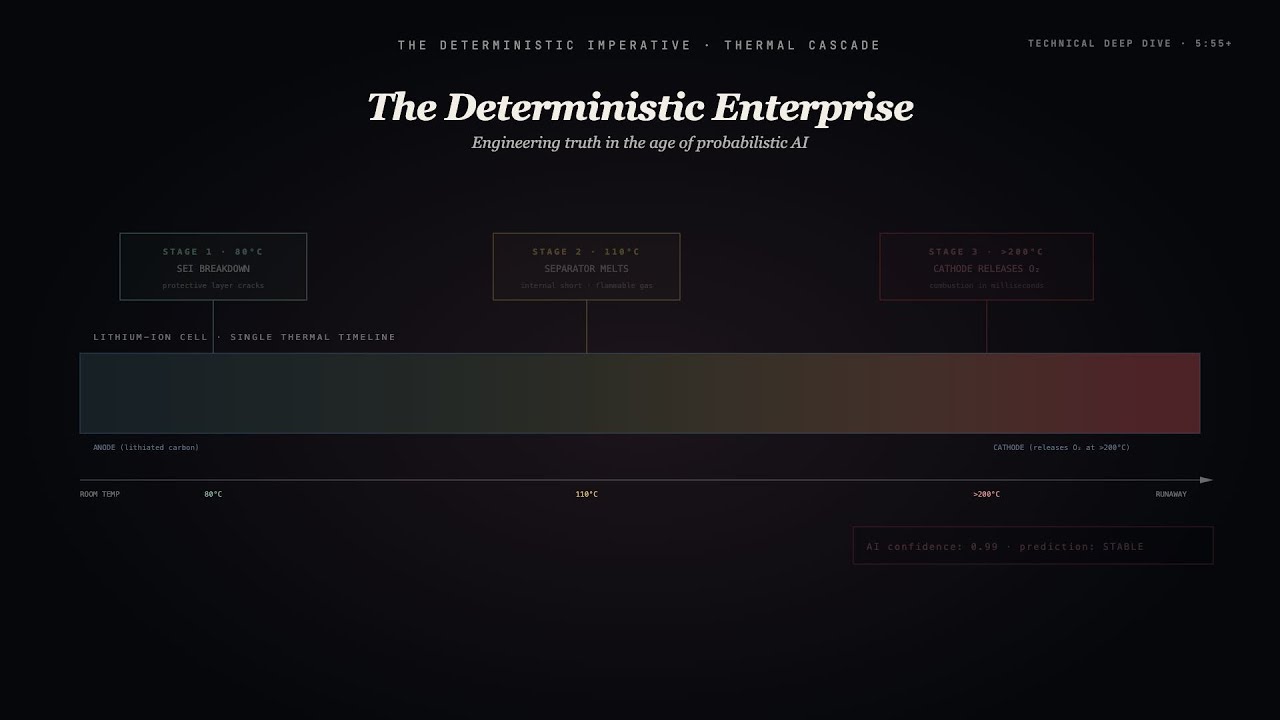
Thermal runaway is not a random accident—it's a deterministic sequence of chemical failures. Understanding these stages is critical for engineering stable electrolytes.
SEI Decomposition: Solid Electrolyte Interphase breaks down. Lithiated carbon reacts with solvent, releasing exothermic heat (Q_exo).
Separator Melting: Polymer separator (PE/PP) loses integrity → Internal Short Circuit (ISC). Electrolyte decomposes into flammable gases.
Cathode Collapse: Lattice decomposes, releasing O₂. Oxygen + flammable gases + heat = massive combustion. Battery becomes thermal bomb.
Critical Insight: Traditional liquid electrolytes (LiPF₆ in EC/DMC) are the fuel source in Stage 3. Veriprajna uses GNoME + DFT to discover solid-state alternatives with decomposition energies stable beyond 200°C.
While LLMs process linear text, materials are defined by 3D geometry and quantum mechanical forces. GNoME treats materials as graphs where atoms are nodes and bonds are edges.
Encode features: atomic number, electronegativity, atomic radius. Each node represents a single atom in the crystal.
Encode interatomic connections: bond distances, angles. Edges represent the spatial relationships between atoms.
Atoms update their state based on neighbors' states. The network learns "local chemical environment" for every atom.
Material properties (like energy) remain unchanged under rotation. GNoME enforces this symmetry mathematically—predictions are consistent with physical laws regardless of coordinate system.
Symmetry-Aware Partial Substitutions. Takes known stable crystals and proposes intelligent substitutions based on periodic table chemistry.
Generates random chemical formulas based on charge neutrality (e.g., Li₃PS₄) and predicts most stable lattice using active learning.
A material is only stable if it is thermodynamically competitive against all other possible phases. The Convex Hull represents the lower bound of energy for a compositional space.
Where E_crystal is total crystal energy, n_i is atoms of element i, and μ_i is chemical potential.
Veriprajna Workflow:
GNoME predicts E_hull (probabilistic) → DFT calculates true convex hull (deterministic) → Only validated materials proceed to synthesis
GNoME + DFT is not a linear pipeline—it's a cyclic loop where each iteration improves the hit rate from <1% (random) to 80%+ (guided).
GNoME generates 10,000 candidates. Model predicts E_hull with uncertainty. Select high-confidence stable (exploitation) + high-uncertainty (exploration) batches.
Selected batch sent to HPC cluster for r²SCAN DFT calculation. True convex hull energies computed. Results fed back into GNoME training set.
GNN updates weights. Learns "phosphate tetrahedra distorted this way are unstable." Hit rate improves. Cycle repeats until target materials discovered.
Black box diffusion models create provenance obfuscation. Enterprises cannot use generated audio if they cannot prove chain of title.
Diffusion models trained on billions of scraped copyrighted works. When generating audio, the model traverses latent space—a mathematical amalgamation of training data.
Retrieval-Augmented Generation (RAG) for Audio. Construct new soundscapes from specific, licensed audio stems. Every component traceable to verified source.
Convolutional layers downsample audio waveform. Compresses to high-dimensional latent representation capturing semantic essence ("this is a kick drum").
Transposed convolutions upsample latent back to raw waveform. Skip connections preserve high-frequency details lost in bottleneck.
Inserts Transformer at bottleneck for long-range context. Self-attention analyzes entire sequence—understands repetitive musical structure across seconds.
Cross-domain: Time (waveform) + Frequency (spectrogram) fusion
Broadcast archives, music libraries (verified IP ownership)
Separate into 4+ stems: Vocals, Drums, Bass, Other (near-studio quality)
Stems indexed by audio features (timbre, pitch, rhythm) in vector database
Copyright-safe "Lego blocks" ready for retrieval and reassembly
Separates content (phonemes/prosody) from speaker identity. Speaker-agnostic "soft units".
Queries licensed voice database. Retrieves closest matching feature vector for each frame.
Fuses retrieved target vectors with input content. Preserves original performance timing.
Converts feature vectors to high-fidelity waveform (48kHz). Realistic, artifact-free.
In traditional deepfake models, target voice is learned as opaque neural network weights. In RVC, acoustic details (breathiness, gravel, resonance) are not generated—they are retrieved from specific, authorized recordings.
Target voice stored as weights → Output source unknown → No audit trail
Retrieved from licensed index point #4592 → C2PA manifest logs exact source → Full audit trail
Generating audio is only half the battle. To be enterprise-grade, assets must carry tamper-evident cryptographic provenance.
Open standard using public-key cryptography to sign tamper-evident "Manifest" embedded directly in media files.
Manifest signed with enterprise private key. Any downstream user (streaming service, broadcaster) validates signature to confirm audio generated using only authorized IP assets.
Adapts image quality metric (SSIM) for audio validation by comparing spectrograms of input and output.
Any asset below SSIM threshold automatically rejected—prevents AI from skipping words, changing rhythm, or introducing artifacts that compromise performance fidelity.
Transitioning from probabilistic AI to deterministic AI requires fundamental infrastructure shifts. You cannot run DFT or train RVC on standard web servers.
| Component | Battery Workflow (GNoME/DFT) | Audio Workflow (Demucs/RVC) |
|---|---|---|
| Compute Type | Hybrid HPC: High CPU core count for DFT (VASP/Quantum Espresso) + GPU for GNN inference | GPU Dense: High VRAM GPUs (A100/H100) for Transformer training and FAISS retrieval |
| Storage | High Throughput: Parallel file systems (Lustre/GPFS) for millions of small crystal structure files | Object Storage: Scalable storage (S3-compatible) for massive audio stem libraries |
| Database | Graph DB: Neo4j or similar for storing crystal topology | Vector DB: Milvus or Pinecone for storing FAISS indices of audio features |
| Networking | InfiniBand for low-latency node-to-node communication in DFT clusters | 100GbE for rapid transfer of uncompressed audio assets |
Deep Tech requires deep expertise. Veriprajna replaces the consulting "Pyramid" (many generalist juniors, few partners) with specialists at every level.
Fluent in both Quantum Mechanics (DFT) and PyTorch. Manages active learning loops, interprets convex hull data.
Specialized in cryptography (C2PA), vector search (FAISS), copyright compliance. Ensures "White Box" remains white.
Custodian of "Ground Truth" datasets. Ensures purity of crystal databases and licensing status of audio stems.
Veriprajna's phased approach ensures systematic transition from wrapper AI to deterministic enterprise systems.
Audit existing proprietary data. Clean chemical datasets; isolate audio stems using Demucs. Establish performance baselines.
Deploy Active Learning infrastructure. Connect GNoME to DFT cluster. Connect RVC to C2PA signing module.
Begin autonomous discovery. System runs overnight proposing battery materials or generating localized audio assets. Track and optimize metrics.
The era of "AI Tourism"—where enterprises experimented with chatbots for amusement—is over. As AI moves into core business operations, tolerance for hallucination evaporates.
Constraints Create Reality.
We do not offer "magic"; we offer Engineering Truth. AI that is accountable to the laws of physics and the laws of intellectual property.
GNoME (Graph Networks for Materials Exploration) treats crystal structures as graphs where atoms are nodes and bonds are edges, using E(3)-equivariant architecture to enforce rotational symmetry. The active learning cycle works in steps: GNoME generates 10,000 candidates and predicts formation energy with uncertainty; high-confidence stable candidates (exploitation) and high-uncertainty candidates (exploration) are selected; DFT calculates true convex hull energies on HPC clusters; results feed back into GNoME's training set. This cycle achieves 80%+ hit rate compared to random Edisonian trial-and-error, discovering materials with decomposition stability beyond 200 degrees C.
The convex hull represents the lower bound of formation energy for a compositional space. A material is only stable if it is thermodynamically competitive against all other possible phases. E_hull = 0 means the material is on the hull (thermodynamic ground state, perfectly stable). E_hull between 0-100 meV/atom indicates metastability (kinetically trapped, often synthesizable). E_hull above 100 meV/atom means the material is unstable and will decompose, releasing heat that fuels thermal runaway. GNoME predicts E_hull probabilistically, then DFT calculates the true convex hull deterministically — only validated materials proceed to synthesis.
Black box diffusion models generate audio by traversing opaque latent space built from scraped copyrighted training data — creating 'unconscious plagiarism' risk and provenance obfuscation. Veriprajna's White Box uses Demucs (Hybrid Transformer source separation) to isolate stems from licensed archives, FAISS vector retrieval to find authorized acoustic features (retrieved, not generated), and RVC (HuBERT + HiFi-GAN) for voice conversion using consented voice models. Every output carries a C2PA cryptographic manifest with SHA-256 hashes, voice model IDs, and tamper-evident signatures — providing complete auditability that any downstream consumer can verify.
Veriprajna architects Deep Tech solutions where AI proposes and physics validates—eliminating hallucinations in critical enterprise applications.
Schedule a consultation to explore materials discovery or copyright-safe media generation for your organization.
Complete engineering report with GNoME architecture, DFT validation tiers, active learning mathematics, Demucs/RVC pipelines, C2PA implementation, infrastructure specifications, and comprehensive works cited.