Beyond the Wrapper: Engineering True Educational Intelligence with Deep Knowledge Tracing
Executive Summary: The Crisis of Context in the Age of Generative AI
The educational technology landscape is currently witnessing a paradoxical crisis. We are inundated with "intelligent" tools, yet true pedagogical intelligence remains scarce. The rapid commoditization of Large Language Models (LLMs) has led to a proliferation of "AI Tutors"—applications that are frequently little more than thin software wrappers around public APIs, instructed via system prompts to "act like a teacher." While these systems excel at linguistic roleplay, mimicking the cadence and vocabulary of an educator with uncanny fluency, they fundamentally fail at the core task of education.
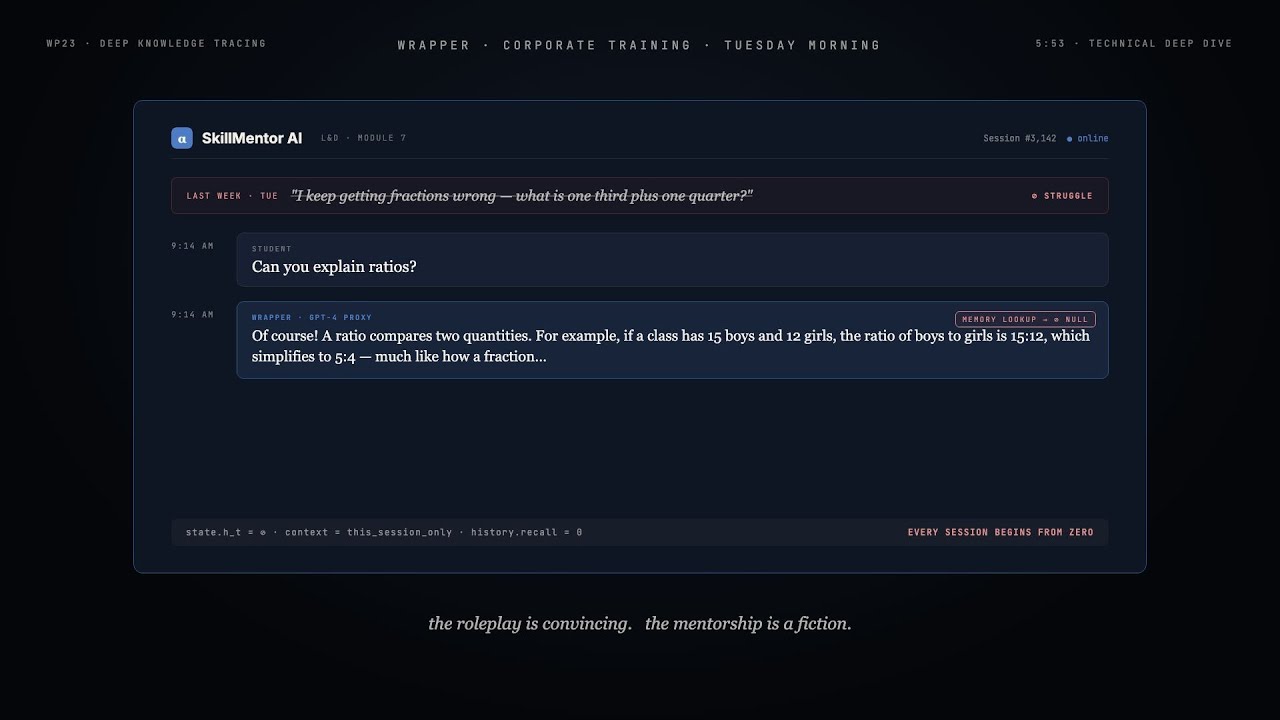
Education is not merely the generation of explanations; it is the management of a learner's cognitive state over time. A real teacher does not just answer a question; they understand why the question was asked. They remember that a student struggled with fractions last week, and therefore anticipate a struggle with ratios today. They construct a mental model of the learner’s proficiency—a "Brain State"—that persists and evolves. Standard LLMs, by contrast, are stateless engines of probability. They suffer from catastrophic forgetting in the context of long-term user history, lacking a persistent memory of the student's unique learning trajectory. They offer roleplay, not mentorship.
Veriprajna operates on the conviction that "Personalized Learning" has become a hollow buzzword. The reality of effective AI education lies in Deep Knowledge Tracing (DKT) . By shifting the architectural focus from text generation to state tracking, utilizing Recurrent Neural Networks (RNNs) to model the hidden dimensionality of the human mind, we can transition from building chatbots to building mentors. This whitepaper outlines the technical necessity of DKT, the architecture of the "Brain State," and the deployment of neuro-symbolic systems that keep learners in the "Flow Zone"—the optimal intersection of challenge and skill where deep learning occurs.
Part I: The "AI Tutor" Fallacy and the Wrapper Problem
1.1 The Illusion of Competence: Why Chatbots Are Not Tutors
The current market is saturated with "wrapper" applications—software that provides a user interface but offloads all cognitive processing to third-party LLMs like GPT-4 or Claude. These models are probabilistic engines designed to predict the next token in a sequence based on training data. 1 When prompted to "act like a math tutor," the model generates a response that is statistically likely to follow the user's query.
However, this process is distinct from pedagogical reasoning. The model does not "know" the student; it only knows the immediate context window of the current conversation. This limitation manifests in several critical failures:
1. Statelessness and the Memory Deficit: A student's learning journey spans months or years, involving thousands of micro-interactions. Standard LLMs operate with limited context windows. While these windows are expanding, the cost and latency of processing a student’s entire history for every single interaction are prohibitive for scalable deployment. 3 Consequently, the "AI Tutor" treats every session as a semi-isolated event. It cannot effectively link a misconception in algebra from three months ago to a failure in calculus today because it lacks a structured, persistent model of the learner's proficiency. 5
2. The Hallucination of Pedagogy: Research indicates that while LLMs can solve straightforward problems, they frequently fail to diagnose specific misconceptions. They are prone to "hallucinations"—generating plausible but factually incorrect explanations or reasoning chains. 6 In a study of LLMs in math tutoring, models often provided correct final answers via incorrect intermediate steps, or conversely, flagged correct student steps as incorrect, confusing the learner. 8 A novice student lacks the expertise to distinguish between a valid explanation and a confident hallucination.
3. Roleplay vs. Strategy: The "act like a teacher" prompt instructs the model on tone, not on strategy . It simulates the persona of an educator—supportive, Socratic, authoritative—without the requisite cognitive model to make strategic decisions about curriculum sequencing. 9 It reacts to the user rather than guiding them.
1.2 The Wrapper Trap in Enterprise EdTech
For enterprise EdTech providers and corporate Learning & Development (L&D) departments, the "wrapper" approach presents a significant strategic risk. Applications that rely entirely on public APIs for their intelligence have no defensive moat. If the core value of a product is a prompt that anyone can replicate, the product is a commodity.
True value in the AI era is not generated by the chat interface, but by the proprietary data model that sits beneath it. A "Deep AI" solution provider must function as a state manager . The competitive advantage lies in the ability to maintain a "hidden state"—a high-dimensional digital twin of the student's knowledge—that dictates what the LLM should say. This distinction defines the gap between a chatbot, which is a utility, and a mentor, which is an asset.
Part II: The Science of Deep Knowledge Tracing (DKT)
2.1 From Bayesian Inference to Deep Learning
To understand the future of AI mentorship, we must examine the evolution of Knowledge Tracing (KT) —the machine learning task of modeling a student's knowledge over time to predict future performance. 10
Historically, this field was dominated by Bayesian Knowledge Tracing (BKT) . BKT models learning as a Hidden Markov Model (HMM), where student knowledge is represented as a set of binary latent variables (Learned vs. Not Learned). 11 While BKT was a foundational technology, it suffers from rigidity:
● Binary Assumption: It assumes a student either "knows" a skill or doesn't, failing to capture partial mastery or "rusty" knowledge.
● Independence Assumption: It treats concepts as independent silos. It does not inherently understand that mastery of "Multiplication" is a prerequisite for "Division" unless explicitly hard-coded by human experts. 12
● Annotation Bottleneck: BKT requires every question to be manually tagged with a "skill" or "concept." This mapping is often ambiguous and labor-intensive. 11
Deep Knowledge Tracing (DKT) represents a paradigm shift. Introduced in seminal research by Piech et al., DKT utilizes Recurrent Neural Networks (RNNs) and Long Short-Term Memory (LSTM) networks to model learning. 11 DKT abandons the binary, expert-labeled constraints of BKT in favor of a flexible, high-dimensional representation that learns from raw data.
Table 1: Comparative Analysis of Knowledge Tracing Architectures
| Feature | Bayesian Knowledge Tracing (BKT) |
Deep Knowledge Tracing (DKT) |
|---|---|---|
| State Representation | Binary (0 or 1); Known / Unknown |
Continuous High-Dimensional Vector (e.g., 200+ dimensions) |
| Concept Dependencies | Assumes independence (Silos) |
Captures complex, non-linear, latent dependencies |
| Temporal Dynamics | First-order Markov (Memory of previous step only) |
Infni ite Impulse Response (Long-term memory via LSTM) |
|---|---|---|
| Input Requirement | Requires expert labeling of "skills" per question |
Can learn latent concept structures from raw interaction logs |
| Predictive Performance | Lower AUC (Area Under Curve) |
Signifcantly higher AUC (e.g., 25% gain over BKT)13 |
| Adaptability | Rigid, rule-based structure | Flexible, data-driven, "deep" in time |
2.2 The Architecture of the "Brain State"
The core innovation of DKT is the use of the RNN to maintain a Hidden State Vector () . In the Veriprajna architecture, this vector serves as the digital proxy for the student's "Brain State."
Unlike a grade book that records past performance, the hidden state vector is a predictive model of current capability. It is a dense, continuous vector that evolves with every interaction.
● Input (): The student attempts a problem (e.g., Question ID 502, Answer: Incorrect).
● Processing: The RNN updates the hidden state based on this new information and the previous state ().
● Output (): The model generates a probability vector predicting the likelihood of the student answering every other question in the database correctly. 14
This continuous representation allows the system to encode nuances that binary models miss:
1. Latent Correlations: The model learns the structure of the curriculum without human tagging. If students who fail Question A also tend to fail Question B, the model encodes a dependency between them in the hidden state. If a student masters A, the probability of mastering B automatically rises in the prediction vector. 10
2. Partial Knowledge: The state can represent a student who is "40% proficient" in a topic—perhaps they understand the concept but make calculation errors.
3. Forgetting Curves: The LSTM architecture is uniquely suited to model the decay of memory. If a student has not practiced a specific skill for a week, the values in the hidden state associated with that skill will drift, reflecting the natural "forgetting curve" observed in cognitive science. 15
2.3 The LSTM Advantage: Solving the Vanishing Gradient
Standard RNNs struggle with long-term dependencies due to the "vanishing gradient" problem—they tend to forget information from the distant past. Education, however, is a long-term process; a concept learned in September is relevant in May.
Veriprajna employs Long Short-Term Memory (LSTM) units to solve this. LSTMs utilize a complex cell structure with "gates" that regulate the flow of information:
● Forget Gate: Decides what information from the past state is no longer relevant (e.g., the specific numbers in a math problem) and should be discarded.
● Input Gate: Decides what new information (e.g., the mastery of the underlying rule) should be stored in the long-term cell state.
● Output Gate: Determines the current prediction based on the updated state. 13
This architecture allows the "Brain State" to act as a robust, persistent memory, preserving critical signals across thousands of interactions while filtering out noise.
Part III: The Pedagogy of Flow and Dynamic Difficulty Adjustment
3.1 Beyond Correctness: The Psychological Mandate
The ultimate utility of tracking the "Brain State" is not merely prediction; it is intervention . The most effective intervention strategy in learning science is maintaining the student in the Zone of Proximal Development (ZPD), often referred to as the "Flow Zone."
Flow, a state defined by psychologist Mihaly Csikszentmihalyi, is characterized by complete absorption in an activity. It occurs only when there is an optimal balance between the difficulty of the challenge and the skill of the participant. 16
● The Boredom Channel: If Skill > Challenge, the student disengages.
● The Anxiety Channel: If Challenge > Skill, the student becomes frustrated and quits.
● The Flow Channel: If Challenge Skill, the student is engaged, focused, and learning.
3.2 Operationalizing Flow with Probability Vectors
In a traditional classroom or a standard chatbot app, identifying this zone is a matter of guesswork. In a DKT system, it is a matter of calculation.
The output vector of the DKT model provides the probability of correctness () for every potential next exercise. We can map these probabilities directly to
the psychological states of the learner 18 :
● Mastery / Boredom Zone (): The model predicts the student has a high likelihood of success. Presenting this content offers little educational value and risks inducing boredom.
● Frustration / Anxiety Zone (): The model predicts the student will likely fail. Presenting this content without scaffolding risks inducing anxiety and churn.
● The Flow Zone ($0.40 \le P_{correct} \le 0.70$): This is the sweet spot. The student has a roughly 50-60% chance of success. This implies they possess the foundational knowledge to attempt the problem but must exert cognitive effort to succeed. This matches Vygotsky’s definition of the ZPD: the gap between what a learner can do alone and what they can do with guidance. 19
3.3 Dynamic Difficulty Adjustment (DDA) Algorithms
Veriprajna utilizes the "Brain State" to drive Dynamic Difficulty Adjustment (DDA) . Instead of a linear curriculum where every user follows the same path, the DKT model acts as a real-time policy engine.
The Control Loop:
1. Interaction: Student answers a question.
2. State Update: The LSTM updates the hidden vector .
3. Predictive Lookahead: The system calculates for all candidate questions in the database.
4. Selection Policy: The system filters for questions where falls strictly within the Flow Zone (e.g., $0.55$).
5. Delivery: The AI Mentor presents the optimally challenging problem.
This ensures that the student is perpetually suspended in a state of maximum cognitive engagement. If a student struggles, the hidden state adjusts, the probabilities shift, and the system automatically serves simpler, remedial content (scaffolding) to rebuild confidence before returning to complexity. 20
Part IV: The Neuro-Symbolic Architecture: Building the Mentor
To build a system that talks like a teacher and thinks like a data scientist, we propose a Neuro-Symbolic Architecture . This hybrid approach combines the generative capabilities of LLMs (Symbolic/Linguistic) with the state-tracking precision of DKT (Connectionist/Neural).
4.1 The Interface Layer (The Mouth)
This layer handles the natural language interaction. It is powered by a fine-tuned LLM (e.g., Llama 3 or GPT-4o).
● Role: Parsing user input, generating conversational responses, and formatting explanations.
● Constraint: This layer is stateless . It does not decide what to teach; it only decides how to say it.
4.2 The Cognitive Layer (The Brain)
This layer houses the DKT model (LSTM/RNN).
● Role: Processing interaction logs . Updating the Hidden State Vector.
● Output: The "Knowledge State" and the probability matrix for the curriculum.
4.3 The Policy Layer (The Guide)
This layer acts as the bridge. It interprets the "Brain" and instructs the "Mouth."
● Function: It queries the Cognitive Layer to identify the next best concept to teach (based on Flow optimization).
● Prompt Construction: It dynamically assembles the system prompt for the Interface Layer.
○ Example Instruction: "The student is currently in the Flow Zone for 'Quadratic Equations' (). Present Problem #882. Do not reveal the answer. Provide a hint related to 'Factoring' if they hesitate."
This architecture mitigates hallucinations . By restricting the LLM's scope to a specific exercise identified by the verified DKT model, we reduce the search space for the generative model, forcing it to stay grounded in the pedagogical strategy. 21
4.4 Handling the "Cold Start"
A common challenge in Deep Learning is the "Cold Start"—how to model a new user with no history. Veriprajna employs transfer learning strategies:
1. Pre-training: The DKT model is pre-trained on anonymized aggregate data from thousands of historical learning traces. This establishes a "baseline" brain state.
2. Cluster Initialization: New users are assigned to a "learner cluster" based on initial diagnostic assessment or demographic metadata, seeding their hidden state with the centroid of similar learners. 23
3. Rapid Convergence: The LSTM is designed to rapidly diverge from the generic baseline to a personalized state within the first 10-20 interactions.
Part V: The Business Case for Deep AI in Education
For decision-makers in EdTech and Corporate Training, the shift from Wrapper AI to DKT is not just a technical upgrade; it is a fundamental driver of business value.
5.1 ROI of Retention and Engagement
In the subscription economy, churn is the primary threat to revenue. Churn in education is largely emotional: it stems from Boredom (product is too easy) or Anxiety (product is too hard). By implementing DKT to mechanically maintain users in the Flow Zone, organizations can directly impact retention metrics.
Research indicates that personalized, adaptive tutoring can double learning outcomes (the "2 Sigma" effect) and significantly increase session duration. 24 Increasing the average Customer Lifetime Value (LTV) by extending user retention translates to massive revenue gains that far outweigh the computational cost of running DKT models.
5.2 Efficiency in Corporate L&D
In corporate environments, training is often a cost center. The metric of success is "Time to Proficiency." A one-size-fits-all video course is inefficient because employees must sit through material they already know.
● The DKT Advantage: A DKT-powered system identifies mastery instantly () and allows the employee to skip redundant content, focusing only on their knowledge gaps. This can reduce total training time by 40-50%, returning employees to productivity faster and generating significant operational savings. 26
5.3 Strategic Differentiation: The Data Moat
As LLMs become commoditized, the barrier to entry for building a "chat tutor" drops to near zero. A competitor can replicate a wrapper application in a weekend.
● The DKT Moat: A DKT-based system builds a defensive moat through its proprietary model of student behavior. The more learners interact with the system, the more refined the DKT model becomes at predicting learning trajectories. This "Data Flywheel" creates a unique asset—the aggregated "Brain State" data—that competitors cannot clone via an API. 5
Part VI: Implementation Roadmap
Transitioning from a standard LMS or chatbot to a Deep AI solution requires a structured approach.
6.1 Phase 1: Data Audit and Infrastructure
● Trace Data Collection: Shift from logging "Test Scores" to logging "Interaction Traces." Every attempt, every hint request, and every latency metric must be captured in a time-series database.
● Anonymization: Implement rigorous hashing of user IDs to ensure privacy compliance while maintaining the integrity of sequential data.
6.2 Phase 2: Model Training and Validation
● Offline Training: Train the LSTM model on historical data to benchmark predictive accuracy (AUC) against existing methods.
● Flow Calibration: Analyze historical logs to determine the empirical probability thresholds that correlate with user drop-off, calibrating the "Flow Zone" specifically for your content.
6.3 Phase 3: The Neuro-Symbolic Integration
● API Orchestration: Deploy the Policy Layer to intercept user messages, query the DKT model, and inject context into the LLM prompt.
● A/B Testing: Roll out the "AI Mentor" to a subset of users, measuring distinct metrics: Learning Gain (pre-test vs. post-test) and Engagement (session length).
Part VII: Conclusion
The promise of "Personalized Learning" has long been unfulfilled, trapped in the limitations of rule-based systems and the buzzwords of marketing. The arrival of Generative AI offered a glimpse of a solution, but without a cognitive architecture, it gave us only the illusion of a teacher.
Knowledge Tracing is the reality. It is the mathematical backbone required to turn a conversational interface into a pedagogical engine. By implementing Deep Knowledge Tracing, we acknowledge that learning is a complex, temporal, and deeply human process that cannot be solved by probability tokens alone. We must model the struggle, the forgetting, and the breakthrough.
We must build systems that remember that you struggled with fractions last week, so they can help you with ratios today. We must build systems that respect the delicate balance of the Flow Zone. We must stop building chatbots and start building mentors.
Veriprajna. Don't just process text. Trace Knowledge.
Data Appendix
Table 2: The Economic Impact of Adaptive Learning
| Metric | Traditional Linear Learning |
DKT-Powered Adaptive Learning |
Business Impact |
|---|---|---|---|
| Completion Rates | ~15-20% (MOOC/Standard) |
60-80% (Adaptive) | Higher LTV & Renewal Rates |
| Time to Profciency |
Fixed (High) | Variable (Optimized) |
40-50% Reduction in Training Costs24 |
| Engagement | Passive Consumption |
Active Flow State | Increased Daily Active Users (DAU) |
| Scalability | High (but low efectiveness) |
High (with high efectiveness) |
Solves the "2 Sigma" Scalability Problem25 |
Table 3: Interpreting the DKT Probability Vector
Hypothetical output for a student ("Alex") learning Algebra.
| Concept ID | Concept Name |
Predicted P(Correct) |
State Diagnosis |
Policy Action |
|---|---|---|---|---|
| C_101 | Integer Addition |
0.99 | Mastery (Boredom) |
Skip. Do not show. |
| C_205 | Fraction Addition |
0.35 | Weakness (Anxiety) |
Scafold. Provide hints or prerequisite review. |
| C_301 | Linear Equations |
0.62 | Flow Zone | Teach. Present this concept next. |
| C_302 | Quadratic Eq | 0.15 | Unprepared | Lock. content |
Works cited
Limitations of LLMs – ChatGPT in STEM Teaching: An introduction ..., accessed December 11, 2025, https://ecampusontario.pressbooks.pub/llmtoolsforstemteachinginhighered/part/technical-limitations-of-llms/
Knowledge Integrity in Large Language Models: A State-of-The-Art Review MDPI, accessed December 11, 2025, https://www.mdpi.com/2078-2489/16/12/1076
The Context Window Problem: Scaling Agents Beyond Token Limits - Factory.ai, accessed December 11, 2025, https://factory.ai/news/context-window-problem
What is long context and why does it matter for AI? | Google Cloud Blog, accessed December 11, 2025, https://cloud.google.com/transform/the-prompt-what-are-long-context-windows-and-why-do-they-mater t
LLM-KT: Aligning Large Language Models with Knowledge Tracing using a Plug-and-Play Instruction - arXiv, accessed December 11, 2025, https://arxiv.org/html/2502.02945v1
4 LLM Hallucination Examples and How to Reduce Them - Vellum AI, accessed December 11, 2025, https://www.vellum.ai/blog/llm-hallucination-types-with-examples
Mitigating Hallucinations in LLMs for Community College Classrooms: Strategies to Ensure Reliable and Trustworthy AI-Powered Learning Tools - Faculty Focus, accessed December 11, 2025, https://www.facultyfocus.com/articles/teaching-with-technology-articles/mitigating-hallucinations-in-llms-for-community-college-classrooms-strategies-to-ensure-reliable-and-trustworthy-ai-powered-learning-tools/
Beyond Final Answers: Evaluating Large Language Models for Math Tutoring arXiv, accessed December 11, 2025, https://arxiv.org/html/2503.16460v1
Why AI chatbots make bad teachers - and how teachers can exploit that weakness - ZDNET, accessed December 11, 2025, https://www.zdnet.com/article/why-ai-chatbots-make-bad-teachers-and-how-teachers-can-exploit-that-weakness/
Deep Knowledge Tracing - Stanford University, accessed December 11, 2025, https://stanford.edu/~cpiech/bio/papers/deepKnowledgeTracing.pdf
Deep Knowledge Tracing, accessed December 11, 2025, https://arxiv.org/abs/1506.05908
Deep Knowledge Tracing - NIPS papers, accessed December 11, 2025, https://papers.nips.cc/paper/5654-deep-knowledge-tracing
[Quick Review] Deep Knowledge Tracing - Liner, accessed December 11, 2025, https://liner.com/review/deep-knowledge-tracing
Deep Knowledge Tracing - Neural Dynamics and Computation Lab - Stanford University, accessed December 11, 2025, https://ganguli-gang.stanford.edu/pdf/DeepKnowledgeTracing.pdf
Deep knowledge tracing with learning curves - PMC - NIH, accessed December 11, 2025, https://pmc.ncbi.nlm.nih.gov/articles/PMC10097988/
Flow Theory – Design in Progress: A Collaborative Text on Learning Theories, accessed December 11, 2025, https://isu.pressbooks.pub/thuf/chapter/ff low-theory-jennifer-uptmor/
Unlock Your Potential: Mastering the Mental Model of Flow State for Peak Performance - FunBlocks AI, accessed December 11, 2025, https://www.funblocks.net/thinking-maters/classic-mental-models/ft low-state
The zone of proximal development (ZPD): The power of just right - NWEA, accessed December 11, 2025, https://www.nwea.org/blog/2025/the-zone-of-proximal-development-zpd-the-power-of-just-right/
Zone of proximal development - Wikipedia, accessed December 11, 2025, https://en.wikipedia.org/wiki/Zone_of_proximal_development
Revisiting Applicable and Comprehensive Knowledge Tracing in Large-Scale Data - arXiv, accessed December 11, 2025, https://arxiv.org/html/2501.14256v1
TutorLLM: Customizing Learning Recommendations with Knowledge Tracing and Retrieval-Augmented Generation - ePrints Soton, accessed December 11, 2025, https://eprints.soton.ac.uk/498281/1/RecSys_A_personalized_large_language_model_learning_recommender_tool_based_on_knowledge_tracing.pdf
Towards the Pedagogical Steering of Large Language Models for Tutoring: A Case Study with Modeling Productive Failure - ACL Anthology, accessed December 11, 2025, https://aclanthology.org/2025.findings-acl.1348.pdf
Collaborative Learning Groupings Incorporating Deep Knowledge Tracing Optimization Strategies - MDPI, accessed December 11, 2025, https://www.mdpi.com/2076-3417/15/5/2692
AI Tutoring vs. Traditional Tutoring: Key Differences - Dialzara, accessed December 11, 2025, https://dialzara.com/blog/ai-tutoring-vs-traditional-tutoring-key-diferences f
Tutors of tomorrow? A new benchmark for evaluating LLMs - MBZUAI, accessed December 11, 2025, https://mbzuai.ac.ae/news/tutors-of-tomorrow-a-new-benchmark-for-evaluating-llms/
How adaptive learning is reshaping corporate training - CYPHER Learning, accessed December 11, 2025, https://www.cypherlearning.com/blog/business/how-adaptive-learning-is-reshaping-corporate-training
Delivering the ROI of Learning - Fulcrum Labs Infographic, accessed December 11, 2025, https://www.fulcrumlabs.ai/blog/roi-learning-infographic/
Prefer a visual, interactive experience?
Explore the key findings, stats, and architecture of this paper in an interactive format with navigable sections and data visualizations.
Frequently Asked Questions
Why do AI chatbot tutors fail at real education despite fluent responses?
AI chatbot tutors are stateless probabilistic engines that treat every session as an isolated event. They cannot remember a student struggled with fractions last week to anticipate difficulty with ratios today. They lack persistent cognitive models, suffer from catastrophic forgetting of long-term user history, and hallucinate pedagogical reasoning. They simulate the persona of a teacher without the strategic ability to manage learning trajectories.
What is Deep Knowledge Tracing and how does it model a student's Brain State?
Deep Knowledge Tracing uses LSTM recurrent neural networks to maintain a continuous hidden state vector representing a student's evolving knowledge profile. Unlike Bayesian Knowledge Tracing's binary known-unknown model, DKT captures partial mastery, latent concept correlations, and forgetting curves in a high-dimensional vector that predicts success probability across the entire curriculum, achieving 25% higher AUC.
How does Dynamic Difficulty Adjustment keep learners in the Flow Zone?
The DKT model outputs probability vectors predicting success on every potential exercise. The system selects problems where success probability falls between 0.40 and 0.70, the optimal challenge-skill balance where deep learning occurs. If a student struggles, the hidden state shifts automatically, serving remedial scaffolding content before returning to complexity, mechanically maintaining the Flow Zone.
Also Published On
Build Your AI with Confidence.
Partner with a team that has deep experience in building the next generation of enterprise AI. Let us help you design, build, and deploy an AI strategy you can trust.
Veriprajna Deep Tech Consultancy specializes in building safety-critical AI systems for healthcare, finance, and regulatory domains. Our architectures are validated against established protocols with comprehensive compliance documentation.