Engineering True Educational Intelligence with Deep Knowledge Tracing
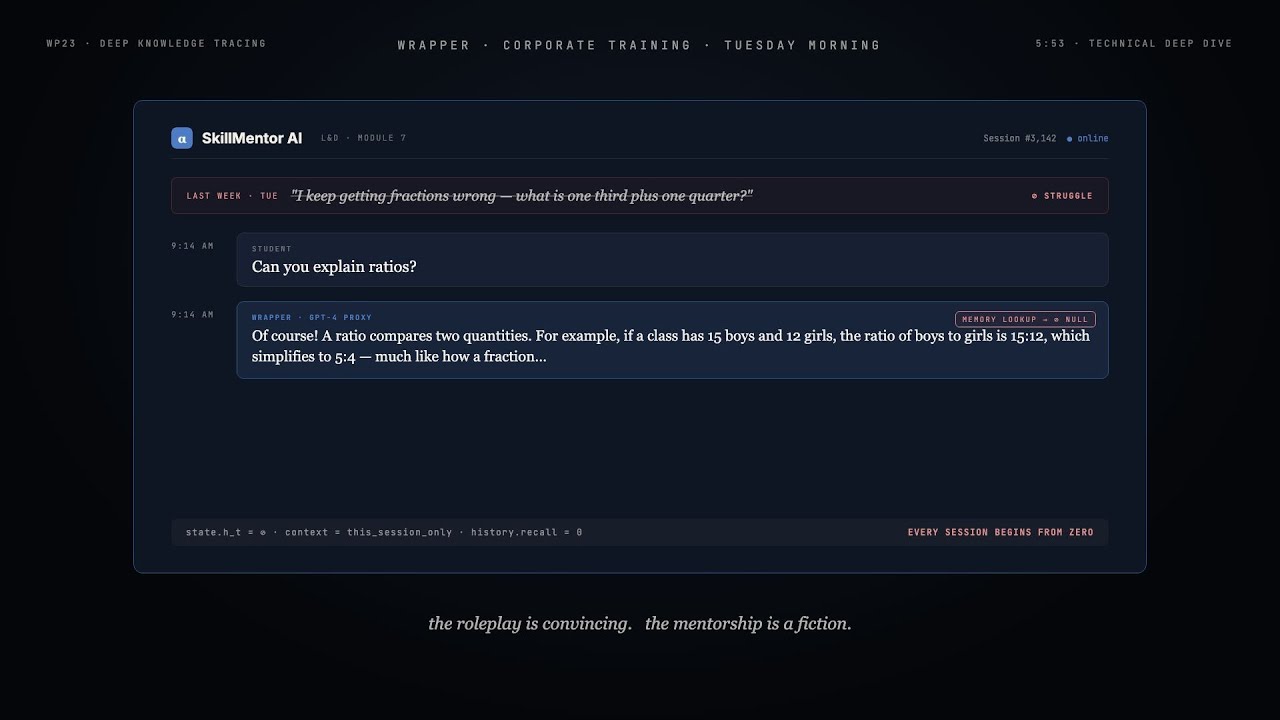
The EdTech landscape is flooded with "AI Tutors" that are merely thin wrappers around LLM APIs. They roleplay as teachers but fundamentally fail at education's core task: managing a learner's cognitive state over time.
Veriprajna architects true pedagogical intelligence through Deep Knowledge Tracing (DKT)—using Recurrent Neural Networks to model the "Brain State" and maintain learners in the Flow Zone where deep learning occurs.
We are inundated with "intelligent" tools, yet true pedagogical intelligence remains scarce.
Standard LLMs excel at linguistic roleplay, mimicking the cadence of an educator. But they fundamentally fail at education's core task: understanding why a question was asked.
Real teachers construct a mental model of the learner's proficiency—a "Brain State"—that persists and evolves. They remember struggles with fractions last week and anticipate issues with ratios today.
LLMs are prone to hallucinations—generating plausible but factually incorrect explanations. Research shows models provide correct answers via incorrect steps, or flag correct student work as wrong.
"Education is not merely the generation of explanations; it is the management of a learner's cognitive state over time. Standard LLMs offer roleplay, not mentorship."
— Veriprajna Technical Whitepaper, 2024
Applications that offload all intelligence to third-party LLM APIs have no defensive moat. If your core value is a prompt, your product is a commodity.
Knowledge Tracing is the machine learning task of modeling a student's knowledge over time to predict future performance. DKT represents a paradigm shift from rigid Bayesian models to flexible deep learning.
| Feature | Bayesian Knowledge Tracing (BKT) | Deep Knowledge Tracing (DKT) |
|---|---|---|
| State Representation | Binary (0 or 1) Known / Unknown |
Continuous High-Dimensional Vector (e.g., 200+ dimensions) |
| Concept Dependencies | Assumes independence (Silos) | Captures complex, non-linear latent dependencies |
| Temporal Dynamics | First-order Markov (Memory of previous step only) |
Infinite Impulse Response (Long-term memory via LSTM) |
| Input Requirement | Requires expert labeling of "skills" per question | Learns latent concept structures from raw interaction logs |
| Predictive Performance | Lower AUC | Significantly higher AUC (25% gain) |
| Adaptability | Rigid, rule-based structure | Flexible, data-driven, "deep" in time |
Model learns curriculum structure without human tagging. If students who fail Question A tend to fail Question B, dependency is automatically encoded.
State can represent "40% proficient"—student understands concept but makes calculation errors. No binary limitation.
LSTM models memory decay. If student hasn't practiced a skill for weeks, hidden state values drift, reflecting natural forgetting.
Standard RNNs forget long-term dependencies. Education is a long-term process—a concept from September is relevant in May. LSTM's gated architecture preserves critical signals across thousands of interactions.
Decides what information from past state is no longer relevant (e.g., specific numbers in a problem) and should be discarded.
Decides what new information (e.g., mastery of underlying rule) should be stored in long-term cell state.
Determines current prediction based on updated state—what should be remembered for this moment's decision.
The ultimate utility of tracking the "Brain State" is intervention. Maintain learners in the Zone of Proximal Development where challenge ≈ skill.
Flow, defined by psychologist Mihaly Csikszentmihalyi, is complete absorption in an activity. It occurs only when difficulty and skill are optimally balanced.
The DKT output vector provides P(correct) for every exercise. We map probabilities to psychological states:
Adjust the probability slider to see how DKT classifies content difficulty for a learner
Student is in the Flow Zone (P=0.55). Present this concept next. Probability indicates foundational knowledge exists but cognitive effort required—ideal for learning.
Result: Student perpetually suspended in maximum cognitive engagement. If struggle detected, system auto-serves scaffolding to rebuild confidence before returning to complexity.
To build systems that talk like teachers and think like data scientists, we combine LLMs (Symbolic/Linguistic) with DKT (Connectionist/Neural).
For EdTech and Corporate L&D decision-makers, the shift from Wrapper AI to DKT is not just technical—it's a fundamental driver of business value.
Churn stems from Boredom (too easy) or Anxiety (too hard). DKT mechanically maintains users in the Flow Zone, directly impacting retention.
One-size-fits-all training forces employees through material they already know. DKT identifies mastery (P{'>'} 0.9) and allows skipping.
As LLMs commoditize, wrappers have no moat. A DKT system builds proprietary "Brain State" data—competitors cannot clone via API.
| Metric | Traditional Linear Learning | DKT-Powered Adaptive Learning | Business Impact |
|---|---|---|---|
| Completion Rates | 15-20% (MOOC/Standard) |
60-80% (Adaptive) |
Higher LTV & Renewal Rates |
| Time to Proficiency | Fixed (High) | Variable (Optimized) | 40-50% Reduction in Training Costs |
| Engagement | Passive Consumption | Active Flow State | Increased Daily Active Users (DAU) |
| Scalability | High (but low effectiveness) | High (with high effectiveness) | Solves "2 Sigma" Scalability Problem |
See how DKT predicts student performance across multiple concepts and drives policy decisions
The DKT model's hidden state has been updated based on Alex's last 247 interactions over 3 weeks. The output probability vector reveals:
Transitioning from a standard LMS or chatbot to a Deep AI solution requires structured execution. Veriprajna provides end-to-end guidance.
Shift from logging "Test Scores" to logging "Interaction Traces." Capture every attempt, hint request, latency metric in time-series database.
Implement rigorous hashing of user IDs. Ensure privacy compliance while maintaining integrity of sequential data.
Train LSTM model on historical data. Benchmark predictive accuracy (AUC) against existing methods. Validate on holdout set.
Analyze historical logs to determine empirical probability thresholds correlated with drop-off. Calibrate Flow Zone for your content.
Deploy Policy Layer to intercept user messages, query DKT model, inject context into LLM prompt. Build middleware for state management.
Roll out "AI Mentor" to subset. Measure Learning Gain (pre/post-test) and Engagement (session length). Compare to control group.
How do we model new users with no history? Veriprajna employs transfer learning:
DKT model pre-trained on anonymized aggregate data from thousands of historical learners. Establishes "baseline" brain state.
New users assigned to learner cluster based on diagnostic assessment. Hidden state seeded with centroid of similar learners.
LSTM diverges from generic baseline to personalized state within first 10-20 interactions. True personalization emerges quickly.
Veriprajna partners with organizations that recognize the strategic imperative of moving beyond wrapper applications.
Transform your tutoring platform from a commodity wrapper to a defensible AI product. Build proprietary Brain State models that competitors cannot replicate.
Optimize training efficiency with intelligent skill gap analysis. Return employees to productivity 40-50% faster by eliminating redundant content.
Deploy research-grade adaptive learning systems. Collect interaction traces for learning science research. Solve the "2 Sigma Problem" at institutional scale.
Don't build another wrapper. Start with a defensible architecture. Veriprajna provides DKT infrastructure so you can focus on domain expertise and UX.
Deep Knowledge Tracing uses LSTM (Long Short-Term Memory) recurrent neural networks to process every student interaction — question attempts, hint requests, response times — and update a persistent 200+ dimensional hidden state vector representing the learner's 'Brain State.' Unlike Bayesian Knowledge Tracing which uses binary (known/unknown) states, DKT models partial knowledge on a continuous spectrum (e.g., '40% proficient in fractions'). The LSTM architecture solves the vanishing gradient problem through forget, input, and output gates, enabling the model to remember that a concept from September is relevant in May. This achieves 25% higher predictive accuracy (AUC) than Bayesian approaches.
Flow Zone optimization maps DKT probability predictions to Csikszentmihalyi's psychological flow theory. The DKT output vector provides P(correct) for every exercise in the curriculum. Problems where P is between 0.40 and 0.70 fall in the Flow Zone — the student has foundational knowledge but must exert cognitive effort, which is ideal for learning. Problems with P above 0.75 indicate mastery (boredom risk), while P below 0.35 indicates anxiety risk. A Dynamic Difficulty Adjustment control loop continuously selects the next optimal problem to keep the student in Flow. This drives completion rates from 15-20% (traditional) to 60-80% (adaptive).
LLM wrappers fail education at three levels: First, they are stateless — treating every session as an isolated event with no persistent memory of the student's learning history across months. Context windows cannot scale to track hundreds of interactions at acceptable cost. Second, they are reactive rather than strategic — responding to queries without guiding curriculum sequencing based on a knowledge model. Third, they hallucinate pedagogy — generating plausible but incorrect explanations that novice students cannot distinguish from valid instruction (e.g., Khanmigo validating 3,750 times 7 equals 21,690). The wrapper is a commodity with no data moat, while DKT builds proprietary Brain State data that improves with every interaction.
The promise of "Personalized Learning" has been trapped in buzzwords. Deep Knowledge Tracing is the reality.
We must build systems that remember you struggled with fractions last week, so they can help you with ratios today. We must build systems that respect the delicate balance of the Flow Zone.
Complete research paper: BKT vs DKT analysis, LSTM architecture, neuro-symbolic design patterns, implementation roadmap, business case studies, comprehensive works cited.
Veriprajna.
Don't just process text. Trace Knowledge.