Beyond the Bounding Box: The Imperative for Physics-Constrained Intelligence in Enterprise AI
A Veriprajna Whitepaper
Executive Summary
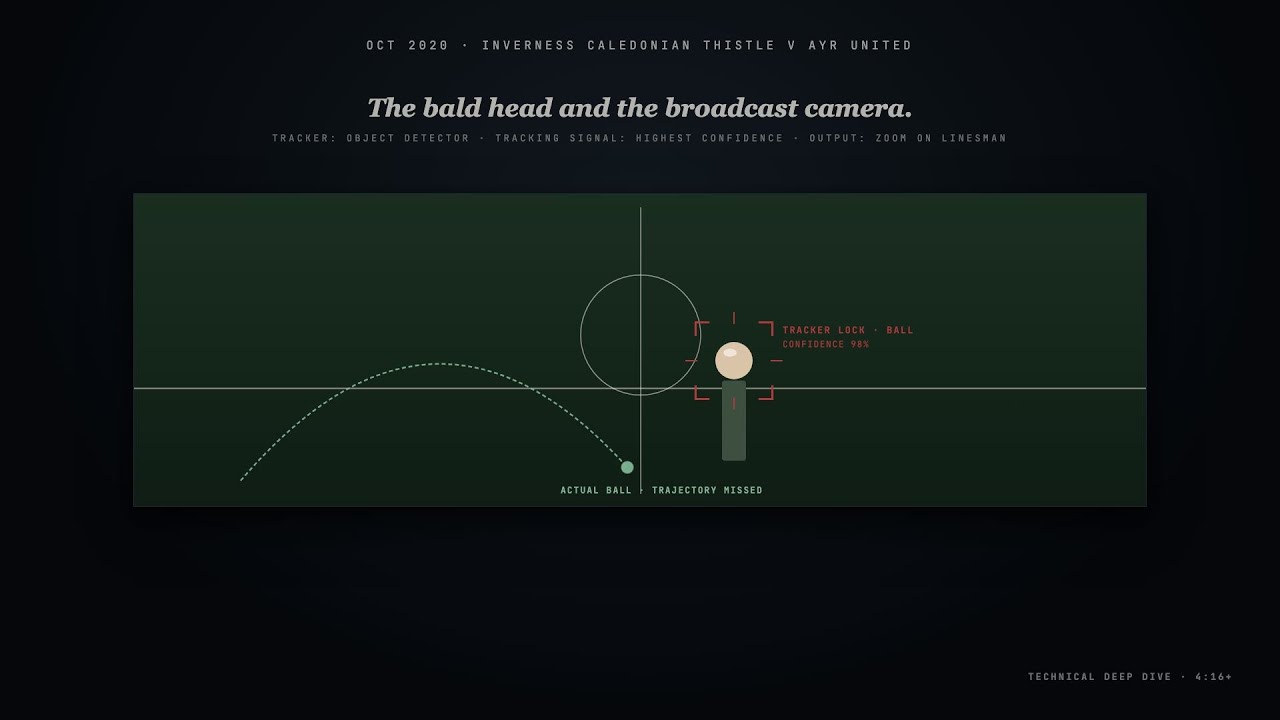
In the high-stakes arena of enterprise artificial intelligence, the distinction between detecting an object and understanding its nature is not merely semantic—it is the difference between operational success and catastrophic failure. This reality was vividly illustrated in October 2020, during a Scottish Championship soccer match between Inverness Caledonian Thistle and Ayr United. A newly installed, automated camera system, designed to autonomously broadcast the game by tracking the ball, failed in a manner that was both comical and instructive. Instead of following the play, the AI system repeatedly panned away from the high-speed action to zoom in on the bald head of a linesman standing on the sideline.
To the viewers at home, denied a view of the goals being scored, the match was a frustration. To the AI architect, it was a revelation. The system, likely built on standard discriminative deep learning architectures similar to YOLO (You Only Look Once) or SSD (Single Shot Detector), had correctly identified a visual pattern: a round, light-colored object with a texture resembling a synthetic sphere under stadium floodlights. In the lexicon of computer vision, the linesman’s head was a "ball." The system failed because it relied exclusively on visual probability while ignoring physical possibility. It lacked the contextual framework to understand that a soccer ball follows the laws of projectile motion, accelerates upon impact, and cannot physically be attached to a human torso moving at walking pace.
This incident serves as a defining parable for the current state of industrial AI. We are witnessing a saturation of "wrapper" solutions—thin application layers atop generic Large Language Models (LLMs) or pre-trained Computer Vision APIs. These systems excel at probabilistic pattern matching but crumble when faced with the deterministic constraints of the physical world. They detect, but they do not comprehend.
At Veriprajna, we posit that the next frontier of artificial intelligence is not found in larger parameter counts, but in Physics-Constrained Vision Systems . By embedding the immutable laws of physics—kinematics, thermodynamics, and conservation of energy—directly into neural architectures and inference logic, we transform brittle detection models into robust understanding engines. This whitepaper articulates the necessity of this shift, detailing the technical failure modes of generic vision, the mathematical foundations of physics-based constraints, and the economic imperative for "Deep AI" in sectors ranging from sports technology to semiconductor manufacturing and autonomous systems.
1. The Parable of the Bald Linesman: A Forensic Analysis of AI Failure
To understand the solution, one must first ruthlessly dissect the problem. The Inverness Caledonian Thistle incident is frequently dismissed as a humorous technical glitch, but it represents a fundamental limit of purely data-driven, discriminative computer vision. 1
1.1 The Technology: Automated Broadcasting and the Texture Bias
The system in question utilized a Pixellot camera array, a sophisticated automated sports production solution designed to democratize broadcasting by eliminating the human camera operator. 1 These systems typically employ a panoramic, high-resolution optical assembly to capture the entire pitch, utilizing a software layer to generate a "virtual crop"—a digital pan-and-zoom that simulates the output of a broadcast camera. 2
The core algorithm driving this virtual camera relies on Object Detection to identify the region of interest (ROI) in every frame. Deep learning models, particularly Convolutional Neural Networks (CNNs), learn to identify objects by decomposing images into hierarchical features—edges, curves, textures, and shapes. However, widely deployed architectures are often heavily biased toward texture rather than structural logic.
In the Inverness match, the visual semantics of the linesman’s head created an adversarial example.
● Visual Similarity : The linesman’s bald head was round, shiny, and illuminated by bright stadium lights, creating a specular highlight. 3 Under the specific lighting conditions of the match, the pixel gradients of the head were statistically indistinguishable from those of a soccer ball to the specific model in use.
● Confidence Calibration : The tracking logic likely prioritized the target with the highest "confidence score." If the sun or floodlights glinted off the linesman's head, the confidence score for "ball" might have spiked to 98%, while the actual ball—moving rapidly, blurring, or passing through shadows—might have registered a confidence of only 80%.
● The Result : The system, programmed to follow the highest-confidence signal, locked onto the head. 4
1.2 The Context Gap: Semantic Ambiguity vs. Physical Impossibility
The failure occurred because the model operated in a vacuum of physical context. It processed the visual field as a "Bag of Features," identifying a "round thing" without understanding the concept of a ball. 1
A human observer—or a physics-constrained AI—instantly distinguishes a head from a ball not merely by texture, but by kinematic context:
● Connectivity : A head is attached to a body. A ball is a discrete, disconnected entity.
● Velocity : A linesman moves at 0–15 mph. A soccer ball in play moves at 0–80 mph.
● Trajectory : A head maintains a relatively constant height of 5–6 feet (roughly 1.7 meters).
A ball moves in arcs defined by gravity, bounces on the pitch, or rolls along the ground. 5 The AI saw a "ball." It did not understand that a "ball" moving at 3 mph at a constant altitude of 5.5 feet, attached to a vertical cylindrical object (the body), violates the physical profile of a soccer ball in play. The generic model lacked the "common sense" derived from physics to reject the false positive, illustrating the fragility of AI that relies solely on visual probability. 3
2. The Limits of Generic Computer Vision in Enterprise
The "Bald Head" problem is not unique to sports; it is endemic to any application where generic, off-the-shelf Computer Vision (CV) APIs are applied to dynamic, physical environments. The reliance on purely data-driven approaches leads to specific failure modes that are costly in retail, dangerous in automotive, and ruinous in manufacturing.
2.1 The Static Frame Bias and Temporal Amnesia
Most generic Object Detection APIs (such as those provided by major cloud hyperscalers) process video as a sequence of independent images rather than a continuous stream of time-series data. This is known as Frame-Independent Inference .
In this paradigm, the inference engine analyzes Frame , detects a "ball" at coordinates , and then forgets everything. It proceeds to Frame , detects a "ball" (the head) at , and returns that result. The system does not natively enforce the constraint that the distance between and must be physically plausible given the time delta . 6
This lack of temporal consistency allows the tracker to jump instantaneously across the frame to a false positive if the visual confidence suggests it. In a manufacturing setting, this manifests when a defect detection system "flickers," flagging a defect in one frame and ignoring it in the next, simply because of a slight change in lighting angle. 7
2.2 The Occlusion Problem: Object Permanence
In the physical world, objects do not cease to exist when they are obscured from view. In the world of generic computer vision, they often do. Occlusion—where one object blocks the view of another—is a primary cause of tracking failure in sports and industrial logistics. 8
● The Generic Response : When a player runs between the camera and the ball, the object detector fails to find the ball. The confidence score drops to zero. The tracker declares the object "lost" and typically resets or halts.
● The Enterprise Consequence : In a retail "Just Walk Out" store, if a customer places an item in their bag and their hand obscures the item for a fraction of a second, a generic system loses track of the SKU. This leads to missed charges or false accusations of theft, degrading the customer experience. 9
● The Physics Reality : A ball moving at 20 m/s will continue to move at roughly 20 m/s (minus drag) even if it is invisible. A physics-constrained system maintains the existence of the object in its state memory, "hallucinating" its position behind the occlusion based on its pre-occlusion trajectory. 6
2.3 The High Cost of False Positives
In the Inverness match, a false positive meant unhappy fans and a PR embarrassment. In industrial applications, false positives directly erode margins.
Table 1: The Economic Impact of False Positives by Industry
| Industry | False Positive Scenario |
Consequence | Business Impact |
|---|---|---|---|
| Sports Broadcasting |
Tracking a referee's head instead of the ball. |
Camera pans away from goal; unwatchable stream. |
Subscriber churn; reputational damage.4 |
| Semiconductor Mfg |
Flagging dust/noise as a circuit defect. |
Good wafers are scrapped or sent for manual review. |
Yield loss; increased labor costs; botlenecked production.10 |
| Autonomous Vehicles |
"Phantom Braking" for shadows/signs. |
Vehicle slams on brakes on highway. |
Collision risk; passenger injury; regulatory recalls.11 |
| Retail Security | Flagging normal shopper behavior as thef. |
False accusations; friction at checkout. |
Customer alienation; operational inefciency.9 |
In semiconductor manufacturing, specifically, yield is the primary driver of profitability. If an automated optical inspection (AOI) system has a high false positive rate, the manufacturer must employ human experts to review thousands of images, or worse, scrap viable product. Research indicates that improving defect detection accuracy by just 1% can lead to a 5–10% yield increase, saving millions annually. 10 Generic "Wrapper AI" lacks the precision to distinguish between a fatal defect and a harmless surface variation because it does not model the physical interaction of light and material.
3. Physics-Constrained Vision: The Veriprajna Methodology
Veriprajna distinguishes itself from generic AI consultancies by building Physics-Constrained Vision Systems . We do not merely wrap open-source models; we wrap reality around the AI. Our systems utilize a hybrid architecture that fundamentally alters the relationship between the pixel and the prediction. We treat the output of a Deep Learning model not as a "fact," but as a "noisy measurement" that must be validated against the immutable laws of physics.
3.1 The Hybrid Architecture: Deterministic Logic + Probabilistic Perception
The core of our approach is the integration of deterministic state estimation into the probabilistic detection loop. We employ a rigorous mathematical framework that filters the neural network's output through a physics engine.
The Equation of Hybrid Intelligence:
This architecture ensures that no detection is accepted unless it is kinematically, geometrically, and temporally consistent.
3.2 State Estimation with Kalman Filters
The primary mechanism for enforcing kinematic consistency in our systems is the Kalman Filter and its non-linear variants (Extended Kalman Filter - EKF, Unscented Kalman Filter UKF). 5
3.2.1 The Mechanics of Trajectory Prediction
A Kalman Filter maintains a probabilistic belief about the state of an object (its position, velocity, and acceleration) and, crucially, the uncertainty (covariance) of that belief. 5 It operates in a continuous "Prediction-Update" loop:
1. Prediction (The Physics Step) : Before the vision system even processes the next frame, the Kalman filter predicts where the object must be, based on its previous state and Newtonian mechanics.
○ Scenario : The ball was at midfield (), moving East at 20 m/s ().
○ Prediction : In 0.04 seconds (), the ball will be at $x_{new} = x_0 + v_x \Delta t$. The uncertainty of this prediction expands slightly due to process noise (wind, spin).
2. Measurement (The Vision Step) : The Computer Vision model scans the frame and returns candidate detections:
○ Candidate A : "Ball" at location matching the prediction.
○ Candidate B : "Ball" (Head) at a location 15 meters away.
3. Update (The Fusion Step) : The filter compares the prediction with the measurements using the Innovation term (the residual difference between prediction and measurement).
○ Rejection Logic : The "Head" candidate generates a massive Innovation value. It implies the ball accelerated at a rate physically impossible for a soccer ball. The filter calculates the Mahalanobis Distance —a statistical measure of how many standard deviations the measurement is from the prediction. If the distance exceeds a threshold (e.g., 3 sigmas), the measurement is rejected as an outlier, regardless of the visual confidence score. 12
3.2.2 The Kalman Gain
The filter dynamically adjusts its trust using the Kalman Gain () . 12
● If the vision system is noisy (e.g., heavy rain, blur), the measurement noise covariance () increases. The Kalman Gain decreases, causing the system to trust the Physics Prediction more than the Visual Measurement .
● This mechanism allows the system to "coast" smoothly through occlusions or momentary glitches (like the bald head) without deviating from the true path.
3.3 Optical Flow as a Hard Constraint
Beyond probabilistic filtering, we employ Optical Flow as a hard constraint in tracking. 14 Optical flow calculates the motion vectors of pixels between consecutive frames.
● The Logic : A soccer ball moving through the air generates a specific flow field. A stationary linesman generates a near-zero flow field (or one that matches the camera pan).
● Constraint Implementation : We impose a constraint: $ \text{ObjectVelocity} > \text{Threshold} $. If the object detector identifies a "ball" but the optical flow at that region indicates the object is stationary relative to the ground, the detection is invalidated immediately.
● Lagrange Multipliers : In advanced implementations, we treat tracking as a constrained optimization problem. We solve for the trajectory that minimizes visual error subject to the constraint that the object must obey the optical flow equation ($ \nabla I \cdot v + I_t = 0 $). This transforms "soft" preferences into "hard" mathematical requirements. 14
3.4 Physics-Informed Neural Networks (PINNs)
For complex environments where simple Newtonian mechanics are insufficient—such as predicting the curve of a ball subject to the Magnus effect or modeling fluid flow in industrial pipes—Veriprajna deploys Physics-Informed Neural Networks (PINNs) . 15
3.4.1 The PINN Innovation: Encoding Laws into Loss
Standard neural networks optimize parameters to minimize the error between predictions and labeled data (). They are prone to overfitting and can predict physically impossible states if the training data contains noise.
PINNs introduce a regularization term derived from the underlying differential equations governing the system:
● : This term evaluates the residual of the governing physical equation (e.g., the Navier-Stokes equation or the projectile motion equation). If the network predicts a trajectory where a ball turns mid-air without an external force, the differential equation is violated, and spikes. 16
● Training Effect : During training, the network is penalized not just for missing the target, but for violating the laws of physics. It essentially "learns" gravity, momentum, and conservation of energy.
● Result : A PINN requires far less training data than a standard network because the search space of possible solutions is drastically reduced by the physical constraints. It generalizes better to unseen scenarios because it understands the rules of the game, not just the history of the game. 15
4. Deep Dive: Industrial Applications and Case Studies
While the "Bald Head" incident provides a clear illustration of the problem, the application of Physics-Constrained Vision extends far beyond sports, addressing critical challenges in high-value industries.
4.1 Sports Technology: The 3D Reality
A soccer ball is a 3D object moving in a gravitational field, yet most cameras see only a 2D plane. Veriprajna systems bridge this gap.
● 3D Trajectory Reconstruction : By utilizing 3D Kalman Filters, we estimate the depth (-axis) of the ball based on scale changes and gravitational acceleration constraints (-axis acceleration must equal ). 13
● Spin and Aerodynamics : Advanced models incorporate aerodynamic drag and the Magnus effect (spin). A "knuckleball" moves differently than a curling free kick. A physics-constrained model can identify the shot type from the initial trajectory and predict the curve, allowing the camera to pan ahead of the action rather than reacting to it. 18
● Semantic Consistency : To solve the Inverness problem specifically, we implement semantic kinematic checks. We classify "tracks" rather than just objects. A track that maintains a constant height of 1.7 meters for minutes is semantically classified as "Human," regardless of its visual texture. A track that exhibits high-variance velocity is classified as "Projectile."
4.2 Semiconductor Manufacturing: Zero-Defect Inspection
In the nanometer-scale world of semiconductor fabrication, the cost of a false positive is extreme.
● The Problem : A generic AI might flag a 2nm dust particle as a "kill defect" because it looks like a short circuit.
● The Veriprajna Solution : We utilize Multi-View Geometry constraints. 19 By imaging the wafer from multiple angles, we apply epipolar geometry to verify the defect. A physical pit or scratch will shift position in a predictable way (parallax). A surface stain or dust particle might behave differently. If the defect candidate does not satisfy the geometric constraints of triangulation, it is dismissed as a surface artifact, saving the wafer from scrap. 20
● Economic Impact : By reducing false positives, we directly improve the "First Pass Yield" metric, which is the single most critical KPI in semiconductor economics. 10
4.3 Autonomous Systems: Solving "Phantom Braking"
"Phantom Braking" occurs when an autonomous vehicle's vision system misinterprets a shadow, bridge, or road sign as an obstacle and slams on the brakes. 11 This is a failure of physical reasoning.
● The Failure : A contrast-based system sees a dark band (shadow) across the road and classifies it as a "wall" or "vehicle."
● The Physics Constraint : A static obstacle on a highway has 3D structure. A shadow lies on the road plane. Veriprajna advocates for Temporal Consistency Checks using Optical Flow. By analyzing the "obstacle" over several frames, we can determine its height relative to the road surface. If the Optical Flow indicates zero height (the object is moving exactly with the road texture), the system prohibits braking, overriding the object detector. 11
● Sensor Fusion : We employ "Sensor Fusion as a Truth Anchor." While a camera can be fooled by light, Radar and LiDAR (Time-of-Flight sensors) offer ground truth on distance. Physics logic dictates that if Vision says "Obstacle" but Radar says "Empty Space," the system must arbitrate based on physical plausibility. 21
5. The Economic Case: Build vs. Buy in 2025
For enterprise leaders, the decision to implement AI is often a choice between buying off-the-shelf APIs ("Wrapper AI") or building custom solutions. The "Bald Head" incident clarifies the economics of this choice.
5.1 The "90% Trap"
Generic APIs allow companies to reach 90% accuracy rapidly and cheaply. They can identify a ball, a car, or a defect in standard conditions.
● The Last 10% : The business value—and the business risk—lies entirely in the last 10%. This segment contains the edge cases: the bald head, the shadow on the road, the occlusion, the rare defect.
● The Cost of Failure : Generic APIs fail at the edge. In sports, this means lost subscribers. In manufacturing, it means lost yield. In autonomous systems, it means liability.
● Veriprajna Value Proposition : We bridge the gap from 90% to 99.99% by adding the
Physics Layer . We do not rely solely on data, which can be sparse or biased; we rely on physics, which is universal and immutable.
5.2 Total Cost of Ownership (TCO) Analysis
While a custom Physics-Constrained system has a higher initial CAPEX than a Wrapper API, the OPEX and risk profile favor the "Build" approach for mission-critical tasks. 22
Table 2: Build vs. Buy Strategic Analysis
| Feature | Wrapper API (The "Buy" Approach) |
Physics-Constrained System (Veriprajna) |
|---|---|---|
| Initial Cost | Low (Subscription based) | Moderate/High (Engineering cost) |
| Accuracy | High on standard data; Low on edge cases. |
High on standard data; Robust on edge cases. |
| False Positives | Frequent (requires human review). |
Minimal (flitered by physics). |
|---|---|---|
| Data Privacy | Data ofen leaves premise/cloud. |
Full data sovereignty/On-premise capable. |
| IP Ownership | None (Vendor lock-in). | Full ownership of the model and logic. |
| Long-Term TCO | High (scaling costs + cost of errors). |
Low (amortized build cost + efciency gains). |
As noted in industry reports, buying a platform can accelerate time-to-value, but building a proprietary, physics-aware solution creates a defensive moat and long-term operational resilience. 23
6. Technical Architecture of a Veriprajna Solution
When Veriprajna engages with a client, we deploy a standardized yet flexible architecture designed for physics-constrained inference. This "Phys-Vision" pipeline ensures that every pixel is vetted by logic.
6.1 The Pipeline Steps
1. Ingest : High-FPS video stream (Raw/Bayer preferred to avoid compression artifacts that confuse flow algorithms).
2. Pre-Processing : Distortion correction (essential for accurate kinematic measurements).
3. Probabilistic Detection (The "Hypothesis") :
○ A state-of-the-art CNN (e.g., EfficientDet, YOLOv8) runs to generate candidate bounding boxes.
○ Output :, .
4. Deterministic Verification (The "Test") :
○ Kinematic Gate : Is the candidate within the Predicted Region of Interest (ROI) from the Kalman Filter?
○ Optical Flow Gate : Does the pixel motion inside the box match the object's expected velocity profile?
○ Geometric Gate : Does the object size satisfy 3D perspective constraints relative to the camera position?. 25
5. State Update :
○ If Verified : Update the Kalman Filter state.
○ If Rejected : Treat as outlier/clutter.
6. Action : Pan camera / Trigger robot / Alert operator.
6.2 Advanced Implementation: Hamiltonian Neural Networks (HNNs)
For systems requiring strict energy conservation (e.g., orbital mechanics or robotic arm manipulation), we utilize Hamiltonian Neural Networks . 26
● The Concept : Instead of learning the vector field directly, an HNN learns the Hamiltonian (a scalar function representing the total energy of the system, ).
● The Mechanism: The network outputs , and the system calculates the gradients:
● The Benefit : This guarantees that the system is symplectic —it preserves volume in phase space. In practical terms, this means our tracking predictions will not "drift" or gain/lose energy artifically over long time horizons, a common failure in standard Recurrent Neural Networks (RNNs). 28
7. Conclusion: Context is the New Accuracy
The "Bald Head" incident is a humorous warning of a serious reality. As we entrust more control to AI—in factories, vehicles, and stadiums—we must demand more than just statistical correlation. We must demand physical consistency.
Generic AI models see the world as a collection of textures. They do not know that balls bounce, that cars cannot stop instantly, or that objects continue to exist when hidden. At Veriprajna, we believe that Object Detection is not Object Understanding .
We build Physics-Constrained Vision Systems because we don't just look for the ball; we use Kalman Filters to predict its trajectory, Optical Flow to verify its motion, and Thermodynamics to ensure its plausibility.
Does your AI know the difference between a ball and a head? If it only relies on pixels, the answer is "sometimes." If it relies on physics, the answer is "always."
Veriprajna: Deep AI Solutions for a Deterministic World.
#SportsTech #ComputerVision #AI #Engineering #PhysicsInformedAI #Veriprajna
Works cited
Report 1559 - AI Incident Database, accessed December 11, 2025, t fb https://incidentdatabase.ai/reports/1559/
AI-Controlled Camera Follows Bald Referee's Head Instead of the Ball t fb Bitdefender, accessed December 11, 2025, https://www.bitdefender.com/en-us/blog/hotorsecurity/ai-controlled-camera-follfows-bald-referees-head-instead-ball
AI's Confusion Over a Bald Head Demonstrates One Area Where Artificial Intelligence Needs Improvement - My TechDecisions, accessed December 11, 2025, https://mytechdecisions.com/it-infrastructure/ai-bald-head/
AI Camera Ruins Football Game By Mistaking Referee's Bald Head For Ball - NDTV, accessed December 11, 2025, https://www.ndtv.com/offbeat/ai-camera-ruins-football-game-by-mistaking-referees-bald-head-for-ball-2319171
Kalman filtering | Computer Vision and Image Processing Class Notes - Fiveable, accessed December 11, 2025, https://fiveable.me/computer-vision-and-image-processing/unit-9/kalman-filtering/study-guide/uOR622FiNSXNONR4
TOTNet: Occlusion-Aware Temporal Tracking for Robust Ball ... - arXiv, accessed t fb December 11, 2025, https://arxiv.org/pdf/2508.09650?
The Role of False Positives in Automated Visual Inspection - UnitX, accessed t fb December 11, 2025, https://www.unitxlabs.com/false-positive-machine-vision-system-inspection-errors-impact/
Overcoming Occlusion in Object Detection for Sports Analytics with Annotation & Post-Processing | AskGalore, accessed December 11, 2025, https://askgalore.com/whitepaper/occlusion-problem-ai-computer-vision-sports-analytics
Defining false positives: Why outcomes matter with Vision AI | SeeChange, accessed December 11, 2025, https://seechange.com/defining-false-positives-why-outcomes-mater-with-visiotn-ai/
Traditional vs. AI Methods in Semiconductor Defect Detection - Indium Software, accessed December 11, 2025, https://www.indium.tech/blog/traditional-vs-ai-semiconductor-defect-detection/
How To Deal With Tesla Phantom Braking Problems - Auto Scandia, accessed t fb December 11, 2025, https://autoscandia.com/how-to-deal-with-tesla-phantom-braking-problems/
Kalman filter - Wikipedia, accessed December 11, 2025, t fb https://en.wikipedia.org/wiki/Kalman_filter
Depth-Based Tracking with Physical Constraints for Robot Manipulation, accessed December 11, 2025, https://rse-lab.cs.washington.edu/papers/DepthBasedTracking-icra-2015.pdf
Optical Flow Constraints on Deformable Models with Applications to Face Tracking - University of Pennsylvania, accessed December 11, 2025, https://repository.upenn.edu/bitstreams/38a7b702-3449-45c1-880a-4f26566f9f4e/download
Physics-informed Machine Learning | PNNL, accessed December 11, 2025, https://www.pnnl.gov/explainer-articles/physics-informed-machine-learning
Physics-informed neural networks - Wikipedia, accessed December 11, 2025, https://en.wikipedia.org/wiki/Physics-informed_neural_networks
What Are Physics-Informed Neural Networks (PINNs)? - MATLAB & Simulink MathWorks, accessed December 11, 2025, https://www.mathworks.com/discovery/physics-informed-neural-networks.html
Kinematic 3D Object Detection in Monocular Video - Computer Vision Lab Michigan State University, accessed December 11, 2025, http://cvlab.cse.msu.edu/project-kinematic.html
Geometric Verification Using Semi-2D Constraints for 3D Object Retrieval Computer Vision, accessed December 11, 2025, https://vision.unipv.it/CV/materiale2016-17/1st%20Choice/0223.pdf
3D Object Modeling and Recognition Using Local Affine-Invariant Image Descriptors and Multi-View Spatial Constraints - Svetlana Lazebnik, accessed December 11, 2025, https://slazebni.cs.illinois.edu/publications/ijcv06.pdf
Tesla drivers report a surge in 'phantom braking' - Hacker News, accessed December 11, 2025, https://news.ycombinator.com/item?id=30179681
Build vs Buy Software in 2025: Cost, ROI and Decision Guide - Appinventiv, accessed December 11, 2025, https://appinventiv.com/blog/build-vs-buy-software/
Build or Buy for Vision Automation — What's the Difference - Wevolver, accessed December 11, 2025, https://www.wevolver.com/article/build-or-buy-for-vision-automation-whats-the-diferencef
Build vs. buy: computer vision AI for telecom and utilities field operations - IQGeo, accessed December 11, 2025, https://www.iqgeo.com/blog/build-vs.-buy-computer-vision-ai-for-telecom-and-utilities-field-operations
Real time face detection using geometric constraints, navigation and depth-based skin segmentation on mobile robots - SciSpace, accessed December 11, 2025, https://scispace.com/pdf/real-time-face-detection-using-geometric-constraints-835fe04b2e.pdf
Hamiltonian Neural Networks - Natural Intelligence, accessed December 11, 2025, https://greydanus.github.io/2019/05/15/hamiltonian-nns/
Hamiltonian Neural Networks - SciBits.blog, accessed December 11, 2025, https://www.scibits.blog/posts/hnn/
Hamiltonian and Lagrange Neural Networks - AI Weekly Report, accessed December 11, 2025, https://weeklyreport.ai/briefings/hamiltonian-nn/
Prefer a visual, interactive experience?
Explore the key findings, stats, and architecture of this paper in an interactive format with navigable sections and data visualizations.
Frequently Asked Questions
Why do generic computer vision APIs fail in enterprise applications?
Generic vision APIs process video as independent frames, relying on texture-based pattern matching without physical context. They suffer from temporal amnesia, occlusion blindness, and texture bias — famously demonstrated when an AI camera tracked a bald referee's head instead of a football because both appeared as round, light-colored objects with high confidence scores.
What is a physics-constrained vision system?
A physics-constrained vision system treats neural network detections as noisy measurements that must be validated against physical laws. It integrates Kalman filters for kinematic consistency, optical flow for motion verification, and geometric constraints for 3D plausibility — rejecting detections that violate Newtonian mechanics regardless of visual confidence scores.
How do Physics-Informed Neural Networks improve enterprise AI accuracy?
PINNs encode governing physical equations (projectile motion, Navier-Stokes, conservation of energy) directly into the neural network's loss function. The network is penalized during training for predicting physically impossible states, which dramatically reduces the search space, requires less training data, and ensures predictions remain physically plausible even in novel scenarios.
Also Published On
Build Your AI with Confidence.
Partner with a team that has deep experience in building the next generation of enterprise AI. Let us help you design, build, and deploy an AI strategy you can trust.
Veriprajna Deep Tech Consultancy specializes in building safety-critical AI systems for healthcare, finance, and regulatory domains. Our architectures are validated against established protocols with comprehensive compliance documentation.