The Imperative for Physics-Constrained Intelligence in Enterprise AI
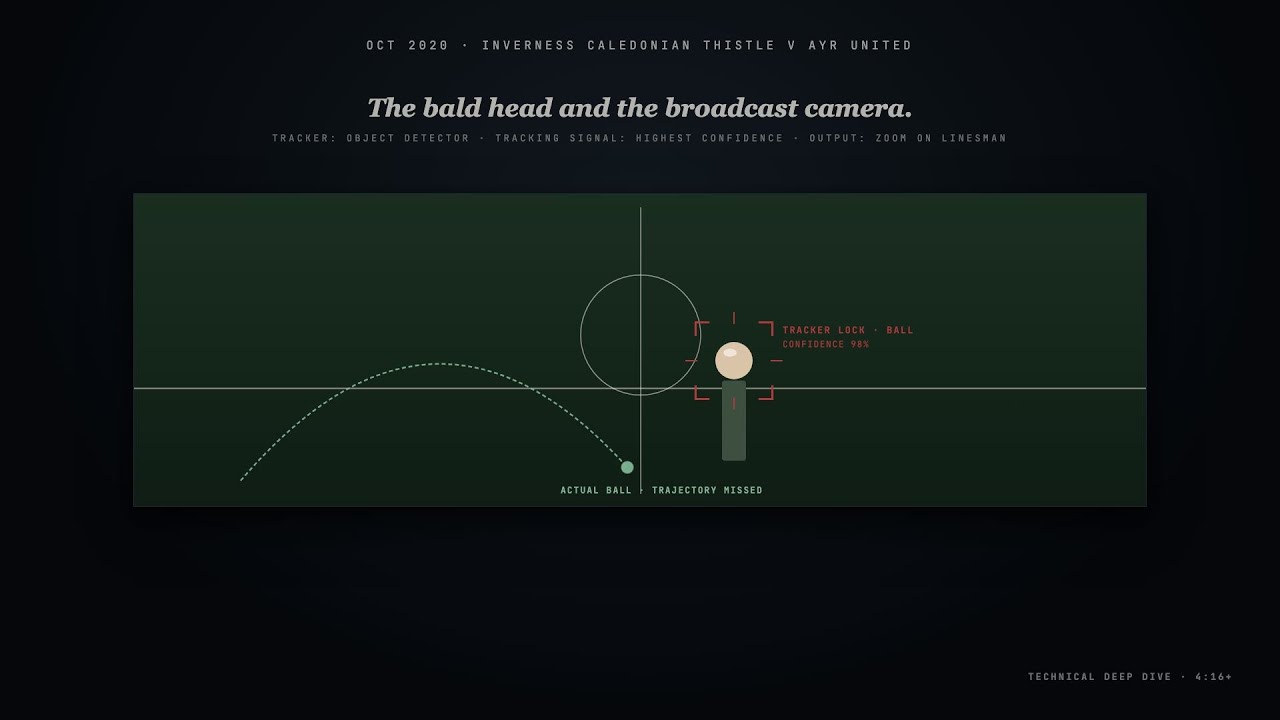
In October 2020, an AI-powered soccer camera mistook a bald linesman's head for the ball, ruining the broadcast. This wasn't a software bug—it was a fundamental failure of vision systems that detect without understanding.
Veriprajna builds Physics-Constrained Vision Systems that embed the immutable laws of physics—kinematics, thermodynamics, conservation of energy—directly into AI architectures, transforming brittle detection into robust understanding.
A forensic analysis of AI failure that reveals the fundamental limits of purely data-driven computer vision
October 2020: Inverness Caledonian Thistle vs Ayr United. An automated Pixellot camera system, designed to track the ball and broadcast the match, repeatedly panned away from the action to zoom in on the bald head of a linesman.
The AI relied exclusively on visual probability while ignoring physical possibility. It saw a round object but lacked contextual understanding that a soccer ball cannot be attached to a human torso moving at walking pace.
"The system correctly identified a visual pattern—a round, light-colored object with texture resembling a synthetic sphere under stadium lights. In the lexicon of computer vision, the linesman's head was a 'ball.' The system failed because it relied exclusively on visual probability while ignoring physical possibility."
— Veriprajna Whitepaper, 2024
Interactive simulation showing how generic vision systems fail while physics-constrained systems maintain accurate tracking
Processes video as sequence of independent frames. No temporal consistency. Jumps to highest-confidence visual match regardless of physical plausibility.
Kalman Filter predicts where ball must be based on previous trajectory and Newtonian mechanics. Rejects detections that violate kinematic constraints.
The "Bald Head" problem is endemic to any application where generic, off-the-shelf Computer Vision APIs are applied to dynamic, physical environments.
Generic APIs process video as independent images, not continuous time-series data. System "forgets" between frames, allowing tracker to jump instantaneously to false positives.
When object is obscured, confidence drops to zero. System declares object "lost" and resets. No concept of object permanence or predictive hallucination.
CNNs heavily biased toward texture over shape/structure. Objects with similar pixel gradients (bald head vs ball) become indistinguishable without physics context.
| Industry | False Positive Scenario | Consequence | Business Impact |
|---|---|---|---|
| Sports Broadcasting | Tracking referee's head instead of ball | Camera pans away from goal; unwatchable stream | Subscriber churn; reputational damage |
| Semiconductor Mfg | Flagging dust/noise as circuit defect | Good wafers scrapped or sent for manual review | Yield loss; increased labor costs; bottlenecks |
| Autonomous Vehicles | "Phantom Braking" for shadows/signs | Vehicle slams on brakes on highway | Collision risk; passenger injury; recalls |
| Retail Security | Flagging normal shopper behavior as theft | False accusations; friction at checkout | Customer alienation; operational inefficiency |
In semiconductor manufacturing, improving defect detection accuracy by just 1% can lead to 5-10% yield increase, saving millions annually.
We wrap reality around the AI. Output of Deep Learning is treated as "noisy measurement" that must be validated against immutable laws of physics.
No detection is accepted unless it is kinematically, geometrically, and temporally consistent.
Maintains probabilistic belief about object state (position, velocity, acceleration) and uncertainty. Predicts where object must be before vision system processes next frame.
Mahalanobis Distance: Rejects measurements >3σ from prediction. "Head" candidate violates physics—rejected regardless of 98% visual confidence.
Calculates motion vectors of pixels between frames. Soccer ball generates specific flow field; stationary linesman generates near-zero flow.
If detector identifies "ball" but optical flow shows stationary object, detection invalidated immediately—transforming soft preferences into hard mathematical requirements.
Encodes physical laws directly into loss function. Network penalized for violating differential equations (projectile motion, Navier-Stokes, conservation of energy).
Requires far less training data. Generalizes better to unseen scenarios because it understands rules of the game, not just history.
For systems requiring strict energy conservation (orbital mechanics, robotic arms). Network learns Hamiltonian (total energy H = T + V), guarantees symplectic structure.
Predictions won't drift or gain/lose energy artifically—common failure in standard RNNs for long time horizons.
See how physics-based prediction filters noisy visual measurements in real-time
Wind, spin, air resistance—how much physics model uncertainty
Rain, blur, occlusion—how noisy are visual detections
K < 0.5: Trust physics prediction more
K > 0.5: Trust vision measurement more
Green: True position • Blue: Noisy measurements • Red: Kalman filtered estimate
Physics-Constrained Vision extends far beyond sports, addressing critical challenges in high-value industries
3D Trajectory Reconstruction: Estimate depth (z-axis) from scale changes and gravitational acceleration constraints (y-axis = -g). Predict curve for knuckleball vs free kick using Magnus effect.
Zero-Defect Inspection: Multi-view geometry constraints using epipolar geometry. Physical pit/scratch exhibits parallax; surface dust doesn't. Saves wafers from scrap.
Solving Phantom Braking: Temporal consistency checks via optical flow. Shadow on road has zero height. Physical obstacle has 3D structure. Sensor fusion as truth anchor.
"Generic 'Wrapper AI' lacks precision to distinguish fatal defect from harmless surface variation because it does not model the physical interaction of light and material."
The "Bald Head" incident clarifies the economics. Business value lies in the last 10%—the edge cases where generic APIs fail.
Identify ball, car, defect in standard conditions. Rapid deployment, low initial cost.
Bald head, shadow on road, occlusion, rare defect. In sports: lost subscribers. In manufacturing: lost yield. In autonomous: liability.
We add the Physics Layer. We don't rely solely on data (which can be sparse/biased)—we rely on physics, which is universal and immutable.
| Feature | Wrapper API ("Buy") | Physics-Constrained (Veriprajna) |
|---|---|---|
| Initial Cost | Low (Subscription) | Moderate/High (Engineering) |
| Accuracy | High on standard; Low on edge cases | High standard; Robust edge cases |
| False Positives | Frequent (requires human review) | Minimal (filtered by physics) |
| Data Privacy | Data leaves premise/cloud | Full sovereignty/On-premise |
| IP Ownership | None (Vendor lock-in) | Full ownership of model & logic |
| Long-Term TCO | High (scaling + error costs) | Low (amortized + efficiency gains) |
Veriprajna's standardized architecture ensures every pixel is vetted by logic before action
High-FPS video stream. Raw/Bayer format preferred to avoid compression artifacts. Distortion correction for accurate kinematic measurements.
State-of-art CNN (EfficientDet, YOLOv8) generates candidate bounding boxes. This is "The Hypothesis"—not yet validated.
"The Test": Kinematic Gate (Kalman ROI), Optical Flow Gate (velocity profile), Geometric Gate (3D perspective constraints).
If verified: Update Kalman Filter state with measurement. If rejected: Treat as outlier/clutter, maintain prediction.
Execute control command: Pan camera, trigger robot, alert operator. Deterministic timing critical for real-time systems.
Log edge cases, update physics parameters, retrain PINNs with new data. Closed-loop improvement while maintaining physics guarantees.
Belt: 2-3 m/s. Camera→Nozzle: ~1m. Time budget: 300-500ms total (acquisition, preprocessing, inference, segmentation, valve timing).
Jitter = Contamination. If air jet fires 50ms late, it hits wrong object. GPU batch processing introduces unacceptable variance.
The "Bald Head" incident is a humorous warning of a serious reality. As we entrust more control to AI—in factories, vehicles, and stadiums—we must demand more than just statistical correlation. We must demand physical consistency.
"Generic AI models see the world as a collection of textures. They do not know that balls bounce, that cars cannot stop instantly, or that objects continue to exist when hidden."
At Veriprajna: Object Detection is not Object Understanding.
We build Physics-Constrained Vision Systems because we don't just look for the ball—we use Kalman Filters to predict its trajectory, Optical Flow to verify its motion, and Thermodynamics to ensure its plausibility.
The AI relied exclusively on visual probability while ignoring physical possibility. A bald head under stadium lights produces similar specular highlights, round shape, and texture patterns as a synthetic soccer ball, scoring 98% visual confidence. However, the system lacked physics context: a ball is discrete (not attached to a human torso), moves at 0-80 mph (not walking pace), and follows projectile trajectories under gravity (not constant 5.5 feet height). Veriprajna's Kalman Filter would reject this detection using Mahalanobis distance because the candidate violates kinematic constraints regardless of visual confidence.
Kalman Filters maintain a probabilistic belief about object state (position, velocity, acceleration) and predict where an object must be based on Newtonian mechanics before the next frame arrives. Any detection with Mahalanobis distance greater than 3 sigma from this prediction is rejected as physically impossible. Optical Flow calculates motion vectors between frames, enabling hard kinematic constraints. If a detector identifies a 'ball' but optical flow shows a stationary object, the detection is immediately invalidated. Together, these transform soft statistical preferences into hard mathematical requirements.
Generic APIs achieve 90% accuracy fast but fail at edge cases where business risk concentrates. In sports broadcasting, tracking failures cause subscriber churn. In semiconductor manufacturing, improving defect detection accuracy by just 1% leads to 5-10% yield increase worth millions annually, as physics-based multi-view geometry distinguishes true defects from dust. In autonomous vehicles, phantom braking from misclassified shadows causes collision risks and recalls. Veriprajna bridges this gap by adding a physics verification layer, achieving 99.99% target accuracy with FPGA-level deterministic latency under 300ms.
Veriprajna's Physics-Constrained AI doesn't just improve detection rates—it fundamentally changes how machines understand reality.
Schedule a consultation to discuss how Deep AI can solve your critical vision challenges.
Complete engineering analysis: Kalman Filters, PINNs, HNNs, optical flow constraints, industrial case studies, build vs buy economics, comprehensive citations.