The Illusion of Control: Why Banning Generative AI Failed and How Private Enterprise LLMs Secure the Future
Executive Summary: The Shadow AI Paradox and the Imperative for Sovereign Intelligence
The modern enterprise stands at a precipice, balanced precariously between the undeniable transformative potential of Generative Artificial Intelligence (GenAI) and an unprecedented landscape of security vulnerabilities. Since the public release of Large Language Models (LLMs) like ChatGPT, organizations have grappled with a binary dilemma: embrace these tools and risk the exfiltration of intellectual property, or ban them and accept a significant competitive disadvantage in productivity. The initial reflex for the corporate world—driven by traditional cybersecurity paradigms—was prohibition. Major entities, including global financial institutions and technology giants, erected digital firewalls, blocked domains, and issued stern policy memoranda forbidding the use of public AI tools.
However, a comprehensive analysis of the evolving threat landscape reveals that this strategy of prohibition has unequivocally failed. It has resulted in a phenomenon best described as "security theater"—a superficial display of control that masks a deepening crisis of data governance. The data indicates that banning authorized AI channels has not curtailed usage; rather, it has driven it underground, birthing the "Shadow AI" epidemic. In this opaque environment, employees—driven by the intense pressure to maintain efficiency—bypass corporate safeguards, pasting proprietary code, sensitive financial projections, and confidential strategic documents into personal accounts on public AI platforms. 1
The consequences of this shift are not theoretical. The 2023 Samsung incident, where semiconductor engineers inadvertently leaked trade secrets to OpenAI while attempting to debug proprietary source code, serves as the grim harbinger of this new reality. 3 It demonstrated that the greatest threat to enterprise security is not the malicious outsider, but the conscientious employee deprived of secure tools. When the workforce views security policies as obstacles to competence, they will inevitably circumvent them, effectively crowdsourcing corporate IP into the training datasets of third-party model providers.
This whitepaper, prepared by Veriprajna, posits that the era of the "wrapper"—thin, dependency-laden interfaces atop public APIs—is insufficient for the security and sovereignty needs of the modern enterprise. We argue that the only viable path forward is Deep AI : the deployment of Private Enterprise LLMs within the organization's own Virtual Private Cloud (VPC). By leveraging high-performance open-source models such as Llama 3, orchestrated via secure containerization and fortified with advanced guardrails like NVIDIA NeMo, enterprises can achieve "sovereign intelligence." This architecture ensures that data never leaves the corporate perimeter, is never used for external training, and remains immune to the extraterritorial reach of foreign legal frameworks like the US CLOUD Act. 5
Security in the age of AI is no longer about the capacity to say "No." It is about the architectural capability to say "Yes, safely."
1. The Anatomy of Failure: Why Prohibition Bred the Shadow AI Crisis
The trajectory of enterprise AI adoption has been defined by a fundamental tension between the utility of the technology and the rigidity of traditional information security models. In early 2023, as the capabilities of models like GPT-4 became apparent, this tension snapped, leading to a wave of corporate bans that inadvertently created a massive, unmonitored attack surface.
1.1 The Samsung Incident: A Forensic Analysis of Exfiltration
The catalyst for the industry-wide realization of AI risk was the series of security incidents at Samsung Electronics in May 2023. These events provide a definitive case study in the mechanics of accidental insider threats and the porous nature of public AI endpoints.
Engineers at Samsung’s semiconductor division, tasked with the highly complex work of optimizing chip fabrication processes and debugging yield-measurement software, sought to leverage the reasoning capabilities of ChatGPT. In their pursuit of efficiency, they bypassed the implications of the tool's terms of service, which at the time allowed the provider to retain inputs for model training.
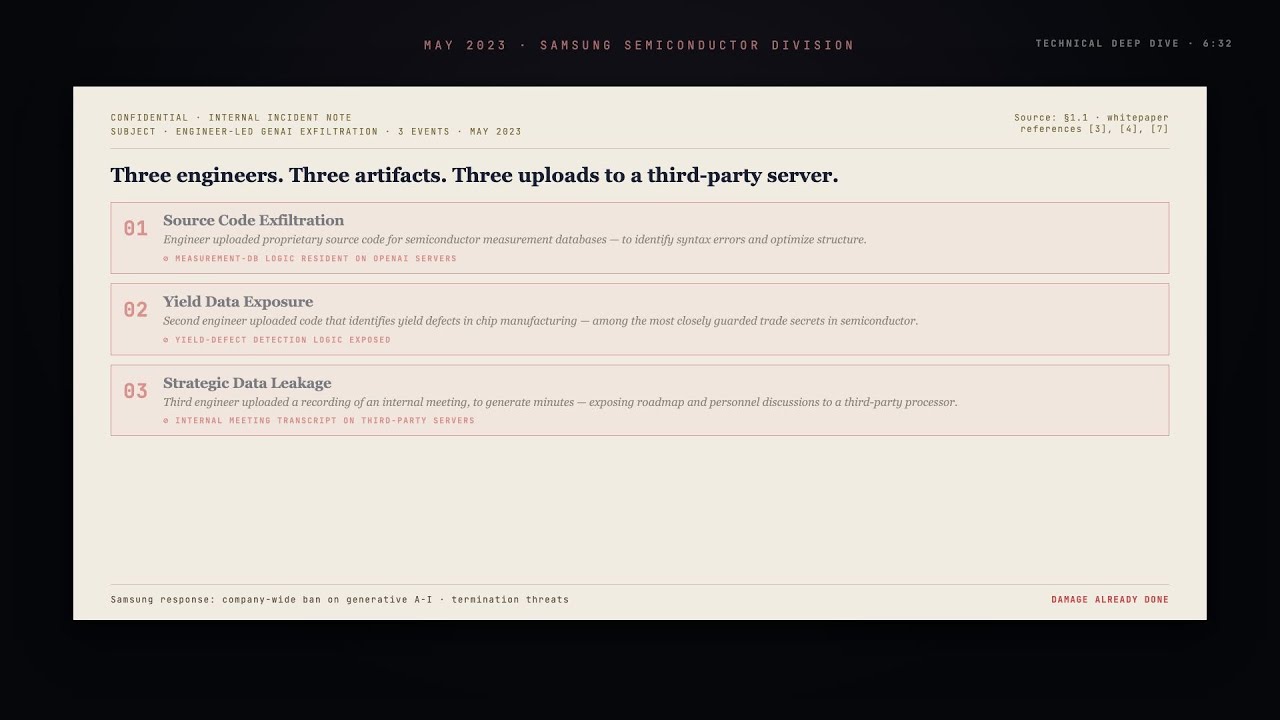
Three distinct leakage events occurred, each illustrating a different facet of the risk:
1. Source Code Exfiltration: An engineer uploaded proprietary source code related to semiconductor facility measurement databases. The intent was to identify syntax errors and optimize the code structure. In doing so, the logic governing Samsung's proprietary measurement facilities became resident on OpenAI's servers. 3
2. Yield Data Exposure: A second employee uploaded program code designed to identify yield defects in chip manufacturing. Yield rates—the percentage of functional chips produced—are among the most closely guarded trade secrets in the semiconductor industry, directly impacting stock price and competitive positioning. This upload effectively exposed Samsung's manufacturing efficiency data and error detection logic. 3
3. Strategic Data Leakage: A third employee uploaded a recording of an internal meeting to generate minutes. This exposed confidential strategic discussions, potentially including roadmap details or personnel decisions, to a third-party processor. 3
The critical failure here was not malicious intent. These were not disgruntled employees seeking to harm the company; they were high-performing engineers attempting to "debug their work" and "enhance employees' productivity and efficiency". 3 They viewed ChatGPT as a calculator—a stateless tool that processes and discards input. They failed to realize they were interacting with a "learning" system where inputs could be retained for abuse monitoring or reinforcement learning, effectively transferring Samsung's intellectual property into the hands of a US-based AI provider. 7
Samsung's response was a draconian "temporary" ban on Generative AI across company devices and networks, accompanied by threats of termination for non-compliance. 4 However, the damage was done. The incident revealed that "security by policy" is ineffective against tools that offer exponential productivity gains.
1.2 The Psychology of Shadow AI: The Productivity Imperative
"Shadow AI" refers to the unsanctioned use of artificial intelligence tools by employees within an organization. It is a specific, high-risk evolution of the broader "Shadow IT" phenomenon. To understand why bans fail, one must understand the psychological and economic drivers of the modern workforce.
The Productivity Paradox: In the current hyper-competitive economic environment, employees are judged on output, speed, and innovation. Generative AI has been demonstrated to increase coding speed by significant margins and improve writing quality for business tasks. When an organization bans these tools, it places its employees at a functional disadvantage relative to peers in other companies who have access, or even freelancers who use these tools without restriction. Research into workplace psychology suggests that visible security systems and restrictive policies often trigger a "workaround" mentality. When security is perceived as a "blocker" rather than an enabler, conscientious employees—those most dedicated to getting the job done—become the primary violators of security policy. They rationalize the violation as necessary for the business: "I need to fix this code now, and the AI can do it in seconds. I'll just change the variable names so it's anonymous". 8
This behavior creates a "Trust Paradox." Studies indicate that while employees generally respect security, they prioritize task completion. When a tool becomes essential for workflow (as LLMs have for coding and content generation), a ban forces the workflow into the shadows. Employees switch to personal devices (smartphones, personal laptops) or utilize 4G/5G hotspots to bypass corporate network filters, creating a "Paste Gap" where data leaves the secure corporate endpoint, travels to a personal device, and is then pasted into a public cloud service. 4
1.3 The Scale of the Invisible Breach
The transition from sanctioned corporate tools to Shadow AI has created a massive, invisible data leak. Recent telemetry and survey data from 2024 and projections for 2025 paint a stark picture of the disconnect between policy and reality.
| Metric | Statistic | Implications for Enterprise Security |
|---|---|---|
| Adoption Rate | ~50% of knowledge workers |
Half the workforce is operating outside of IT governance, utilizing tools that have not been veted for security or compliance.10 |
| Defance of Bans | 46% unwilling to stop | Nearly half of employees explicitly state they will continue to use AI tools even if their organization bans them, rendering policy unenforceable.2 |
| Data Exfltration | 38% admit to sharing sensitive data |
A signifcant portion of the workforce admits to uploading sensitive work-related information (IP, PII, fnancial data) to AI tools without employer knowledge.2 |
| Egress Volume | 30x increase (YoY) | The volume of data sent to GenAI apps has increased thirty-fold, indicating an exponential rise in data leakage opportunities.1 |
| Source Code Leaks | 485% increase in pasted code |
Proprietary source code is the primary vector of leakage, with engineers pasting code blocks to |
| Col1 | Col2 | debug or optimize software, replicating the Samsung scenario at scale.2 |
|---|---|---|
| Shadow IT Dominance | 72% of usage via personal accounts |
The vast majority of enterprise AI usage occurs through personal accounts, meaning the organization has zero visibility into the data retention policies agreed to by the employee.1 |
The data unequivocally indicates that "Shadow AI is the new data breach." Unlike a traditional hack where data is stolen by an adversary, Shadow AI involves data being voluntarily handed over to third parties by employees. This "insider threat" is driven not by malice, but by a desperation for efficiency that the enterprise has failed to satisfy.
1.4 The "Security Theater" of Firewall Blocking
Many organizations rely on traditional cybersecurity defenses—Secure Web Gateways (SWGs), CASBs (Cloud Access Security Brokers), and firewalls—to block access to domains like chat.openai.com or claude.ai. This approach is widely regarded by advanced security architects as "security theater"—an illusion of safety that does not address the actual risk vector.
The Failure Mechanisms of Blocking:
1. Mobile Proliferation: Employees carry personal supercomputers (smartphones) with independent 5G connections. A corporate network block does not extend to a personal device sitting on the employee's desk. The "air gap" between the corporate laptop and the personal phone is bridged by the employee simply typing or photographing data.
2. App Proliferation: There are not just three or four AI apps; there are thousands. Netskope tracks over 317 distinct GenAI apps in enterprise use. Blocking the "Big Three" (OpenAI, Google, Anthropic) simply drives users to less secure, long-tail AI startups that may have even worse data privacy policies or security standards. 1
3. Browser Extensions: Shadow AI often enters via browser extensions that claim to "summarize emails" or "auto-complete forms." These extensions often have read-access to the browser DOM (Document Object Model), allowing them to scrape sensitive internal web applications (CRMs, ERPs) without the user even explicitly pasting data. 2
The industry consensus is clear: You cannot ban your way to AI security. The utility of the technology is too high, and the vectors for access are too numerous. The only effective strategy is to provide a sanctioned, secure alternative that is better, faster, and more integrated than the public tools employees are using in the shadows. This requires a shift from "blocking" to "provisioning"—specifically, the provisioning of Private Enterprise LLMs.
2. Beyond the Wrapper: The Strategic Necessity of Deep AI
In the burgeoning AI consultancy market, a critical distinction has emerged between "AI Wrappers" and "Deep AI Solution Providers." Understanding this distinction is vital for enterprises selecting a partner for their AI transformation, as it determines the long-term viability, security, and defensibility of the deployed solution.
2.1 The "Wrapper" Trap: Commoditization and Dependency
An "AI Wrapper" is a software application that acts as a thin interface layer over a third-party foundation model, typically OpenAI's GPT-4.
● Mechanism: The application takes user input, perhaps adds a "system prompt" (a hidden instruction like "You are a helpful legal assistant"), sends it to the OpenAI API, and displays the result. It manages API calls and structures output but performs little actual cognitive processing. 11
● Dependency: The wrapper has no intellectual property in the AI itself. It is entirely dependent on the API provider's pricing, uptime, and model behavior. If the provider changes the model or raises prices, the wrapper business model is vulnerable.
● Data Flow: By definition, a wrapper facilitates the transfer of enterprise data to the API provider. It does not solve the data sovereignty issue; it merely beautifies the interface of data egress.
Why Wrappers Fail the Enterprise:
1. Commoditization Risk: Wrappers are easily replicated. If a consultancy builds a "Marketing Copy Generator" that is just a prompt into GPT-4, the enterprise could build that internally in a day. The barrier to entry is low, meaning the value provided is minimal. 13
2. Lack of Context: Thin wrappers often lack deep integration with enterprise data. They struggle with large document repositories because they rely on the limited context window of the public API (which is also expensive to fill). They are often "stateless," forgetting the nuance of company history. 15
3. Security Theater: Using a wrapper often feels like using a private tool, but the backend is still the public API. The data is still leaving the perimeter, and the risks of the US CLOUD Act and third-party data retention remain. 16
2.2 The Veriprajna "Deep AI" Approach
Veriprajna positions itself as a Deep AI provider . This entails a fundamental shift from "renting intelligence" via APIs to "building intelligence capabilities" within the enterprise infrastructure.
Components of a Deep AI Solution:
1. Infrastructure Ownership: We do not resell API keys. We deploy the full inference stack (e.g., vLLM, TGI, BentoML) directly onto the client's Kubernetes clusters or bare-metal GPUs. This ensures that the "brain" of the AI resides on hardware the client controls. 17
2. Retrieval-Augmented Generation (RAG) 2.0:
○ Instead of just pasting text, Deep AI builds a "semantic brain" for the company. This involves setting up Vector Databases (like Milvus, Qdrant, or Pinecone) inside the VPC. 19
○ Secure Indexing: Proprietary documents (PDFs, Confluence, SharePoint) are ingested, chunked, embedded, and stored locally.
○ RBAC-Aware Retrieval: The system respects existing access controls. If an employee doesn't have permission to see a document in SharePoint, the RAG system won't retrieve it to answer their question—a feature rarely available in generic wrappers. 21
3. Model Fine-Tuning (The "Last Mile" of Accuracy):
○ Generic models (Llama 3) are proficient in general English but lack expertise in an organization's specific nomenclature, legacy codebases, or legal templates.
○ Deep AI involves "Continued Pre-training" (CPT) or "Instruction Tuning" (LoRA) on the enterprise's unique corpus. This creates a bespoke model asset that belongs to the client, increasing accuracy by up to 15% for domain-specific tasks. 22
4. Agentic Workflows:
○ Moving beyond "Chat." Deep AI builds agents that can do things—query an SQL database, execute a Python script, or call an internal API—securely within the network. This requires complex orchestration frameworks (like LangGraph or custom state machines) rather than simple API calls. 24
The Value Proposition: Veriprajna does not sell access to a model; it sells the capability to run models independently. It is the difference between buying a fish (API) and building a high-tech aquaculture facility (Private AI). This approach ensures that the enterprise builds defensible value—creating assets (fine-tuned models, vector indices) that are proprietary, rather than renting capability that is available to every competitor.14
3. The Sovereignty & Compliance Crisis: Why APIs Are
Insufficient
To solve the Shadow AI crisis, enterprises must understand the fundamental architectural differences between public AI consumption and private AI hosting. The distinction lies in Data Sovereignty —the concept that data is subject to the laws and governance structures of the nation or organization where it is located.
3.1 The Public API Model: Risks and Limitations
The dominant model of AI consumption today is the "Model-as-a-Service" (MaaS) approach, exemplified by the OpenAI API. In this model, the enterprise sends data (prompts, context, documents) across the public internet to the provider's inference servers.
The "Black Box" Problem: Once data leaves the enterprise perimeter and enters the API provider's infrastructure, the enterprise loses technical control. While providers like OpenAI have introduced "Enterprise" tiers with promises of "zero data retention" (ZDR) and "no training on business data," several residual risks remain:
1. Abuse Monitoring Retention: Even in enterprise agreements, providers often retain data for a short window (e.g., 30 days) to monitor for abuse. This constitutes a window of vulnerability where highly sensitive data sits on third-party storage. 26
2. Opaque Processing: The enterprise cannot verify the provider's internal security controls, logging practices, or sub-processor relationships. It is a relationship based on contractual trust, not technical verification.
3. Regulatory Friction: For highly regulated industries (defense, healthcare, finance), sending data to a third-party multi-tenant environment—even with a Business Associate Agreement (BAA)—may violate strict interpretations of data residency or "need to know" principles. 28
3.2 The US CLOUD Act and the Sovereignty Trap
For non-US enterprises (e.g., in the EU, UK, or APAC), or US enterprises with international operations, the US CLOUD Act presents a significant sovereignty challenge that APIs cannot solve.
The Clarifying Lawful Overseas Use of Data (CLOUD) Act allows US law enforcement to compel US-based technology companies to provide data stored on their servers, regardless of where those servers are physically located . 5
● The Jurisdiction Mechanism: If a German bank uses Microsoft Azure OpenAI or the OpenAI API (even if the data center is in Frankfurt), the provider (Microsoft/OpenAI) is a US company. Therefore, it is subject to US warrants.
● Conflict with GDPR: This creates a direct conflict with GDPR and local data protection laws. While OpenAI has expanded data residency options to keep data "at rest" in specific regions 30, the controlling legal entity remains subject to US extraterritorial jurisdiction.
● Inference Vulnerability: Crucially, data residency often applies only to storage. When data is used for inference (processing), it may still be routed to US-based GPUs if local capacity is unavailable, or processed by US-controlled software stacks. 32
The Conclusion: True sovereignty—where data is legally and technically immune from foreign subpoena—is difficult, if not impossible, to achieve when using US-based hyperscaler APIs.
3.3 The Private Enterprise LLM Model (VPC)
The alternative—and the solution advocated by Veriprajna—is the "Private Enterprise LLM" deployed within the customer's Virtual Private Cloud (VPC) or on-premise data center.
Definition: In this architecture, the model weights (e.g., Llama 3, Mistral, Mixtral) are downloaded and deployed onto GPU instances that are fully owned or controlled by the enterprise. The inference engine (the software that runs the model) sits inside the corporate firewall. The "No Egress" Guarantee:
1. Code Security: When a developer prompts the model with proprietary code, that code travels from their laptop to the internal VPC server. It is processed in RAM and returned. It never traverses the public internet and never touches a third-party server. 33
2. Auditability: The enterprise controls the logs. They can see exactly who is asking what. They can enforce data loss prevention (DLP) rules before the prompt hits the model.
3. Physical Control: For extreme security (e.g., ITAR compliance, top-secret clearance), the model can be run on air-gapped hardware with no internet connection whatsoever. 35
3.4 Comparison: Public API vs. Private VPC
| Feature | Public API (e.g., ChatGPT Enterprise) |
Private VPC (Veriprajna / Llama 3) |
|---|---|---|
| Data Location | Provider's Cloud (Multi-tenant) |
Customer's VPC (Single-tenant) |
| Data Training | "Opt-out" policy (Contractual) |
Impossible by design (Technical) |
| Network Egress | Data leaves corporate perimeter |
Data stays behind frewall |
| Latency | Variable (Internet + Provider Load) |
Low / Deterministic (Local Network) |
|---|---|---|
| Customization | Fine-tuning is limited/expensive |
Full access to model weights/system |
| Censorship | Provider-enforced safety flters |
Enterprise-defned guardrails |
| Legal Risk | US CLOUD Act / Third-party risk |
Sovereign / First-party control |
| Cost Structure | Per-token (OpEx, variable) | Infrastructure (CapEx/OpEx, fxed) |
The Strategic Pivot: Security leaders are increasingly recognizing that "contractual security" (signing a DPA) is inferior to "architectural security" (owning the infrastructure). As open-source models close the performance gap with proprietary models (with Llama 3 70B rivaling GPT-4 in many benchmarks), the argument for sending data to a third party is weakening.22
4. Technical Architecture: The "Yes, Safely" Stack
Veriprajna advocates for a standardized, hardened architecture for deploying Private Enterprise LLMs. This blueprint, which we term the "Yes, Safely" Stack, ensures that enabling AI does not compromise security posture. It combines state-of-the-art open models with enterprise-grade orchestration and defense mechanisms.
4.1 The Infrastructure Layer: No Data Egress
The foundation of the stack is the Air-Gapped or VPC-Enclosed Environment .
● Compute Provisioning: We utilize high-performance GPU instances, such as NVIDIA A100s, H100s, or the cost-effective L40S, provisioned via major cloud providers (AWS EC2, Azure, Google Cloud) or on-premise clusters.
● Orchestration with Kubernetes: We deploy models using Kubernetes (K8s) to manage containerized model services. This allows for auto-scaling—spinning up more GPU nodes during business hours to handle load and scaling to zero at night to save costs. 36
● Networking: The VPC is configured with strict egress rules. The inference servers have no route to the public internet. They communicate only with internal application servers via private subnets. This physically prevents the model from "phoning home" data to a creator or leaking data to external observers. 34
4.2 The Model Layer: Open Weights & High Performance
We utilize best-in-class open-weights models that offer performance parity with proprietary APIs.
● Llama 3 (Meta): The current gold standard for open enterprise models. The 70B parameter version offers reasoning capabilities comparable to GPT-4, while the 8B version is incredibly fast and efficient for simpler tasks like summarization or classification. 17
● Specialized Models: For coding tasks, we deploy models like CodeLlama or StarCoder, integrated directly into VS Code or IntelliJ. This replaces GitHub Copilot with a private alternative that understands the enterprise's codebase without uploading it to GitHub. 23
● Serving Engines: We employ high-performance inference engines like vLLM (which optimizes memory usage with PagedAttention) or BentoML / TGI (Text Generation Inference). These tools dramatically increase throughput and reduce latency compared to standard implementations. 17
4.3 The Knowledge Layer: Private RAG 2.0
The "Brain" of the system is the Private Vector Database, enabling Retrieval-Augmented Generation (RAG).
● Ingestion Pipeline: We build secure connectors to internal data sources (Google Drive, OneDrive, Jira, Slack, SharePoint). Data is ingested, cleaned, and "chunked" into semantic segments. 24
● Vector Storage: We utilize privacy-first Vector Databases like Milvus, Qdrant, or Weaviate deployed within the K8s cluster. All vectors are encrypted at rest using customer-managed keys (CMK). 20
● RBAC Integration: Crucially, the system mirrors the enterprise's Active Directory (AD) or Okta permissions. The vector database stores the "Access Control List" (ACL) alongside the document embedding.
○ Scenario: A user asks, "What are the Q3 revenue projections?"
○ Check: The system checks the user's ID against the ACL of the "Q3_Projections.pdf" document.
○ Action: If the user lacks clearance, the document is excluded from the context, and the model responds, "I cannot access that information." This prevents the "flat authorization" vulnerability common in simple wrappers. 21
4.4 The Guardrails Layer: Defense-in-Depth
Raw models can be unpredictable. To make them "Enterprise Grade," we wrap them in
Guardrails —effectively a "firewall for prompts."
● NVIDIA NeMo Guardrails: We implement this programmable framework to enforce safety policies.
○ Input Guardrails: Before a prompt reaches the model, it is scanned for PII (Personally Identifiable Information). If an employee types a Social Security Number or a credit card number, the guardrail redacts it or blocks the request. 40
○ Topic Control: We restrict the bot's scope. If an employee asks an HR bot about "Database Passwords," the guardrail intercepts the intent and refuses to answer, preventing "Social Engineering" of the model. 41
○ Jailbreak Detection: We deploy active defenses against "DAN" (Do Anything Now) attacks or prompt injection attempts designed to bypass safety protocols. 42
● Cisco AI Defense: For runtime security, we can integrate Cisco’s AI Defense to provide real-time threat intelligence and monitoring, ensuring that the model does not become a vector for attack. 43
5. The Economics of Autonomy: Cost and Performance Analysis
A common objection to self-hosted AI is cost. "GPUs are expensive," the argument goes, "and APIs are cheap (pennies per million tokens)." While true for low-volume hobbyists, this logic inverts at the enterprise scale.
5.1 The Token Trap vs. Fixed Infrastructure
API Economics (Variable Cost):
● Pricing: Models like GPT-4o charge per input and output token.
● Scaling: Costs scale linearly with usage. If adoption triples, the bill triples.
● RAG Penalty: Enterprise RAG applications are "token hungry." To answer a simple question, the system might retrieve 10 pages of context (input tokens). A single query can cost $0.10 - $0.30. For 1,000 employees asking 10 questions a day, this is $1,000 $3,000 per day ($365k - $1M/year). 44
Self-Hosted Economics (Fixed Cost):
● Pricing: The cost is the hardware (GPU rental or purchase) + electricity.
● Scaling: Costs are step-functions. A single 8xH100 node can handle thousands of requests per second. Until you saturate that node, the marginal cost of the next token is effectively zero.
● High Utilization: For an enterprise with continuous background jobs (e.g., "Summarize every email sent yesterday," "Scan all new code commits for bugs"), a self-hosted GPU running 24/7 offers massive savings over paying per-token for millions of background operations. 45
Case Comparison:
● Scenario: A mid-sized tech company processing 1 billion tokens per month (code generation, documentation, logs).
● API Cost (GPT-4o class): ~$5,000 - $15,000 per month (depending on input/output mix).
● Self-Hosted Cost (Llama 3 70B on 2x A100s): ~$2,000 - $4,000 per month (cloud GPU rental).
● Result: Self-hosting can be 50-70% cheaper at scale, with the added benefit of privacy being "free". 22
5.2 Latency and Throughput
Privacy is not the only technical advantage. Local inference eliminates the "network tax."
● Round Trip Time: API calls to OpenAI involve internet latency to US data centers.
● Queue Times: Public APIs often suffer from "cold starts" or load balancing delays during peak hours.
● Local Speed: A model running on a local server in the same availability zone as the application server can achieve sub-20ms latency. For applications like code-completion (where the AI suggests code as you type), this low latency is non-negotiable for user experience. 49
5.3 The "Hidden" Costs of APIs
Beyond the sticker price, APIs carry hidden operational risks:
1. Rate Limits: Providers cap the number of requests per minute. An enterprise launching a company-wide tool may hit these limits, causing service outages.
2. Model Deprecation: OpenAI and others retire older model versions (e.g., gpt-3.5-turbo-0613). This forces the enterprise to constantly update their prompts and test their apps against new models. A self-hosted model (e.g., Llama 3) never changes unless you decide to upgrade it. It offers stability and predictability. 46
6. Compliance, Governance, and the Future of Work
The deployment of Private Enterprise LLMs is not just an IT project; it is a compliance necessity and a strategic enabler that future-proofs the organization.
6.1 Regulatory Insulation
By self-hosting, the enterprise insulates itself from the shifting sands of AI regulation.
● GDPR: Data never leaves the EU (if hosted in an EU VPC). There is no "International Data Transfer" to worry about, simplifying Data Protection Impact Assessments (DPIAs). 50
● EU AI Act: High-risk AI systems require strict documentation and transparency. With a private model, the enterprise has full visibility into the system architecture and control over the model weights, facilitating compliance reporting in a way that black-box APIs cannot. 50
● Copyright & IP: Using open models with permissive licenses (like Apache 2.0 or Llama Community License) reduces the risk of copyright litigation compared to opaque "black box" API models trained on unknown internet data. Furthermore, owning the model means the enterprise owns the output unequivocally. 51
6.2 From "Chatbot" to "Workforce": The Agentic Future
The ultimate vision of Veriprajna is to move beyond the simple "Chat with a PDF" use case to true Agentic Workflows .
● Shadow AI is a signal: The massive adoption of Shadow AI shows that employees want automation. They are desperate for it.
● Sanctioned AI Agents: We build secure "Agents" that can perform multi-step tasks.
○ Example: A "Compliance Agent" that scans every new vendor contract, compares it against the company's risk policy, identifies deviations, and drafts a rejection email—all within the secure VPC. 39
○ Example: A "DevOps Agent" that analyzes server logs, identifies the root cause of an outage, suggests a patch, and opens a Jira ticket. 23
6.3 Conclusion: The "Safe Yes"
The Samsung incident was a warning shot for the industry. It demonstrated that in the absence of a secure alternative, employees will breach security protocols to access the power of AI. The response—banning—is a failure of imagination and leadership. It creates a false sense of security while the real data bleeds out through personal devices.
Security leaders must pivot. The technology now exists to bring the power of GPT-4 class models inside the corporate perimeter. By deploying Private Enterprise LLMs, organizations can achieve the holy grail of modern IT: enabling massive productivity gains while strictly guaranteeing data sovereignty, privacy, and compliance.
You do not need to ban AI. You need to own it.
Key Takeaways for the C-Suite
| Employee Behavior | Hidden usage ("Shadow AI") |
Managed, visible usage |
|---|---|---|
| Data Flow | Uncontrolled egress to public clouds |
Contained within corporate VPC |
| IP Risk | High (Leaks to training sets) |
Zero (No external training) |
| Compliance | Non-compliant (GDPR/ITAR violations) |
Fully compliant (Sovereign control) |
| Productivity | Stifed / Underground | Accelerated / Integrated |
| Cost Model | Hidden (Risk/Breaches) | Predictable (Infrastructure ROI) |
#CyberSecurity #InfoSec #DataPrivacy #LLM #EnterpriseAI #SovereignAI
Technical Appendix: Architecture Reference
For the CIO/CTO
1. Secure Ingestion Pipeline
● Tools: Unstructured.io, LangChain, Apache NiFi.
● Function: Extract text from PDFs, PPTs, HTML. Redact PII (regex + NER models). Chunking (recursive character split).
2. Vector Store (Private)
● Options: Milvus (K8s native), Qdrant, Weaviate.
● Security: TLS 1.3 in transit, AES-256 at rest. Network policies restricting access to Inference Server only.
3. Inference Engine
● Software: vLLM (high throughput), TGI (Hugging Face), TensorRT-LLM (NVIDIA optimized).
● Hardware: NVIDIA A10G (Cost efficient), A100/H100 (High performance).
4. Orchestration & UI
● Backend: FastAPI / Python.
● Frontend: Chainlit / Streamlit (Internal tools) or Custom React App.
● Auth: OIDC integration with Azure AD / Okta.
5. Observability
● Tools: LangSmith (Self-hosted), Arize Phoenix, Prometheus/Grafana.
● Metrics: Token throughput, latency, guardrail triggering events, user feedback scores.
(End of Report)
About Veriprajna: We are architects of Sovereign AI. We do not wrap APIs; we build secure, private cognitive infrastructure for the enterprise.
Works cited
Cloud and Threat Report: Generative AI 2025 - Netskope, accessed December 10, 2025, https://www.netskope.com/resources/cloud-and-threat-reports/cloud-and-threat-report-generative-ai-2025
Shadow AI: Why 37% of Employees Are a 2025 Security Threat, accessed December 10, 2025, https://skywork.ai/blog/shadow-ai-corporate-security-threat-2025/
Samsung bans staff from using ChatGPT after data leak - Tech Monitor, accessed December 10, 2025, https://techmonitor.ai/technology/cybersecurity/samsung-bans-chatgpt
Samsung to ban staff from using ChatGPT after 'code leak' • The ..., accessed December 10, 2025, https://www.theregister.com/2023/05/02/samsung_generative_ai_ban/
Understanding the implications and risks of the US Cloud Act - Claromentis, accessed December 10, 2025, https://www.claromentis.com/blog/understanding-the-implications-and-risks-of-the-us-cloud-act
Why your AI is only as sovereign as your cloud | DLA Piper, accessed December 10, 2025, https://www.dlapiper.com/insights/topics/algorithm-to-advantage/why-your-ai-is-only-as-sovereign-as-your-cloud
Samsung workers banned from using ChatGPT after engineers leak source code to chatbot, accessed December 10, 2025, https://www.thehindu.com/sci-tech/technology/samsung-workers-banned-using-chatgpt-afer-engineers-leak-source-code-chatbot/article66802957.ece t
Psychological impact of security systems on employee productivity - Goldy Locks, Inc., accessed December 10, 2025, https://goldylocksinc.com/psychological-impact-of-visible-security-systems-on-employee-productivity/
The Effects of Job Insecurity on Psychological Well-Being and Work Engagement: Testing a Moderated Mediation Model - PubMed Central, accessed December 10, 2025, https://pmc.ncbi.nlm.nih.gov/articles/PMC12292226/
Shadow AI is widespread — and executives use it the most - Cybersecurity Dive, accessed December 10, 2025, https://www.cybersecuritydive.com/news/shadow-ai-employee-trust-upguard/805280/
AI Wrapper Applications: What They Are and Why Companies Develop Their Own, accessed December 10, 2025, https://www.npgroup.net/blog/ai-wrapper-applications-development-explained/
What is an AI Wrapper? - Loganix, accessed December 10, 2025, https://loganix.com/what-is-an-ai-wrapper/
What are AI Wrappers: Understanding the Tech and Opportunity - AI Flow Chat, accessed December 10, 2025, https://aiflowchat.com/blog/articles/ai-wrappers-understanding-the-tech-and-opportunity
Beyond the Blank Slate: Escaping the AI Wrapper Trap - jeffreybowdoin.com, accessed December 10, 2025, https://jeffreybowdoin.com/beyond-blank-slate-escaping-ai-wrapper-trap/
The 'AI Wrapper' is Dead. Long Live the 'AI Workflow' Startup. - Guru Startups, accessed December 10, 2025, https://www.gurustartups.com/reports/the-ai-wrapper-is-dead-long-live-the-ai-workflow-startup
Thin vs. Thick Wrappers in AI: Understanding the Trade-offs as a Product Manager - Medium, accessed December 10, 2025, https://medium.com/@beingdigvj/thin-vs-thick-wrappers-in-ai-understanding-the-trade-ofs-as-a-product-manager-d9ea91419e87 f
How to Deploy Llama 3.3 70B on the Cloud: A Hands-On Guide - DataCamp, accessed December 10, 2025, https://www.datacamp.com/tutorial/deploy-llama-33-70b-on-the-cloud
How to deploy Llama 3.2-1B-Instruct model with Google Cloud Run, accessed December 10, 2025, https://cloud.google.com/blog/products/ai-machine-learning/how-to-deploy-llama-3-2-1b-instruct-model-with-google-cloud-run
Build and Run Secure, Data-Driven AI Agents | NVIDIA Technical Blog, accessed December 10, 2025, https://developer.nvidia.com/blog/build-and-run-secure-data-driven-ai-agents/
Enterprise RAG Architecture : r/Rag - Reddit, accessed December 10, 2025, https://www.reddit.com/r/Rag/comments/1ofmxfp/enterprise_rag_architecture/
How to Build a RAG System: A Complete Guide to Enterprise RAG Architecture Azumo, accessed December 10, 2025, https://azumo.com/artificial-intelligence/ai-insights/build-enterprise-rag-system
Llama 3 70B vs GPT-4: Comparison Analysis - Vellum AI, accessed December 10, 2025, https://www.vellum.ai/blog/llama-3-70b-vs-gpt-4-comparison-analysis
Custom LLM Case Study: Healthcare (Innovaccer, Unicorn) - Belitsoft, accessed December 10, 2025, https://belitsoft.com/custom-llm-training/innovaccer-healthcare-llm
Building Enterprise RAG Applications with Amazon Bedrock and LlamaIndex, accessed December 10, 2025, https://builder.aws.com/content/32i8DauNhONN7ZC6uQywNRsxSgz/building-enterprise-rag-applications-with-amazon-bedrock-and-llamaindex
Using NIM Guardrails To Keep Agentic AI From Jumping To Wrong Conclusions, accessed December 10, 2025, https://www.nextplatorm.com/2025/01/16/using-nim-guardrails-to-keep-agenticf-ai-from-jumping-to-wrong-conclusions/
Data controls in the OpenAI platform, accessed December 10, 2025, https://platorm.openai.com/docs/guides/your-data f
Enterprise privacy at OpenAI, accessed December 10, 2025, https://openai.com/enterprise-privacy/
Why Self-Managed AI Models Are Blind Spots and What to Do About It - Palo Alto Networks, accessed December 10, 2025, https://www.paloaltonetworks.com/blog/cloud-security/self-managed-ai-security-risks/
CLOUD Act vs. GDPR: The Conflict About Data Access Explained – - Exoscale, accessed December 10, 2025, https://www.exoscale.com/blog/cloudact-vs-gdpr/
OpenAI expands data residency for enterprise customers - Computerworld, accessed December 10, 2025, https://www.computerworld.com/article/4096675/openai-expands-data-residency-for-enterprise-customers.html
Expanding data residency access to business customers worldwide - OpenAI, accessed December 10, 2025, https://openai.com/index/expanding-data-residency-access-to-business-customers-worldwide/
Data residency and inference Residency for ChatGPT - OpenAI Help Center, accessed December 10, 2025, https://help.openai.com/en/articles/9903489-data-residency-and-inference-residency-for-chatgpt
Data Residency & Sovereignty with Private Cloud AI Platforms, accessed December 10, 2025, https://www.nexastack.ai/blog/data-residency-sovereignty
Will LLM Hosting Replace OpenAI & ChatGPT APIs? - Database Mart, accessed December 10, 2025, https://www.databasemart.com/blog/llm-hosting-vs-llm-api
Self-hosted AI: Balance innovation & security in government - GitLab, accessed December 10, 2025, https://about.gitlab.com/the-source/ai/self-hosted-ai-balance-innovation-and-security-in-government/
Deploying Llama 3.2 Vision with OpenLLM: A Step-by-Step Guide - Nexastack, accessed December 10, 2025, https://www.nexastack.ai/blog/deploy-llama-3-2-vision-with-openllm
Choosing a self-hosted or managed solution for AI app development | Google h Cloud Blog, accessed December 10, 2025, https://cloud.google.com/blog/products/application-development/choosing-a-self-hosted-or-managed-solution-for-ai-app-development
Deploy MAX on GPU in the Cloud - Modular Docs, accessed December 10, 2025, h https://docs.modular.com/max/deploy/local-to-cloud/
Top 10 Enterprise Use Cases for Private LLMs - AIVeda, accessed December 10, h 2025, https://aiveda.io/blog/enterprise-use-cases-for-private-llms
NeMo Guardrails | NVIDIA Developer, accessed December 10, 2025, https://developer.nvidia.com/nemo-guardrails
NeMo Guardrails - NVIDIA Developer, accessed December 10, 2025, h https://developer.nvidia.com/nemo-guardrails/?ncid=GTC-NVWU7UV9
Securing GenAI with AI Runtime Security and NVIDIA NeMo Guardrails - Palo Alto Networks, accessed December 10, 2025, https://www.paloaltonetworks.com/blog/network-security/securing-genai-with-ai-runtime-security-and-nvidia-nemo-guardrails/
Cisco AI Defense Integrates with NVIDIA AI Enterprise Software to Secure AI Applications Using NVIDIA NeMo Guardrails, accessed December 10, 2025, https://blogs.cisco.com/ai/cisco-ai-defense-integrates-with-nvidia-nemo-guardrails
Hidden Costs Behind Cheap LLM API Pricing - My Expensive Learning Experience, accessed December 10, 2025, https://community.latenode.com/t/hidden-costs-behind-cheap-llm-api-pricing-my-expensive-learning-experience/34393
What would the usage be so that self-host LLM actually profitable for h businesses? - Reddit, accessed December 10, 2025, https://www.reddit.com/r/LocalLLaMA/comments/1mpw2un/what_would_the_usage_be_so_that_selfhost_llm/
8 Reasons Why Self-Hosted LLMs Surpass API Services - Rubyness, accessed December 10, 2025, http://rubyness.co.uk/blog/tpost/3i1ta4591-8-reasons-why-self-hosted-llms-surfpass-a
Is local LLM cheaper than ChatGPT API? : r/LocalLLaMA - Reddit, accessed h December 10, 2025, https://www.reddit.com/r/LocalLLaMA/comments/13pt5f3/is_local_llm_cheaper_than_chatgpt_api/
Llama 3 vs GPT 4: A Detailed Comparison | Which to Choose? - PromptLayer Blog, h accessed December 10, 2025, https://blog.promptlayer.com/llama-3-vs-gpt-4/
LLM as a Service vs. Self-Hosted: Cost and Performance Analysis - Binadox, h accessed December 10, 2025, https://www.binadox.com/blog/modern-digital-area/llm-as-a-service-vs-self-hosted-cost-and-performance-analysis/
Industry News 2024 Cloud Data Sovereignty Governance and Risk Implications of h Cross Border Cloud Storage - ISACA, accessed December 10, 2025, https://www.isaca.org/resources/news-and-trends/industry-news/2024/cloud-data-sovereignty-governance-and-risk-implications-of-cross-border-cloud-storage
The Rise of Shadow AI: Auditing Unauthorized AI Tools in the Enterprise - ISACA, accessed December 10, 2025, https://www.isaca.org/resources/news-and-trends/industry-news/2025/the-rise-of-shadow-ai-auditing-unauthorized-ai-tools-in-the-enterprise
Prefer a visual, interactive experience?
Explore the key findings, stats, and architecture of this paper in an interactive format with navigable sections and data visualizations.
Frequently Asked Questions
What is Shadow AI and why do corporate bans fail to prevent it?
Shadow AI is the unsanctioned use of public AI tools by employees who bypass corporate bans. Bans fail because employees face intense productivity pressure and view AI restrictions as obstacles to competence. The Samsung incident demonstrated this: semiconductor engineers pasted proprietary source code, yield data, and meeting transcripts into ChatGPT not out of malice, but to debug code and generate minutes. Studies show visible restrictive policies trigger a 'workaround mentality' where the most conscientious employees become the primary policy violators.
Why does the US CLOUD Act undermine enterprise API data sovereignty?
The US CLOUD Act compels American technology companies to produce data stored anywhere in the world upon receipt of a valid US legal process, regardless of where the data physically resides. Even enterprise API tiers with contractual 'no training' clauses and data residency features cannot override this legal obligation. For organizations subject to GDPR or operating in regulated industries, this creates an irreconcilable conflict between US legal compulsion and EU data protection requirements that only VPC-hosted private deployment resolves.
How does a private enterprise LLM architecture ensure data security?
Private deployment runs open-source models like Llama 3 within the organization's own VPC on dedicated GPU infrastructure (e.g., 4xA100 for 70B parameter models). vLLM with PagedAttention provides efficient inference serving. NVIDIA NeMo Guardrails adds programmable safety rails for topic restriction, PII redaction, and toxicity filtering. Kubernetes orchestrates scaling. Data never leaves the corporate perimeter, is never used for external model training, and remains immune to extraterritorial legal frameworks.
Also Published On
Build Your AI with Confidence.
Partner with a team that has deep experience in building the next generation of enterprise AI. Let us help you design, build, and deploy an AI strategy you can trust.
Veriprajna Deep Tech Consultancy specializes in building safety-critical AI systems for healthcare, finance, and regulatory domains. Our architectures are validated against established protocols with comprehensive compliance documentation.