Why Banning Generative AI Failed and How Private Enterprise LLMs Secure the Future
The modern enterprise stands at a precipice. Banning AI tools has created Shadow AI—an underground epidemic where employees voluntarily leak proprietary data to public services. The Samsung incident proved: prohibition doesn't work.
Veriprajna's Deep AI approach deploys Private Enterprise LLMs within your VPC, achieving sovereign intelligence—data never leaves your perimeter, is never used for external training, and remains immune to the US CLOUD Act.
Banning AI tools has resulted in "security theater"—a superficial display of control masking a deepening data governance crisis.
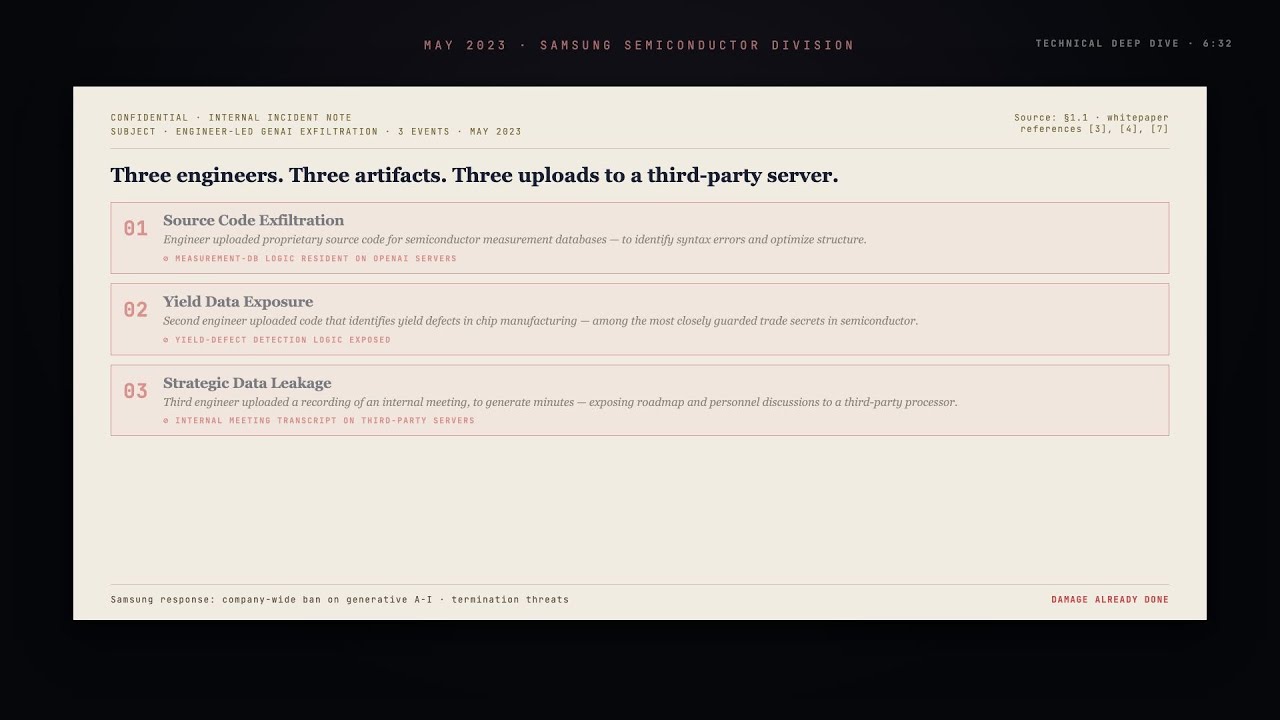
Three Samsung semiconductor engineers leaked proprietary source code, yield measurement data, and strategic meeting recordings to ChatGPT while attempting to debug work. None were malicious—they viewed AI as a "calculator."
Employees are judged on speed and output. AI offers exponential productivity gains. When companies ban these tools, workers switch to personal devices and 5G hotspots—creating the "Paste Gap."
Firewall blocks are ineffective: employees use smartphones, VPNs, and browser extensions to bypass corporate networks. You cannot ban your way to AI security.
"The greatest threat to enterprise security is not the malicious outsider, but the conscientious employee deprived of secure tools. When the workforce views security policies as obstacles to competence, they will inevitably circumvent them."
— Veriprajna Whitepaper, 2024
See how much corporate data is potentially at risk from unauthorized AI usage
Industry average: 50% (Netskope 2025)
Industry average: 38% admit to sharing IP/PII
Recommendation: Deploy Private Enterprise LLMs to provide secure, sanctioned alternatives.
Not all AI solutions are created equal. The distinction between "Wrappers" and "Deep AI" determines your security posture and competitive advantage.
AI Wrappers are thin interfaces over third-party APIs (e.g., OpenAI). They add prompts and format outputs but have no intellectual property in the AI itself.
Deep AI builds intelligence capabilities within your infrastructure. We deploy the full inference stack onto your VPC—you own the "brain."
Veriprajna does not sell access to a model; we sell the capability to run models independently. It's the difference between buying a fish (API) and building a high-tech aquaculture facility (Private AI).
This approach ensures you build defensible value—creating proprietary assets (fine-tuned models, vector indices) rather than renting capability available to every competitor.
For regulated industries and non-US enterprises, public APIs present an unsolvable sovereignty challenge.
Once data enters an API provider's infrastructure, you lose technical control. Even "zero retention" policies involve 30-day abuse monitoring windows.
US law enforcement can compel US companies to provide data regardless of physical location. This creates direct conflict with GDPR and local data protection laws.
Defense, healthcare, and financial sectors face strict "need to know" principles. Multi-tenant environments may violate compliance mandates.
| Feature | Public API (OpenAI, etc.) | Private VPC (Veriprajna) |
|---|---|---|
| Data Location | Provider's Cloud (Multi-tenant) | Customer's VPC (Single-tenant) |
| Data Training | "Opt-out" policy (Contractual) | Impossible by design (Technical) |
| Network Egress | Data leaves corporate perimeter | Data stays behind firewall |
| Latency | Variable (Internet + Load) | Low / Deterministic (Local) |
| Customization | Fine-tuning limited/expensive | Full access to model weights |
| Legal Risk | US CLOUD Act / Third-party risk | Sovereign / First-party control |
| Cost Structure | Per-token (OpEx, variable) | Infrastructure (CapEx/OpEx, fixed) |
Hardware captures chemistry, AI translates hypercubes into real-time commands. Here's how we architect sovereign intelligence.
Air-gapped or VPC-enclosed environment. GPU instances (A100, H100, L40S) orchestrated with Kubernetes. Zero egress routes.
Open-weights models (Llama 3 70B, CodeLlama). Served via vLLM with PagedAttention. Performance parity with GPT-4.
Private Vector Databases (Milvus, Qdrant) with RBAC integration. RAG 2.0 respects Active Directory permissions.
NVIDIA NeMo Guardrails for PII redaction, jailbreak detection, and topic control. Cisco AI Defense for runtime security.
See the economic crossover point for your usage
% Input tokens (RAG applications are input-heavy)
Cloud GPU rental: 2x A100 ~$2-4K/mo
Private Enterprise LLMs enable secure, agentic workflows that go far beyond simple Q&A.
Deploy CodeLlama directly in VS Code/IntelliJ. Engineers get AI-powered debugging and code completion without uploading source code to GitHub Copilot.
AI agents scan vendor contracts against risk policies, identify deviations, and draft rejection emails—all within secure VPC with full audit trails.
RAG 2.0 with RBAC-aware retrieval. Employees query Confluence, SharePoint, and Slack—respecting existing access controls without flat authorization vulnerabilities.
Self-hosting insulates your organization from the shifting sands of AI regulation.
Data never leaves the EU if hosted in EU VPC. No "International Data Transfer" concerns. Simplified Data Protection Impact Assessments (DPIAs).
High-risk AI systems require strict documentation and transparency. Full visibility into system architecture and model weights facilitates compliance reporting.
Open models with permissive licenses (Apache 2.0, Llama Community License) reduce litigation risk. Owning the model means you own the output unequivocally.
| Strategy | "Banning" (The Old Way) | "Private Enterprise AI" (The Veriprajna Way) |
|---|---|---|
| Employee Behavior | Hidden usage ("Shadow AI") | Managed, visible usage |
| Data Flow | Uncontrolled egress to public clouds | Contained within corporate VPC |
| IP Risk | High (Leaks to training sets) | Zero (No external training) |
| Compliance | Non-compliant (GDPR/ITAR violations) | Fully compliant (Sovereign control) |
| Productivity | Stifled / Underground | Accelerated / Integrated |
| Cost Model | Hidden (Risk/Breaches) | Predictable (Infrastructure ROI) |
"Security in the age of AI is no longer about the capacity to say 'No.' It is about the architectural capability to say 'Yes, safely.'"
— Veriprajna Deep AI Framework
Shadow AI is the unauthorized use of public AI tools by employees who bypass corporate bans using personal devices, VPNs, and browser extensions. Netskope 2025 data shows 50% of knowledge workers use unauthorized AI, 38% admit sharing sensitive corporate data, and there has been a 30x year-over-year increase in data egress volume. The Samsung incident, where engineers leaked proprietary semiconductor code to ChatGPT, demonstrates the real-world consequences.
Private enterprise LLMs deploy self-hosted AI models within the corporate VPC, replacing prohibition with secure enablement. Data never leaves the corporate perimeter, is never used for external training, and remains immune to the US CLOUD Act. This 'Yes, Safely' approach provides employees with sanctioned AI tools that match or exceed public alternatives, eliminating the productivity gap that drives Shadow AI.
API-based services process data on external infrastructure subject to the US CLOUD Act, which compels US-headquartered providers to disclose data regardless of storage location. Data may be used for model training despite contractual assurances, and API terms can change unilaterally. Self-hosted deployment within your VPC provides the only architectural guarantee of data sovereignty and regulatory compliance under GDPR and similar frameworks.
Veriprajna's Deep AI solution doesn't just improve security—it fundamentally changes the architecture of intelligence in your enterprise.
Schedule a consultation to assess your Shadow AI risk and design your Private Enterprise LLM deployment.
Full engineering report: Samsung incident forensics, Shadow AI statistics, wrapper vs Deep AI comparison, CLOUD Act analysis, Llama 3 deployment architecture, cost models, compliance frameworks, and 51 academic citations.