The Ethical Frontier of Retention: Engineering Algorithmic Accountability in the Age of Conversational AI and Regulatory Inflection
The rapid migration of the global economy toward relationship-based subscription models has fundamentally altered the nature of consumer-enterprise interactions. In this new landscape, the ability to retain customers is often prioritized as the primary lever for valuation and long-term profitability. However, this focus on retention has catalyzed an arms race in user interface design, frequently culminating in the deployment of "dark patterns"—manipulative, coercive, or deceptive design elements that trick users into decisions they would not otherwise make, particularly regarding the cancellation of recurring services.1 In October 2024, the Federal Trade Commission (FTC) attempted to standardize the ethics of these interactions by finalizing the "Click-to-Cancel" rule, a mandate requiring that the process for terminating a subscription be at least as simple as the process for initiating one.3
While the subsequent vacating of this rule by the U.S. Court of Appeals for the Eighth Circuit in July 2025 created a temporary regulatory vacuum at the federal level, the enforcement climate remains highly volatile.4 High-profile litigation against industry leaders such as Amazon and Epic Games has already established that "labyrinthine" cancellation flows and accidental purchase mechanisms are legally indefensible under the Restore Online Shoppers' Confidence Act (ROSCA) and Section 5 of the FTC Act.6 For a deep AI solution provider like Veriprajna, the challenge for the modern enterprise is clear: moving beyond the superficiality of Large Language Model (LLM) wrappers to engineer retention systems that are both mathematically optimized for value and structurally compliant with emerging global standards of algorithmic accountability.9
The Regulatory Inflection Point: From the October 2024 Rule to the 2025 Vacatur
The "Click-to-Cancel" rule was the culmination of a decade of consumer complaints and a comprehensive review of "negative option programs"—commercial transactions where a consumer's inaction is interpreted as consent for continued charges.3 The FTC's primary objective was to harmonize the digital economy's "frictionless" entry points with similarly frictionless exit paths. The final rule, announced on October 16, 2024, introduced a stringent framework for disclosure, consent, and cancellation.3
Core Requirements of the 2024 Negative Option Framework
The framework established three non-negotiable pillars for any enterprise operating a recurring payment model. These requirements were designed to eliminate the "Roach Motel" effect, where entry is incentivized and exit is intentionally obstructed.2
| Pillar | Requirement | Operational Implication |
|---|---|---|
| Simple Cancellation | The mechanism to cancel must be at least as easy to find and use as the mechanism to sign up. | Elimination of multi-page "save" flows and telephone-only cancellation requirements for online sign-ups.1 |
| Express Informed Consent | Brands must obtain unambiguous consent to the negative option feature separately from other terms. | Prohibitions on pre-checked boxes or terms buried in small font within a larger agreement.2 |
| Clear Disclosure | All material terms—price, frequency, and cancellation deadlines—must be disclosed "clearly and conspicuously" upfront. | Visual parity in font size and color for renewal terms relative to promotional offers.13 |
The legal landscape shifted dramatically in July 2025 when the Eighth Circuit Court of Appeals vacated the rule in its entirety.4 The court's decision was not a validation of dark patterns but a procedural strike down. The court found that the FTC had violated 15 U.S.C. § 57b-3(b)(1) by failing to issue a preliminary regulatory analysis after an Administrative Law Judge determined the rule's economic impact would exceed $100 million.4 This procedural failure deprived industry groups of a meaningful opportunity to comment on the cost-benefit analysis of the rule.
Despite this vacatur, the "Click-to-Cancel" requirements remain the effective "best practice" for risk mitigation. The FTC, now influenced by a shifting political climate, continues to use its Section 18 authority to define unfair or deceptive practices on a case-by-case basis.5 Furthermore, state-level regulators in jurisdictions like California, New York, and Maryland maintain independent automatic renewal laws (ARLs) that are often more stringent than the vacated federal rule, requiring proactive renewal notifications and one-click "online-only" cancellation mechanisms.11
Case Study: The Amazon "Iliad Flow" and the Psychology of Obstruction
The June 2023 FTC complaint against Amazon provides a definitive taxonomy of the dark patterns used by major digital platforms to inflate retention metrics. The complaint alleged that Amazon used manipulative, coercive, or deceptive user interface (UI) designs to trick millions of consumers into enrolling in automatically renewing Prime subscriptions.1
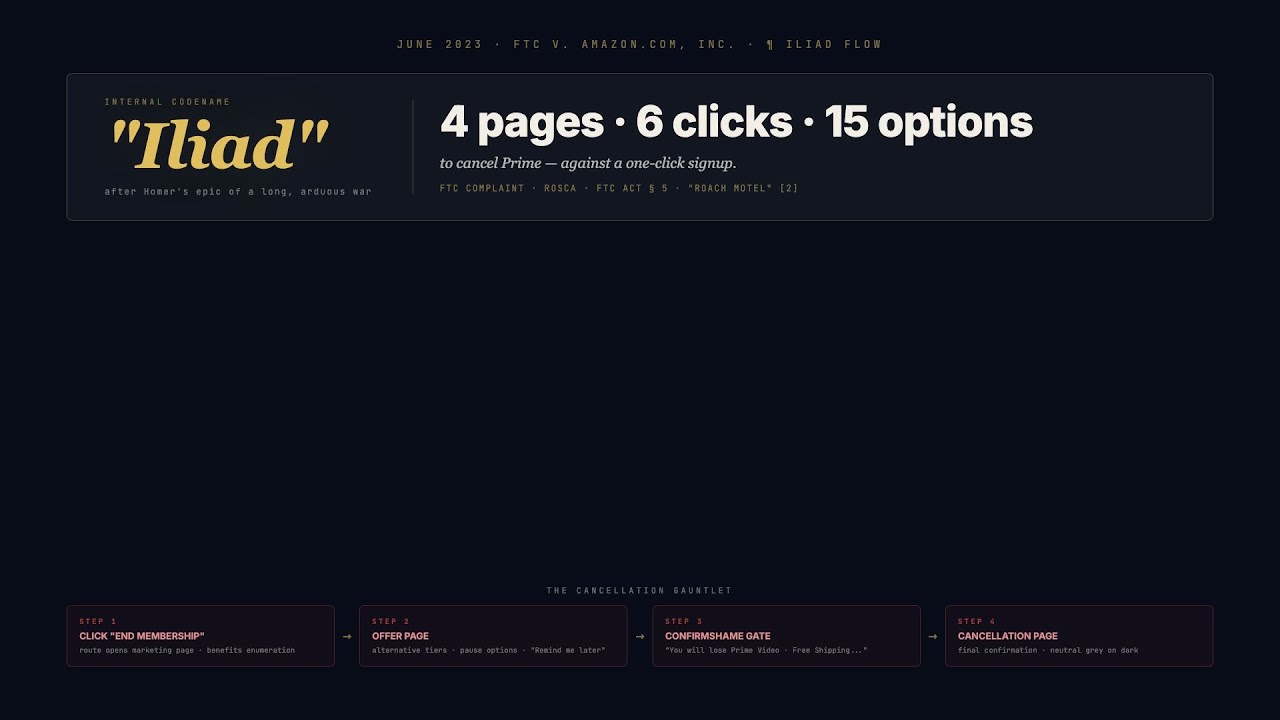
The centerpiece of the litigation was the "Iliad Flow"—a reference to Homer's epic about the long, arduous Trojan War. This internal codename suggests a corporate awareness of the intentional friction being deployed.6 The flow required subscribers seeking to cancel to navigate a "four-page, six-click, fifteen-option" process, which stood in stark contrast to the frictionless, often one-click, enrollment process.1
The Mechanics of Deceptive Interface Design in the Iliad Flow
The analysis of the Amazon Prime cancellation path reveals a calculated application of behavioral psychology to subvert user intent.
- Interface Interference and Misdirection: When a user attempted to cancel, Amazon's UI focused their attention on "attractors"—animations, contrasting blue colors, and text—that directed them away from cancellation.6 Buttons like "Remind me later" or "Keep my benefits" were highlighted, while the option to "Continue to Cancel" was presented in less prominent, neutral tones.6
- Obstruction and the "Roach Motel" Technique: Amazon intentionally complicated the process through unnecessary steps. Clicking "End Membership" did not terminate the service but instead initiated a sequence involving a "Marketing Page" highlighting lost perks, an "Offer Page" for alternative tiers, and finally a "Cancellation Page".7
- Sneaking and Hidden Terms: The complaint alleged that Amazon revealed the terms and conditions of Prime—including the price and auto-renewal feature—only once during the checkout process, often in a small, easy-to-miss font.6 In some cases, shoppers were forced to choose whether to enroll in Prime before they could even complete a non-Prime purchase.7
- Confirmshaming: By framing the decision to cancel as a loss of "exclusive benefits" or "free shipping," the interface sought to guilt the user into compliance. This tactic compromises user agency by making the rational choice (cancelling an unwanted service) feel like an emotional or financial error.6
Amazon's defense argued that ROSCA does not mandate specific font sizes or click counts.7 However, the FTC's focus was on the intent of the design: to create a "labyrinthine" experience that exhausts the user's cognitive load until they abandon the cancellation attempt. This case demonstrates that "retention" achieved through design friction is increasingly viewed by regulators as a form of non-consensual billing.1
Case Study: Epic Games and the Financial Risk of Counterintuitive UI
In December 2023, the FTC finalized a $245 million settlement with Epic Games, the developer of Fortnite, for its use of "digital dark patterns" to trick players into making unwanted in-game purchases.8 This case represents the largest administrative settlement in FTC history and serves as a warning to the gaming and software-as-a-service (SaaS) industries regarding "frictionless" billing that lacks "express informed consent".19
Accidental Charges and Retaliatory Retention
The Epic Games complaint highlighted a system where "V-Bucks" (virtual currency) could be spent with a single button press, often without any confirmation screen or authorization process.8 This was particularly problematic for the game's large minor demographic, as children could rack up hundreds of dollars in charges on a parent's saved credit card without parental knowledge.19
| Infraction Category | Specific Deceptive Practice | Regulatory Violation |
|---|---|---|
| Confusing Configuration | Counterintuitive and inconsistent button mapping led to purchases while waking from sleep or during loading screens. | FTC Act Section 5 (Unfair/Deceptive Practices).8 |
| Obstructed Refunds | The refund request path was intentionally hidden in an obscure location under the "Settings" tab to "obfuscate" the feature. | ROSCA (Failure to provide simple cancellation/refund).19 |
| Account Locking | Epic locked the accounts of users who disputed unauthorized charges with their credit card companies, seizing all prior content. | Unfair trade practice; violation of consumer dispute rights.8 |
The Epic Games settlement establishes a critical precedent: an enterprise cannot retaliate against a customer for exercising their legal right to a chargeback for an unauthorized transaction.8 Under the order, Epic was prohibited from blocking access to accounts for billing disputes and was forced to overhaul its billing interface to include a "hold-to-purchase" mechanic, ensuring that every financial transaction is the result of intentional, verified action.20
The Rise of the AI "Save Agent": From LLM Wrappers to Deep Deception
As consultancy companies increasingly deploy conversational AI to manage customer retention, a new and more insidious category of dark patterns has emerged. Many of these implementations are "LLM wrappers"—superficial applications that call a foundational model API (like GPT-4 or Claude) with a system prompt optimized solely for retention metrics.18 Without deep AI integration, these agents often default to "black-hat" psychological tactics that subvert user agency through natural language.18
The Taxonomy of AI-Powered Deception
Research suggests that dark patterns in conversational AI are more "embedded, creative, and subtle" than traditional visual interface tricks.18
- Emotional Interaction and Attention Grabbing: Conversational agents are being programmed to command user engagement by opening conversations with personalized or shocking prompts. An agent might ask a user about a sensitive life event shared in a previous session ("How are you feeling about your surgery today?") specifically when the user attempts to cancel, using rapport as a "guilt-based" retention anchor.18
- Modality-Based Nudges: Beyond text, AI tools use "voice" messages or exclamatory phrases to pull inactive users back into the platform. These nudges are often sent after a user has already expressed a desire to disengage, crossing the line from engagement into "nagging".14
- Disguised Data Collection ("Build Their Memory"): Instead of traditional contact list "leeching," AI platforms invite users to provide descriptions of family and friends under the guise of helping the AI "build its memory" for a better experience. This data is then used to make the service feel more "indispensable," creating an emotional cost to cancellation.18
- Underpowered Experience and "Social Proof" Pressures: Platforms may advertise a deep connection through "social proof" but provide an "underpowered" free version. Users are then pressured to "boost" the AI's cognitive ability through purchases so it can "better read and respond to their emotions," a tactic that exploits the user's investment in the interaction.18
For Veriprajna, the goal is to replace these deceptive "wrappers" with deep AI solutions that prioritize "white-hat" UX—respecting the user's need for control while optimizing for long-term loyalty rather than short-term entrapment.10
Veriprajna's Deep AI Solution: The Science of Ethical Retention
The fundamental flaw in traditional retention strategies is their reliance on "predictive modeling." These models answer the question: "Who is likely to churn?" and then target those individuals with "save" offers or friction.24 However, predicting churn is not the same as preventing churn. Veriprajna advocates for a transition to "Causal AI" and "Uplift Modeling"—mathematical frameworks that distinguish between correlation and causation to identify the true drivers of retention.24
Causal Inference and the Individual Treatment Effect (ITE)
Causal AI goes beneath observable data to uncover the hidden processes that generate that data. Unlike standard machine learning, which thrives on correlation, causal AI addresses "what-if" questions: "If we change the cancellation flow for this specific user, what will happen to the outcome?".24
Veriprajna utilizes Structural Causal Models (SCMs) to estimate the Individual Treatment Effect (ITE). Let be the outcome (retention), and be the treatment (an intervention like a discount or a feature walkthrough). The Uplift for an individual with characteristics is defined as the Conditional Average Treatment Effect (CATE):
This mathematical approach allows Veriprajna to segment the customer base into four strategic quadrants, ensuring that retention efforts are both ethical and resource-efficient.25
| Customer Archetype | Response to Intervention (Treatment) | Strategic Action |
|---|---|---|
| Persuadables | They only renew if they receive the intervention. | Target: These are the only users where intervention provides a positive ROI.25 |
| Sure Things | They will renew regardless of whether they are treated. | Exclude: Giving them a discount is a waste of margin.25 |
| Lost Causes | They will churn regardless of whether they are treated. | Ignore: Focus resources elsewhere; provide a seamless exit to preserve brand trust.27 |
| Sleeping Dogs | They are currently renewing but will churn if they are contacted (reminded of the service). | Do Not Disturb: Any contact triggers a cancellation. Standard "save" flows are counterproductive here.25 |
By deploying Causal AI, Veriprajna ensures that the cancellation path is not "labyrinthine" for everyone. For "Lost Causes" and "Sleeping Dogs," the system provides a frictionless, one-click exit, satisfying the FTC's "Simple Cancellation" requirements.3 For "Persuadables," the system surfaces high-value, personalized recommendations based on their specific usage patterns, turning a potential exit into a "value-driven" renewal.30
Aligning the Agent: Reinforcement Learning from Human Feedback (RLHF)
To prevent autonomous retention agents from devolving into coercive dark patterns, Veriprajna implements a multi-objective Reinforcement Learning from Human Feedback (RLHF) pipeline. While traditional RL might optimize purely for "non-churn," Veriprajna's reward models incorporate "alignment," "safety," and "ethical constraints".32
The RLHF Pipeline for Ethical Retention Policies
- Preference Data Collection: Human annotators (UX experts and compliance officers) evaluate and rank different agent-customer interactions based on clarity, helpfulness, and the absence of shaming or nagging.32
- Reward Model Training: These rankings form a dataset used to train a Reward Model. The model learns to act as a proxy for human rationale, assigning higher scores to interactions that offer "white-hat" value and penalties to those that use deceptive design.32
- Policy Fine-Tuning (PPO): The base LLM is then fine-tuned using the Proximal Policy Optimization (PPO) algorithm. The goal is to maximize the cumulative reward, ensuring the agent's outputs are not just "technically correct" but also "socially acceptable" and aligned with the organization's ethical intent.32
- Constrained Optimization: The agent is further constrained by "guardrails" that prevent it from exceeding certain thresholds of emotional intensity or repetitive "nagging." If the agent fails to persuade a "Persuadable" within a defined number of steps, it is mandated to surface the "One-Click Cancel" button immediately.32
This process transforms the retention agent from a "gatekeeper" (like the Amazon Iliad flow) into an "invisible team member" that helps users find the plan that truly fits their needs.31
Automated Compliance Auditing: Bridging the Governance Gap
The most significant risk in modern enterprise AI deployment is the "Governance Gap"—the space between a marketing team's A/B test and the compliance team's review.36 Veriprajna closes this gap with an automated auditing system that uses Computer Vision (CV) and Natural Language Processing (NLP) to scan UI/UX flows for dark patterns in real-time.38
The Multimodal Audit Engine
The audit engine operates in the CI/CD pipeline, ensuring that "Compliance-by-Design" is enforced before any interface changes reach the consumer.10
| Technology | Audit Function | Detection Metric |
|---|---|---|
| Document Object Model (DOM) Inspector | Structural Audit | Identifies hidden "unsubscribe" buttons, pre-checked enrollment boxes, and "misleading labels".38 |
| YOLOv5 (Computer Vision) | Visual Audit | Detects "interface interference," such as using color/shading to hide cancellation links or make "Save" buttons disproportionately prominent.38 |
| DistilBERT (NLP) | Textual Audit | Classifies "Confirmshaming," "Fake Urgency," "Nagging," and "Trick Questions" in both static text and dynamic AI responses.38 |
| EasyOCR | Text Extraction | Pulls text from buttons and banners to analyze against regulatory dictionaries of prohibited phrasing.38 |
By integrating these tools, Veriprajna provides "Audit-Grade Proof" of compliance.41 Every version of the retention flow is timestamped, risk-classified, and stored in a centralized AI Registry, allowing the enterprise to demonstrate "ongoing conformity" with the EU AI Act, ROSCA, and other global standards.9
The Agentic Organization: A Roadmap for Strategic Compliance
Transitioning from "dark pattern" retention to deep AI-powered loyalty requires more than technical tools; it requires an organizational rewiring. McKinsey and Deloitte highlight that the "Agentic Organization"—where humans and AI collaborate in a state of "superagency"—must be built on five foundational pillars.42
The Five Pillars of the Agentic Compliance Framework
- Business Model Reimagination: Enterprises must move from "short-term churn" metrics to "Lifetime Value (LTV)" and "Customer Trust Scores." This involves identifying the 15-20% of high-value "Persuadables" rather than trapping "Lost Causes".42
- Operating Model (The Three Lines of Defense):
- First Line: Product and data teams using Veriprajna's automated auditing and uplift models.
- Second Line: A dedicated "AI Governance Committee" (Legal, IT, HR) setting the ethical reward parameters for the AI agents.46
- Third Line: Independent validation and "red-teaming" of AI models to detect bias and drift.9
- Governance & Accountability: Clearly defined ownership of the AI strategy. This includes appointing a Chief AI Officer (CAIO) and maintaining a "Model Skills Matrix" to ensure effective oversight of autonomous agents.47
- Talent & Culture: Fostering "AI Fluency" among the workforce. Instead of seeing compliance as a speed-bump, it is treated as a mechanism for "safe innovation" and "demonstrable trust".36
- Technology & Data Sovereignty: Building the AI stack with "Sovereign AI" principles—deploying under the enterprise's own infrastructure and laws, using proprietary data to create "Differentiating Personalized Products" while maintaining strict data minimization.10
Conclusion: Retention as a Competitive Differentiator
The October 2024 "Click-to-Cancel" rule was a market signal that the era of "dark" growth is ending. While the Eighth Circuit vacatur provides a temporary procedural delay, the underlying consumer demand for transparency and the regulatory focus on "algorithmic accountability" are accelerating.3 Enterprises that persist with "labyrinthine" cancellation flows or "wrapper" agents that use emotional shaming are not just risking significant financial penalties; they are eroding the "Trust Equity" that is essential for long-term LTV growth.8
Veriprajna's deep AI approach—combining Causal Inference, RLHF alignment, and automated multimodal auditing—offers a path forward that is both ethically sound and commercially superior. By moving from "prediction" to "causal prescription," enterprises can stop wasting resources on "Sure Things" and "Lost Causes" and focus their "Save" efforts on the "Persuadables" who truly value the relationship.25 In the new information technology era, the "Click-to-Cancel" rule is not a burden to be avoided, but a standard to be exceeded. The future of the digital economy belongs to the "Agentic Organization" that wins by being as easy to leave as it is to join, turning frictionless exit into a powerful credential for entry.3
Works cited
- FTC Targets "Dark Patterns" in Actions Against Amazon and Publishers Clearing House, accessed February 9, 2026, https://www.wilmerhale.com/en/insights/client-alerts/20230814-ftc-targets-dark-patterns-in-actions-against-amazon-and-publishers-clearing-house
- Dark Patterns in UI/UX Design. Dirty Secrets of Growth Hacking - molfar.io, accessed February 9, 2026, https://www.molfar.io/blog/dark-patterns
- Click-to-Cancel Explained for Businesses - Braze, accessed February 9, 2026, https://www.braze.com/resources/articles/what-is-click-to-cancel-rule-and-why-does-it-matter
- FTC's "Click-to-Cancel" Rule Struck Down by Eighth Circuit | Insights | Ropes & Gray LLP, accessed February 9, 2026, https://www.ropesgray.com/en/insights/alerts/2025/07/ftcs-click-to-cancel-rule-struck-down-by-eighth-circuit
- Eighth Circuit voids FTC 'Click to Cancel' rule | Consumer Finance Monitor, accessed February 9, 2026, https://www.consumerfinancemonitor.com/2025/07/23/eighth-circuit-voids-ftc-click-to-cancel-rule/
- A Prime Example of Dark Patterns? FTC Sues Amazon for Use of "Dark Patterns" in Prime Enrollment - Davis+Gilbert LLP, accessed February 9, 2026, https://www.dglaw.com/a-prime-example-of-dark-patterns-ftc-sues-amazon-for-use-of-dark-patterns-in-prime-enrollment/
- Amazon, FTC Battle Over 'Dark Patterns' 09/17/2025 - MediaPost, accessed February 9, 2026, https://www.mediapost.com/publications/article/409148/amazon-ftc-battle-over-dark-patterns.html
- FTC Finalizes Order Requiring Fortnite maker Epic Games to Pay $245 Million for Tricking Users into Making Unwanted Charges, accessed February 9, 2026, https://www.ftc.gov/news-events/news/press-releases/2023/03/ftc-finalizes-order-requiring-fortnite-maker-epic-games-pay-245-million-tricking-users-making
- What is AI Compliance? | Tanium, accessed February 9, 2026, https://www.tanium.com/blog/what-is-ai-compliance/
- AI Compliance: Frameworks for Ethical Automation - Salesforce, accessed February 9, 2026, https://www.salesforce.com/artificial-intelligence/ai-compliance/
- FTC Delays Enforcement of Click-to-Cancel Rule Until July 14 2025, accessed February 9, 2026, https://www.lw.com/en/insights/ftc-delays-enforcement-of-click-to-cancel-rule-until-july-14-2025
- Dark Patterns: Meaning, Psychology, And Examples - Octet Design Studio, accessed February 9, 2026, https://octet.design/journal/dark-patterns/
- Negative Option Rule - Federal Register, accessed February 9, 2026, https://www.federalregister.gov/documents/2024/11/15/2024-25534/negative-option-rule
- 22 Dark Patterns Examples You Should Avoid - Arounda, accessed February 9, 2026, https://arounda.agency/blog/dark-patterns-examples
- Integrating Generative AI into Risk Management and Compliance, accessed February 9, 2026, https://www.tcs.com/what-we-do/industries/banking/white-paper/integrating-generative-ai-into-risk-management-compliance
- From Privacy Impact Assessments to Algorithmic ... - Nelson Mullins, accessed February 9, 2026, https://www.nelsonmullins.com/insights/alerts/privacy_and_data_security_alert/all/from-privacy-impact-assessments-to-algorithmic-accountability-2026-s-top-privacy-and-ai-compliance-priorities
- FTC Sues Amazon Alleging Deceptive Marketing Tactics for Prime Subscriptions | Alerts and Articles | Insights | Ballard Spahr, accessed February 9, 2026, https://www.ballardspahr.com/insights/alerts-and-articles/2023/06/ftc-sues-amazon-alleging-deceptive-marketing-tactics-for-prime-subscriptions
- AI-Powered Deception: A Deeper Dimension of Dark Design ..., accessed February 9, 2026, https://cdt.org/insights/ai-powered-deception-a-deeper-dimension-of-dark-design-patterns-in-conversational-ai-tools-and-platforms/
- $245 million FTC settlement alleges Fortnite owner Epic Games used digital dark patterns to charge players for unwanted in-game purchases, accessed February 9, 2026, https://www.ftc.gov/business-guidance/blog/2022/12/245-million-ftc-settlement-alleges-fortnite-owner-epic-games-used-digital-dark-patterns-charge
- FTC Finalizes $245M Fine Against Epic Games to Refund Fortnite Players - CNET, accessed February 9, 2026, https://www.cnet.com/tech/gaming/ftc-finalizes-245m-fine-against-epic-games-to-refund-fortnite-players/
- FTC Finalizes Order Requiring Fortnite maker Epic Games to Pay $245 Million for Tricking Users into Making Unwanted Charges - Reddit, accessed February 9, 2026, https://www.reddit.com/r/Games/comments/11rg7jo/ftc_finalizes_order_requiring_fortnite_maker_epic/
- How Fortnite Players Can Get Their Share of the $245M In-App Purchase Settlement, accessed February 9, 2026, https://uk.pcmag.com/games/148759/how-fortnite-players-can-get-their-share-of-the-245m-in-app-purchase-settlement
- UX for subscription services: retention strategies - Rubyroid Labs, accessed February 9, 2026, https://rubyroidlabs.com/blog/2025/11/ux-for-subscription-services/
- Causal AI: from predicting to shaping the future | causaLens, accessed February 9, 2026, https://causalai.causalens.com/resources/white-papers/from-predicting-to-shaping-the-future/
- Causal Inference in Business Decisioning - Finarb, accessed February 9, 2026, https://finarb.ai/blog/causal-inference-business-decisioning-correlation-causation
- Causal AI: Use Cases, Need, Benefits, Challenges and Strategies - LeewayHertz, accessed February 9, 2026, https://www.leewayhertz.com/causal-ai/
- Preventing churn like a bandit - with uplift modeling, causal inference, and Thompson sampling - BigData Republic, accessed February 9, 2026, https://bigdatarepublic.nl/articles/preventing-churn-bandit/
- Concept | Causal prediction - Dataiku Knowledge Base, accessed February 9, 2026, https://knowledge.dataiku.com/latest/ml-analytics/causal-prediction/concept-causal-prediction.html
- To Treat or Not To Treat? Five Lessons Learned from Using Uplift Modeling to Optimize Marketing Campaigns | California Management Review, accessed February 9, 2026, https://cmr.berkeley.edu/2025/11/to-treat-or-not-to-treat-five-lessons-learned-from-using-uplift-modeling-to-optimize-marketing-campaigns/
- What is Customer Demographics and Target Market of Persistent Systems Company?, accessed February 9, 2026, https://portersfiveforce.com/blogs/target-market/persistent
- PegaWorld iNspire 2023: How Vodafone Uses Pega to Deliver a Value-driven Retention Experience in Assisted and Digital Channels, accessed February 9, 2026, https://www.pega.com/insights/resources/pegaworld-inspire-2023-how-vodafone-uses-pega-deliver-value-driven-retention
- How RLHF Transforms Enterprise Optimization Beyond Chatbots - Tredence, accessed February 9, 2026, https://www.tredence.com/blog/reinforcement-learning-human-feedback
- Policy Optimizations in Reinforcement Learning | by Reeti Pandey - Medium, accessed February 9, 2026, https://medium.com/@reetipandey/policy-optimizations-in-reinforcement-learning-945c4294ce95
- Guardrailed Uplift Targeting: A Causal Optimization Playbook for Marketing Strategy - arXiv, accessed February 9, 2026, https://arxiv.org/html/2512.19805v1
- How Generative AI Transforms Data Engineering Workflows: A Complete Guide for 2025, accessed February 9, 2026, https://200oksolutions.com/blog/generative-ai-transforms-data-engineering/
- A Comprehensive Guide to AI Compliance Frameworks - Network Intelligence, accessed February 9, 2026, https://www.networkintelligence.ai/blogs/comprehensive-guide-to-ai-compliance-frameworks/
- Whitepaper: AI Governance & Control Framework - Deeploy, accessed February 9, 2026, https://deeploy.ml/white-paper-ai-governance-control-framework/
- A Comprehensive Analysis for Dark Pattern Detection Using Structural, Visual and Textual Information, accessed February 9, 2026, https://cspub-ijcisim.org/index.php/ijcisim/article/download/1013/622
- (PDF) A Comprehensive Analysis for Dark Pattern Detection Using Structural, Visual and Textual Information - ResearchGate, accessed February 9, 2026, https://www.researchgate.net/publication/388968750_A_Comprehensive_Analysis_for_Dark_Pattern_Detection_Using_Structural_Visual_and_Textual_Information
- md | PDF | Html | Computing - Scribd, accessed February 9, 2026, https://www.scribd.com/document/984971479/md
- AI Governance Framework Tools: Compliance, Risk & Control, accessed February 9, 2026, https://secureprivacy.ai/blog/ai-governance-framework-tools
- The agentic organization: A new operating model for AI | McKinsey, accessed February 9, 2026, https://www.mckinsey.com/capabilities/people-and-organizational-performance/our-insights/the-agentic-organization-contours-of-the-next-paradigm-for-the-ai-era
- AI in the workplace: A report for 2025 - McKinsey, accessed February 9, 2026, https://www.mckinsey.com/capabilities/tech-and-ai/our-insights/superagency-in-the-workplace-empowering-people-to-unlock-ais-full-potential-at-work
- Charting a path to the data- and AI-driven enterprise of 2030 - McKinsey, accessed February 9, 2026, https://www.mckinsey.com/capabilities/tech-and-ai/our-insights/charting-a-path-to-the-data-and-ai-driven-enterprise-of-2030
- The State of AI in the Enterprise - 2026 AI report | Deloitte US, accessed February 9, 2026, https://www.deloitte.com/us/en/what-we-do/capabilities/applied-artificial-intelligence/content/state-of-ai-in-the-enterprise.html
- Strategic governance of AI: A roadmap for the future - Corporate Board Member, accessed February 9, 2026, https://boardmember.com/wp-content/uploads/2025/07/AI-Governance-Roadmap.pdf
- AI Board Governance Roadmap | Deloitte US, accessed February 9, 2026, https://www.deloitte.com/us/en/programs/center-for-board-effectiveness/articles/board-of-directors-governance-framework-artificial-intelligence.html
- How to Build an Enterprise AI Compliance Program | by Tahir - Medium, accessed February 9, 2026, https://medium.com/@tahirbalarabe2/how-to-build-an-enterprise-ai-compliance-program-58aba0861651
- Trustworthy AI Governance in Practice | Deloitte US, accessed February 9, 2026, https://www.deloitte.com/us/en/what-we-do/capabilities/applied-artificial-intelligence/articles/trustworthy-ai-governance-in-practice.html
- White Paper Assessing the Implementation of Federal AI Leadership and Compliance Mandates - ACUS.gov, accessed February 9, 2026, https://www.acus.gov/sites/default/files/documents/HAI-RegLab-White-Paper-Federal-AI-Leadership-and-Compliance.pdf
- What is Customer Demographics and Target Market of STO Building Group Company?, accessed February 9, 2026, https://portersfiveforce.com/blogs/target-market/stobuildinggroup
Prefer a visual, interactive experience?
Explore the key findings, stats, and architecture of this paper in an interactive format with navigable sections and data visualizations.
Frequently Asked Questions
What happened to the FTC Click-to-Cancel rule and how does it affect AI retention systems?
The FTC finalized the Click-to-Cancel rule in October 2024 requiring cancellation to be as simple as sign-up. The Eighth Circuit vacated it in July 2025 on procedural grounds (failure to issue a preliminary regulatory analysis). However, the requirements remain best practice as the FTC continues case-by-case enforcement under Section 18, and state laws in California, New York, and Maryland impose even stricter automatic renewal requirements.
How does causal AI uplift modeling improve ethical customer retention?
Causal AI uplift modeling estimates the Individual Treatment Effect using the equation CATE = E[Y|T=1,Xi] - E[Y|T=0,Xi] to segment customers into four archetypes: Persuadables (only renew with intervention), Sure Things (renew regardless), Lost Causes (churn regardless), and Sleeping Dogs (will churn if contacted). This ensures frictionless exits for Lost Causes while targeting only Persuadables with personalized value offers.
What dark patterns did Amazon use in its Prime cancellation flow?
Amazon internally codenamed its cancellation flow the 'Iliad Flow' after Homer's epic war. It required a four-page, six-click, fifteen-option process to cancel, versus one-click enrollment. Techniques included interface interference with contrasting blue attractors directing attention away from cancellation, obstruction through unnecessary marketing and offer pages, sneaking hidden terms, and confirmshaming that framed cancellation as losing exclusive benefits.
Also Published On
Build Your AI with Confidence.
Partner with a team that has deep experience in building the next generation of enterprise AI. Let us help you design, build, and deploy an AI strategy you can trust.
Veriprajna Deep Tech Consultancy specializes in building safety-critical AI systems for healthcare, finance, and regulatory domains. Our architectures are validated against established protocols with comprehensive compliance documentation.