Engineering Algorithmic Accountability in the Age of Conversational AI and Regulatory Inflection
The FTC's "Click-to-Cancel" rule signaled that the era of dark-pattern growth is ending. Enterprises that persist with labyrinthine cancellation flows or wrapper agents using emotional shaming are eroding the Trust Equity essential for long-term value.
Veriprajna's deep AI approach—combining Causal Inference, RLHF alignment, and automated multimodal auditing—offers a path that is both ethically sound and commercially superior.
From the October 2024 "Click-to-Cancel" rule to the 2025 Eighth Circuit vacatur—the enforcement climate remains volatile, and state-level regulators maintain independent standards.
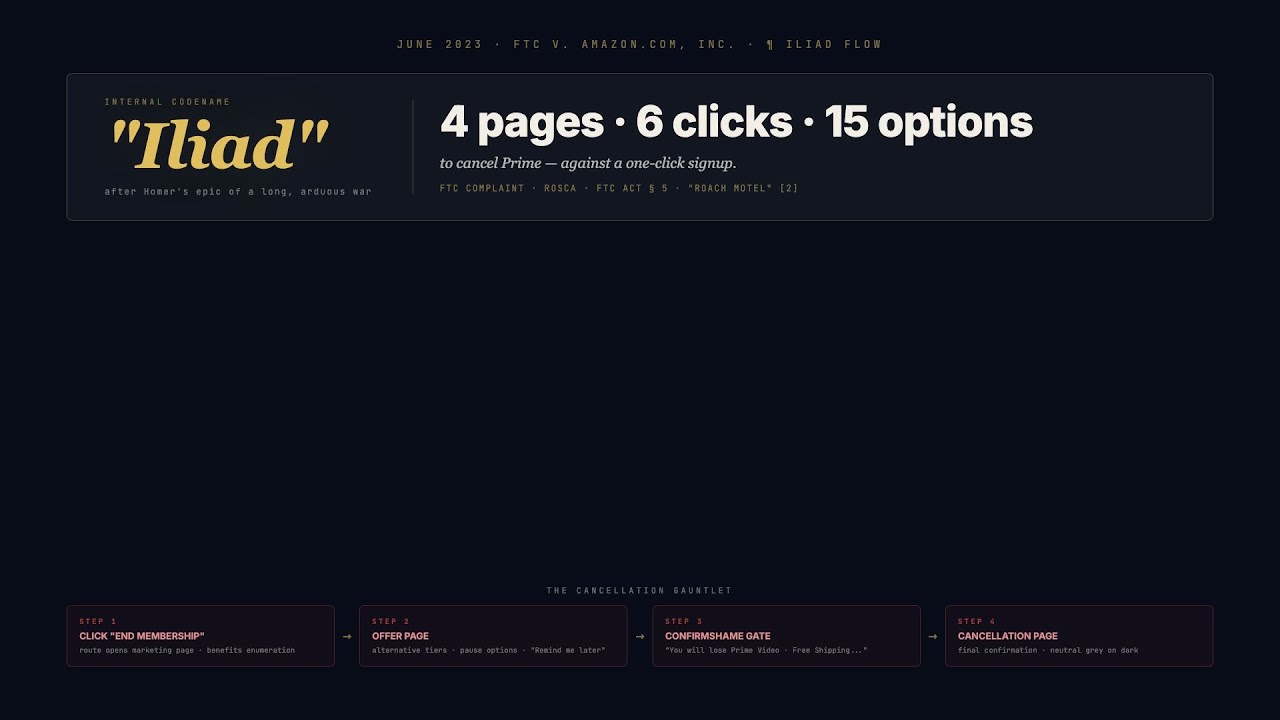
FTC sues Amazon over "Iliad Flow"—a 4-page, 6-click, 15-option cancellation maze designed to exhaust users.
$245M Epic Games settlement finalized—largest FTC administrative order for dark pattern billing practices.
FTC finalizes "Click-to-Cancel" rule—exit must be as simple as entry. Three pillars: Simple Cancellation, Express Consent, Clear Disclosure.
Eighth Circuit vacates rule on procedural grounds—but state ARLs in CA, NY, MD enforce stricter standards independently.
The mechanism to cancel must be at least as easy to find and use as the mechanism to sign up.
Brands must obtain unambiguous consent to recurring charges separately from other terms.
All material terms—price, frequency, cancellation deadlines—must be disclosed clearly and conspicuously upfront.
High-profile FTC litigation has established that labyrinthine cancellation flows and accidental purchase mechanisms are legally indefensible.
Named after Homer's epic about the long, arduous Trojan War—a corporate codename revealing internal awareness of intentional friction.
Largest administrative settlement in FTC history for "digital dark patterns" tricking players into unwanted in-game purchases.
"Retention achieved through design friction is increasingly viewed by regulators as a form of non-consensual billing. The Amazon case demonstrates that no amount of claimed opt-out availability can justify a labyrinthine experience designed to exhaust the user's cognitive load until they abandon the cancellation attempt."
Toggle between a dark-pattern flow designed to trap users and Veriprajna's ethical approach powered by Causal AI.
Many retention deployments are superficial LLM wrappers optimized solely for churn metrics, defaulting to psychological tactics that subvert user agency through natural language.
Agents reference sensitive life events shared in prior sessions ("How are you feeling about your surgery?") specifically when a user attempts to cancel—weaponizing rapport as a guilt-based retention anchor.
AI tools deploy voice messages and exclamatory phrases to pull inactive users back—sent after users have already expressed a desire to disengage, crossing from engagement into harassment.
Platforms invite users to describe family and friends under the guise of "building memory for a better experience"—then use that data to make cancellation feel like losing personal connections.
Platforms advertise deep connection via social proof but provide underpowered free tiers, then pressure users to "boost" the AI's cognition through purchases to "better read emotions."
Moving from "prediction" to "causal prescription"—mathematical frameworks that distinguish between correlation and causation to identify the true drivers of retention.
Unlike standard ML that thrives on correlation, Causal AI addresses counterfactual questions: "If we change the cancellation flow for this specific user, what will happen?"
Causal AI segments your customer base to ensure retention efforts are both ethical and resource-efficient. Hover over each quadrant to learn the strategic action.
Renew only if they receive the right intervention.
Will renew regardless of treatment.
Will churn regardless of treatment.
Currently renewing, but will churn if contacted.
To prevent autonomous retention agents from devolving into coercive dark patterns, Veriprajna implements a multi-objective Reinforcement Learning from Human Feedback pipeline.
UX experts and compliance officers rank agent-customer interactions based on clarity, helpfulness, and absence of shaming or nagging.
Rankings train a Reward Model that scores interactions—higher for "white-hat" value, penalties for deceptive design or emotional manipulation.
Proximal Policy Optimization ensures outputs are not just technically correct but socially acceptable and aligned with organizational ethical intent.
Hard constraints prevent exceeding emotional intensity thresholds. If persuasion fails within defined steps, the One-Click Cancel surfaces immediately.
This process transforms the retention agent from a "gatekeeper" (like the Amazon Iliad flow) into an "invisible team member" that helps users find the plan that truly fits their needs.
Closing the "Governance Gap"—the space between a marketing team's A/B test and the compliance team's review—with a multimodal audit engine in the CI/CD pipeline.
Structural audit that identifies hidden unsubscribe buttons, pre-checked enrollment boxes, and misleading labels.
Visual audit detecting interface interference—color/shading hiding cancel links or making "Save" buttons disproportionately prominent.
Textual audit classifying confirmshaming, fake urgency, nagging, and trick questions in both static text and dynamic AI responses.
Text extraction from buttons and banners, analyzed against regulatory dictionaries of prohibited phrasing patterns.
Rate your current retention practices to estimate compliance risk
1 = Labyrinthine multi-page flow • 10 = One-click cancel
1 = Pre-checked boxes, fine print • 10 = Explicit separate consent
1 = Terms buried in fine print • 10 = Full visual parity, upfront
1 = Unaligned LLM wrapper • 10 = RLHF-aligned with guardrails
Transitioning from dark-pattern retention to deep AI-powered loyalty requires an organizational rewiring built on five foundational pillars.
Move from short-term churn metrics to Lifetime Value and Customer Trust Scores. Target the 15-20% of Persuadables, not Lost Causes.
Product teams use automated auditing. AI Governance Committee sets ethical rewards. Independent red-teaming detects bias and drift.
Clearly defined AI strategy ownership with a Chief AI Officer and Model Skills Matrix for effective oversight of autonomous agents.
Foster AI Fluency across the workforce. Compliance becomes a mechanism for safe innovation and demonstrable trust, not a speed bump.
Deploy under enterprise infrastructure with Sovereign AI principles. Proprietary data creates differentiating products with strict data minimization.
The "Click-to-Cancel" rule was a market signal that the era of dark growth is ending. While the Eighth Circuit vacatur provides a temporary procedural delay, the underlying consumer demand for transparency and regulatory focus on algorithmic accountability are accelerating.
Enterprises that persist with labyrinthine cancellation flows or wrapper agents that use emotional shaming are not just risking significant financial penalties—they are eroding the Trust Equity essential for long-term LTV growth.
By moving from "prediction" to "causal prescription," enterprises can stop wasting resources on Sure Things and Lost Causes and focus their efforts on the Persuadables who truly value the relationship.
The "Click-to-Cancel" rule is not a burden to be avoided, but a standard to be exceeded. The future of the digital economy belongs to the Agentic Organization that wins by being as easy to leave as it is to join—turning frictionless exit into a powerful credential for entry.
Causal AI uses Individual Treatment Effect (ITE) modeling to segment customers into four archetypes: Persuadables (who renew only with the right intervention), Sure Things (who renew regardless), Lost Causes (who churn regardless), and Sleeping Dogs (who churn if contacted). This ensures retention efforts target only the 15-20% of Persuadable customers, avoiding wasted resources on Sure Things and preventing the trust damage of pressuring Lost Causes.
The FTC's October 2024 Click-to-Cancel rule establishes three pillars: Simple Cancellation (exit must be as easy as entry), Express Informed Consent (unambiguous consent for recurring charges), and Clear Disclosure (material terms disclosed upfront). While the Eighth Circuit vacated the rule on procedural grounds in July 2025, state-level regulators in California, New York, and Maryland enforce stricter independent standards. The $245M Epic Games settlement demonstrates the scale of enforcement penalties.
Veriprajna implements a multi-objective RLHF pipeline where UX experts and compliance officers rank agent interactions based on clarity, helpfulness, and absence of shaming. These rankings train a Reward Model that penalizes deceptive design and emotional manipulation. Proximal Policy Optimization (PPO) fine-tuning ensures outputs are socially acceptable, while hard guardrails prevent exceeding emotional intensity thresholds — surfacing One-Click Cancel if persuasion fails within defined steps.
Veriprajna's deep AI approach replaces dark-pattern wrappers with Causal Inference, RLHF alignment, and automated compliance auditing.
Schedule a consultation to audit your retention flows and model the transition from coercive friction to ethical, AI-driven loyalty.
Complete analysis: Regulatory framework, dark pattern taxonomy, Causal AI mathematics, RLHF pipeline architecture, multimodal compliance auditing, and the Agentic Organization roadmap.