Beyond the Hallucination: The Imperative for Constraint-Based Generative Design in Enterprise Architecture
1. The Divergence of Art and Engineering: A Crisis of Utility
The architectural and construction industries stand at a precipice of a technological revolution that is as seductive as it is misleading. The rapid democratization of generative artificial intelligence, driven largely by diffusion-based image synthesis models, has created a paradigm where the visualization of architectural form has become instantaneous and virtually cost-free. Platforms such as Midjourney, Stable Diffusion, and DALL-E have enabled architects, developers, and even laypersons to generate photorealistic renderings of structures that possess emotive lighting, futuristic geometries, and atmospheric depth. These tools promise a democratization of creativity, suggesting a future where the constraints of design are limited only by the imagination of the prompter.
However, beneath this veneer of infinite creativity lies a profound structural weakness that threatens to bifurcate the discipline of architecture into two incompatible realms: the generation of digital art and the engineering of physical assets. The output of these generalist "Generative AI" tools can best be described as "Escher paintings"—visually arresting paradoxes that crumble under the interrogation of physical laws and construction logic. They produce staircases that terminate in solid walls, windows that lack operability mechanisms, and load-bearing columns that dissolve into ceilings without transferring force. 1
For the enterprise developer, the distinction between a "cool looking building" and a constructible asset is not merely academic; it is existential. In the high-stakes environment of commercial real estate and infrastructure development, aesthetics constitute a minority fraction of the value proposition—often estimated at no more than 10% of the total project success metric. The remaining 90% is defined by rigorous adherence to manufacturability, structural integrity, supply chain logistics, and economic viability. A generative design that necessitates the use of custom-molded, double-curved glass panes at a unit cost of $50,000 will not merely delay a project; it will render it financially insolvent. 3
Veriprajna positions itself diametrically opposed to the prevailing trend of "AI wrappers"—consultancies that merely build thin user interfaces atop public Large Language Model (LLM) APIs. We contend that true enterprise value is not found in the hallucinations of a text-to-image prompter but in the rigor of Constraint-Based Generative Design (CBGD) . This whitepaper elucidates the necessity of moving beyond artistic generation to asset generation. It details the technical imperative of hard-coding physics, inventory data, and cost logic directly into the AI's reward function. We argue that by utilizing Deep Reinforcement Learning (DRL) agents operating within high-fidelity physics simulators, we can transition the industry from the era of digital hallucination to the era of autonomous engineering.
2. The Wrapper Trap: Why Generalist Models Fail the Enterprise
2.1 The Shallow Architecture of API Wrappers
The current landscape of AI consultancy is dominated by entities that function effectively as "LLM Wrappers." These organizations capitalize on the hype cycle by repackaging generalist foundational models—such as GPT-4, Claude, or Midjourney—into proprietary interfaces, selling them as bespoke enterprise solutions. 5 While these tools may offer utility in drafting marketing copy or summarizing meeting notes, their application in the domain of structural engineering and architectural design is fraught with catastrophic risk.
A wrapper-based solution operates on a fundamental misunderstanding of the architectural domain. When a user prompts a generalist model to "design a sustainable high-rise in Miami," the model relies on probabilistic token prediction or pixel diffusion based on a training set of billions of internet images and text. It does not "know" architecture; it statistically predicts what an architectural image looks like . It has no internal model of the Miami-Dade County Building Code, no awareness of the shear forces generated by a Category 5 hurricane, and no connection to the real-time inventory of local steel service centers. 6
The result is a "hallucination of function." The generated image may depict a glass façade that appears structurally sound to the untrained eye, but which relies on material properties that do not exist or construction methods that are economically unfeasible. In the context of "Deep AI," Veriprajna defines its methodology not by the breadth of its training data, but by the rigidity of its constraints. We do not simply wrap a model; we engineer the cognitive architecture of the agent to align with the immutable laws of statics and economics.
2.2 The Latent Space vs. The Physical Space
The failure of generalist models in engineering stems from their reliance on "latent space"—a multi-dimensional mathematical space where images or concepts are represented as vectors. In this space, the concept of "window" is defined by its visual proximity to other images of windows. However, in "physical space," a window is a complex assembly defined by thermal breaks, glazing ratios, rough opening dimensions, and flashing details.
Diffusion models, which generate images by iteratively denoising random static, struggle profoundly with geometric consistency and functional logic. A column that appears in the foreground of a generated image may not align with the structural grid in the background. The AI does not understand that load must be transferred continuously to the foundation; it only understands that columns are typically vertical features found in buildings. This lack of causal understanding leads to the "Escher Effect," where the generated geometry creates spatial paradoxes—stairs that go nowhere, doors that cannot open, and roofs that have no support. 1
Furthermore, these models are fundamentally incapable of "rationalizing" complex geometry. A diffusion model might generate a fluid, organic curve that looks stunning in a JPEG. However, transforming that curve into a manufacturable reality requires rationalization—breaking the curve down into planar, developable surfaces that can be cut from standard flat sheets of material. Without this rationalization step integrated into the generation process, the design is effectively a fiction. The cost to construct a non-rationalized, double-curved surface is exponentially higher than a rationalized one, a distinction that generalist AI models fail to make. 8
3. The Economics of Aesthetics: The High Cost of the Unbuildable
3.1 The 90/10 Rule and the Bankruptcy of Vision
In the construction industry, the "90/10 Rule" dictates that while aesthetics (the 10%) drive the initial emotional engagement and sales, the execution (the 90%) determines the project's profitability and viability. The history of modern architecture is replete with cautionary tales where visionary aesthetics collided with the hard realities of manufacturability, leading to massive cost overruns and delays.
The Sydney Opera House serves as the archetypal example of unconstrained geometric ambition. Jørn Utzon’s competition entry was a masterpiece of expressionist sculpture, but it was structurally undefined. The concrete shells, as originally drawn, were geometrically indeterminate and virtually unbuildable with the technology of the time. The project proceeded without a resolved structural solution, leading to a decade of engineering struggle to find a "spherical solution" that allowed for the pre-casting of the ribs. The consequences were severe: the budget exploded from an initial estimate of $7 million to a final cost of $102 million—a staggering 1,400% overrun—and the project was delayed by ten years. 9
This historical lesson is acutely relevant to the current wave of Generative AI. By generating designs that are decoupled from the constraints of construction, AI tools risk replicating the Sydney Opera House scenario on a massive scale. They encourage the exploration of forms that are fiscally irresponsible, pushing clients toward concepts that will inevitably require expensive value engineering or total redesign once they reach the fabrication stage.
3.2 The Material Cost Differential: A Tale of Two Panes
To fully appreciate the danger of unconstrained generative design, one must examine the cost structures of primary construction materials, specifically glass and steel.
3.2.1 The Glass Differential: Flat vs. Curved
In the world of architectural glazing, the geometric definition of a pane of glass is the primary driver of cost.
● Standard Flat Tempered Glass: This is the industry standard, produced in automated float plants and tempered in continuous furnaces. It is a commodity product. In 2025, the cost for standard clear tempered glass ranges from $18 to $25 per square foot . It is readily available, easy to transport, and easy to replace. 3
● Custom Curved (Bent) Glass: Achieving a curve in glass requires a secondary heating process where the glass is slumped over a custom mold (gravity bending) or mechanically forced into shape (tempering bending). This process is slow, energy-intensive, and requires distinct tooling for each unique radius. The cost for custom curved glass can range from $100 to over $500 per square foot, depending on the complexity and the need for lamination or coatings. 4
A generalist AI model sees no distinction between a flat pixel and a curved pixel. To the diffusion model, a sinuous, waving façade is just as easy to generate as a box. However, to the developer, the difference is a 20x increase in the façade budget . If an AI tool proposes a design with 50,000 square feet of glazing, the difference between specifying flat glass ($1.25 million) and curved glass ($25 million) is the difference between a profitable asset and a bankrupt project. Veriprajna’s Constraint-Based engines are hard-coded to penalize curvature unless it is explicitly justified by a massive increase in the value function, ensuring that the AI defaults to the economic rationality of the flat plane. 3
3.2.2 The Steel Supply Chain: Inventory vs. Mill Orders
Structural steel procurement is governed by the dichotomy between "Service Center" inventory and "Mill Orders."
● Service Centers: These are local distribution hubs that stock standard AISC shapes (e.g., W12x26, W24x84). Fabricators can purchase steel from service centers with lead times measured in days. This allows for rapid construction and lower carrying costs. However, service centers only stock the most common sizes. 14
● Mill Orders: If a design calls for a specific beam size or weight that is not stocked locally, or if the project requires a massive tonnage of a single size, the steel must be ordered directly from the mill. Mill orders often have high minimum tonnage requirements and lead times that can stretch to months, depending on the mill's rolling schedule. A specific shape might only be rolled once every quarter. 15
An unconstrained AI, unaware of these logistics, might optimize a structure by selecting a W14x730 beam because it perfectly satisfies the math of a local load condition. However, if that beam is a mill-order item with a six-month lead time, the AI has introduced a critical path delay that could cost millions in financing charges. Veriprajna’s system integrates live inventory databases, rewarding the use of "in-stock" sections and penalizing the use of "special order" sections, effectively forcing the AI to design within the supply chain. 16
4. The Physics of Failure: Case Studies in Architectural Negligence
The necessity of physics-based constraints is best illustrated by the failures of the recent past, where the pursuit of aesthetic novelty led to dangerous real-world consequences.
4.1 The Vdara "Death Ray": A Physics Failure
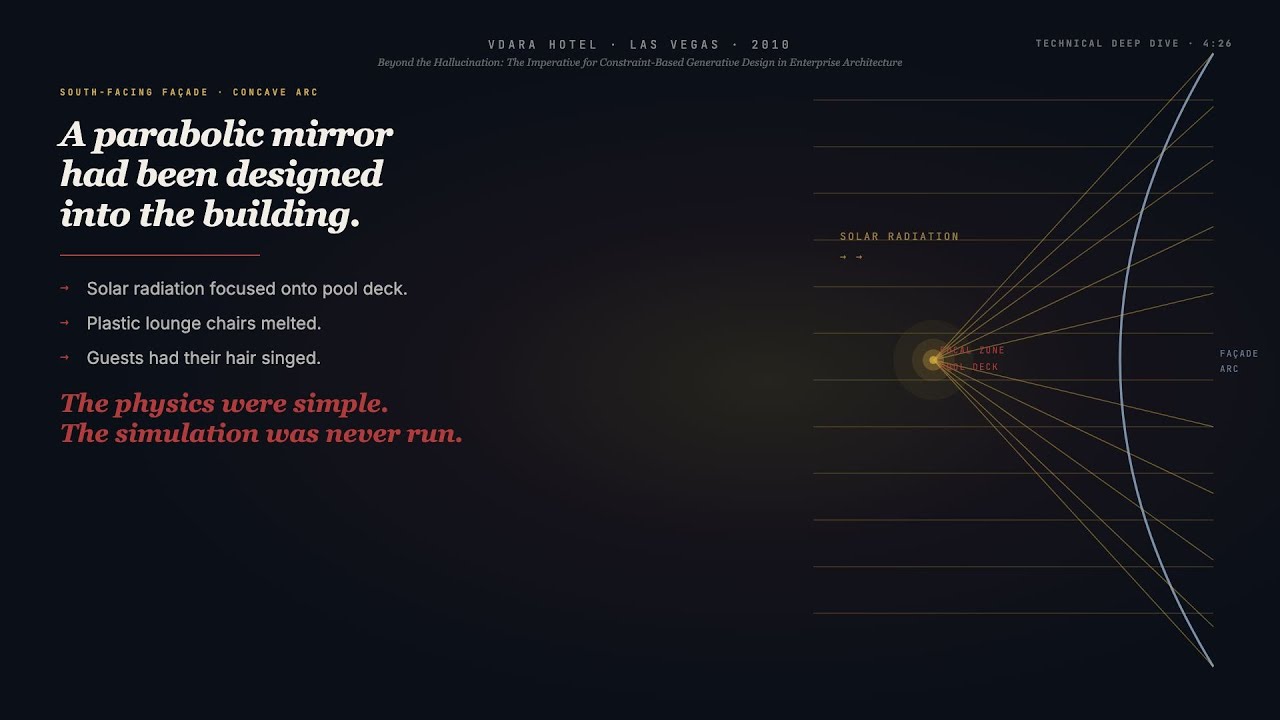
The Vdara Hotel in Las Vegas, designed by Rafael Viñoly, features a distinctive crescent shape. The south-facing façade is a concave arc of glass. In the design phase, the focus was likely on the sleek, modern aesthetic and the maximization of views. However, the concave geometry acted as a massive parabolic reflector.
During certain times of the day and year, the façade focused solar radiation onto a specific area of the pool deck, much like a magnifying glass burning an ant. This phenomenon, dubbed the "Vdara Death Ray," created a convergence zone where temperatures soared, melting plastic lounge chairs, singeing guests' hair, and causing severe thermal discomfort. The physics were simple and predictable: a concave mirror focuses light. Yet, the design process failed to simulate this environmental interaction effectively. 17
The remediation was costly and inelegant: the installation of large umbrellas and non-reflective film on the glass, which compromised the original aesthetic intent. A Constraint-Based Generative Design system, equipped with a simple ray-tracing reward function, would have detected this convergence in the first millisecond of simulation. The AI would have "punished" the concave geometry for creating a hazardous heat flux, forcing the generation of a convex or faceted façade that scattered light safely. 19
4.2 The "Walkie-Talkie" Scorch
A similar failure occurred in London with the 20 Fenchurch Street building, also known as the "Walkie-Talkie." Its concave, top-heavy design focused sunlight onto the streets below, generating temperatures hot enough to melt the bodywork of a Jaguar car parked on the street. This repetition of the same physics error by the same architect underscores a fundamental gap in traditional and aesthetic-led design processes: the lack of rigorous, automated physics verification during the conceptual phase. 17
These examples serve as a stark warning. As AI tools make it easier to generate complex, curved, and reflective geometries, the risk of creating inadvertent "death rays" or wind tunnels increases. Veriprajna’s approach treats the laws of physics not as a final check, but as a generative constraint.
5. Constraint-Based Generative Design: The Veriprajna Methodology
Veriprajna defines the state-of-the-art in AEC AI not as "text-to-image" but as "parameter-to-topology." Our methodology relies on Deep Reinforcement Learning (DRL), where an intelligent agent learns to construct a building by interacting with a high-fidelity physics simulator.
5.1 The Shift from Generative Art to Generative Engineering
True generative design in engineering is a search process. The AI explores a vast "design space" to find the optimal configuration of material that satisfies a set of conflicting objectives.
● Topology Optimization (TO): This is the foundational technology of generative engineering. It involves the algorithmic removal of material from a design volume to create the most efficient load path. However, traditional TO often produces organic, "bone-like" structures that are efficient but prohibitively expensive to manufacture using standard methods. 8
● Constraint-Based Generative Design (CBGD): Veriprajna advances TO by imposing manufacturing and logic constraints on the optimization process. We do not just ask the AI to "minimize weight"; we ask it to "minimize weight subject to using standard AISC steel sections and resisting Category 5 wind loads". 22
5.2 The Reinforcement Learning (RL) Engine
Our core engine utilizes Reinforcement Learning, a branch of Machine Learning where an agent learns through trial and error to maximize a cumulative reward.
● The Agent: The AI designer.
● The Environment: A complex simulation environment that integrates structural physics (FEA), fluid dynamics (CFD), and economic databases.
● The Action Space: The set of possible moves the agent can make. Instead of "drawing a pixel," the agent's actions are engineering decisions: "Place a column at (x,y)," "Assign W24x68 profile to Beam B1," "Increase slab thickness to 200mm". 24
● The Reward Function: This is the heart of the Veriprajna system. It is a carefully engineered equation that guides the agent toward desirable outcomes. The reward is not binary (success/fail) but continuous, providing gradient feedback on the quality of the design.
In this equation, the agent is rewarded for structural efficiency (), low cost (), and ease of assembly (). It is heavily penalized () for violating hard constraints like code compliance or safety factors. 25
6. Deep Dive: Hard-Coding the Supply Chain (The Inventory Constraint)
6.1 The Inventory-Aware Agent
The first pillar of Veriprajna’s methodology is the Inventory Constraint . We operate on the principle: "Don't Generate Art. Generate Assets." An asset is defined by its liquidity and its standardization.
Our AI agents are connected via API to live databases of structural steel inventory and building material indices. The "Action Space" of the AI is discretized to align with these databases. When the AI decides to place a beam, it cannot simply choose a generic "I-beam" of arbitrary dimension. It must select from a discrete list of available AISC W-shapes (e.g., W14x90, W14x99, W14x109). 27
6.2 The Logistics of Availability
The AI's reward function is sensitive to the logistics of supply.
● Service Center Preference: The reward function applies a bonus to sections that are flagged as "Common Stock" in regional service centers. This encourages the agent to design structures that can be sourced immediately, reducing project schedule risk. 15
● Mill Order Penalty: Sections that are flagged as "Mill Order Required" or "Infrequently Rolled" carry a cost penalty in the reward function. This reflects the real-world cost of delay and high minimum order quantities. The AI will only select these sections if the structural benefit is so massive that it outweighs the logistical penalty. 14
● Waste Minimization: The agent is also aware of standard stock lengths (e.g., 40ft, 60ft).
It is penalized for designs that generate excessive off-cuts (waste). For example, if a design calls for a 42-foot beam, the agent might be penalized for the 18 feet of waste from a 60-foot stock beam, or encouraged to adjust the column grid to 40 feet to align with the stock length. 28
This level of inventory awareness transforms the AI from a designer into a procurement strategist. It ensures that the generated blueprints are not just structurally sound, but logistically optimized for the specific region and supply chain reality of the project.
7. Deep Dive: Hard-Coding the Laws of Physics (The Environmental Constraint)
7.1 Physics-Informed Neural Networks (PINNs)
The second pillar is the Physics Constraint . "Gravity is not a suggestion. Wind is not a texture."
Simulating physics in a generative loop is computationally expensive. Running a full Finite Element Analysis (FEA) or Computational Fluid Dynamics (CFD) simulation for every design iteration can take hours, making it impossible to iterate through millions of designs. To solve this, Veriprajna employs Physics-Informed Neural Networks (PINNs) .
PINNs represent a breakthrough in scientific computing. Instead of relying solely on data to train a neural network, PINNs embed the governing partial differential equations (PDEs) of physics directly into the network's loss function. For a structural problem, the network is constrained by the equations of equilibrium and stress-strain compatibility. For a wind problem, it is constrained by the Navier-Stokes equations. 29
This allows the PINN to approximate the results of a complex simulation in milliseconds. The AI can "predict" the wind pressure on a façade or the stress in a beam almost instantly, allowing it to explore the design space with "physics intuition" at the speed of neural inference.
7.2 The Wall of Wind: Surviving Category 5
For projects in hurricane-prone regions (e.g., Florida, the Caribbean), the AI must design for extreme wind loads. We hard-code the provisions of ASCE 7-16 (Minimum Design Loads and Associated Criteria for Buildings and Other Structures) into the verification loop.
The AI calculates the Design Wind Pressure () using the standard formula:
Where is the velocity pressure evaluated at roof height, and the terms represent external and internal pressure coefficients.7 In our "Virtual Wind Tunnel," the AI subjects every generated topology to simulated wind speeds exceeding 157 mph (Category 5).
● Aerodynamic Optimization: The AI learns that sharp corners and flat faces increase drag and base shear. It discovers—through millions of iterations—that softening corners, tapering the building form, or introducing "vortex shedding" cutouts can significantly reduce wind loads. 32
● Structural Robustness: The AI ensures that the lateral force resisting system (bracing, shear walls) is sufficient to limit drift to acceptable levels (typically H/400 or H/500). If a design exceeds these drift limits, it receives a severe penalty, forcing the agent to stiffen the structure or reshape the aerodynamic profile.
This process ensures that safety is not an afterthought checked by an engineer at the end of the process, but a fundamental driver of the form itself.
8. Deep Dive: Hard-Coding Economic Viability (The Cost Constraint)
8.1 The Cost Constraint
The third pillar is the Cost Constraint . "Aesthetics are 10% of the job. Manufacturability is 90%."
Veriprajna’s system integrates a sophisticated Cost Engine that estimates the Total Cost of Ownership (TCO) for every design candidate. This engine uses regression models trained on historical construction data and real-time material indices.
8.2 Real-Time Costing and Fabrication Logic
The reward function quantifies cost not just in dollars, but in complexity.
● Material Cost: The AI knows the unit price of materials. It knows that steel costs roughly $0.90 - $1.60 per pound, while engineered timber (Glulam) might have a different cost curve depending on the span. 33 It optimizes the weight of the structure to minimize material expenditure.
● Fabrication Complexity: The AI estimates the "Labor Hours" associated with connections. A standard bolted shear connection is cheap and fast; the AI rewards this. A complex moment connection requiring full-penetration field welding is expensive and slow; the AI penalizes this. This discourages the generation of "Escher-like" structures that look cool but require impossible welding geometries. 23
● Energy Efficiency (Thermal Bridging): The analysis extends to the operational phase. The AI analyzes the thermal envelope. If a design features excessive thermal bridging (e.g., steel beams penetrating the insulation layer), the AI calculates the long-term energy penalty and reduces the reward score. This drives the design toward energy-efficient detailing, such as using thermal break pads or keeping structure within the thermal envelope. 34
8.3 The Avoidance of Bankruptcy
By rigorously penalizing high-cost features like custom-molded glass and non-standard steel, the AI acts as a fiduciary for the developer. It ensures that the creative exploration is bounded by the financial realities of the project. It prevents the "sticker shock" that often occurs when a concept design is priced by a contractor, ensuring that the generated asset remains within the feasibility budget from Day One.
9. The Technical Architecture: Inside the Veriprajna Engine
Veriprajna’s solution is not a single model but a federated architecture of specialized agents working in concert. This "Mixture of Experts" approach ensures that each domain—geometry, physics, cost—is handled by a dedicated, optimized system.
9.1 Table 3: The Veriprajna System Components
| Component | Function | Technology Stack |
|---|---|---|
| The Generator | Proposes initial 3D geometries and topologies. |
Voxel-based Generative Adversarial Network (GAN) or 3D Difusion Model, seeded by constraints. |
| The Physicist | Validates structural integrity (Stress, Strain, Buckling, CFD). |
Physics-Informed Neural Network (PINN) / Surrogate FEA Model / OpenSees / PyBullet.26 |
| The Accountant | Estimates BOM cost, fabrication time, and lifecycle TCO. |
Database lookup (SQL/NoSQL) & Regression Models based on RSMeans/Historical Data. |
| The Auditor | Checks against Building Codes (ASCE 7, IBC, AISC). |
Rule-Based Expert System / Logic Solver (Symbolic AI).35 |
| The Optimizer | Updates the policy to maximize the composite reward. |
Proximal Policy Optimization (PPO) - Deep Reinforcement Learning.26 |
9.2 The Optimization Loop
1. Initialization: The user defines the "Design Domain" (e.g., the buildable envelope on the site) and the "Boundary Conditions" (e.g., support locations, wind direction, gravity).
2. Action: The Generator places material (voxels) or assigns structural members within the domain. It might choose to place a W24x68 beam spanning two columns.
3. Observation: The Physicist (PINN) instantly calculates the stress distribution and deflection of that beam. The Accountant calculates the cost of the steel and the connection. The Auditor checks if the deflection exceeds code limits ().
4. Reward/Penalty: The Optimizer aggregates the feedback.
○ Constraint Check: Did the beam fail? (Penalty: -10,000).
○ Inventory Check: Is W24x68 in stock? (Reward: +100).
○ Cost Check: Is this the lightest beam that works? (Reward: Scaled by weight savings).
5. Learning: The Optimizer updates the agent's policy. The agent learns that for this span and load, a W24x68 is a "good" action, but a W12x26 is a "bad" action (failure), and a W40x200 is a "bad" action (too expensive).
Over millions of training episodes, the agent converges on a design that is not just a valid structure, but an optimal asset—balancing safety, cost, and availability in a way that no human engineer could manually iterate. 36
10. Conclusion: The Era of Autonomous Assets
The construction industry does not suffer from a lack of imagination; it suffers from a lack of certainty. The current wave of generative AI, with its focus on image synthesis and artistic style, offers imagination without certainty. It offers the illusion of design—the "Escher painting"—without the substance of engineering.
Veriprajna rejects the notion that AI's role in architecture is merely to dream. We believe AI's role is to build. By rejecting the "wrapper" model and investing in Deep AI —specifically Constraint-Based Generative Design using Reinforcement Learning—we bridge the gap between the digital hallucination and the physical asset.
We hard-code the physics because gravity is non-negotiable. We hard-code the inventory because supply chains are rigid. We hard-code the cost because budgets are finite. In doing so, we empower developers, architects, and engineers to generate designs that are not just "cool," but constructible, compliant, and profitable.
The future of architecture is not in better prompts. It is in better physics.
Don't Generate Art. Generate Assets.
Veriprajna.
Authored by the Senior AI Systems Architect, Veriprajna. References embedded via Source IDs.
Works cited
Analytical Evaluation of Midjourney Architectural Virtual Lab: Defining Major Current Limits in AI-Generated Representations of Islamic Architectural Heritage - MDPI, accessed December 12, 2025, https://www.mdpi.com/2075-5309/14/3/786
What Mid Journey AI can't do! - SJM Studio Leeds, accessed December 12, 2025, https://sjmstudio.co.uk/2023/10/08/what-mid-journey-ai-cant-do/
Tempered Glass Price 2025 | Complete Cost Guide, accessed December 12, 2025, https://www.fabglassandmirror.com/blog/tempered-glass-cost/
Curved Glass Price Guide: Comprehensive Cost Analysis and Value Benefits, accessed December 12, 2025, https://www.shwuyongglass.com/application/curved-glass-price
ICLR 2025 Papers, accessed December 12, 2025, https://iclr.cc/virtual/2025/papers.html
The Ephemeral Scaffolding or Enduring Infrastructure? LLMs, Their Wrappers, and the Specter of a Dotcom Déjà Vu - Torome, accessed December 12, 2025, https://torome.co.uk/Template/PDO3/the-ephemeral-scafolding-or-enduring-inffrastructure-llms-their-wrappers-and-the-specter-of-a-dotcom-deja-vu
Hurricane Impact Rating: What you need to know - The French Steel Company, accessed December 12, 2025, https://frenchsteel.com/blog/hurricane-impact-rating/
Topology Optimization for Multi-Axis Additive Manufacturing Considering Overhang and Anisotropy - arXiv, accessed December 12, 2025, https://arxiv.org/html/2502.20343v1
Evaluating The Sydney Opera House Building Construction Project (A MSC Academic Essay) MSC) | PDF - Scribd, accessed December 12, 2025, https://www.scribd.com/doc/200973691/Evaluating-the-Sydney-Opera-House-Building-Construction-Project-A-MSc-academic-essay-MSc
Sydney Opera House History: Controversial Story Behind Icon, accessed December 12, 2025, https://www.machupicchu.org/sydney-opera-house-history-the-controversial-story-behind-the-icon.htm
Lessons in Business Planning from the Sydney Opera House - John Olivant, accessed December 12, 2025, https://www.johnolivant.com/2023/09/27/lessons-in-business-planning-from-the-sydney-opera-house/
Custom Luxury Glass Curved Radius Windows | Features & Costs, accessed December 12, 2025, https://www.panda-windows.com/blog/custom-luxury-glass-curved-radius-windows-or-features-and-costs
Is Custom Tempered Glass Worth it? Benefits & Cost Guide, accessed December 12, 2025, https://www.fabglassandmirror.com/blog/custom-tempered-glass-benefits-cost-guide/
What's the difference between mill-direct and service center stock - EOXS, accessed December 12, 2025, https://eoxs.com/new_blog/whats-the-diference-between-mill-direct-and-servifce-center-stock/
Structural Steel Service Centers, accessed December 12, 2025, https://www.aisc.org/globalassets/why-steel/service-center-brochure.pdf
Minimum steel mill order? : r/engineering - Reddit, accessed December 12, 2025, https://www.reddit.com/r/engineering/comments/7modyh/minimum_steel_mill_order/
When Buildings Become Death Rays | Atria, accessed December 12, 2025, https://www.askatria.ai/learn/architectural-death-rays
An Analysis of Caustic Surface Generation at the Vdara® Hotel | COMSOL Blog, accessed December 12, 2025, https://www.comsol.com/blogs/an-analysis-of-caustic-surface-generation-at-the-vdara-hotel
When Buildings Attack Their Neighbors: Strategies for Protecting Against “Death Rays” - ctbuh, accessed December 12, 2025, https://global.ctbuh.org/resources/papers/download/2100-when-buildings-attack-their-neighbors-strategies-for-protecting-against-death-rays.pdf
A death ray from the Walkie Talkie scorchie - Socialist Worker, accessed December 12, 2025, https://socialistworker.co.uk/news/the-troublemaker/a-death-ray-from-the-walkie-talkie-scorchie/
Topology Optimization Is Not True Generative Design, accessed December 12, 2025, https://parametricdesign.com/en/topology-optimization-is-not-true-generative-design/
Manufacturing Constraints in Topology Optimization for the Direct Manufacturing of Extrusion-Based Additively Manufactured Parts - MDPI, accessed December 12, 2025, https://www.mdpi.com/2411-9660/7/1/8
Revolutionizing Engineering: Unlocking the Power of Topology Optimization, accessed December 12, 2025, https://avidpd.com/topology-optimization/revolutionizing-engineering-unlocking-the-power-of-topology-optimization/
Comprehensive Overview of Reward Engineering and Shaping in Advancing Reinforcement Learning Applications - arXiv, accessed December 12, 2025, https://arxiv.org/html/2408.10215v1
Reinforcement Learning based Constrained Optimal Control: an Interpretable Reward Design - arXiv, accessed December 12, 2025, https://arxiv.org/html/2502.10187v1
Reinforcement learning-based topology optimization for generative designed lightweight structures - PMC - NIH, accessed December 12, 2025, https://pmc.ncbi.nlm.nih.gov/articles/PMC12355488/
W-Shape Availability, accessed December 12, 2025, https://www.aisc.org/globalassets/modern-steel/archives/2006/01/2006v01_w-shape.pdf
Steel Beams: Types, Sizes, and Applications Guide, accessed December 12, 2025, https://tampasteel.com/steel-beams-types-sizes-and-applications-guide/
A Physics-Informed Reinforcement Learning Framework for HVAC Optimization: Thermodynamically-Constrained Deep Deterministic Policy Gradients with Simulation-Based Validation - Preprints.org, accessed December 12, 2025, https://www.preprints.org/manuscript/202511.0139/v1
Physics-informed neural networks for inviscid transonic flows around an airfoil, accessed December 12, 2025, https://pubs.aip.org/aip/pof/article/37/8/086169/3360261/Physics-informed-neural-networks-for-inviscid
Applications of physics-informed neural networks for property characterization of complex materials - RILEM Technical Letters, accessed December 12, 2025, https://leters.rilem.net/index.php/rilem/article/download/174/173/1760t
The Wall of Wind can blow away buildings at Category 5 hurricane strength to help engineers design safer homes – but even that isn't powerful enough PreventionWeb, accessed December 12, 2025, https://www.preventionweb.net/news/wall-wind-can-blow-away-buildings-category-5-hurricane-strength-help-engineers-design-safer
2025 Steel Beam Costs | Install Support Beam Prices (LVL vs. Wood) HomeGuide, accessed December 12, 2025, https://homeguide.com/costs/steel-beam-cost
Cold Storage Construction Using PEB: Complete 2026 Guide | Kishore Infratech, accessed December 12, 2025, https://kishoreindustries.in/cold-storage-construction-using-peb-complete-2026-guide/
Rule-based compliance checking and generative design for building interiors using BIM, accessed December 12, 2025, https://www.researchgate.net/publication/343899346_Rule-based_compliance_checking_and_generative_design_for_building_interiors_using_BIM
Optimal Truss Design using Reinforcement Learning - POLITesi, accessed December 12, 2025, https://www.politesi.polimi.it/retrieve/bbc03c4c-e956-4ca6-8302-74c836497ad9/2023_05_Yusuf1.pdf
Prefer a visual, interactive experience?
Explore the key findings, stats, and architecture of this paper in an interactive format with navigable sections and data visualizations.
Frequently Asked Questions
Why do generalist AI tools like Midjourney fail at architectural design?
Generalist AI tools operate in latent space where a window is defined by visual similarity to other window images, not by thermal breaks, glazing ratios, or flashing details. They produce geometries that violate physics — staircases terminating in walls, unsupported roofs, and concave facades that create dangerous solar convergence zones. They lack any model of building codes, structural loads, or material costs.
How does Constraint-Based Generative Design differ from standard AI image generation?
Constraint-Based Generative Design uses Deep Reinforcement Learning agents that interact with physics simulators rather than pixel diffusion. The AI's reward function penalizes unbuildable geometry, non-standard materials, and supply chain delays. It generates topology-optimized structures using available steel sections and flat glass defaults, producing constructible assets instead of digital art.
What is the cost impact of unconstrained AI-generated architecture?
Custom curved glass costs $100-500 per square foot versus $18-25 for standard flat glass — a 20x cost increase. The Sydney Opera House saw a 1,400% budget overrun from unbuildable geometry. Mill-order steel sections can add six-month delays. Constraint-based AI eliminates these risks by integrating live inventory databases and cost logic directly into the generation process.
Also Published On
Build Your AI with Confidence.
Partner with a team that has deep experience in building the next generation of enterprise AI. Let us help you design, build, and deploy an AI strategy you can trust.
Veriprajna Deep Tech Consultancy specializes in building safety-critical AI systems for healthcare, finance, and regulatory domains. Our architectures are validated against established protocols with comprehensive compliance documentation.