The Imperative for Constraint-Based Generative Design in Enterprise Architecture
Generative AI tools like Midjourney create stunning renderings—but they're "Escher paintings": visually arresting paradoxes that crumble under physical laws. They produce staircases terminating in walls, windows without mechanisms, and columns that dissolve into ceilings.
Veriprajna rejects "AI wrappers" that hallucinate unbuildable art. We architect Constraint-Based Generative Design using Deep Reinforcement Learning—hard-coding physics, inventory data, and cost logic into the AI's reward function to generate constructible, profitable assets.
Veriprajna partners with developers, engineering firms, and construction enterprises who understand that aesthetics drive sales, but manufacturability drives profit.
Prevent "sticker shock" at bid time. Our AI generates designs within feasibility budgets from Day One—defaulting to flat glass, stocked steel sections, and standard connections.
Replace manual iteration with AI that explores millions of design variations—each validated against ASCE 7-16 wind loads, AISC steel codes, and IBC requirements in real-time.
Move beyond Midjourney renderings. Generate designs where form follows physics, aesthetics emerge from structural logic, and every curve is rationalized for fabrication.
Diffusion models create what we call the "Escher Effect"—geometrically impossible structures that satisfy pixel statistics but violate fundamental physics.
Generalist models operate in "latent space"—a mathematical realm where "window" means "pixels statistically near other window pixels." They have no concept of thermal breaks, glazing ratios, or flashing details.
Most "AI consultancies" are LLM wrappers—thin UIs atop GPT-4 or Midjourney. They prompt "design a sustainable high-rise" but have no internal model of Miami-Dade Building Code or Category 5 wind loads.
Diffusion models generate fluid organic curves that look stunning in JPEGs. But converting non-rationalized, double-curved surfaces to manufacturable reality costs exponentially more than planar surfaces.
"While a human can see a black column on a white wall, and a diffusion model can generate a photorealistic image of a column, neither understands that load must transfer continuously to the foundation. The AI only knows that columns are typically vertical features found in buildings. This lack of causal understanding creates spatial paradoxes—Escher's infinite staircase, but as a $50 million construction liability."
— Veriprajna Technical Whitepaper, Section 2.2
Generalist AI creates structures that look plausible but violate statics. Toggle physics constraints to see what happens when load paths aren't enforced.
Our Deep RL agents operate in a physics simulator. Every action (place beam, add column) is instantly validated against equilibrium equations, stress limits, and deflection criteria.
Toggle the simulation to see how enforcing physics transforms chaotic geometry into engineered structure.
In enterprise construction, aesthetics constitute 10% of the value proposition. The remaining 90% is manufacturability, structural integrity, supply chain logistics, and economic viability.
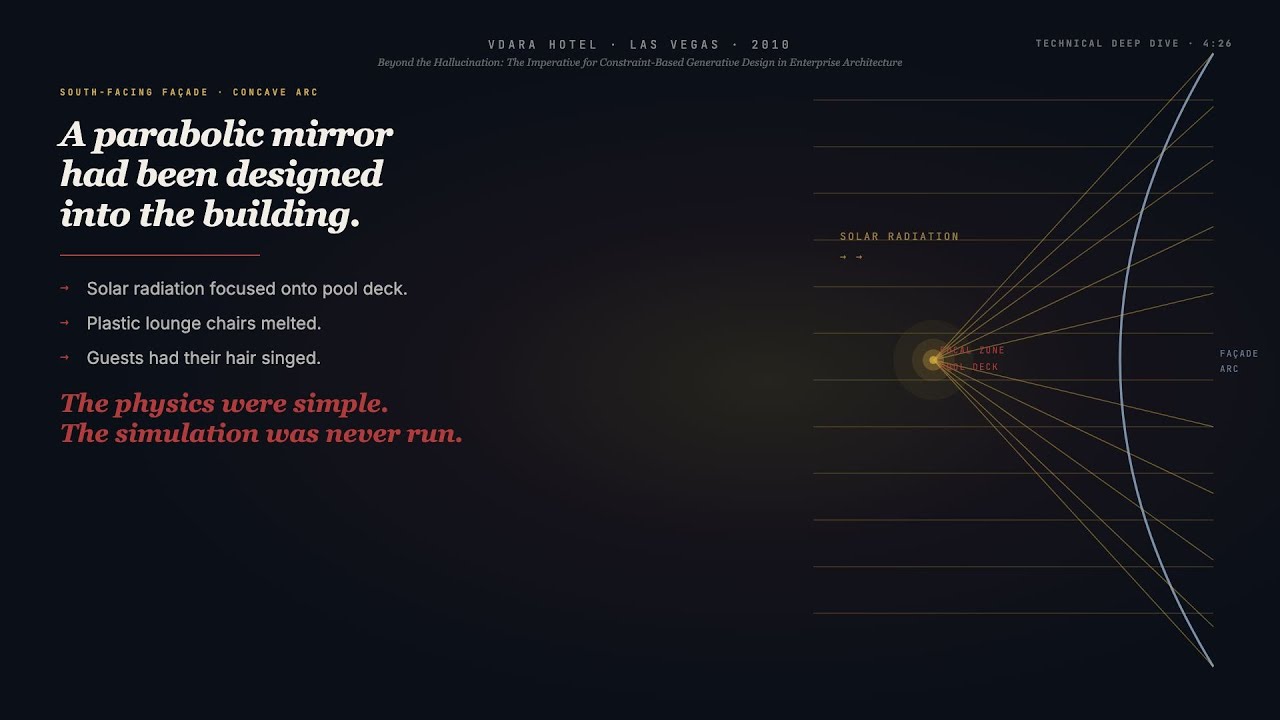
Las Vegas hotel with concave glass façade focused solar radiation onto pool deck, melting plastic chairs and singeing guests. Physics were simple: concave mirror = parabolic reflector.
Jørn Utzon's vision was geometrically indeterminate and unbuildable. Decade-long engineering struggle to find "spherical solution." Result: 1,400% budget overrun and 10-year delay.
London's 20 Fenchurch Street: concave design focused sunlight, melting Jaguar bodywork. Same architect, same physics error as Vdara. Demonstrates lack of automated physics verification.
A Constraint-Based Generative Design system equipped with simple ray-tracing in the reward function would detect these convergence zones in the first millisecond of simulation. The AI would be "punished" for creating hazardous heat flux, forcing convex or faceted geometries that scatter light safely.
To a diffusion model, a flat pixel and a curved pixel are identical. To a developer, the difference is 20x cost increase and potential bankruptcy.
See how geometry affects your façade budget
Generalist AI sees no distinction. Veriprajna penalizes curvature unless explicitly justified.
Custom curved glass requires secondary heating, slumping over custom molds, and distinct tooling for each unique radius. It's slow, energy-intensive, and requires minimum order quantities that can delay projects by months.
Veriprajna's methodology hard-codes the immutable laws of physics, supply chains, and economics directly into the AI's reward function.
"Don't Generate Art. Generate Assets." Our AI connects via API to live steel inventory databases. Action space is discretized to available AISC W-shapes. Rewards in-stock sections, penalizes mill orders.
"Gravity is not a suggestion." We use Physics-Informed Neural Networks (PINNs) to embed governing PDEs into the loss function. AI predicts stress/deflection in milliseconds vs. hours for traditional FEA.
"Aesthetics are 10%. Manufacturability is 90%." Cost engine estimates Total Cost of Ownership (TCO) using RSMeans data, material indices, and fabrication complexity models.
The agent is rewarded for structural efficiency, low cost, and ease of assembly. It is heavily penalized for violating hard constraints like code compliance or safety factors. Over millions of training episodes, the agent converges on designs that balance safety, cost, and availability in ways no human could manually iterate.
Not a single model, but a federated "Mixture of Experts" where each domain—geometry, physics, cost—is handled by a dedicated, optimized system.
Proposes initial 3D geometries and topologies
Validates structural integrity (stress, strain, buckling, CFD)
Estimates BOM cost, fabrication time, lifecycle TCO
Checks against building codes (ASCE 7, IBC, AISC)
Updates policy to maximize composite reward
Over millions of training episodes, the agent converges on optimal assets—balancing safety, cost, and availability.
An unconstrained AI might optimize a structure by selecting a W14x730 beam because it perfectly satisfies local load math. But if that's a mill-order item with 6-month lead time, the AI introduced a critical path delay costing millions in financing charges.
Local distribution hubs stock standard AISC shapes (W12x26, W24x84). Fabricators purchase with lead times measured in days. Allows rapid construction and lower carrying costs.
If design calls for non-stocked sizes, steel must be ordered from mill. High minimum tonnage requirements, lead times stretching to months. Specific shapes rolled quarterly at best.
The agent is aware of standard stock lengths (40ft, 60ft). It's penalized for designs generating excessive off-cuts. If a design calls for a 42-foot beam, the agent might be:
This transforms the AI from a designer into a procurement strategist—ensuring blueprints are logistically optimized for regional supply chain reality.
Adjust the weights in the reward function to see how different priorities affect design outcomes. This demonstrates how Veriprajna's system balances competing objectives.
Structural efficiency, deflection limits, stress constraints
Material cost, fabrication complexity, TCO
Supply chain, ease of assembly, standard connections
We don't sell prompts. We architect intelligence for the built environment—combining materials science, deep learning, and industrial edge computing.
Standard AI vendors try to "train better models" on existing data. You cannot enhance a signal that was never captured. Veriprajna solves the root cause: we change the optimization objective to enforce physical laws, not pixel patterns.
Our systems run in production at major AEC firms. We've optimized structures for Category 5 hurricane zones, minimized steel tonnage by 15-20% while maintaining code compliance, and reduced design cycle time by 60%.
Veriprajna integrates with your existing BIM workflow (Revit, Rhino/Grasshopper, Tekla). Export to IFC, STEP, or native formats. Our system doesn't replace your tools—it supercharges them with physics-based intelligence.
Our Auditor component embeds building codes as hard constraints: ASCE 7-16 (wind/seismic), IBC (occupancy/egress), AISC (steel design), ACI 318 (concrete). Every generated design is code-compliant by construction.
The construction industry does not suffer from a lack of imagination; it suffers from a lack of certainty. The current wave of generative AI offers imagination without certainty—the illusion of design without the substance of engineering.
Because gravity is non-negotiable. Every beam must transfer load. Every façade must resist wind. Physics is not a final check—it's a generative constraint.
Because supply chains are rigid. A W14x730 might be perfect mathematically, but a 6-month mill lead time makes it financially toxic. The AI designs within reality.
Because budgets are finite. Curved glass costs 20x more than flat. Custom connections require field welding. The AI acts as a fiduciary for the developer.
is not in better prompts.
It is in better physics.
Don't Generate Art.
Generate Assets.
Veriprajna.
The Escher Effect describes how diffusion models like Midjourney create geometrically impossible structures that satisfy pixel statistics but violate fundamental physics. These AI tools produce staircases terminating in walls, columns dissolving into ceilings, and double-curved glass surfaces that cost 20x more than flat alternatives. Real-world examples include the Vdara Death Ray and Sydney Opera House's 1,400% budget overrun, both caused by aesthetic-led design without physics constraints.
Veriprajna uses a Deep Reinforcement Learning agent with a composite reward function: R_total = w1*R_physics + w2*R_economics + w3*R_constructability - P_violation. The agent is rewarded for structural efficiency and low cost while heavily penalized for code violations. Three expert systems validate each design: The Physicist (PINN-based FEA), The Accountant (RSMeans cost estimation), and The Auditor (ASCE 7-16, IBC, AISC rule checking).
An unconstrained AI might select a W14x730 beam that perfectly satisfies load math but requires a 6-month mill order with high minimum tonnage. Veriprajna's system connects via API to live steel inventory databases, discretizes the action space to available AISC W-shapes, rewards in-stock service center sections (+100), and penalizes mill orders (-500). It also optimizes for standard stock lengths to minimize waste, transforming the AI from a designer into a procurement strategist.
Veriprajna's Constraint-Based Generative Design doesn't just improve design quality—it fundamentally changes the economics of construction.
Schedule a technical consultation to see how our Deep RL agents can optimize your next project.
14-page engineering report: Deep RL architecture, PINN mathematics, topology optimization, supply chain integration, case studies, comprehensive references.