The Autonomy Paradox: Engineering Resilient Navigation in GNSS-Denied and Contested Environments
Executive Summary
The premise of modern autonomous systems has long relied on a fragile assumption: the ubiquity and reliability of Global Navigation Satellite Systems (GNSS). For decades, the Global Positioning System (GPS) and its international counterparts have served as the invisible tether for unmanned aerial vehicles (UAVs), providing the spatial truth required for stabilization, waypoint navigation, and return-to-home protocols. However, the geopolitical and technological landscape of the 2020s has shattered this assumption. As evidenced by high-intensity conflicts in Eastern Europe and the operational realities of subterranean mining and critical infrastructure inspection, GNSS is no longer a guaranteed utility; it is a contested vulnerability.
This whitepaper, prepared by Veriprajna, argues that a drone dependent on GPS for stability is not truly autonomous; it is merely automated within a permissive environment. When that environment becomes non-permissive—due to electronic warfare (EW), physical obstruction, or signal multipath degradation—the system fails, rendering sophisticated hardware into "paperweights." Furthermore, the industry's reliance on cloud-based Artificial Intelligence (AI) for decision-making introduces fatal latency and bandwidth dependencies that are untenable in mission-critical scenarios.
We present a comprehensive architectural analysis of Visual Inertial Odometry (VIO) and Edge AI as the foundational technologies for true autonomy. By fusing high-frequency inertial data with computer vision at the edge, UAVs can achieve "dead reckoning" capabilities that are mathematically robust, un-jammable, and completely self-contained. This report details the transition from distinct, fragile navigation stacks to integrated, semantic Visual Simultaneous Localization and Mapping (vSLAM) systems. We analyze the computational requirements of running deep neural networks on embedded platforms like the NVIDIA Jetson Orin series and demonstrate how Veriprajna’s approach—moving beyond simple API wrappers to deep, sensor-fused engineering—delivers the resilience required for modern defense, industrial, and public safety operations.
1. The Fragility of the Connected Paradigm
The definition of "autonomy" in the commercial drone sector has often been conflated with "automation." An automated system executes a pre-defined script based on external inputs (GPS coordinates, pilot commands). True autonomy implies the ability to perceive the environment, determine state, and make decisions without external reliance. The current generation of commercial UAVs largely falls into the former category, creating catastrophic points of failure when external signals are disrupted.
1.1 The Physics and Tactics of GNSS Denial
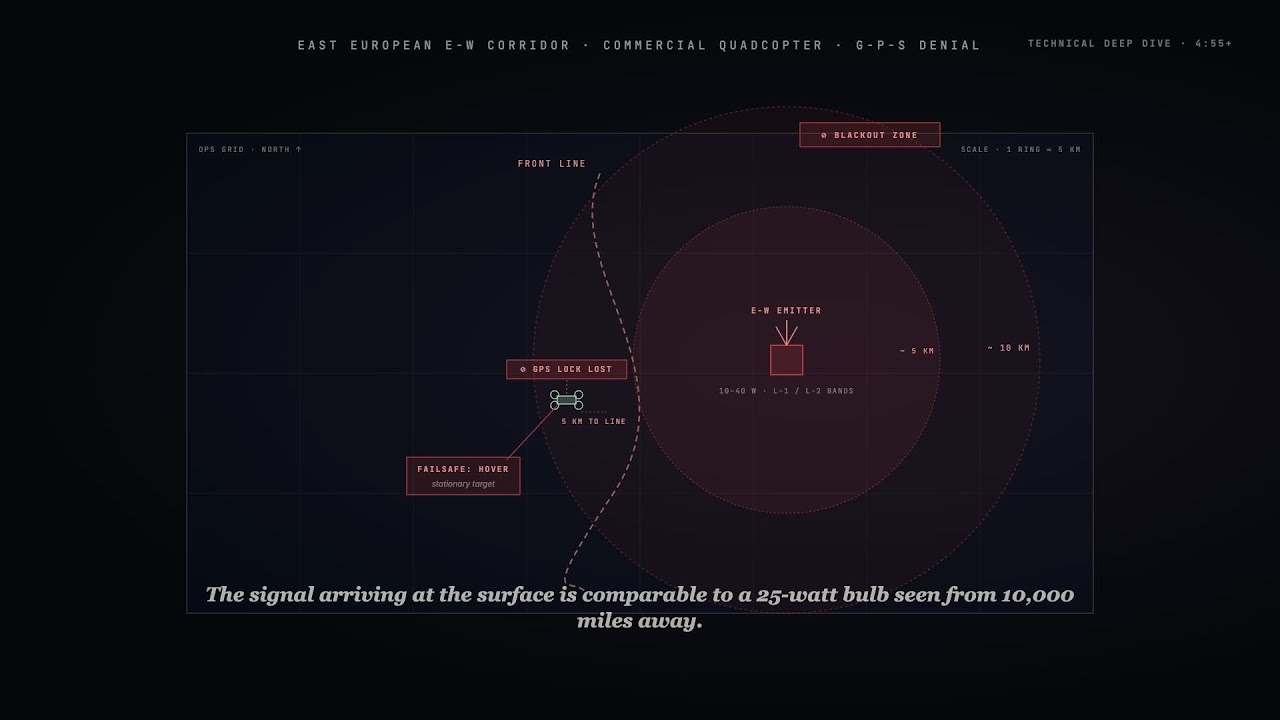
GNSS jamming is the "first move" in modern warfare because it is asymmetric: low-cost, ground-based emitters can neutralize high-value aerial assets over vast areas. The physics of this vulnerability lies in the signal strength. GPS satellites orbit approximately 20,200 kilometers above the Earth, transmitting signals that arrive at the surface with extremely low power—often compared to detecting a 25-watt light bulb from 10,000 miles away. This weak signal is easily overwhelmed by terrestrial noise, whether accidental or malicious.
1.1.1 Mechanisms of Interference: Jamming and Saturation
Electronic Warfare (EW) systems exploit this weak signal through several primary vectors, predominantly focused on saturating the receiver's front end. Modern GNSS receivers operate by tracking the phase of the carrier wave sent by satellites. Jammers emit high-power Radio Frequency (RF) noise to saturate the L1 (1575.42 MHz), L2 (1227.60 MHz), and E1/E5 bands. 1
The effectiveness of this denial is governed by the inverse-square law, but the power differential is massive. A satellite signal travels thousands of kilometers; a jammer is often only a few kilometers away. Even portable jammers operating at relatively low power levels of 10–40 watts can create "blackout zones" extending several kilometers. 1 Within these zones, the Signal-to-Noise Ratio (SNR) drops below the threshold required for the receiver to lock onto the carrier phase. For small drones, which depend on satellite navigation for stabilization, route following, and autonomous return-to-home, the effects are immediate: drift, loss of positional confidence, or failsafe descent. 1
In high-intensity conflict zones like Ukraine, this is not a theoretical risk but a dominant operational constraint. Reports indicate that FPV and commercial quadcopters routinely experience GNSS loss within 5–10 km of front-line EW deployments. 1 Advanced Russian systems, such as the R-330Zh Zhitel, provide near-constant area denial, forcing operators to rely on manual visual piloting. 2 This reliance on manual control demands high operator skill and unobstructed video feeds, both of which are scarce resources in combat.
1.1.2 Spoofing and Meaconing: The Deception Vector
More insidious than jamming is spoofing, where an adversary transmits a counterfeit GNSS signal at a slightly higher power than the authentic satellite constellation. Unlike jamming, which triggers a "loss of signal" warning, spoofing deceives the navigation stack.
● Meaconing: This involves recording actual GNSS signals and rebroadcasting them with a slight delay. The receiver locks onto the stronger, delayed signal, causing the computed position to drift.
● Coherent Spoofing: Sophisticated attackers generate false signals that perfectly mimic the satellite constellation's almanac and ephemeris data but introduce gradual errors in Position, Velocity, and Time (PVT) solutions. 1
The consequences of spoofing are severe. A drone may believe it is stationary while it is actually drifting into hostile territory, or it may perceive a false altitude change and crash into the ground. 3 Historical incidents, such as the disruption of drone surveillance during the 2017 Venezuelan presidential election, demonstrate the geopolitical utility of these tactics. 3 While multi-constellation receivers (tracking GPS, GLONASS, Galileo, and BeiDou) and authenticated services like Galileo OSNMA raise the difficulty of spoofing, they do not eliminate the risk against state-level adversaries capable of broadband signal manipulation. 1
1.1.3 Command-and-Control (C2) Severance
Modern wideband electronic attack systems do not stop at navigation; they also target the Command and Control (C2) links (typically 2.4 GHz, 5.8 GHz, or 900 MHz). 1 For First Person View (FPV) and teleoperated drones, the severance of the C2 link is catastrophic. Without a pilot in the loop, a drone without true autonomy enters a failsafe mode—usually hovering or landing immediately. 1 In a combat zone, a hovering drone is a stationary target; in an industrial setting, a drone landing indiscriminately can damage expensive machinery or pose safety risks to personnel.
1.2 The Economic Risks in Civilian Sectors
While the military implications are kinetic, the civilian implications are economic. The reliance on GPS extends into mining, infrastructure, and logistics, where signal denial is often a function of physics rather than malice. The economic footprint of GPS is staggering; a study sponsored by the National Institute of Standards and Technology (NIST) estimated that GPS generated approximately $1.4 trillion in economic benefits for the U.S. private sector between 1984 and 2017. 4 Conversely, a loss of GPS service is estimated to cost the U.S. economy roughly $1 billion per day. 5
1.2.1 Subterranean and Industrial Denial
In underground mining, the environment is naturally GPS-denied. Navigating stopes, drifts, and tunnels to inspect for rock mass characteristics or post-blast fragmentation cannot rely on satellite signals. 6
● The Cost of Manual Inspection: Traditional inspection methods involve humans or expensive, specialized equipment like borehole scanners. These methods are slow, labor-intensive, and hazardous. Manual surveys can take days or weeks, while drone-based solutions can reduce this to hours. 7
● The Equipment Risk: Utilizing non-autonomous drones in these environments puts the asset at risk. A drone that loses stability due to sensor failure in a confined mine shaft is likely to crash. With industrial drone platforms costing upwards of $10,000 to $50,000, reliable, non-GPS stabilization is an economic necessity.
1.2.2 Multipath and Infrastructure Shadows
Critical infrastructure inspection presents a similar challenge known as the "multipath" effect. When flying near large metallic structures like oil storage tanks, bridges, or in "urban canyons," GPS signals bounce off surfaces before reaching the receiver. This delay corrupts the timing calculation, leading to position errors of several meters. 9
● Pipeline Inspection: For oil and gas pipelines, the cost of failure is immense. A single pipeline failure can cost millions in cleanup and regulatory fines. 8 Drones are used to detect leaks, corrosion, and erosion. However, inspecting the underside of a bridge or the base of a tank farm places the drone in a GPS shadow. Without Visual Inertial Odometry (VIO), the drone cannot maintain the precise station-keeping required for high-resolution photogrammetry or thermal imaging. 10
● Financial Implications: The ROI of drone inspection is predicated on efficiency. Drone operations can reduce inspection costs by up to 70% compared to manned helicopters or ground crews. 7 However, this ROI evaporates if the drone cannot fly in the necessary locations due to signal instability.
The "paperweight" phenomenon described in the founder's thesis is thus validated by both military attrition rates and industrial operational constraints. A system that cannot navigate without GPS is a system with a single point of failure that is exposed to both adversarial action and environmental physics.
2. The Latency Trap: Why Cloud AI Fails in Robotics
The second pillar of the "connected autonomy" fallacy is the reliance on Cloud AI. The paradigm of streaming video data from a drone to a cloud server for processing (e.g., object detection, photogrammetry), and receiving commands back, is fundamentally flawed for mission-critical operations due to the constraints of latency, bandwidth, and reliability.
2.1 The Physics of the Control Loop
Autonomous flight requires extremely tight control loops. A quadcopter makes hundreds of motor adjustments per second to maintain stability. High-level guidance commands (e.g., "avoid obstacle," "track target") must be received and processed within milliseconds to be effective at speed.
2.1.1 Latency: Head vs. Tail
In networked control systems, latency is not a single number; it is a distribution.
● Head Latency: This represents the minimum or average latency observed under ideal conditions. In 5G networks, this can be impressively low (single-digit milliseconds).
● Tail Latency: This represents the worst-case scenario—the 99th percentile of request times. In robotics, tail latency is the killer. 11 A momentary spike in network lag due to congestion, packet loss, or handover between cell towers results in "jitter."
For a drone moving at 20 meters per second, a 300-millisecond delay—common in cloud round-trips when accounting for upload, processing, and download—translates to 6 meters of travel distance. 12 During this blind interval, the drone continues on its previous trajectory. If an obstacle appears or the target maneuvers, the drone will react too late. Research indicates that variable latency significantly degrades control, with teleoperation becoming practically uncontrollable above 700ms. 12
2.1.2 The Jitter Instability
Jitter—the variance in latency—is even more destructive than constant latency. Control algorithms (like PID controllers) can be tuned to handle a constant delay, but stochastic jitter destabilizes the feedback loop, leading to oscillation and potential loss of control. 13 In a contested environment where EW systems are actively inducing noise, network jitter becomes the norm, rendering cloud-loop control suicidal for the airframe.
2.2 Bandwidth and the "Silent" Imperative
Vision-based navigation generates massive amounts of data. A stereo camera setup running at 30 frames per second generates hundreds of megabytes of raw data per minute. Streaming this to the cloud is bandwidth-prohibitive and creates a massive electromagnetic signature.
2.2.1 The Cost of Data Gravity
"Data Gravity" refers to the difficulty of moving large datasets. In an industrial inspection scenario, a drone might capture 4K video or LiDAR point clouds. Transmitting this raw data to the cloud for real-time processing requires immense bandwidth (High Uplink).
● Cloud AI Model: High bandwidth consumption, high latency, high operational cost (data plans), and total dependence on network coverage. 14
● Edge AI Model: Data is processed locally. Only high-level insights (e.g., "corrosion detected at coordinate X") are transmitted. This reduces bandwidth usage by orders of magnitude. 15
2.2.2 Electronic Visibility
In defense applications, radio silence is survival. A drone streaming video to the cloud acts as a high-power beacon, easily triangulated by enemy Direction Finding (DF) assets. 1 Cloud-based AI makes "stealth" impossible. Edge AI enables operations in total radio silence: the drone perceives, decides, and acts without emitting a single byte of data until the mission parameters dictate a burst transmission or return-to-base.
2.3 Reliability and Security
Cloud dependence expands the attack surface. Data in transit is vulnerable to interception, and the cloud infrastructure itself is a target.
● Security: Edge AI keeps sensitive raw data (video feeds of critical infrastructure or tactical positions) on the device. It never traverses the public internet, reducing the risk of interception. 14
● Survivability: If the network link is severed, a cloud-dependent drone is lobotomized; it loses its "brain." An edge-native drone continues its mission because its intelligence is onboard. This distinction is the difference between a "paperweight" and a weapon system. 16
3. Principles of Autonomous Navigation: Visual Inertial Odometry
To sever the tether of GPS and Cloud, we must replicate the biological navigational capability: the integration of vision (eyes) and the vestibular system (inner ear). In robotics, this is Visual Inertial Odometry (VIO) . It is the cornerstone of Veriprajna's solution architecture.
3.1 Technical Principles of VIO
VIO is the fusion of two complementary sensor modalities:
1. Visual Odometry (VO): Estimates pose by tracking the movement of distinctive texture "landmarks" (features) across successive camera frames. 18
2. Inertial Odometry (IO): Estimates state changes using high-frequency (200Hz–1kHz) accelerometers and gyroscopes within an Inertial Measurement Unit (IMU). 18
3.1.1 The Complementary Nature of Vision and Inertia
Neither sensor is sufficient alone.
● Vision Limits: Cameras are relatively slow (30–60Hz) and suffer from motion blur during rapid maneuvers. Furthermore, monocular visual odometry lacks metric scale—the drone can determine it is moving forward, but not whether it moved 1 meter or 10 meters, without an external reference or stereo baseline. 19
● Inertial Limits: IMUs are fast (1000Hz) but suffer from rapid drift. Navigation requires double-integrating acceleration to obtain position (). This means that any small error in the sensor reading accumulates quadratically over time ($Error \propto t^2$). A consumer-grade MEMS IMU can drift by meters within seconds if not corrected. 18
VIO fuses these modalities to cancel out their respective weaknesses. The IMU provides the high-rate state prediction and handles rapid movements where images might blur. The camera provides the "correction" step, anchoring the drifting IMU estimate to fixed landmarks in the world. 18 This fusion allows for drift rates as low as 1-2% of the distance traveled, even in
GPS-denied environments. 1
3.2 Sensor Fusion Architectures: Filtering vs. Optimization
Implementing VIO requires sophisticated mathematical frameworks to define how these sensors inform each other. There are two primary approaches in modern robotics.
3.2.1 Filter-Based Approaches (MSCKF)
The Multi-State Constraint Kalman Filter (MSCKF) utilizes an Extended Kalman Filter (EKF) structure.
● Mechanism: It maintains a state vector including the drone's pose and the IMU biases. It propagates the state using IMU readings (Prediction) and updates the state when visual features are tracked across multiple frames (Update). 18
● Pros: Computationally efficient, suitable for resource-constrained platforms (micro-controllers).
● Cons: It relies on linearization at the current state. Once a state is marginalized (processed), the information is fixed. It cannot go back and re-linearize past measurements if a better estimate becomes available later, making it less accurate over long trajectories. 18
3.2.2 Optimization-Based Approaches (VINS-Mono / ORB-SLAM3)
Veriprajna prioritizes optimization-based approaches, often referred to as graph-based SLAM or sliding-window optimization.
● Mechanism: These systems construct a "factor graph" where nodes represent robot poses and edges represent constraints (visual measurements or IMU pre-integrations). They solve a non-linear least squares problem to minimize the total error across a sliding window of recent frames. 18
● Advantages:
○ Re-linearization: The system can correct past pose estimates as new information arrives, providing a more consistent trajectory.
○ Loop Closure: This architecture naturally extends to SLAM (Simultaneous Localization and Mapping), allowing for global consistency (discussed in Section 4).
○ Robustness: Algorithms like VINS-Mono and ORB-SLAM3 have demonstrated superior accuracy in benchmarks like EuRoC and KITTI, particularly in aggressive motion scenarios typical of tactical drones. 23
| Computational Cost | Low (Linear) | High (Cubic with window size) |
|---|---|---|
| Accuracy | Good for short term | Superior, reduces drif |
| Loop Closure | Difcult to integrate | Native integration |
| Hardware Target | Micro-UAVs / MCUs | Edge AI Computers (Jetson) |
| Veriprajna Choice | Backup / Failsafe | Primary Navigation Stack |
3.3 The Failure Modes of VIO and Mitigation
While VIO is un-jammable, it is not infallible. Understanding its limits is key to robust engineering.
3.3.1 Feature-Poor Environments
VIO relies on tracking texture (contrast, corners). Environments with low texture—such as white walls, dense fog, smoke, or open water—can cause "tracking loss". 24
● Mitigation: LiDAR-VIO Fusion. Integrating lightweight solid-state LiDAR provides dense geometric data that works in total darkness or texture-less voids. The LiDAR point cloud provides geometric constraints that anchor the VIO solution when cameras fail. 1
3.3.2 Dynamic Environments
Standard VIO algorithms assume the world is static. Moving objects (trucks, people, foliage in wind) can be mistaken for static landmarks. If the drone tracks a moving truck and assumes it is a stationary wall, the drone will incorrectly estimate its own motion to compensate.
● Mitigation: Semantic Masking. This is where "Deep AI" meets navigation. We utilize deep learning models (like SegNet or YOLO-based masks) to identify dynamic objects pixel-by-pixel. These regions are "masked out" of the VIO pipeline, ensuring the drone only tracks static background features. 25
4. Semantic Intelligence: SLAM and the Understanding of Space
VIO provides local consistency (e.g., "I moved 5 meters forward"), but it accumulates drift over time. To achieve global consistency without GPS, the system must recognize where it has been. This is the transition from Odometry to Simultaneous Localization and Mapping (SLAM) .
4.1 The "Kidnapped Robot" and Loop Closure
In robotics, the "Kidnapped Robot Problem" describes a scenario where a robot is abruptly moved to a new location without being told how it got there (e.g., a drone recovering from a spin or signal loss). To survive, it must recognize its surroundings to relocalize.
Loop closure acts as an internal GPS correction. When the drone returns to a previously visited area, the system matches the current visual fingerprint against its stored map. If a match is found, it calculates the drift error accumulated since the last visit and "snaps" the entire trajectory back into alignment. 27
4.1.1 Bag of Words (BoW)
Traditional loop closure uses "Bag of Words" representations. Visual features (ORB, SIFT) are clustered into a vocabulary tree. The system queries this database to ask, "Have I seen this image before?". 27
● Mechanism: Each image is converted into a vector of "visual words." Similarity is calculated using metrics like cosine distance. If a high-confidence match is found, the system attempts to geometrically align the current frame with the historical frame. 30
● Importance: Without loop closure, a drone inspecting a long pipeline or perimeter will eventually drift meters off course. With loop closure, the map remains consistent over long durations, enabling re-visitation of waypoints with centimeter-level precision. 28
4.2 Semantic Understanding: The "Deep AI" Difference
Standard VIO treats the world as a cloud of meaningless points. Veriprajna's "Deep AI" approach integrates Semantic SLAM .
● Geometric vs. Semantic: Geometric SLAM sees points, lines, and planes. Semantic SLAM sees "Door," "Wall," "Truck," "Enemy Combatant". 31
4.2.1 The Semantic Advantage
1. Robustness in Dynamic Scenes: By understanding that a "car" is an object class that moves, the Semantic SLAM algorithm proactively excludes features on cars from the map optimization process. This prevents map corruption in busy environments. 26
2. Long-Term Navigation: Geometric features (pixel intensity of a corner) change with lighting (day vs. night). Semantic features (the concept of a "window" or "door") are invariant to lighting conditions. A Semantic SLAM system can recognize a location visited during the day even when returning at night, provided the semantic structure remains visible. 33
3. Human-Centric Command: It enables high-level instructions like "Fly through the door" or "Inspect the red tank," rather than "Fly to coordinate X,Y,Z". 35 This is critical for reducing operator cognitive load.
4.3 Algorithm Selection: ORB-SLAM3 vs. VINS-Fusion
For enterprise deployment, the choice of core algorithm is critical. Veriprajna has evaluated the leading open-source frameworks to build our proprietary stack.
4.3.1 ORB-SLAM3
● Architecture: A feature-based method that supports visual, visual-inertial, and multi-map SLAM.
● Strengths: It is the first system able to perform multi-map merging (Atlas system). If the drone gets lost (tracking loss), it starts a new map. When it recognizes a previous location, it merges the two maps. This makes it incredibly resilient to "kidnapping" or aggressive maneuvers that break tracking. 36
● Performance: Consistently demonstrates superior accuracy in benchmarks (EuRoC) and achieves errors an order of magnitude lower than some competitors due to its robust bundle adjustment. 23
4.3.2 VINS-Fusion
● Architecture: An optimization-based sliding window estimator.
● Strengths: Highly efficient and modular. It excels at fusing global sensors (like GPS, if available) with VIO.
● Weaknesses: Can struggle in texture-less environments compared to ORB-SLAM3's sophisticated map management and place recognition. 36
The Veriprajna Stack: We leverage a modified version of ORB-SLAM3 enhanced with a deep-learning frontend (SuperPoint/SuperGlue) to replace standard ORB features. This combines the robust backend of ORB-SLAM3 with the superior feature extraction of modern neural networks, ensuring performance even in challenging lighting where traditional features fail. 24
5. The Compute Engine: Edge AI Hardware Architectures
The mathematical complexity of VIO and Semantic SLAM requires substantial computational power. Executing non-linear optimization (VIO) alongside Convolutional Neural Networks (Semantic Segmentation) in real-time (30+ FPS) demands specialized hardware. This is where "Edge AI" becomes hardware reality, not just a buzzword.
5.1 Hardware Architecture: NVIDIA Jetson Orin
The NVIDIA Jetson Orin series represents the current state-of-the-art for embedded robotic computing, providing server-class AI performance in an embedded form factor.
5.1.1 Performance Density
The Jetson Orin NX delivers up to 100 TOPS (Trillion Operations Per Second) of AI performance. This is a massive leap over previous generations like the Xavier NX, offering 3x to 5x performance gains. 38
| Metric | Jetson Orin Nano | Jetson Orin NX (16GB) |
Jetson AGX Orin |
|---|---|---|---|
| AI Performance | 40 TOPS | 100 TOPS | 275 TOPS |
| GPU Architecture | Ampere (1024 cores) |
Ampere (1024 cores) |
Ampere (2048 cores) |
| Memory | 8GB LPDDR5 | 16GB LPDDR5 | 64GB LPDDR5 |
| Power | 7W - 15W | 10W - 25W | 15W - 60W |
| Target Use Case | Entry-level VIO | Advanced Semantic VIO |
Heavy Industrial / Hub |
For tactical micro-drones and industrial inspectors, the Orin NX offers the optimal balance of SWaP-C (Size, Weight, Power, and Cost). It allows running VIO backends (like Isaac ROS Visual SLAM or custom ORB-SLAM3 implementations) alongside object detection networks (YOLOv8/v11) without saturating the thermal budget. 38
5.2 Optimization Strategies for Real-Time Flight
Raw silicon power is insufficient without software optimization. Latency in the vision pipeline translates directly to flight instability.
5.2.1 TensorRT and Quantization
We utilize NVIDIA's TensorRT to compile neural networks, optimizing layer fusion and kernel selection.
● Int8 Quantization: Converting neural network weights from Floating Point 32 (FP32) to Integer 8 (Int8) reduces memory bandwidth usage and increases throughput. On Orin platforms, this is essential to achieving the >30 FPS required for control loop stability. 41
● Result: TensorRT optimization can double or triple inference throughput compared to raw PyTorch execution, bringing complex semantic segmentation models within the latency budget of a flying drone. 42
5.2.2 Hardware Acceleration (VPI & CUDA)
To prevent CPU bottlenecks, we offload specific tasks:
● Frontend: Feature tracking and optical flow are offloaded to the Vision Programming Interface (VPI) or dedicated PVA (Programmable Vision Accelerator) cores on the Orin, freeing up the GPU for deep learning inference. 43
● Backend: The non-linear optimization (bundle adjustment) is parallelized using CUDA kernels on the GPU, ensuring that map updates do not stall the tracking thread.
This heterogeneous computing approach ensures that the flight controller receives odometry updates at the required frequency (typically >50Hz) regardless of the complexity of the scene being analyzed. 43
6. Operational Realities: Defense, Mining, and Infrastructure
The transition to VIO-based autonomy is not merely a technical upgrade; it is an operational imperative that unlocks new capabilities and cost savings across sectors.
6.1 Defense: The Un-Jammable Loitering Munition
In the context of the Ukraine conflict and future peer-to-peer engagements, GNSS denial is a certainty.
● Terminal Guidance: Current FPV drones rely on analog video links that break up near the ground (due to the Fresnel zone and jamming). VIO-equipped drones can "lock on" to a target visually and autonomously execute the final strike phase even if the C2 link is severed. 44
● Fire-and-Forget Swarms: Autonomous navigation allows a single operator to deploy a swarm. The drones navigate a GNSS-denied corridor using VIO, locate targets using onboard semantic AI, and engage based on pre-set Rules of Engagement (ROE). This multiplies force effectiveness while reducing operator exposure. 46
● Survivability: By removing the radio link, the drone becomes a "silent killer," undetectable by standard RF scanners until it is visual. 44
6.2 Mining: Digitizing the Subsurface
The mining industry faces a naturally GPS-denied environment where safety is paramount.
● Post-Blast Inspection: After blasting, stopes are filled with dust and potentially toxic gases. Waiting for clearance costs money. VIO-enabled drones can fly into these dark, dust-filled environments (potentially aided by LiDAR fusion) to inspect rock fragmentation and structural stability immediately. 6
● Cost vs. Risk: Removing humans from these hazardous zones is the primary value driver.
Additionally, replacing manual surveying (which can take days) with drone photogrammetry (hours) drastically reduces operational costs. A manual survey team costs thousands per day; a drone does it in 30 minutes. 7
6.3 Critical Infrastructure: The Cost of Failure
For oil and gas pipelines, the cost of a missed inspection can be catastrophic ($8.5 million for a single failure vs. $75,000 for repair). 8
● GPS-Shadow Operations: Drones inspecting the underside of bridges or flying between large storage tanks often lose GPS due to multipath effects. A VIO system maintains precise station-keeping in these "shadows," allowing the drone to capture high-resolution imagery without the risk of drifting into the structure. 10
● Scalability: Truly autonomous drones (docked, VIO-enabled) can run scheduled inspections daily without a pilot in the loop, detecting leaks or corrosion at the earliest detectable stage. This moves maintenance from reactive to predictive. 48
7. Conclusion: The Veriprajna Vision
The era of "automated" drones—reliant on fragile satellite tethers and cloud connectivity—is ending. The future belongs to Autonomous Edge Systems .
Veriprajna does not merely wrap LLM APIs; we engineer the fundamental navigation and perception stacks that allow machines to exist and act in the physical world. By mastering Visual Inertial Odometry, implementing Semantic SLAM, and optimizing for Edge Compute, we build systems that are:
1. Un-Jammable: Immune to GNSS denial and spoofing.
2. Un-Tethered: Capable of mission completion without radio links or cloud connectivity.
3. Truly Autonomous: Possessing the onboard intelligence to perceive, understand, and navigate the complex reality of modern environments.
For the defense commander, the mine operator, and the infrastructure manager, this distinction is not academic—it is the difference between mission success and a lost asset.
Technical Addendum: Comparative Analysis of Navigation Modalities
| Col1 | Navigation | Flow (P4/Mavic) | Semantic VIO |
|---|---|---|---|
| Primary Reference |
External Satellites | Downward Camera (Ground Texture) |
360° Visual Features + IMU + Semantic Understanding |
| Jamming Susceptibility |
High (L1/L2/L5 bands) |
Medium (Needs GPS for yaw/height) |
Zero (Passive Sensing) |
| Drif Rate | N/A (Absolute Position) |
High over time / Low Accuracy |
Low (<1-2%) via Loop Closure |
| Denied Env. Capability |
Fails (Indoor/Undergroun d/EW) |
Limited (Requires good light/texture) |
High (Works in complex/GPS-deni ed zones) |
| Dynamic Object Handling |
N/A | Fails (Drifs if ground moves) |
Robust (Masks dynamic objects via AI) |
| Compute Requirement |
Low (Microcontroller) |
Low (ASIC/DSP) | High (NVIDIA Jetson / NPU) |
| Operational Status |
"Paperweight" in EW |
Unstable in EW | Mission Capable |
Glossary of Terms
● GNSS (Global Navigation Satellite System): The collective term for satellite navigation systems, including GPS (USA), Galileo (EU), GLONASS (Russia), and BeiDou (China).
● VIO (Visual Inertial Odometry): The fusion of camera data and inertial sensors to track position without external signals.
● SLAM (Simultaneous Localization and Mapping): The computational problem of constructing a map of an unknown environment while simultaneously keeping track of an agent's location within it.
● EW (Electronic Warfare): Military action involving the use of electromagnetic and directed energy to control the electromagnetic spectrum or to attack the enemy.
● SWaP-C: Size, Weight, Power, and Cost—critical constraints in drone engineering.
● Edge AI: The deployment of AI algorithms on local devices (e.g., drones) rather than in centralized cloud servers.
● Loop Closure: The process in SLAM of recognizing a previously visited location to correct accumulated navigational drift.
Works cited
Navigating Small Drones in an Electronic Warfare Environment ..., accessed December 11, 2025, https://dras.in/navigating-small-drones-in-an-electronic-warfare-environment/
Drone War Accelerates Over Ukraine - Inside Unmanned Systems, accessed December 11, 2025, https://insideunmannedsystems.com/drone-war-accelerates-over-ukraine/
Protecting Autonomous UAVs from GPS Spoofing and Jamming: A comparative analysis of detection and mitigation techniques - AWS, accessed December 11, 2025, https://sdiopr.s3.ap-south-1.amazonaws.com/2024/Oct/28-Oct-24/JERR_124341/Revised-ms_JERR_124341_v1.pdf
The Economic Power of GPS Technology - Economy Insights, accessed December 11, 2025, https://www.economyinsights.com/p/the-economic-power-of-gps-technology
DOC Study on Economic Benefits of GPS - Office of Space Commerce, accessed December 11, 2025, https://space.commerce.gov/doc-study-on-economic-benefits-of-gps/
Safety Inspections and Gas Monitoring in Hazardous Mining Areas Shortly After Blasting Using Autonomous UAVs - DiVA portal, accessed December 11, 2025, https://www.diva-portal.org/smash/get/diva2:1923729/FULLTEXT03
Drones in mining: Benefits, use cases & industry impacts - SPH Engineering, accessed December 11, 2025, https://www.sphengineering.com/news/drones-in-mining
Cutting Costs, Boosting ROI: The Business Case for Drone Pipeline Inspections Datumate, accessed December 11, 2025, https://www.datumate.com/blog/drone-pipeline-inspections/
GPS and IMU Require Visual Odometry for Elevation Accuracy - SciSpace, accessed December 11, 2025, https://scispace.com/pdf/gps-and-imu-require-visual-odometry-for-elevation-accuracy-5an1ym9sye.pdf
Smart Safety Helmets with Integrated Vision Systems for Industrial Infrastructure Inspection: A Comprehensive Review of VSLAM-Enabled Technologies - PMC PubMed Central, accessed December 11, 2025, https://pmc.ncbi.nlm.nih.gov/articles/PMC12349484/
Metrics and evaluations for computational and sustainable AI efficiency - arXiv, accessed December 11, 2025, https://arxiv.org/html/2510.17885v1
Research on the Implementation of New Communication Technologies to Improve Quality and Stability in Motion Control of Autonomous Mobile Robots MDPI, accessed December 11, 2025, https://www.mdpi.com/2227-7080/13/12/556
Stability of networked control systems - KTH, accessed December 11, 2025, https://www.kth.se/social/upload/512798bdf2765428364644c7/NCS.pdf
Edge AI vs. Cloud AI - IBM, accessed December 11, 2025, https://www.ibm.com/think/topics/edge-vs-cloud-ai
AI at the Edge Explained: Benefits, Uses & More - Advantech, accessed December 11, 2025, https://www.advantech.com/en-us/resources/industry-focus/edge-ai
Harnessing Edge AI to Strengthen National Security | Strategic Technologies Blog | CSIS, accessed December 11, 2025, https://www.csis.org/blogs/strategic-technologies-blog/harnessing-edge-ai-strengthen-national-security
Edge AI is advancing rapidly. So are the ways in which it's being secured., accessed December 11, 2025, https://www.techmonitor.ai/digital-economy/ai-and-automation/edge-ai-cybersecurity
How Visual Inertial Odometry (VIO) Works - Think Autonomous, accessed December 11, 2025, https://www.thinkautonomous.ai/blog/visual-inertial-odometry/
Efficient and Accurate Downfacing Visual Inertial Odometry - arXiv, accessed December 11, 2025, https://arxiv.org/html/2509.10021v1
Visual Inertial Odometry (VIO) | PX4 Guide (main), accessed December 11, 2025, https://docs.px4.io/main/en/computer_vision/visual_inertial_odometry
A Comprehensive Introduction of Visual-Inertial Navigation - arXiv, accessed December 11, 2025, https://arxiv.org/pdf/2307.11758
Dense Visual-Inertial Odometry for Tracking of Aggressive Motions - Yonggen Ling, accessed December 11, 2025, https://ygling2008.github.io/papers/ROBIO2015.pdf
Comparison of modern open-source visual SLAM approaches ..., accessed December 11, 2025, https://www.alphaxiv.org/overview/2108.01654v2
A robust visual-inertial SLAM based deep feature extraction and matching - arXiv, accessed December 11, 2025, https://arxiv.org/html/2405.03413v2
D-VINS: Dynamic Adaptive Visual–Inertial SLAM with IMU Prior and Semantic Constraints in Dynamic Scenes - MDPI, accessed December 11, 2025, https://www.mdpi.com/2072-4292/15/15/3881
RO-SLAM: A Robust SLAM for Unmanned Aerial Vehicles in a Dynamic Environment, accessed December 11, 2025, https://www.techscience.com/csse/v47n2/53640/html
Simple bag-of-words loop closure for visual SLAM - Nicolò Valigi, accessed December 11, 2025, https://nicolovaligi.com/articles/bag-of-words-loop-closure-visual-slam/
Introduction to Loop Closure Detection in SLAM - Think Autonomous, accessed December 11, 2025, https://www.thinkautonomous.ai/blog/loop-closure/
Evaluation of Bags of Binary Words for Place Recognition in Challenging Scenarios - inesc tec, accessed December 11, 2025, https://repositorio.inesctec.pt/server/api/core/bitstreams/66f0e40f-317b-4a83-b890-eeb7ff307e7a/content
Bag of Visual Words - 5 Minutes with Cyrill - YouTube, accessed December 11, 2025, https://www.youtube.com/watch?v=a4cFONdc6nc
A Frontier Review of Semantic SLAM Technologies Applied to the Open World MDPI, accessed December 11, 2025, https://www.mdpi.com/1424-8220/25/16/4994
Is Semantic SLAM Ready for Embedded Systems ? A Comparative Survey - arXiv, accessed December 11, 2025, https://arxiv.org/html/2505.12384v1
Hierarchical Loop Closure Detection for Long-term Visual SLAM with Semantic-Geometric Descriptors - GitHub Pages, accessed December 11, 2025, https://siewkeilam.github.io/ei-research-group/Paper/2021C-Gaurav-ITSC.pdf
Semantic Loop Closure Detection for Intelligent Vehicles Using Panoramas ResearchGate, accessed December 11, 2025, https://www.researchgate.net/publication/372631598_Semantic_Loop_Closure_Detection_for_Intelligent_Vehicles_Using_Panoramas
Visual Planar Semantic SLAM for Aerial Robotic Systems - DSpace@MIT, accessed December 11, 2025, https://dspace.mit.edu/bitstream/handle/1721.1/135936/09045978.pdf?sequence=2&isAllowed=y
ORB-SLAM3: An Accurate Open-Source Library for Visual, Visual-Inertial and Multi-Map SLAM - ResearchGate, accessed December 11, 2025, https://www.researchgate.net/publication/343179441_ORB-SLAM3_An_Accurate_Open-Source_Library_for_Visual_Visual-Inertial_and_Multi-Map_SLAM
SuperVINS: A visual-inertial SLAM framework integrated deep learning features arXiv, accessed December 11, 2025, https://arxiv.org/html/2407.21348v1
NVIDIA® Jetson Comparison: Nano, TX2 NX, Xavier NX, AGX, Orin - Latest News from Seeed Studio, accessed December 11, 2025, https://www.seeedstudio.com/blog/nvidia-jetson-comparison-nano-tx2-nx-xavier-nx-agx-orin/
Jetson Orin™ NX Performance vs. Xavier™ NX - Connect Tech - YouTube, accessed December 11, 2025, https://www.youtube.com/watch?v=t4WPyKVX61I
Jetson Benchmarks - NVIDIA Developer, accessed December 11, 2025, https://developer.nvidia.com/embedded/jetson-benchmarks
Jetson orin nano fp16/int8 performance - NVIDIA Developer Forums, accessed December 11, 2025, https://forums.developer.nvidia.com/t/jetson-orin-nano-fp16-int8-performance/326723
Performance analysis on Jetson Orin Nano 8GB - NVIDIA Developer Forums, accessed December 11, 2025, https://forums.developer.nvidia.com/t/performance-analysis-on-jetson-orin-nano-8gb/292343
Isaac ROS Visual SLAM, accessed December 11, 2025, https://nvidia-isaac-ros.github.io/repositories_and_packages/isaac_ros_visual_slam/index.html
The Rush for AI-Enabled Drones on Ukrainian Battlefields - Lawfare, accessed December 11, 2025, https://www.lawfaremedia.org/article/the-rush-for-ai-enabled-drones-on-ukrainian-battlefields
Ukraine's Future Vision and Current Capabilities for Waging AI-Enabled Autonomous Warfare - CSIS, accessed December 11, 2025, https://www.csis.org/analysis/ukraines-future-vision-and-current-capabilities-waging-ai-enabled-autonomous-warfare
Drones rack up 70% of troop losses in the Ukraine war — and AI's killing spree will make it worse - Euromaidan Press, accessed December 11, 2025, https://euromaidanpress.com/2025/06/14/drones-rack-up-70-of-troop-losses-in-the-ukraine-war-and-ais-killing-spree-will-make-it-worse/
Drone Mining Surveys vs Manual Methods: A Cost & Time Comparison, accessed December 11, 2025, https://safesightxp.com/2025/06/21/drone-vs-manual-mining-surveys/
Generative AI + Autonomy: The Next Leap for Industrial Drone Programs Dronelife, accessed December 11, 2025, https://dronelife.com/2025/11/19/generative-ai-autonomy-the-next-leap-for-industrial-drone-programs/
Prefer a visual, interactive experience?
Explore the key findings, stats, and architecture of this paper in an interactive format with navigable sections and data visualizations.
Frequently Asked Questions
Why is GPS dependence a critical vulnerability for autonomous drones?
GPS signals arrive at extremely low power, comparable to a 25-watt light bulb from 10,000 miles. Portable jammers at 10-40 watts create blackout zones extending several kilometers. In Ukraine, drones routinely lose GPS within 5-10km of electronic warfare deployments. A GPS-dependent drone is merely automated, not truly autonomous.
How does visual inertial odometry enable GPS-free navigation?
VIO fuses high-frequency IMU data (1000Hz) with camera-based feature tracking (30-60Hz). The IMU handles rapid maneuvers while camera observations correct accumulating drift. This complementary fusion achieves drift rates as low as 1-2% of distance traveled, is completely un-jammable, and requires no external signals.
What is the advantage of edge AI over cloud AI for drone autonomy?
Cloud AI introduces 300ms latency in round-trips, translating to 6 meters of blind travel at 20m/s. Network jitter destabilizes PID control loops. Edge AI on the NVIDIA Jetson Orin NX delivers 100 TOPS locally at 10-25W, keeping intelligence onboard. The drone operates in total radio silence, invisible to RF scanners.
Also Published On
Build Your AI with Confidence.
Partner with a team that has deep experience in building the next generation of enterprise AI. Let us help you design, build, and deploy an AI strategy you can trust.
Veriprajna Deep Tech Consultancy specializes in building safety-critical AI systems for healthcare, finance, and regulatory domains. Our architectures are validated against established protocols with comprehensive compliance documentation.