Engineering Resilient Navigation in GNSS-Denied and Contested Environments
A drone dependent on GPS for stability is not truly autonomous—it is merely automated within a permissive environment. When that environment becomes non-permissive due to electronic warfare, the system fails, rendering sophisticated hardware into "paperweights."
Veriprajna presents a comprehensive architectural analysis of Visual Inertial Odometry (VIO) and Edge AI as foundational technologies for true autonomy—un-jammable, un-tethered, and completely self-contained.
Modern autonomous systems rely on a fragile assumption: the ubiquity and reliability of GNSS. This assumption has been shattered by geopolitical realities and operational constraints.
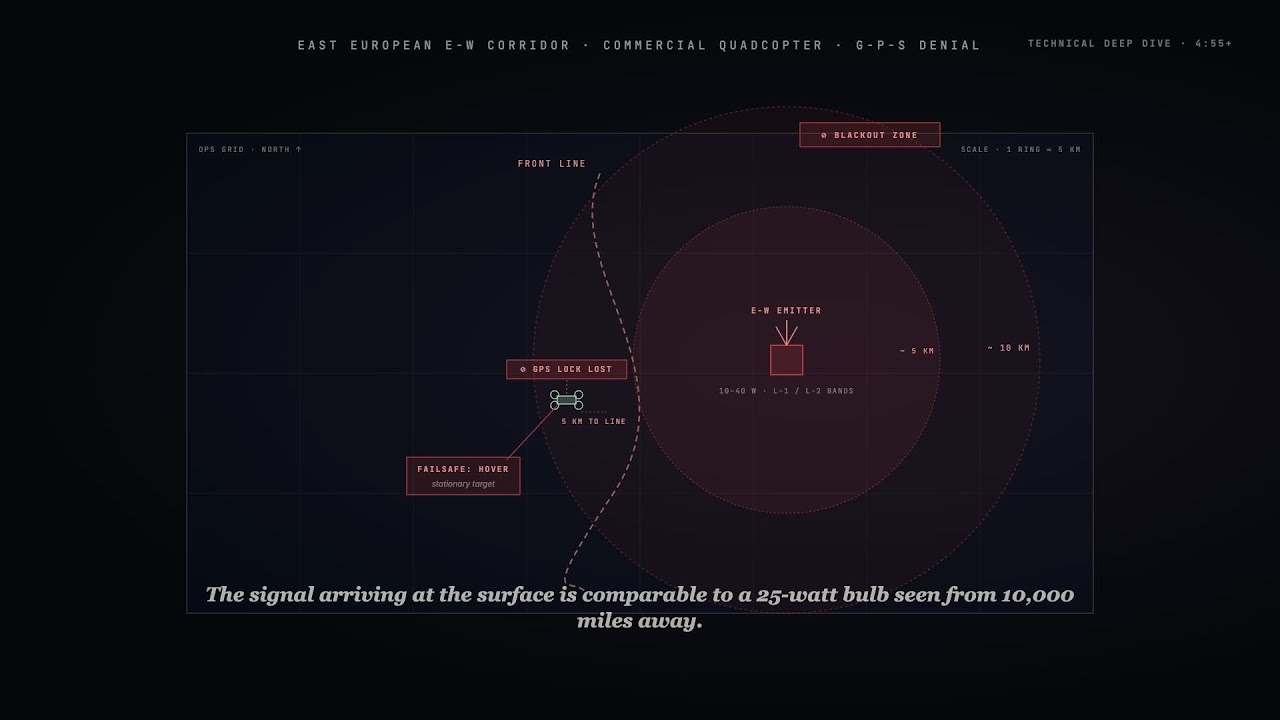
GPS satellites transmit signals from 20,200 km away with power comparable to a 25-watt bulb at 10,000 miles. Ground-based jammers operating at 10-40 watts create blackout zones extending several kilometers.
More insidious than jamming, spoofing transmits counterfeit GNSS signals. Unlike jamming which triggers warnings, spoofing deceives the navigation stack—the drone may believe it's stationary while drifting into hostile territory.
Underground mines, urban canyons, and infrastructure shadows create naturally GPS-denied environments. Multipath effects near metallic structures corrupt timing calculations, causing position errors of several meters.
Adjust jammer power and distance to see effective denial radius
Portable: 10-40W | Vehicle-mounted: 50-100W
Streaming video to the cloud for processing introduces fatal latency and bandwidth dependencies that are untenable in mission-critical scenarios.
For a drone moving at 20 m/s, a 300ms cloud round-trip delay translates to 6 meters of blind travel. During this interval, the drone continues on its previous trajectory—if an obstacle appears, it reacts too late.
A stereo camera at 30 FPS generates hundreds of megabytes per minute. Streaming this raw data requires immense uplink bandwidth and creates a massive electromagnetic signature.
VIO replicates biological navigation by fusing vision (eyes) with inertial sensing (vestibular system). It is un-jammable, self-contained, and mathematically robust.
Estimates pose by tracking distinctive texture "landmarks" (features) across successive camera frames. Provides spatial correction but is slow (30-60Hz) and suffers motion blur.
Uses high-frequency (200Hz-1kHz) accelerometers and gyroscopes. Provides fast prediction but suffers quadratic drift (Error ∝ t²). MEMS IMU can drift meters within seconds uncorrected.
| Feature | Visual Odometry | Inertial Odometry | VIO Fusion |
|---|---|---|---|
| Update Rate | 30-60 Hz (Slow) | 200-1000 Hz (Fast) | High-rate prediction + correction |
| Drift Characteristics | Linear with distance | Quadratic (t²) | 1-2% of distance traveled |
| Motion Blur | Vulnerable | Immune | IMU handles rapid maneuvers |
| Scale Ambiguity | Monocular: No metric scale | Provides scale | IMU resolves scale |
| Jamming Vulnerability | Zero (Passive) | Zero (Passive) | ZERO (Un-jammable) |
Standard VIO treats the world as meaningless points. Veriprajna's Deep AI integrates Semantic SLAM—the drone understands what it sees.
Sees: Points, Lines, Planes
Sees: "Door," "Wall," "Vehicle," "Person," "Infrastructure"
When the drone returns to a previously visited area, it matches the visual fingerprint against its stored map, calculates accumulated drift, and "snaps" the trajectory back into alignment—achieving centimeter-level precision over long durations.
Visual features (ORB, SIFT) clustered into vocabulary tree. Each image becomes a vector of "visual words" for fast similarity matching.
VIO and Semantic SLAM demand server-class AI performance in embedded form factor. Veriprajna leverages NVIDIA Jetson Orin for real-time onboard intelligence.
| Metric | Jetson Orin Nano | Jetson Orin NX (16GB) | Jetson AGX Orin |
|---|---|---|---|
| AI Performance | 40 TOPS | 100 TOPS | 275 TOPS |
| GPU Architecture | Ampere (1024 cores) | Ampere (1024 cores) | Ampere (2048 cores) |
| Memory | 8GB LPDDR5 | 16GB LPDDR5 | 64GB LPDDR5 |
| Power Envelope | 7W - 15W | 10W - 25W | 15W - 60W |
| Veriprajna Target | Entry VIO | Advanced Semantic VIO | Heavy Industrial |
Jetson Orin NX: Optimal SWaP-C balance for tactical micro-drones and industrial inspectors
Stereo/mono cameras at 30-60 FPS generate high-dimensional visual data stream
SuperPoint/ORB feature detection offloaded to VPI (Vision Programming Interface)
Non-linear optimization (Bundle Adjustment) parallelized via CUDA on GPU
TensorRT-optimized YOLOv8/SegNet with Int8 quantization for real-time segmentation
Converting neural network weights from FP32 to Int8 reduces memory bandwidth by 4× and increases throughput. Essential for achieving >30 FPS required for stable control loops.
Ensures flight controller receives odometry at required frequency regardless of scene complexity
VIO-based autonomy is not a technical upgrade—it's an operational imperative unlocking new capabilities and cost savings
In Ukraine and future peer conflicts, GNSS denial is certainty. VIO-equipped drones execute terminal guidance even if C2 link is severed.
Underground mines are naturally GPS-denied. VIO enables post-blast inspection in dark, dust-filled stopes without satellite signals.
Inspecting bridge undersides, tank farms, and pipelines places drones in multipath shadows. VIO maintains station-keeping for high-res imagery.
The difference between a "paperweight" and a weapon system
| Feature | GPS/GNSS | Standard Optical Flow | Veriprajna Semantic VIO |
|---|---|---|---|
| Primary Reference | External Satellites | Downward Camera (Ground Texture) | 360° Visual Features + IMU + Semantic |
| Jamming Susceptibility | HIGH (L1/L2/L5 bands) | Medium (needs GPS for yaw/height) | ZERO (Passive Sensing) |
| Drift Rate | N/A (Absolute Position) | High / Low Accuracy | <1-2% via Loop Closure |
| GPS-Denied Capability | FAILS | Limited | HIGH (Works in complex zones) |
| Dynamic Object Handling | N/A | Fails (drifts if ground moves) | Robust (AI masks dynamics) |
| Compute Requirement | Low (Microcontroller) | Low (ASIC/DSP) | High (NVIDIA Jetson) |
| Operational Status in EW | "PAPERWEIGHT" | Unstable | MISSION CAPABLE |
Calculate operational cost savings and mission success rate improvement
GPS satellites transmit signals from 20,200 km with power comparable to a 25-watt bulb at 10,000 miles. Ground-based jammers operating at just 10-40 watts create blackout zones extending several kilometers, trivially overpowering the weak satellite signals. In the Ukraine conflict, FPV drones routinely lose GNSS within 5-10 km of electronic warfare deployments. More insidiously, GPS spoofing transmits counterfeit signals that deceive the navigation stack without triggering warnings — the drone may believe it is stationary while drifting into hostile territory.
VIO replicates biological navigation by fusing visual odometry (camera-based feature tracking at 30-60 Hz for spatial correction) with inertial measurement (accelerometers and gyroscopes at 200-1000 Hz for fast prediction). The fusion compensates for each sensor's weaknesses: visual odometry corrects IMU drift while the IMU handles motion blur and provides metric scale. Using optimization-based SLAM (ORB-SLAM3 or VINS-Fusion) with loop closure, VIO achieves 1-2% drift rate relative to distance traveled and centimeter-level precision when revisiting locations — all with zero jamming vulnerability since both sensors are passive.
Veriprajna uses NVIDIA Jetson Orin modules, with the Orin NX (100 TOPS, 16GB LPDDR5, 10-25W power) as the optimal balance for tactical micro-drones. TensorRT optimization with Int8 quantization achieves 2-3x inference throughput versus raw PyTorch, enabling real-time semantic segmentation at 30+ FPS. Heterogeneous computing distributes workloads: PVA cores handle optical flow and feature tracking, GPU handles deep learning inference and bundle adjustment optimization, and CPU manages high-level mission planning. This eliminates cloud dependency — at 20 m/s, a 300ms cloud round-trip means 6 meters of blind travel.
Veriprajna engineers the fundamental navigation and perception stacks that enable machines to exist and act in the physical world—without external dependencies.
Master Visual Inertial Odometry, Semantic SLAM, and Edge Compute to build systems that are un-jammable, un-tethered, and truly autonomous.
Comprehensive engineering report: VIO principles, SLAM architectures, Edge AI hardware, optimization strategies, industry applications, comparative analysis, and complete works cited.