The Governance Frontier: Algorithmic Integrity, Enterprise Liability, and the Transition from Predictive Wrappers to Deep AI Solutions
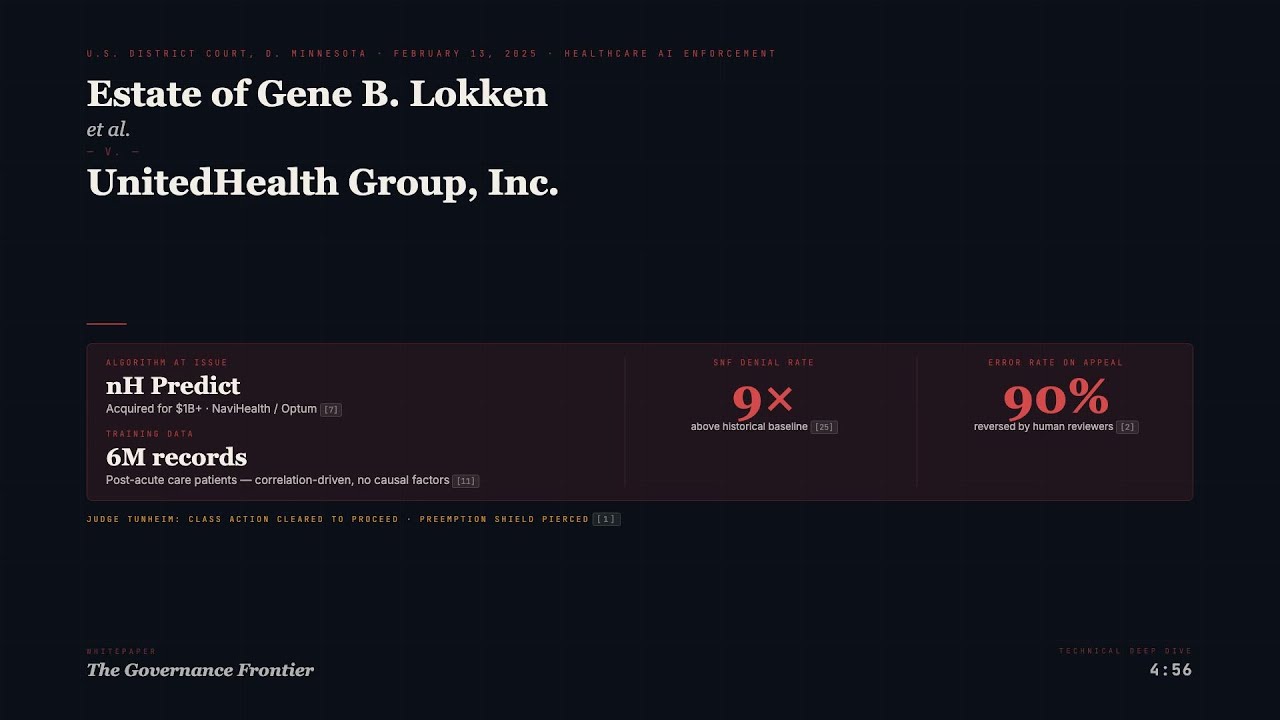
The healthcare industry stands at a volatile crossroads in early 2025, marked by a watershed moment in the intersection of clinical care and artificial intelligence. For years, the narrative of AI in the enterprise has been dominated by the rapid adoption of large language models and thin-layer "wrapper" applications designed to optimize administrative workflows. However, the catastrophic collapse of UnitedHealth Group’s nH Predict algorithm—culminating in a federal class action proceeding in February 2025—has exposed the lethal risks inherent in deploying "black-box" predictive tools without rigorous governance, causal validation, and human-centric oversight.1 This whitepaper, presented by Veriprajna, examines the systemic failures of the UnitedHealth incident to define a new standard for "Deep AI" solutions. As a consultancy positioned at the vanguard of algorithmic integrity, Veriprajna argues that the era of the simplistic LLM wrapper is ending; in its place must emerge a framework of causal intelligence, explainable architecture, and robust corporate governance.4
The Anatomy of a Systemic Failure: The nH Predict Crisis
The crisis surrounding UnitedHealth Group (UHC) and its subsidiary, NaviHealth, serves as the definitive case study for the "Alignment Problem" in enterprise AI. At the center of the controversy is nH Predict, a predictive algorithm acquired by UHC’s Optum division in 2020 for over $1 billion.7 Marketed as a care management tool, the algorithm was designed to predict the length of stay and medical needs for Medicare Advantage patients in post-acute care settings, such as skilled nursing facilities and rehabilitation centers.9
The fundamental failure of nH Predict was not merely technical, but architectural. It relied on a database of 6 million patient records to cross-correlate historical outcomes and generate a "target" discharge date.11 However, the model functioned as a correlation-driven black box, failing to account for the lived realities of individual patients—such as the absence of a caregiver at home, financial instability, or specific clinical complications—factors that are vital for determining medical necessity under Medicare standards.12
The Quantitative Toll of Algorithmic Friction
The operationalization of nH Predict led to a statistically anomalous surge in coverage denials. By utilizing "Machine Assisted Prior Authorization," UHC sought to accelerate the review process, reducing the time required for medical professionals to evaluate requests by six to ten minutes.3 While this increased throughput, it simultaneously decoupled the decision-making process from clinical nuance.3
| Operational Metric | 2019/2020 Baseline | 2022 Reported Level | Statistical Shift |
|---|---|---|---|
| Post-Acute PAC Denial Rate | 8.7% - 10.9% | 22.7% | 108% - 160% Increase |
| Skilled Nursing Facility Denials | Standard baseline | 9x Baseline level | 800% Increase |
| Error Rate on Appealed Denials | N/A | 90% | 9 of 10 reversed |
| Percentage of Patients Who Appeal | N/A | 0.2% | Deeply suppressed |
| UnitedHealth Group Revenue | $240bn (2019) | $300bn (2024) | Projecting $340bn (2025) |
The most damning statistic emerging from the Senate Permanent Subcommittee on Investigations (PSI) and the ongoing litigation is the 90% error rate on appealed denials.2 Nine out of ten times that a human administrative law judge or an internal physician reviewed the algorithm’s denial, the decision was reversed.12 However, UHC’s strategic advantage lay in the fact that only 0.2% of elderly or disabled patients possessed the cognitive, physical, or financial resources to navigate the complex appeals process.3 This created a perverse economic incentive where an inaccurate algorithm remained highly profitable because the "administrative friction" it generated successfully deterred the vast majority of legitimate claims.15
Algorithmic Coercion and the Erosion of Clinical Discretion
A central pillar of the February 2025 class action is the allegation that UnitedHealth did not merely use AI as a "guide," but as a mandatory directive that superseded human judgment.3
This transformation of a decision-support tool into an automated gatekeeper represents a total collapse of the "human-in-the-loop" (HITL) safeguard that is ostensibly required by the Centers for Medicare & Medicaid Services (CMS).7
The Variance Mandate: 3% to 1%
Internal investigations and whistleblower testimonies revealed that NaviHealth managers set rigid targets for clinical employees. Case managers were instructed to keep patients' lengths of stay within a narrow variance of the algorithm’s projection.8 Initially set at 3%, this target was subsequently narrowed to 1%.8 Frontline care coordinators were directed to time their progress reviews to coincide precisely with the algorithm’s predicted discharge date, effectively "engineering" the clinical timeline to fit the model.11
The consequence of this mandate was "Algorithmic Coercion." Employees who deviated from the nH Predict projections to accommodate a patient's actual medical needs faced disciplinary action or termination.8 This environment forced experienced clinicians—doctors and nurses whose primary duty is patient welfare—to act as "rubber stamps" for a flawed mathematical model.7 The result was what experts call the "Slow-Motion HAL" effect, where a system methodically turns off the "life-support" of insurance coverage regardless of the human outcome.17
Real-World Consequences: The Clemens Case
The human cost of this governance failure is illustrated by the experience of patients like Carol Clemens. Following a severe episode of methemoglobinemia—a life-threatening blood disorder—Clemens required intensive skilled nursing care.8 Despite clinical evidence of her ongoing need for rehabilitation, nH Predict’s projections were used to terminate her coverage, forcing her family to pay over $16,768 out-of-pocket to prevent her premature discharge.8 The litigation alleges that UHC "banked" on the impaired conditions and lack of resources of patients like Clemens to prevent them from appealing these meritless determinations.16
The Legal Watershed: February 13, 2025 Ruling
The litigation titled Estate of Gene B. Lokken v. UnitedHealth Group reached a critical milestone on February 13, 2025, when U.S. District Judge John R. Tunheim ruled that the class action could proceed.1 This ruling is a landmark for AI jurisprudence, as it pierces the "preemption shield" that many Medicare Advantage Organizations (MAOs) have historically used to evade state-law claims.1
While the court dismissed claims of negligence and state consumer protection violations—finding them preempted by the federal Medicare Act—it allowed claims for breach of contract and breach of the implied covenant of good faith and fair dealing to proceed.1 The reasoning was profound: UHC's own policy documents promised that coverage decisions would be made by "clinical services staff" and "physicians".7 By substituting these humans with an AI algorithm that effectively dictated the outcome, the company potentially violated its contractual promise to policyholders.7
The Waiver of Exhaustion
In a significant move, the court waived the requirement for plaintiffs to exhaust their administrative remedies before filing suit.1 Typically, Medicare beneficiaries must navigate multiple levels of appeal before seeking judicial review. However, the court found that given the "irreparable injury" patients faced (such as being kicked out of care facilities) and the "futility" of appealing to a system with a 90% error rate, the class could proceed directly to litigation.1 This ruling sets a precedent that if an AI system is fundamentally broken, the legal system will not require victims to "participate in the charade" of a rigged appeal process.7
Deep AI vs. LLM Wrappers: A Strategic Differentiation
The nH Predict crisis highlights the danger of "Thin AI" or "Wrapper AI"—solutions that apply a superficial layer of automation over a core engine without understanding the underlying logic or controlling for bias.4 Veriprajna positions itself as a "Deep AI" provider, specifically to address the vulnerabilities inherent in these commoditized models.5
The Wrapper Economy Trap
As noted by the Google India Accelerator and other industry analysts, "wrapper" companies are increasingly seen as liabilities in regulated industries.5 These companies often "wrap" an existing AI engine (like OpenAI’s GPT or Google’s Gemini) in a custom interface.5
| Risk Category | LLM Wrapper Solutions | Deep AI Solutions (Veriprajna) |
|---|---|---|
| Defensibility | Easily replicated; no proprietary IP.4 | Proprietary models and causal logic.5 |
| Vendor Lock-in | Vulnerable to third-party API changes.4 | Hybrid architecture; independent of single vendors.5 |
| Compliance | Black-box logic; impossible to audit.4 | Explainable AI (XAI) and audit trails.22 |
| Bias Mitigation | Inherits bias from foundational models.4 | Causal inference to neutralize proxy variables.25 |
| Accountability | Liability resides with the deployer.4 | Board-level governance and risk mapping.28 |
Deep AI solutions require moving beyond probabilistic pattern recognition to Causal AI.6 While a predictive model might conclude that "patients with X diagnosis usually stay 14 days," a causal model asks, "what factors cause a patient to need more time, and how does removing coverage cause a relapse?".25 This transition from "what" to "why" is the foundation of trustworthy intelligence.6
The Regulatory Horizon: Compliance in 2025 and 2026
The regulatory environment has shifted aggressively toward algorithmic accountability. Organizations can no longer deploy AI in high-stakes environments without meeting specific, rigorous standards set by the FDA, WHO, and NIST.30
FDA’s 7-Step Credibility Assessment Framework
In January 2025, the FDA issued draft guidance (FDA-2024-D-4689) establishing a mandatory framework for AI models used in medical and regulatory decision-making.33 This framework is essential for any enterprise-grade AI deployment.
1. Define Question of Interest: Clearly articulate the exact decision the AI is intended to address.34
2. Define Context of Use (COU): Specify the model's role, data inputs, and the workflow it inhabits.34
3. Assess Model Risk: Evaluate "Model Influence" (how much authority the AI has) and "Decision Consequence" (the severity of harm if the AI is wrong).34
4. Develop Credibility Plan: Outline validation strategies, metrics, and acceptance criteria.34
5. Execute Plan: Conduct rigorous testing, including stress-testing for edge cases.34
6. Document Results: Create a "Credibility Report" that highlights any deviations from the plan.34
7. Determine Adequacy: Final validation of the model's fitness for its specific clinical purpose.34
The nH Predict system failed at every stage of this framework. It lacked a clear COU, its risk assessment ignored the life-threatening consequences of denied care, and its "validation" was focused on cost-containment rather than clinical accuracy.2
WHO Ethics and the EU AI Act
The World Health Organization (WHO) has specifically targeted "Automation Bias"—the tendency for humans to defer to an algorithm even when it contradicts their own senses.31 The WHO’s 2024 guidance on Large Multimodal Models (LMMs) warns that AI can lead to a "degradation of skills" among physicians who stop exercising critical appraisal.31
Concurrently, the EU AI Act began its phased enforcement in 2025.1 Under this Act, AI systems used in healthcare are classified as "High-Risk," requiring mandatory conformity assessments, transparency disclosures, and human oversight.37 The steep penalties for non-compliance (up to 7% of global turnover) make algorithmic governance a board-level financial imperative.37
Engineering Trust: The Explainable AI (XAI) Mandate
To prevent a repeat of the UnitedHealth collapse, deep AI solutions must be "Explainable by Design".22 Explainable AI (XAI) bridges the gap between complex mathematical weights and human-readable rationale.39
Technical Methods: SHAP and LIME
In clinical decision support, XAI tools like SHAP (SHapley Additive exPlanations) and LIME (Local Interpretable Model-Agnostic Explanations) are critical.41
● SHAP provides a global view of feature importance. In the context of insurance, it can reveal if a denial was primarily driven by "Age" or "Zip Code" (often a proxy for race), allowing auditors to flag discriminatory biases.24
● LIME provides a local explanation for a single decision. For a patient like Carol Clemens, LIME would have highlighted that the AI was ignoring her "Life-threateningly low blood oxygen levels" in favor of her "Average diagnosis-based recovery time".8
By integrating these tools, Veriprajna ensures that clinicians are not "passive recipients" of AI output, but rather partners who can appraise and validate the logic.40
The Implementation of Confidence Scoring
A key feature of Deep AI is Confidence Scoring—a metric that tells the human user how reliable a particular prediction is.23 If a patient presents with a rare condition not well-represented in the training data, the AI must explicitly flag its own uncertainty and route the case for immediate human review (Human-in-the-Loop Routing).23
Algorithmic Governance: A C-Suite and Board Responsibility
The era where AI was a "IT project" is over. By 2025, 72% of S&P 500 companies have disclosed material AI risks in their annual SEC filings.37 Reputational risk is now the top-cited concern, as a single AI failure can viralize and trigger massive litigation.29
The Role of the AI Ethics and Compliance Committee
For organizations to build resilience, they must establish cross-functional AI Governance Committees.28 These committees should include clinical leaders, legal counsel, and patient safety representatives with the authority to:
● Define approval criteria for all AI use cases.47
● Maintain a central AI Registry that catalogs every model in the organization's stack.28
● Enforce Model Change Management with "Kill Switch" or rollback options if performance degrades or "Drift" is detected.30
Operationalizing the NIST AI Risk Management Framework (RMF)
The NIST AI RMF 1.0 (released in 2023 and updated in 2025) provides the blueprint for this governance.32 It is structured around four functions:
1. GOVERN: Build a risk-aware culture where leadership is directly accountable for AI outcomes.28
2. MAP: Catalog where AI interacts with sensitive data (PHI) and identify potential "harm scenarios" like misdiagnosis or biased triage.32
3. MEASURE: Continuously track KPIs like sensitivity, false-negative rates, and "Demographic Fairness".32
4. MANAGE: Implement controls, such as requiring human oversight for high-risk decisions and conducting regular "AI Incident Response Drills".32
Conclusion: The Veriprajna Standard for Deep AI
The collapse of UnitedHealth’s nH Predict algorithm serves as a grim warning: when algorithms are used to optimize for "theoretical efficiency" rather than "real-world clinical outcomes," the human cost is catastrophic and the legal liability is absolute.2 The February 2025 class action represents more than just a lawsuit; it is the first major rejection of the "Black Box" era of healthcare management.
As a deep AI solution provider, Veriprajna rejects the "wrapper" approach. True enterprise AI requires:
● Causal Validation: Understanding why a decision is made, not just the probability of its occurrence.6
● Explainable Architecture: Providing clinicians and auditors with the "homework" behind every output.39
● Ethical Governance: Ensuring that the "human-in-the-loop" is empowered to override the machine, not disciplined for doing so.35
● Regulatory Alignment: Proactively meeting the FDA's 7-step credibility framework and the EU AI Act's transparency mandates.30
The path forward for the enterprise is not found in more automation, but in Better Intelligence. By moving from predictive wrappers to deeply governed, causal systems, organizations can reclaim the promise of AI: to enhance human judgment, protect the vulnerable, and build a healthcare system that is as efficient as it is compassionate..5
Works cited
Lawsuit over AI usage by Medicare Advantage plans allowed to ..., accessed February 6, 2026, https://www.dlapiper.com/insights/publications/ai-outlook/2025/lawsuit-over-ai-usage-by-medicare-advantage-plans-allowed-to-proceed
The Biggest AI Fails of 2025: Lessons from Billions in Losses - NineTwoThree Studio, accessed February 6, 2026, https://www.ninetwothree.co/blog/ai-fails
UnitedHealthcare accused of relying on AI algorithms to deny Medicare Advantage claims, accessed February 6, 2026, https://www.foxbusiness.com/markets/unitedhealthcare-accused-relying-ai-algorithms-deny-medicare-advantage-claims
Risks of AI Wrapper Products and Features - Kader Law, accessed February 6, 2026, https://www.kaderlaw.com/blog/risks-of-ai-wrapper-products-and-features
AI Wrapper Economy Risks Highlighted by Google India Accelerator - AI CERTs News, accessed February 6, 2026, https://www.aicerts.ai/news/ai-wrapper-economy-risks-highlighted-by-google-india-accelerator/
Integrating predictive modeling and causal inference for advancing medical science, accessed February 6, 2026, https://www.chikd.org/journal/view.php?id=10.3339/ckd.24.018
Lawsuit alleging UnitedHealthcare used faulty AI to deny coverage advances in federal court - Insurance News | InsuranceNewsNet, accessed February 6, 2026, https://insurancenewsnet.com/oarticle/lawsuit-alleging-unitedhealthcare-used-faulty-ai-to-deny-coverage-advances-in-federal-court
Minnesota judge: lawsuit over UnitedHealth use of AI can continue - The C.O.R.E. Group, accessed February 6, 2026, https://coregroupusa.com/minnesota-judge-lawsuit-over-unitedhealth-use-of-ai-can-continue/
nH Predict - Wikipedia, accessed February 6, 2026, https://en.wikipedia.org/wiki/NH_Predict
UnitedHealth faces lawsuit over AI, Medicare Advantage care denials, accessed February 6, 2026, https://www.beckerspayer.com/payer/unitedhealth-faces-lawsuit-over-medicare-advantage-care-denials/
STAT “Denied by AI” series a model of solid investigative journalism ..., accessed February 6, 2026, https://healthjournalism.org/blog/2024/10/stats-denied-by-ai-series-a-model-of-solid-investigative-journalism/
When Faulty AI Falls Into the Wrong Hands: The Risks of Erroneous ..., accessed February 6, 2026, https://ijoc.org/index.php/ijoc/article/download/23994/4992/90761
AI-driven insurance decisions raise concerns about human oversight | Stanford Report, accessed February 6, 2026, https://news.stanford.edu/stories/2026/01/ai-algorithms-health-insurance-care-risks-research
Senate report slams Medicare Advantage insurers for using predictive technology to deny claims | Healthcare Dive, accessed February 6, 2026, https://www.healthcaredive.com/news/medicare-advantage-AI-denials-cvs-humana-unitedhealthcare-senate-report/730383/
New AI tool counters health insurance denials decided by automated algorithms | US healthcare | The Guardian, accessed February 6, 2026, https://www.theguardian.com/us-news/2025/jan/25/health-insurers-ai
Lawsuit accuses UnitedHealth Group of using faulty AI to deny Medicare patient claims, accessed February 6, 2026, https://www.startribune.com/lawsuit-accuses-unitedhealth-group-of-using-faulty-ai-to-deny-medicare-patient-claims/600319883
UnitedHealthcare's AI Use to Deny Claims is Center of Industrywide Debate - HFS Research, accessed February 6, 2026, https://www.hfsresearch.com/news/unitedhealthcares-ai-use-to-deny-claims-is-center-of-industrywide-debate/
UnitedHealth Lawsuit: Can AI Deny Healthcare Services? - Haven Health Management, accessed February 6, 2026, https://havenhealthmgmt.org/unitedhealth-lawsuit-can-ai-deny-healthcare-services/
Estate of Gene B. Lokken et al. v. UnitedHealth Group, Inc. et al., accessed February 6, 2026, https://litigationtracker.law.georgetown.edu/litigation/estate-of-gene-b-lokken-the-et-al-v-unitedhealth-group-inc-et-al/
Judge Decides Class Action Can Proceed Against UnitedHealth for Use of AI, accessed February 6, 2026, https://www.legalhie.com/judge-decides-class-action-lawsuit-can-proceed-against-unitedhealth-for-use-of-ai/
Reviewing the 5 Major AI Risks (Part II of II) | The Volkov Law Group - JDSupra, accessed February 6, 2026, https://www.jdsupra.com/legalnews/reviewing-the-5-major-ai-risks-part-ii-8779464/
Explainable AI For Insurance - Meegle, accessed February 6, 2026, https://www.meegle.com/en_us/topics/explainable-ai/explainable-ai-for-insurance
Explainable AI (XAI) in Insurance: Benefits and Use Cases - A3Logics, accessed February 6, 2026, https://www.a3logics.com/blog/explainable-ai-in-insurance/
How AI Bias Is Impacting Healthcare - InformationWeek, accessed February 6, 2026, https://www.informationweek.com/machine-learning-ai/how-ai-bias-is-impacting-healthcare
Correlation vs. Causation: How Causal AI is Helping Determine Key Connections in Healthcare and Clinical Trials - DIA Global Forum, accessed February 6, 2026, https://globalforum.diaglobal.org/issue/october-2024/correlation-vs-causation-how-causal-ai-is-helping-determine-key-connections-in-healthcare-and-clinical-trials/
Who Benefits Most from Causal AI in Healthcare? - BeeKeeperAI, accessed February 6, 2026, https://www.beekeeperai.com/blog/107341-who-benefits-most-from-causal-ai-in-healthcare
AI governance and risk management for regulated industries - Torry Harris, accessed February 6, 2026, https://www.torryharris.com/insights/articles/ai-governance-risk-management-regulated-industries
AI governance: A guide to responsible AI for boards - Diligent, accessed February 6, 2026, https://www.diligent.com/resources/blog/ai-governance
Governing the Ungovernable: Corporate Boards Face AI Accountability Reckoning, accessed February 6, 2026, https://www.jdsupra.com/legalnews/governing-the-ungovernable-corporate-1075132/
FDA Guidance on AI-Enabled Devices: Transparency, Bias, & Lifecycle Oversight, accessed February 6, 2026, https://www.centerwatch.com/insights/fda-guidance-on-ai-enabled-devices-transparency-bias-lifecycle-oversight/
WHO Releases AI Ethics and Governance Guidance for Large Multimodal Models | Insight, accessed February 6, 2026, https://www.bakermckenzie.com/en/insight/publications/2024/01/who-releases-ai-ethics-and-governance-guidance
Understanding the NIST AI Risk Management Framework - databrackets, accessed February 6, 2026, https://databrackets.com/blog/understanding-the-nist-ai-risk-management-framework/
Artificial Intelligence for Drug Development | FDA, accessed February 6, 2026, https://www.fda.gov/about-fda/center-drug-evaluation-and-research-cder/artificial-intelligence-drug-development
FDA's AI Guidance: 7-Step Credibility Framework Explained | IntuitionLabs, accessed February 6, 2026, https://intuitionlabs.ai/articles/fda-ai-drug-development-guidance
The Ultimate AI Compliance Checklist for 2025 - NeuralTrust, accessed February 6, 2026, https://neuraltrust.ai/blog/ai-compliance-checklist-2025
Ethics and governance of artificial intelligence for health. Guidance on large multi-modal models, accessed February 6, 2026, https://iris.who.int/server/api/core/bitstreams/e9e62c65-6045-481e-bd04-20e206bc5039/content
AI Risk Disclosures in the S&P 500: Reputation, Cybersecurity, and Regulation, accessed February 6, 2026, https://corpgov.law.harvard.edu/2025/10/15/ai-risk-disclosures-in-the-sp-500-reputation-cybersecurity-and-regulation/
NIST AI Risk Management Framework: A simple guide to smarter AI governance - Diligent, accessed February 6, 2026, https://www.diligent.com/resources/blog/nist-ai-risk-management-framework
The Role of Explainable AI (XAI) in Building Trust in Healthcare - Nitor Infotech, accessed February 6, 2026, https://www.nitorinfotech.com/blog/the-role-of-explainable-ai-xai-in-building-trust-in-healthcare/
From Insights to Impact: Exploring Explainable AI's Contribution to Healthcare Decision-Making, accessed February 6, 2026, https://dr.lib.iastate.edu/bitstreams/f7b0f5bf-56a6-484e-9c51-9d8adc2a8884/download
Interpretable AI for bio-medical applications - PMC, accessed February 6, 2026, https://pmc.ncbi.nlm.nih.gov/articles/PMC10074303/
Fostering trust and interpretability: integrating explainable AI (XAI) with machine learning for enhanced disease prediction and decision transparency - PMC - NIH, accessed February 6, 2026, https://pmc.ncbi.nlm.nih.gov/articles/PMC12465982/
A Comparative Analysis of LIME and SHAP Interpreters With Explainable ML-Based Diabetes Predictions - Diva-portal.org, accessed February 6, 2026, https://www.diva-portal.org/smash/get/diva2:1886442/FULLTEXT02.pdf
Explainable artificial intelligence - Wikipedia, accessed February 6, 2026, https://en.wikipedia.org/wiki/Explainable_artificial_intelligence
Responsible AI in Health Care: What Providers and AI Vendors Must ..., accessed February 6, 2026, https://www.bakerdonelson.com/responsible-ai-in-health-care-what-providers-and-ai-vendors-must-do-now
"From Disclosure to Defense: A Strategic AI Governance Blueprint" - Shumaker, Loop & Kendrick, LLP, accessed February 6, 2026, https://www.shumaker.com/insight/from-disclosure-to-defense-a-strategic-ai-governance-blueprint/
NIST Cybersecurity Framework for AI Risk in Healthcare | Censinet, Inc., accessed February 6, 2026, https://censinet.com/perspectives/nist-cybersecurity-framework-ai-risk-healthcare
Prefer a visual, interactive experience?
Explore the key findings, stats, and architecture of this paper in an interactive format with navigable sections and data visualizations.
Frequently Asked Questions
What was the nH Predict algorithm and why did it fail?
nH Predict was a predictive algorithm acquired by UnitedHealth's Optum division for over $1 billion, using 6 million patient records to predict discharge dates. It functioned as a correlation-driven black box that failed to account for individual patient factors like caregiver absence or clinical complications. Post-acute denial rates surged 108-160%, and 90% of appealed denials were reversed.
How does causal AI differ from predictive AI in healthcare decision-making?
While predictive AI concludes that patients with X diagnosis usually stay 14 days based on correlation, causal AI asks what factors cause a patient to need more time and how removing coverage causes relapse. This transition from what to why enables models grounded in explainable reasoning rather than black-box pattern matching that ignores individual clinical realities.
What is the FDA 7-step credibility assessment framework for AI?
The FDA framework (FDA-2024-D-4689) requires: defining the question of interest, specifying context of use, assessing model risk through influence and consequence evaluation, developing a credibility plan with validation metrics, executing rigorous testing, documenting results in a credibility report, and determining model adequacy for its specific clinical purpose.
Also Published On
Build Your AI with Confidence.
Partner with a team that has deep experience in building the next generation of enterprise AI. Let us help you design, build, and deploy an AI strategy you can trust.
Veriprajna Deep Tech Consultancy specializes in building safety-critical AI systems for healthcare, finance, and regulatory domains. Our architectures are validated against established protocols with comprehensive compliance documentation.