Algorithmic Integrity, Enterprise Liability, and the Transition from Predictive Wrappers to Deep AI
The catastrophic collapse of UnitedHealth Group's nH Predict algorithm—culminating in a federal class action in February 2025—exposed the lethal risks of deploying black-box predictive tools without rigorous governance, causal validation, and human-centric oversight.
Veriprajna argues that the era of the simplistic LLM wrapper is ending. In its place must emerge a framework of causal intelligence, explainable architecture, and robust corporate governance.
Healthcare stands at a volatile crossroads. The rapid adoption of LLM wrappers has prioritized throughput over patient safety. The legal, regulatory, and human costs are now undeniable.
AI-driven coverage decisions are now under federal litigation. The UHC precedent means every MAO using predictive algorithms faces class-action exposure unless governance is demonstrably robust.
72% of S&P 500 companies now disclose material AI risks in SEC filings. AI governance is no longer an IT project—it is a board-level fiduciary obligation with real financial consequences.
Algorithmic coercion has stripped clinical discretion from experienced physicians. Clinicians are forced to "rubber stamp" flawed models or face termination. Patients face life-threatening coverage gaps.
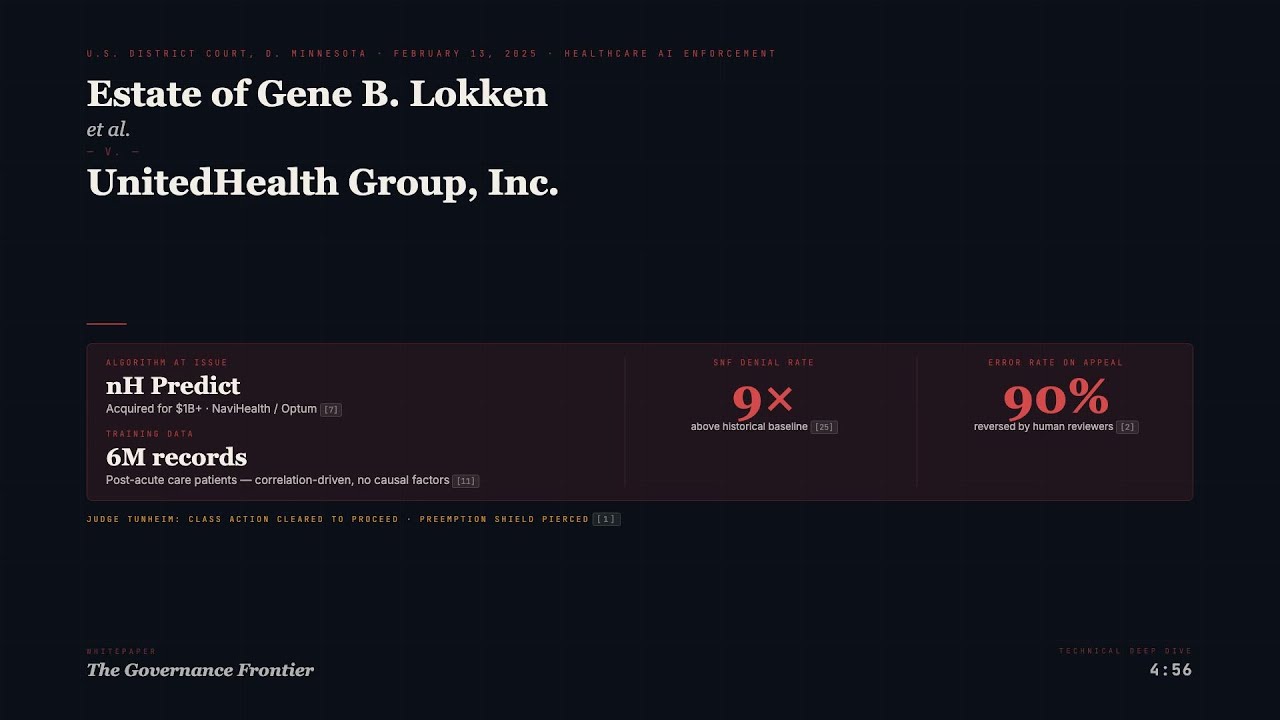
The nH Predict algorithm, acquired by UHC's Optum division for over $1 billion, was designed to predict length of stay for Medicare Advantage patients. What it became was an automated gatekeeper that prioritized cost containment over clinical accuracy.
nH Predict relied on 6 million patient records to generate "target" discharge dates via correlation-driven modeling. It failed to account for individual patient realities—caregiver availability, financial instability, or specific clinical complications.
"Machine Assisted Prior Authorization" reduced review time by 6–10 minutes per case. Throughput increased, but decisions were decoupled from clinical nuance—creating an economic engine that profited from inaccurate denials.
NaviHealth managers set rigid variance targets: case managers had to keep patients' stay within 3% of the algorithm's projection—later narrowed to just 1%. Deviation meant disciplinary action or termination.
"Employees who deviated from the nH Predict projections to accommodate a patient's actual medical needs faced disciplinary action or termination. This environment forced experienced clinicians to act as rubber stamps for a flawed mathematical model—the Slow-Motion HAL effect, where a system methodically turns off life-support coverage regardless of the human outcome."
The operationalization of nH Predict led to statistically anomalous surges in coverage denials across every measurable metric.
Post-Acute Care denial rates before and after nH Predict deployment
Why a 90% error rate remains profitable
Only 0.2% have cognitive, physical, or financial resources
90% error rate—but only on the tiny fraction who fight
NET RESULT: ~998 of 1,000 erroneous denials go unchallenged. The algorithm's inaccuracy is shielded by the administrative burden imposed on the most vulnerable patients.
| Operational Metric | 2019/2020 Baseline | 2022 Reported Level | Statistical Shift |
|---|---|---|---|
| Post-Acute PAC Denial Rate | 8.7% – 10.9% | 22.7% | 108% – 160% Increase |
| Skilled Nursing Facility Denials | Standard baseline | 9x Baseline | 800% Increase |
| Error Rate on Appealed Denials | N/A | 90% | 9 of 10 reversed |
| Patients Who Appeal | N/A | 0.2% | Deeply suppressed |
Real-world consequence of algorithmic governance failure
Following a severe episode of methemoglobinemia—a life-threatening blood disorder—Clemens required intensive skilled nursing care. Despite clinical evidence of ongoing need for rehabilitation, nH Predict's projections were used to terminate her coverage.
Her family was forced to pay $16,768 out-of-pocket to prevent premature discharge. The litigation alleges that UHC "banked" on the impaired conditions and lack of resources of patients like Clemens to prevent them from appealing meritless determinations.
This is the "Alignment Problem" made manifest: an algorithm optimized for cost containment operating without causal understanding of human medical needs.
Estate of Gene B. Lokken v. UnitedHealth Group—U.S. District Judge John R. Tunheim ruled that the class action could proceed, piercing the "preemption shield" that Medicare Advantage Organizations have historically used.
The court waived the requirement for plaintiffs to exhaust administrative remedies before filing suit. The reasoning:
"This ruling sets a precedent: if an AI system is fundamentally broken, the legal system will not require victims to participate in the charade of a rigged appeal process."
The nH Predict crisis highlights the danger of "Thin AI"—solutions that apply superficial automation without understanding underlying logic. Explore the strategic differentiation.
Deep AI solutions move beyond probabilistic pattern recognition to Causal AI. While a predictive model concludes "patients with X diagnosis usually stay 14 days," a causal model asks: "what factors cause a patient to need more time, and how does removing coverage cause a relapse?" This transition from "what" to "why" is the foundation of trustworthy intelligence.
In January 2025, the FDA issued mandatory guidance for AI models used in medical and regulatory decision-making. Click each step to see requirements and how nH Predict failed.
The WHO specifically warns against "Automation Bias"—the tendency for humans to defer to an algorithm even when it contradicts their own clinical judgment. Their 2024 guidance warns AI can lead to a "degradation of skills" among physicians.
Healthcare AI is classified as "High-Risk" under the EU AI Act, requiring mandatory conformity assessments, transparency disclosures, and human oversight. Non-compliance penalties reach up to 7% of global turnover.
Deep AI solutions must be "Explainable by Design"—bridging the gap between complex mathematical weights and human-readable rationale.
SHapley Additive exPlanations
Provides a global view of feature importance. In insurance contexts, SHAP can reveal if a denial was primarily driven by "Age" or "Zip Code" (often a proxy for race), allowing auditors to flag discriminatory biases before they cause harm.
Audit flag: Zip Code influence exceeds clinical factors
Local Interpretable Model-Agnostic Explanations
Provides a local explanation for a single decision. For a patient like Carol Clemens, LIME would have highlighted that the AI was ignoring her life-threateningly low blood oxygen levels in favor of average diagnosis-based recovery time.
Patient #4892 — Coverage Denied
LIME exposes: decision driven by statistical average, not clinical reality
The era where AI was an "IT project" is over. The NIST AI Risk Management Framework provides the blueprint for board-level algorithmic accountability.
Build a risk-aware culture where leadership is directly accountable for AI outcomes.
Click to expand
Catalog where AI interacts with sensitive data and identify potential harm scenarios.
Click to expand
Continuously track KPIs: sensitivity, false-negative rates, and demographic fairness.
Click to expand
Implement controls including human oversight and "Kill Switch" rollback capabilities.
Click to expand
Evaluate your organization's algorithmic governance posture
The collapse of nH Predict is a grim warning: when algorithms optimize for theoretical efficiency rather than real-world clinical outcomes, the human cost is catastrophic and the legal liability is absolute. Veriprajna rejects the wrapper approach. True enterprise AI requires:
Understanding why a decision is made, not just the probability of its occurrence. Moving from correlation to causation.
Providing clinicians and auditors with the "homework" behind every output. SHAP, LIME, and confidence scoring built in.
Ensuring that the human-in-the-loop is empowered to override the machine—not disciplined for doing so.
Proactively meeting the FDA's 7-step credibility framework, the EU AI Act's transparency mandates, and NIST AI RMF standards.
"The path forward for the enterprise is not found in more automation, but in Better Intelligence. By moving from predictive wrappers to deeply governed, causal systems, organizations can reclaim the promise of AI: to enhance human judgment, protect the vulnerable, and build a healthcare system that is as efficient as it is compassionate."
The nH Predict algorithm, acquired by UHC's Optum for over $1 billion, used 6 million patient records to generate target discharge dates via correlation-driven modeling. It failed to account for individual patient realities like caregiver availability or clinical complications. 90% of denials were overturned on appeal, but only 0.2% of patients appealed due to administrative friction. Case managers faced disciplinary action for deviating more than 1% from algorithm projections, creating 'algorithmic coercion.'
While a predictive model concludes 'patients with X diagnosis usually stay 14 days,' a causal model asks 'what factors cause a patient to need more time, and how does removing coverage cause a relapse?' This transition from 'what' to 'why' provides trustworthy intelligence. Deep AI solutions integrate causal validation, explainable architecture via SHAP/LIME, ethical governance with empowered human-in-the-loop oversight, and regulatory alignment with FDA and NIST frameworks.
Issued in January 2025 under FDA-2024-D-4689, the mandatory guidance requires AI models used in medical decision-making to meet seven credibility steps covering model context, verification, validation, applicability analysis, uncertainty quantification, assessment planning, and ongoing monitoring. The nH Predict system failed across multiple steps, most critically in validation and applicability analysis.
Veriprajna's Deep AI advisory doesn't just improve your models—it fundamentally restructures your algorithmic governance to withstand regulatory scrutiny and protect your patients.
Schedule a consultation to audit your AI stack, assess governance maturity, and build a compliant, explainable architecture.
Complete analysis: UHC nH Predict crisis, FDA credibility framework, EU AI Act requirements, NIST RMF implementation, XAI technical specifications, and governance blueprints.