The Invisible Guardian: Transcending Wearables with Passive Wi-Fi Sensing and Deep AI
Executive Summary
The global healthcare landscape is currently navigating a profound demographic shift, characterized by a rapidly aging population and a simultaneous contraction in the available caregiver workforce. This divergence has catalyzed a desperate search for technological force multipliers—solutions that can extend the reach of clinicians and guardians into the home. For the past decade, the industry's primary answer has been "Active Monitoring": the deployment of wearable devices, panic buttons, and smartwatches designed to track vital signs and detect emergencies. However, a rigorous analysis of longitudinal data reveals a critical flaw in this approach: it relies on the compliance of the very population least able to provide it. The most effective health monitor is not the one with the most advanced sensors or the longest battery life; it is the one that requires no interaction whatsoever.
This whitepaper, authored by the specialized AI consultancy Veriprajna, serves as a definitive architectural blueprint for the next generation of Ambient Assisted Living (AAL). We argue that the industry must pivot from device-centric active monitoring to Passive Wi-Fi Sensing, a paradigm that repurposes the omnipresent radio frequency (RF) signals in our environments into a sophisticated, invisible sensing fabric. By analyzing Channel State Information (CSI)—the complex physical layer data inherent in modern Wi-Fi—we can detect falls, monitor respiration, and analyze sleep patterns with clinical-grade accuracy, all without a single wearable device.
However, the transition to Wi-Fi sensing is not merely a hardware upgrade; it is a signal processing challenge of the highest order. It requires moving beyond simplistic statistical methods and embracing Deep AI . This report details why generic Large Language Model (LLM) wrappers are insufficient for this task and why Veriprajna advocates for bespoke deep learning architectures—specifically Convolutional Neural Networks (CNNs), Long Short-Term Memory (LSTM) networks, and Transformers—to decode the subtle language of radio waves. We present a comprehensive analysis of the physics of CSI, the failure modes of active wearables, the deep neural network architectures required for signal interpretation, and the regulatory pathways for deploying invisible biometrics in an enterprise context.
Part I: The Compliance Crisis in Wearable Health
Technology
1.1 The Fallacy of Active Cooperation
The prevailing model of Remote Patient Monitoring (RPM) and "Aging in Place" technology is fundamentally predicated on the concept of active cooperation. This model assumes that the user—often an elderly individual potentially suffering from cognitive decline, arthritis, or sensory impairment—will act as a responsible system administrator for their own health technology. They are expected to remember to wear a device every morning, ensure it is charged daily, and engage with its interface during emergencies. While this model functions reasonably well for the "young-old" (ages 65-75) who are digitally literate and active, it fails catastrophically for the "old-old" (85+) population where the risks of falls and medical emergencies are highest.
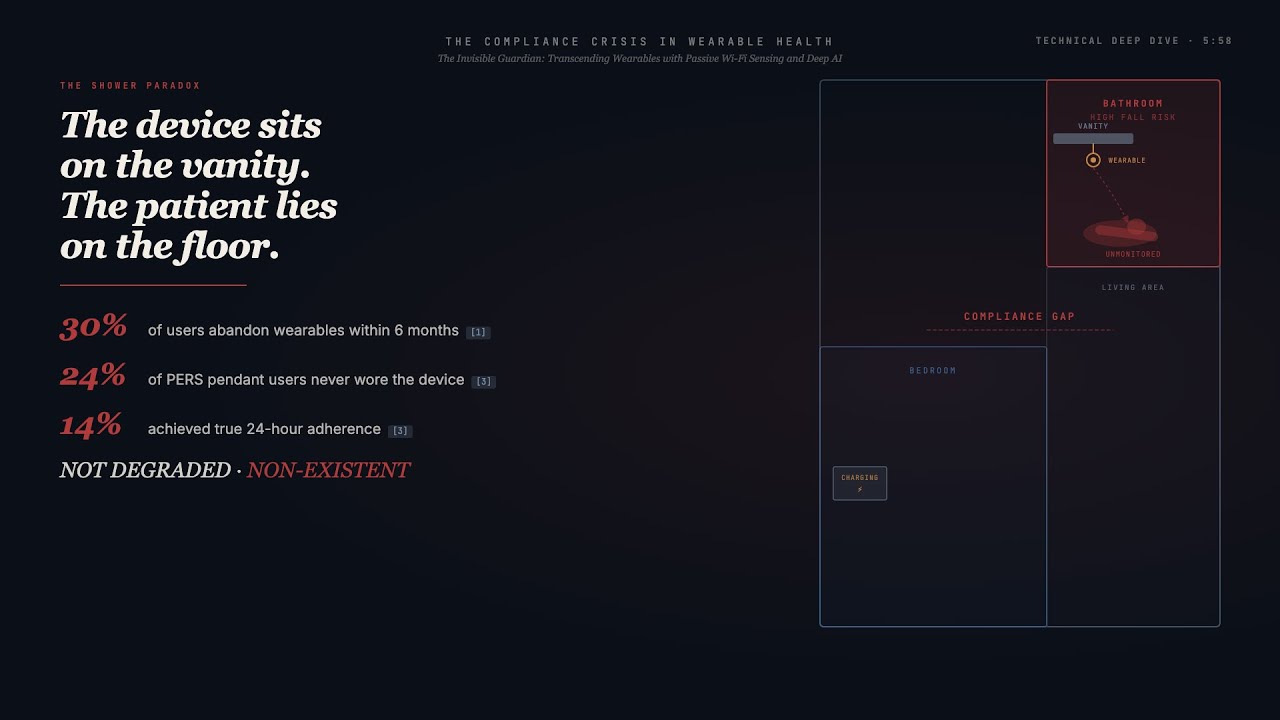
Research into the adoption lifecycles of wearable health monitors reveals a stark and troubling reality: the devices are frequently abandoned by those who need them most. Studies analyzing user behavior indicate that approximately 30% of users discontinue the use of their trackers within six months of acquisition. 1 This attrition rate is not merely a reflection of consumer dissatisfaction; it represents a gaping hole in the safety net. When a device sits in a drawer, the monitoring system is not just degraded—it is non-existent. The reliance on the user to be an active participant in their own surveillance creates a "compliance gap," a perilous chasm between the theoretical safety provided by the technology and the practical reality of its non-use in daily life.
1.1.1 The "Shower Paradox" and the Vulnerability of Hygiene
The functional limitations of wearables are most acutely felt during Activities of Daily Living (ADLs) that involve water or undressing. The bathroom is statistically the most hazardous room in the home for the elderly, with slippery surfaces and hard fixtures creating a high probability of injurious falls. Yet, this is precisely the environment where wearables are most often absent. We term this the "Shower Paradox."
Despite the IP67 or IP68 water-resistance ratings of modern devices, many older adults habitually remove their watches or pendants before bathing. This behavior stems from a lifetime of experience with non-waterproof electronics, a fear of damaging an expensive device, or simple physical discomfort caused by wet straps against fragile skin. 2 Consequently, the user is unmonitored during the exact temporal window where a fall is most likely to occur. If a fall happens in the shower while the device is on the bathroom vanity, the system has failed completely. The "active" nature of the device—requiring the user to decide to keep it on—becomes the single point of failure.
1.1.2 Charging Fatigue and Cognitive Friction
Beyond the bathroom, the requirement for regular charging constitutes a significant barrier to continuous protection. For an 80-year-old individual, the fine motor skills required to connect a proprietary magnetic charger or plug in a micro-USB cable can be demanding. This "charging fatigue" leads to periods where the device is left on a nightstand to charge and is then forgotten in the morning.
Data from Personal Emergency Response Systems (PERS) users paints a concerning picture of adherence. One study found that 24% of users never wore their pendant at all, and only 14% achieved true 24-hour adherence. 3 The cognitive load of managing the device's battery life competes with other daily stressors, and in populations with Mild Cognitive Impairment (MCI) or early-stage dementia, the device is simply forgotten. The result is a "monitored" patient who is, in reality, completely unprotected for large swathes of the day.
1.2 Psychological Barriers: The Stigma of Frailty
Technology adoption is not purely a functional calculus; it is deeply emotional. Many wearable devices, particularly the ubiquitous "SOS" pendants, are designed with a distinctly medical aesthetic. They signal to the world—and to the user themselves—that they are frail, vulnerable, and in need of help. This stigmatization is a potent driver of rejection.
Qualitative meta-syntheses of user experiences reveal that older adults often view these devices as "branding" them as old. 4 The desire to maintain a facade of independence and vitality leads many seniors to hide the devices under clothing (reducing their effectiveness) or refuse to wear them in public or social settings. The device becomes a symbol of lost autonomy rather than a tool for preserving it.
Furthermore, the "fear of false alarms" creates a perverse incentive structure. Users are often terrified of accidentally triggering a siren or summoning emergency services for a non-event, which can be embarrassing and costly. This anxiety leads some users to leave the device behind to avoid the risk of a false positive, or worse, to hesitate in pressing the button during a genuine emergency, wondering if their situation is "serious enough" to warrant the disturbance. This psychological friction renders the active trigger mechanism unreliable.
1.3 The Economic Implications of Device Management
For enterprise stakeholders—insurance providers, Accountable Care Organizations (ACOs), and assisted living facility operators—the reliance on wearables represents a significant economic inefficiency. The deployment of a fleet of wearables involves substantial Capital Expenditure (CapEx) in hardware that is prone to loss, breakage, and obsolescence.
The Operational Expenditure (OpEx) is equally punishing. Managing a fleet of thousands of devices involves logistical challenges: replacing batteries, handling returns of broken units, and providing technical support to non-technical users who may struggle to pair the device with a smartphone or Wi-Fi network. The "churn" of lost devices erodes the Return on Investment (ROI) of the monitoring program. More critically, the "false security" provided by a wearable that is not being worn creates massive liability. If a facility claims to provide 24/7 monitoring but a resident falls while their device is charging, the facility may face legal and reputational repercussions for the failure of the safety net. The industry requires a structural shift from "device-centric" monitoring to "space-centric" monitoring—a solution that is embedded in the infrastructure of the building itself, requires zero effort from the resident, and is impossible to lose or forget.
Part II: The Physics of Invisible Sensing
2.1 From RSSI to Channel State Information (CSI)
To appreciate the Veriprajna approach, it is essential to distinguish between the primitive forms of Wi-Fi sensing that have existed for years and the deep signal analysis we advocate. Early attempts at leveraging Wi-Fi for presence detection relied on Received Signal Strength Indication (RSSI). RSSI is a coarse metric available in almost all wireless stacks; it represents the total power of the received signal, typically averaged over the entire packet and frequency bandwidth.
While RSSI decreases when an object blocks the path between transmitter and receiver (shadowing), it is a fundamentally unstable and low-resolution metric. It is highly susceptible to multipath fading—where signals bounce off walls and interfere constructively or destructively—and environmental noise. A change in humidity, the movement of a pet, or even the operation of a microwave oven can cause RSSI fluctuations that mimic human presence. Crucially, RSSI lacks the sensitivity to detect fine-grained movements; it can tell you if a person is in the room, but it cannot tell you if they are breathing. 5
True Ambient Intelligence requires access to the physical layer (PHY) of the wireless transmission, specifically Channel State Information (CSI) . Modern Wi-Fi standards (802.11n, 802.11ac, 802.11ax, and the upcoming 802.11be) utilize Orthogonal Frequency-Division Multiplexing (OFDM). In OFDM, the wireless channel (e.g., a 20 MHz or 40 MHz channel) is divided into dozens or hundreds of subcarriers. CSI describes the propagation of the signal from the transmitter to the receiver for each individual subcarrier .
Mathematically, if is the transmitted signal vector and is the received signal vector, the relationship is modeled as:
Where is the noise vector and is the Channel State Information matrix. Unlike RSSI, which is a scalar value, is a complex matrix containing two distinct components for every subcarrier:
1. Amplitude (): The attenuation of the signal strength at that specific frequency.
2. Phase (): The delay or phase shift of the signal at that specific frequency.
This matrix provides a high-resolution "image" of the wireless environment. Because different subcarriers have different wavelengths, they interact with objects in the room differently. CSI captures the scattering, reflection, and diffraction caused by the human body with granular detail that RSSI simply cannot see. 6
2.2 The Fresnel Zone Model and Micro-Motion Detection
The theoretical framework that allows us to extract human motion from this electromagnetic data is the Fresnel Zone Model . Fresnel zones are a series of concentric prolate ellipsoids with the transmitter (Tx) and receiver (Rx) acting as the foci.
When a radio wave travels from Tx to Rx, it does not follow a single straight line. It propagates through the volume of space defined by these Fresnel zones. If a dynamic object (a human) exists within these zones, it reflects a portion of the signal. The received signal at the Rx is a superposition of the direct Line-of-Sight (LoS) path and the dynamic path reflected off the human body.
The path length of the reflected signal changes as the person moves. This change in path length, , introduces a phase shift in the dynamic component of the CSI. The relationship is governed by the wavelength () of the signal:
For a standard 5 GHz Wi-Fi signal, the wavelength is approximately 6 centimeters. This means that a movement of just 3 centimeters (half a wavelength) is sufficient to shift the signal from constructive interference (peak) to destructive interference (null). This extreme sensitivity is the key to breathing detection . During respiration, the human chest wall displaces by approximately 4 to 12 millimeters. While this movement is invisible to the naked eye from a distance, in the realm of 5 GHz or 6 GHz Wi-Fi, it represents a significant fraction of a wavelength. As the chest expands and contracts, it traverses the Fresnel zones, causing a rhythmic, periodic oscillation in the phase and amplitude of the CSI data. By analyzing these subtle ripples in the CSI stream, Veriprajna’s algorithms can reconstruct the breathing waveform with accuracy comparable to medical-grade respiratory belts. 8
2.3 Doppler Signatures and Kinematic Analysis
For macro-movements like walking or falling, we look beyond simple phase shifts to Doppler Frequency Shifts. The Doppler effect states that a wave reflected off a moving object will undergo a frequency change proportional to the velocity of the object.
Where is the velocity of the body part and is the angle of movement relative to the wave propagation direction. Different human activities generate unique "Doppler Signatures."
● Walking: The swinging of arms and legs creates a complex pattern of positive and negative Doppler shifts, as limbs move towards and away from the receiver.
● Falling: A fall is characterized by a specific kinematic sequence: a loss of balance (pre-fall), a rapid, accelerating descent due to gravity (the fall), and a sudden impact followed by immobility.
By applying Short-Time Fourier Transforms (STFT) or Discrete Wavelet Transforms (DWT) to the CSI time-series data, we can generate a Spectrogram —a visual representation of velocity over time. A fall appears as a distinct high-energy surge in the spectrogram, accelerating downwards, followed by an abrupt cessation of energy (the "Long Lie"). This allows the system to distinguish a dangerous fall from a controlled action like sitting down or lying on a bed. 10
2.4 Through-Wall Sensing and NLOS Capabilities
One of the most profound advantages of Wi-Fi sensing over optical (camera-based) or infrared (LIDAR) systems is its ability to operate in Non-Line-of-Sight (NLOS) conditions. Wi-Fi signals at 2.4 GHz and 5 GHz have excellent penetration properties for standard building materials like drywall, wood, and glass.
In a typical home environment, the Wi-Fi signal bounces off walls, floors, ceilings, and furniture, creating a "multipath" environment. Even if the Access Point is in the hallway and the user is in the bedroom behind a closed door, the signal penetrates the room, reflects off the user, and penetrates back to the receiver. The user does not need to be "seen" by the router in a visual sense. The distortion they create in the electromagnetic field propagates through the obstacles. This physics-based ubiquity ensures that "blind spots"—which plague camera systems (e.g., behind a shower curtain or a partition)—are virtually eliminated. A single Wi-Fi sensing link can effectively monitor an entire room or even adjacent rooms, providing a level of coverage that would require a constellation of cameras to replicate. 12
Part III: From Signal to Insight – The Deep AI Architecture
3.1 Beyond "LLM Wrappers": The Necessity of Signal Processing AI
In the contemporary technology market, the term "AI" has become nearly synonymous with Large Language Models (LLMs) like GPT. While LLMs are transformative for text and code, they are fundamentally ill-suited for the task of interpreting raw radio frequency data. CSI data is continuous, complex-valued, high-dimensional, and governed by the laws of physics, not the rules of grammar.
Veriprajna distinguishes itself as a Deep AI solution provider. We do not simply wrap an API around a pre-trained text model. We engineer bespoke deep neural networks designed specifically for temporal signal processing. An LLM cannot "read" a 5 GHz waveform; it requires architectures that understand time, frequency, and spatial correlation. Our approach utilizes a sophisticated stack of Convolutional Neural Networks (CNNs), Recurrent Neural Networks (RNNs), and Transformers to extract clinical insights from RF noise.
3.2 The Preprocessing Pipeline: Cleaning the Ether
Raw CSI data extracted from commodity Wi-Fi chipsets is inherently noisy. It is corrupted by hardware imperfections such as Carrier Frequency Offset (CFO), Sampling Frequency Offset (SFO), and random packet loss. Feeding this raw data directly into a neural network would lead to poor performance. Therefore, Veriprajna employs a rigorous, physics-informed preprocessing pipeline:
1. Phase Sanitization: The raw phase data from a Wi-Fi chip is "wrapped" within the range of . We employ linear transformation algorithms to "unwrap" the phase, reconstructing the continuous phase change caused by motion. Furthermore, we apply linear fitting to remove the phase slope introduced by unsynchronized clocks between the transmitter and receiver. 11
2. Outlier Removal: We utilize Hampel Filters and median filtering to remove impulsive noise caused by sudden electrical interference or hardware glitches.
3. Dimensionality Reduction: A typical CSI stream might contain data from 3 antennas 56 subcarriers = 168 data streams. Not all of these carry useful information; some may be in a "deep fade" (destructive interference) and contain mostly noise. We employ Principal Component Analysis (PCA) to extract the principal components that account for the maximum variance in the signal. The first principal component typically corresponds to the dominant motion in the room (e.g., breathing), while the subsequent components capture noise. 5
3.3 Deep Learning Models for CSI Analysis
Once the data is sanitized, it is fed into Veriprajna’s proprietary deep learning models. We advocate for a hybrid architecture that leverages the strengths of different neural network types.
3.3.1 Convolutional Neural Networks (CNNs) for Spatial Features
We treat the CSI data matrix (Subcarriers Time) as a pseudo-image. Just as a CNN can identify the edges of a cat in a photograph, it can identify the "edges" of a motion event in the RF spectrum. A 2D-CNN or 1D-CNN slides a kernel across the subcarrier dimension. This allows the model to learn spatial correlations—for instance, realizing that a fall event causes a simultaneous amplitude drop across a specific cluster of subcarriers. This spatial feature extraction is crucial for distinguishing human motion from background noise like a spinning fan, which has a different spectral signature. 15
3.3.2 Long Short-Term Memory (LSTM) for Temporal Context
Human activities are inherently temporal sequences. A "fall" is not a single point in time; it is a sequence of events: standing losing balance descending impact lying still. A CNN alone might classify the "impact" frame as a fall, but it might also classify jumping on a bed as a fall.
To solve this, we feed the output of the CNN into a Long Short-Term Memory (LSTM) network. LSTM is a type of Recurrent Neural Network (RNN) designed to remember long-term dependencies. It maintains a "memory cell" that carries context from previous time steps. This allows the model to understand the sequence : "The user was walking (velocity X), then accelerated downwards (velocity Y), and is now stationary (velocity 0) on the floor." This temporal context is what allows the system to differentiate a fall from a controlled action like sitting down. 15
3.3.3 Dual-Branch Transformers and Attention Mechanisms
The frontier of our research lies in Transformer architectures. Unlike RNNs which process data sequentially, Transformers process the entire sequence at once using "Self-Attention" mechanisms. This allows the model to weigh the importance of different parts of the signal.
Veriprajna proposes a Dual-Branch Architecture :
● Branch A (Amplitude): Processes the magnitude changes to detect gross motor movements (walking, falling).
● Branch B (Phase): Processes phase shifts to detect micro-movements (breathing, heart rate variability).
These two branches are fused via an Attention Layer . The attention mechanism dynamically prioritizes the most relevant stream based on the context. For example, if the user is sleeping, the model learns to pay more attention to the Phase branch (where the breathing signal is strongest) and ignore the Amplitude branch. Conversely, if the user is walking, the Amplitude branch is given higher weight. This multi-modal fusion significantly enhances the robustness of the system. 17
3.4 Solving the Environment Dependency: Domain Adaptation
A historical criticism of Wi-Fi sensing research has been its lack of generalizability. A model trained on data collected in "Lab A" often fails when deployed in "Apartment B" because the multipath environment (room size, furniture layout) is different. The model overfits to the specific reflections of the training room.
Veriprajna addresses this with Domain Adversarial Neural Networks (DANNs) . This technique involves training the network with two competing goals:
1. Activity Classifier: Minimize the error in predicting the activity (e.g., "Fall" vs. "Walk").
2. Domain Discriminator: Maximize the error in predicting the environment (e.g., "Lab" vs. "Home").
By forcing the Feature Extractor to confuse the Domain Discriminator, the network is compelled to learn features that are invariant to the environment—the "platonic ideal" of a fall signature that looks the same regardless of whether it happens in a studio apartment or a nursing home hallway. This enables a "train once, deploy everywhere" model essential for enterprise scalability. 19
Part IV: Clinical Applications and Use Cases
4.1 Respiratory Monitoring: The Vital Sign of the Future
Respiratory Rate (RR) is often called the "forgotten vital sign," yet it is a leading indicator for clinical deterioration in conditions such as Chronic Obstructive Pulmonary Disease (COPD), Congestive Heart Failure (CHF), and pneumonia. Traditional monitoring requires wearing a chest strap or a cannula, which is uncomfortable for long-term use.
Using the phase-difference analysis described in Section 2.2, Wi-Fi sensing provides continuous, non-contact respiratory monitoring.
● Accuracy: Experimental evaluations using Beamforming Feedback Matrices (BFMs) have demonstrated respiratory rate estimation errors lower than 3.2 breaths/minute. 5 More advanced deep learning models achieve correlation coefficients exceeding 0.92 with reference respiratory belts. 21
● Sleep Apnea Detection: The system is particularly revolutionary for detecting Obstructive Sleep Apnea (OSA). By monitoring the cessation of breathing motion during sleep, the system can flag potential apnea events (AHI index) without the need for a cumbersome Polysomnography (PSG) study in a sleep lab. This allows for longitudinal screening of the elderly population, identifying undiagnosed sleep disorders that contribute to cardiovascular risk. 22
4.2 Fall Detection: The "Long Lie" and Context Awareness
Falls are the leading cause of fatal injury among older adults. However, the immediate impact is often less dangerous than the "Long Lie" —remaining on the floor for hours unable to get up, which leads to rhabdomyolysis, dehydration, and pressure ulcers.
Veriprajna’s Wi-Fi sensing solution offers a comprehensive fall management system:
1. Pre-Fall Gait Analysis: By continuously monitoring walking speed and stride consistency (gait velocity) over weeks, the system can detect the subtle deterioration in mobility that often precedes a fall. A gradual slowing of walking speed is a clinically validated predictor of fall risk, allowing for preventative intervention (e.g., physical therapy) before an accident occurs. 2
2. Real-Time Detection: Using the Doppler signatures described earlier, the system detects the fall event with high sensitivity (>97%). 23
3. Post-Fall Context: Crucially, the system continues to monitor the subject after the fall. If the CSI indicates a lack of gross motor movement but the presence of micro-motion (breathing) at floor level, the system confirms a "fall with inability to recover" and escalates the alert. This context-awareness significantly reduces false alarms compared to wearable accelerometers, which might register dropping the device on the floor as a fall. 24
4.3 Sleep Quality and Hygiene Analysis
Sleep quality is a massive determinant of health in the elderly. Current consumer sleep trackers (smartwatches) estimate sleep stages based on wrist movement (actigraphy) and optical heart rate. Wi-Fi sensing offers "Whole Body Actigraphy."
By analyzing the intensity and periodicity of body movements in bed, the system can classify sleep stages:
● Wakefulness: High amplitude, irregular movements.
● Light Sleep: Reduced movement, regular breathing.
● Deep/REM Sleep: Atonic (paralyzed) body state with highly rhythmic breathing signatures.
The system generates "Sleep Hygiene" reports detailing Sleep Onset Latency (time to fall asleep), Wake After Sleep Onset (WASO), and Total Sleep Duration. Crucially, it can also track Bed Exits, alerting caregivers if a dementia patient wanders out of bed at night and fails to return within a safe window. 3
Part V: The Privacy Paradox – Sensing Without Surveillance
5.1 The "Camera vs. Sensor" Debate
Visual privacy is a paramount concern for the elderly. While cameras are effective for monitoring, they are widely rejected in private spaces like bedrooms and bathrooms. The feeling of being "watched," the risk of capturing nudity, and the potential for video feeds to be hacked create immense resistance to camera-based AAL solutions.
Wi-Fi sensing resolves this privacy paradox. It is visually blind . The data collected—CSI matrices—consists of complex numbers representing signal propagation. It is impossible for a human to look at a CSI packet and "see" a person's face or body. Even if a malicious actor intercepted the raw data stream, they would not retrieve an image or a video, but a stream of unintelligible signal distortions. This makes Wi-Fi sensing uniquely suitable for bathroom monitoring—the most dangerous room in the house where cameras are strictly prohibited. 3
5.2 GDPR and HIPAA Compliance
For enterprise clients, regulatory compliance is non-negotiable. Wi-Fi sensing data, specifically CSI, is classified as Biometric Data under the General Data Protection Regulation (GDPR) (Article 9) because it can potentially be used to identify individuals based on their gait or body shape (biometric identification). 28 Similarly, under the Health Insurance Portability and Accountability Act (HIPAA), health data derived from the home is Protected Health Information (PHI).
Veriprajna’s architecture ensures compliance through a strict Edge Processing strategy:
1. Data Minimization: Raw CSI data is processed locally on the Wi-Fi Access Point or a local edge gateway (using the NPU). The raw, high-bandwidth biometric signal is never transmitted to the cloud. It is discarded immediately after inference.
2. Abstracted Insights: Only the inference event is transmitted. The cloud receives a JSON packet: {"event": "Fall", "location": "Bathroom", "timestamp": "14:02:01", "confidence": 0.98}. This text string contains no biometric data and cannot be reverse-engineered to identify the user's physiology.
3. Anonymization: In standard configurations, the system tracks "presence" and "motion" without linking it to a specific identity. It detects that a person fell, not who fell, unless specifically configured for multi-person tracking with user consent.
4. Security: All data transmission is encrypted via TLS 1.3/WPA3, and the local edge devices are secured with 802.1X authentication to prevent unauthorized access. 30
5.3 The Guest Problem and Social Acceptability
A major friction point for cameras is the monitoring of visitors. When family members or caregivers visit, they are also recorded, raising consent issues. Wi-Fi sensing is inherently less intrusive. While it detects the presence of other people, it does not record their faces or conversations. This "soft surveillance" is far more socially acceptable in semi-private spaces like assisted living common areas or shared apartments, reducing the legal complexity of obtaining consent from every visitor. 33
Part VI: Infrastructure and The Hardware Ecosystem
6.1 The Commoditization of Sensing Hardware
A strategic advantage of Wi-Fi sensing is that it utilizes existing infrastructure. It does not require drilling holes to install proprietary sensors on every wall. The transition of Wi-Fi from a pure communication standard to a sensing standard is being formalized in IEEE 802.11bf (WLAN Sensing), expected to be fully ratified in late 2024/2025. This standard will ensure that future Wi-Fi chipsets natively support CSI extraction and sensing requests, turning every router into a standardized radar. 35
6.2 Key Silicon Enablers
Veriprajna’s software stack is hardware-agnostic but optimized for the leading chipsets that provide access to CSI data:
● Qualcomm: Qualcomm's "Networking Pro Series" and "FastConnect" platforms (Wi-Fi 7) are critical enablers. Crucially, Qualcomm integrates the Hexagon NPU (Neural Processing Unit) into their SoCs. This allows Veriprajna to run the deep learning models (Transformers/CNNs) directly on the router or gateway with high power efficiency, enabling the edge processing strategy described above. The Qualcomm AI Stack and AI Hub provide the toolchains to convert PyTorch models into quantized binaries that run on the Hexagon DSP, ensuring real-time performance without cloud latency. 36
● Broadcom: With their newly announced Wi-Fi 8 ecosystem and Wi-Fi 7 chips (BCM6726, BCM4390), Broadcom has introduced the "BroadStream" wireless telemetry engine. This hardware block is designed specifically to offload the collection and processing of sensing data, providing the high-frequency, low-latency CSI streams required for AI training and inference. 40
● Espressif (ESP32): For low-cost, distributed sensing nodes (e.g., creating a dense mesh in a large facility), the ESP32 microcontroller is a game-changer. The ESP-CSI Toolkit allows developers to extract CSI data from these inexpensive ($5) chips. While less powerful than a router, an ESP32 can act as a dedicated sensing receiver, feeding data to a central gateway. This enables cost-effective scaling of the sensing fabric. 43
6.3 The Commercial Software Landscape
Veriprajna acts as the specialized integrator and AI developer on top of foundational sensing platforms:
● Cognitive Systems (Aura WiFi Motion): Provides a mature, widely deployed API for motion overlay. Their stack handles the lower-level CSI extraction and basic motion classification, allowing Veriprajna to focus on the higher-level medical interpretation. 26
● Origin Wireless (AI Sensing): Pioneers in "Time Reversal Machine" technology for multipath analysis. Their "TruPresence" and fall detection engines are industry benchmarks for accuracy. Origin's software runs entirely on the edge, aligning perfectly with our privacy-first architecture. 35
Part VII: Strategic Implementation for Enterprise
7.1 The "Zero-Hardware" Retrofit
For nursing homes, assisted living facilities, and hospital-at-home providers, the primary value proposition of Wi-Fi sensing is the "Zero-Hardware Retrofit." These facilities already possess enterprise-grade Wi-Fi networks for connectivity. By deploying Veriprajna’s software stack (or updating firmware to a sensing-enabled version), the facility transforms its existing communication network into a safety network.
● CapEx Savings: Eliminates the need to purchase thousands of wearables or install cameras in every room.
● Maintenance: No batteries to change in pendants. No lost devices to replace.
● Scalability: A software update can enable fall detection in 100 rooms instantly.
7.2 Deployment Methodology
Implementing Wi-Fi sensing requires a structured approach to ensure coverage and accuracy:
1. Site Survey: Assess the Wi-Fi density. Sensing requires a certain density of signals. A single router may cover a small apartment, but a mesh network (pods in different rooms) is ideal for "Whole Home" coverage to ensure there are enough sensing links crossing the bathroom and bedroom. 49
2. Hardware Audit: Verify if existing Access Points utilize compatible chipsets (Qualcomm/Broadcom) that support CSI extraction.
3. Edge Gateway Setup: Determine if the APs have sufficient compute (NPU/CPU) for on-device inference. If not, a local edge server (e.g., a small industrial PC running the AI models) can aggregate data from lightweight APs.
4. Calibration: Run the DANN (Domain Adversarial) models for a brief "burn-in" period (e.g., 24 hours) to adapt to the specific furniture layout and structural materials of the building, establishing a baseline for the static environment.
7.3 ROI and Value Realization
● Reduced Hospital Readmissions: By detecting gait changes early, preventative physical therapy can be administered, preventing the fall that leads to a hip fracture and costly hospitalization.
● Staff Efficiency: "Night rounds" can be data-driven. Instead of waking up every resident to check on them (disrupting sleep), staff can monitor the central dashboard for sleep disturbances or bed exits, attending only to those in need.
● Insurance Premiums: Facilities equipped with continuous, non-invasive monitoring may qualify for reduced liability insurance premiums due to the lower risk of undiscovered accidents and the ability to provide data-driven evidence of care.
Conclusion: The Inevitability of Ambient Intelligence
The era of "gadgets" in elderly care is drawing to a close. The friction of compliance, the indignity of wearable stigma, and the functional limitations of battery-powered devices render them a transitional technology. The future of health monitoring is not about strapping sensors onto people; it is about building sensors around them.
Passive Wi-Fi Sensing represents the convergence of advanced physics, ubiquitous infrastructure, and Deep AI. It respects the sanctity of the home by remaining invisible, yet it provides clinical-grade vigilance. It solves the "Shower Paradox," eliminates charging fatigue, and preserves the privacy of the user. For Veriprajna, this is not just a technical evolution; it is a moral imperative to provide dignity and safety to the aging population through intelligence that is felt, but not seen.
The air around us is filled with information. It is time we listened to it.
Table 1: Comparative Analysis of Monitoring Technologies
| Feature | Wearables (Active Monitoring) |
Cameras (Visual Monitoring) |
Passive Wi-Fi Sensing (Veriprajna) |
|---|---|---|---|
| User Compliance | High Friction: Requires wearing, charging, and manual alerts. |
Zero Efort: Passive. |
Zero Efort: Passive. |
| Privacy Impact | Low: Data only (acceleration/HR). |
Severe: Visual recording of intimate spaces. |
Low: Abstract CSI signals; no visual identifers. |
| Bathroom Safety | Critical Failure: Ofen removed for showering/bathing. |
Unacceptable: Privacy concerns prohibit use. |
Excellent: Works in NLOS; penetrates steam/curtains. |
| Maintenance | High: Batery | Medium: Lens | Low: Sofware |
| Col1 | replacement, lost device management. |
cleaning, power supply. |
updates; leverages existing Wi-Fi. |
|---|---|---|---|
| Blind Spots | None (if worn). | High: Blocked by furniture, walls, darkness. |
Minimal: Signals penetrate walls and furniture. |
| Data Richness | Acceleration, Heart Rate. |
Gait, Pose, Context. | Respiration, Gait, Sleep Stages, Falls. |
| Suitability for Dementia |
Poor: Users forget to wear or actively remove devices. |
Medium. | High: Cannot be removed or forgoten. |
Table 2: Regulatory & Technical Framework
| Requirement | Standard / Regulation | Implication for Wi-Fi Sensing |
|---|---|---|
| Data Privacy | GDPR (Article 9) | CSI is biometric data. Requires explicit consent and rigorous data protection (Edge AI). |
| Health Data | HIPAA | In-home health monitoring creates PHI. Data must be encrypted in transit and at rest. |
| Hardware Std | IEEE 802.11bf | Future "WLAN Sensing" standard will standardize CSI extraction across vendors. |
| AI Processing | Edge AI (NPU) | Processing must happen on-device (Qualcomm Hexagon/Broadcom) to |
Table 3: Veriprajna Deep AI Stack vs. Generic Approaches
| Layer | Generic / Competitor Approach |
Veriprajna Deep AI Approach |
|---|---|---|
| Input Data | RSSI (Signal Strength) or Raw CSI |
Sanitized CSI (Phase Unwrapping, PCA Denoising, Hampel Filtering) |
| Feature Extraction | Statistical Features (Mean, Variance) |
CNNs (Convolutional Neural Networks) for Spatial/Spectral Features |
| Temporal Logic | Threshold-based (If signal drops > X) |
LSTM / GRU (Recurrent Neural Networks) for Sequence Context |
| Fusion | Single Stream | Dual-Branch Transformer (Amplitude + Phase) with Atention Mechanism |
| Generalization | Site-Specifc Calibration required |
Domain Adversarial Neural Networks (DANN) for Environment Independence |
Citations: 1
Works cited
Beyond Technical Motives: Perceived User Behavior in Abandoning Wearable Health & Wellness Trackers - arXiv, accessed December 12, 2025, https://arxiv.org/pdf/1904.07986
Fall Detection Using Wi-Fi Sensing, accessed December 12, 2025, https://www.wifisensing.io/use-cases/fall-detection
WiFi Sensing for Senior Independence - Aerial's AI, accessed December 12, 2025, https://aerial.ai/resources-blog/wifi-sensing-for-senior-independence
Beyond the Box: Unpacking the Usage Patterns of Health Monitoring Devices Among American Retirees - Skywork.ai, accessed December 12, 2025, https://skywork.ai/skypage/en/Beyond-the-Box-Unpacking-the-Usage-Paterns-otf-Health-Monitoring-Devices-Among-American-Retirees/1951152759911845888
Respiratory Rate Estimation Based on WiFi Frame Capture - arXiv, accessed December 12, 2025, https://arxiv.org/pdf/2108.03170
Channel state information - Wikipedia, accessed December 12, 2025, https://en.wikipedia.org/wiki/Channel_state_information
Understanding CSI | Hands-on Wireless Sensing with Wi-Fi: A Tutorial, accessed December 12, 2025, https://tns.thss.tsinghua.edu.cn/wst/docs/pre/
Device-Free WiFi Human Sensing: From Pattern-Based to Model-Based Approaches, accessed December 12, 2025, https://ceca.pku.edu.cn/media/lw/de4947b5f57dd4fd5e3ac649f34ed557.pdf
Human Respiration Detection with Commodity WiFi Devices: Do User Location and Body Orientation Matter?, accessed December 12, 2025, http://www-public.tem-tsp.eu/~zhang_da/pub/Daqing%202016%20UbiComp%20respiration.pdf
CSI-F: A Human Motion Recognition Method Based on Channel-State-Information Signal Feature Fusion - MDPI, accessed December 12, 2025, https://www.mdpi.com/1424-8220/24/3/862
Full Respiration Rate Monitoring Exploiting Doppler Information with Commodity Wi-Fi Devices - ResearchGate, accessed December 12, 2025, https://www.researchgate.net/publication/351682808_Full_Respiration_Rate_Monitoring_Exploiting_Doppler_Information_with_Commodity_Wi-Fi_Devices
How Wi-Fi Sensing Helps Monitor Loved Ones at Home - Electronic Caregiver, accessed December 12, 2025, https://electroniccaregiver.com/how-wi-fi-sensing-helps-monitor-loved-ones-at-home/
Collaborative Fall Detection and Response using Wi-Fi Sensing and Mobile Companion Robot - arXiv, accessed December 12, 2025, https://arxiv.org/html/2407.12537v1
WiFi Amplitude and Phase-based Respiratory Rate Monitoring - ieeevtc.org, accessed December 12, 2025, http://ieeevtc.org/vtc2024spring/DATA/PID2024002410.pdf
Deep-Learning-Based Wi-Fi Indoor Positioning System Using Continuous CSI of Trajectories - PubMed Central, accessed December 12, 2025, https://pmc.ncbi.nlm.nih.gov/articles/PMC8434353/
Enhanced Wi-Fi Sensing: Leveraging Phase and Amplitude of CSI for Superior Accuracy, accessed December 12, 2025, https://www.preprints.org/manuscript/202412.2585
Enhanced Human Activity Recognition Using Wi-Fi Sensing ..., accessed December 12, 2025, https://pmc.ncbi.nlm.nih.gov/articles/PMC11859840/
Transformer-Based Person Identification via Wi-Fi CSI Amplitude and Phase Perturbations, accessed December 12, 2025, https://arxiv.org/html/2507.12854v1
A Survey on Wi-Fi Sensing Generalizability: Taxonomy, Techniques, Datasets, and Future Research Prospects - arXiv, accessed December 12, 2025, https://arxiv.org/html/2503.08008v2
Channel State Information (CSI) based sensing method work flow. ResearchGate, accessed December 12, 2025, https://www.researchgate.net/figure/Channel-State-Information-CSI-based-sensing-method-work-flow_fig3_334626596
Noncontact Breathing Pattern Monitoring Using a 120 GHz Dual Radar System with Motion Interference Suppression - MDPI, accessed December 12, 2025, https://www.mdpi.com/2079-6374/15/8/486
Doppler radar remote sensing of respiratory function - PMC - NIH, accessed December 12, 2025, https://pmc.ncbi.nlm.nih.gov/articles/PMC10172641/
Wearable Fall Detection System with Real-Time Localization and Notification Capabilities, accessed December 12, 2025, https://www.mdpi.com/1424-8220/25/12/3632
[Literature Review] Real-Time Fall Detection Using Smartphone Accelerometers and WiFi Channel State Information, accessed December 12, 2025, https://www.themoonlight.io/en/review/real-time-fall-detection-using-smartphone-accelerometers-and-wifi-channel-state-information
WiFi-based indoor passive fall detection for medical Internet of Things ResearchGate, accessed December 12, 2025, https://www.researchgate.net/publication/372813063_WiFi-based_indoor_passive_fall_detection_for_medical_Internet_of_Things
WiFi Motion - Cognitive Systems, accessed December 12, 2025, https://www.cognitivesystems.com/wifi-motion/
WiFi Can See You Now: Carnegie Mellon's “DensePose from WiFi” and the Privacy Paradox, accessed December 12, 2025, https://medium.com/@ajayverma23/wifi-can-see-you-now-carnegie-mellons-densepose-from-wifi-and-the-privacy-paradox-b0c61a850849
Biometric Data GDPR: Compliance Tips for Businesses, accessed December 12, 2025, https://www.gdprregister.eu/gdpr/biometric-data-gdpr/
Biometric recognition | ICO, accessed December 12, 2025, https://ico.org.uk/for-organisations/uk-gdpr-guidance-and-resources/lawful-basis/biometric-data-guidance-biometric-recognition/biometric-recognition/
Making Wi-Fi HIPAA compliant, accessed December 12, 2025, https://hipaatimes.com/making-wi-fi-hipaa-compliant
HIPAA-Compliant Wi-Fi with 802.1X and RADIUS Security - SecureW2, accessed December 12, 2025, https://www.securew2.com/blog/hipaa-compliant-wireless-802-1x
HIPAA Compliance for Guest WiFi: Essential Guidelines - Beambox, accessed December 12, 2025, https://beambox.com/townsquare/how-to-provide-hipaa-compliant-guest-wifi
Occupancy Sensors vs Wi-Fi and Badge Data: Accuracy, Privacy - Occuspace, accessed December 12, 2025, https://www.occuspace.com/blog/occupancy-sensors-vs-wi-fi-and-badge-data-accuracy-privacy
Surveillance Risks in Wi-Fi Sensing, accessed December 12, 2025, https://www.wifisensing.io/risks/surveillance
WiFi Sensing - Origin Wireless, accessed December 12, 2025, https://www.originwirelessai.com/wifi-sensing/
Qualcomm Wi-Fi Products and Chipsets, accessed December 12, 2025, https://www.qualcomm.com/wi-fi
How to build model assets for Snapdragon NPU devices - ONNX Runtime, accessed December 12, 2025, https://onnxruntime.ai/docs/genai/howto/build-models-for-snapdragon.html
NPU AI Engine - Qualcomm, accessed December 12, 2025, https://www.qualcomm.com/processors/ai-engine
Unlocking on-device generative AI with an NPU and heterogeneous computing | Qualcomm, accessed December 12, 2025, https://www.qualcomm.com/content/dam/qcomm-martech/dm-assets/documents/Unlocking-on-device-generative-AI-with-an-NPU-and-heterogeneous-computing.pdf
Broadcom Introduces Industry's First Wi-Fi 8 Silicon Ecosystem Powering the AI Era, accessed December 12, 2025, https://investors.broadcom.com/news-releases/news-release-details/broadcom-introduces-industrys-first-wi-fi-8-silicon-ecosystem
Word on the Street: Media roundup for Wi-Fi 7 - Broadcom Inc., accessed December 12, 2025, https://www.broadcom.com/blog/media-roundup-for-wi-fi-7
Accessing the IoT ecosystem - Broadcom Inc., accessed December 12, 2025, https://www.broadcom.com/blog/accessing-the-iot-ecosystem
ESP32 CSI Toolkit, accessed December 12, 2025, https://stevenmhernandez.github.io/ESP32-CSI-Tool/
Introduction to ESP-CSI Solution - - — ESP-Techpedia latest documentation, accessed December 12, 2025, https://docs.espressif.com/projects/esp-techpedia/en/latest/esp-friends/solution-introduction/esp-csi/esp-csi-solution.html
esp_csi_rs - Rust - Docs.rs, accessed December 12, 2025, https://docs.rs/esp-csi-rs
Cognitive | Creators of WiFi Motion™, accessed December 12, 2025, https://www.cognitivesystems.com/
WiFi Sensing | Origin Wireless, accessed December 12, 2025, https://www.originwirelessai.com/trupresence-2/
Origin Wireless - ICON Outlook, accessed December 12, 2025, https://iconoutlook.com/origin-wireless/
Qualcomm® Wi-Fi Ranging: Delivering ranging and location technologies of tomorrow today., accessed December 12, 2025, https://www.qualcomm.com/content/dam/qcomm-martech/dm-assets/documents/qualcomm-wi-fi-ranging-white-paper.pdf
The Use of Wearable Activity Trackers Among Older Adults: Focus Group Study of Tracker Perceptions, Motivators, and Barriers in the Maintenance Stage of Behavior Change - PMC - NIH, accessed December 12, 2025, https://pmc.ncbi.nlm.nih.gov/articles/PMC6473213/
Wi-Fi 8 | Edge AI | Broadband - Broadcom Inc., accessed December 12, 2025, https://www.broadcom.com/solutions/wireless-mobile-communications/wifi8
Wi-Fi 7 Chips & Tech | Next-Generation WiFi - Qualcomm, accessed December 12, 2025, https://www.qualcomm.com/wi-fi/wi-fi-7
Monitoring Respiratory Motion With Wi-Fi CSI: Characterizing Performance and the BreatheSmart Algorithm - PMC - PubMed Central, accessed December 12, 2025, https://pmc.ncbi.nlm.nih.gov/articles/PMC9830631/
Prefer a visual, interactive experience?
Explore the key findings, stats, and architecture of this paper in an interactive format with navigable sections and data visualizations.
Frequently Asked Questions
What is the Shower Paradox in wearable health monitoring?
The Shower Paradox describes the critical failure where wearable health monitors are removed during the most dangerous activities. The bathroom is the highest-risk room for elderly falls, yet users habitually remove watches and pendants before bathing — due to lifetime habits with non-waterproof electronics, fear of damaging devices, or skin discomfort from wet straps. With only 14% of PERS users achieving 24-hour adherence and 24% never wearing their pendant at all, wearable-dependent systems fail precisely when protection is most needed.
How does Wi-Fi Channel State Information detect falls and respiration?
Wi-Fi CSI captures the amplitude and phase of wireless signals across multiple subcarriers (30-256 per antenna pair in 802.11n/ac). Human motion disturbs the RF environment through the Fresnel zone effect, creating measurable diffraction patterns. Breathing causes sub-centimeter chest displacement detectable through phase shifts at specific subcarrier frequencies. Falls produce distinctive multi-phase Doppler signatures (pre-fall acceleration, impact spike, post-fall stillness) that deep neural networks classify with clinical-grade accuracy.
Why are LLM wrappers insufficient for Wi-Fi sensing AI?
Wi-Fi CSI data is a complex multi-dimensional tensor of amplitude and phase values across subcarriers, antenna pairs, and time. Processing this data requires specialized signal processing AI — CNNs for spatial feature extraction across subcarrier dimensions, LSTMs for temporal sequence modeling of motion patterns, and Transformers for long-range dependency capture in sleep staging. Generic LLMs cannot process raw RF signal data and lack the architecture for the real-time edge inference required for fall detection within the sub-second response window.
Also Published On
Build Your AI with Confidence.
Partner with a team that has deep experience in building the next generation of enterprise AI. Let us help you design, build, and deploy an AI strategy you can trust.
Veriprajna Deep Tech Consultancy specializes in building safety-critical AI systems for healthcare, finance, and regulatory domains. Our architectures are validated against established protocols with comprehensive compliance documentation.