Transcending Wearables with Passive Wi-Fi Sensing and Deep AI
The most effective health monitor is not the one with the most advanced sensors or the longest battery life; it is the one that requires no interaction whatsoever.
Veriprajna's passive Wi-Fi sensing solution detects falls, monitors respiration, and analyzes sleep patterns with clinical-grade accuracy—all without a single wearable device. By analyzing Channel State Information (CSI) from existing Wi-Fi infrastructure, we've solved the compliance crisis plaguing elderly care.
Veriprajna partners with nursing homes, assisted living facilities, hospital-at-home providers, and insurance companies to deploy invisible safety nets that respect dignity while providing clinical-grade vigilance.
Transform your existing Wi-Fi network into a comprehensive safety system. Zero hardware deployment, no batteries to manage, no lost devices. Monitor 100+ residents with a software update.
Enable true "Hospital at Home" with continuous respiratory monitoring, gait analysis for fall prevention, and sleep quality tracking—all HIPAA compliant with edge AI processing.
Gain objective, longitudinal data on patient activity, mobility decline, and fall risk. Data-driven interventions reduce claims while improving outcomes for the "old-old" (85+) population.
The prevailing model of Remote Patient Monitoring assumes active cooperation from the very population least able to provide it.
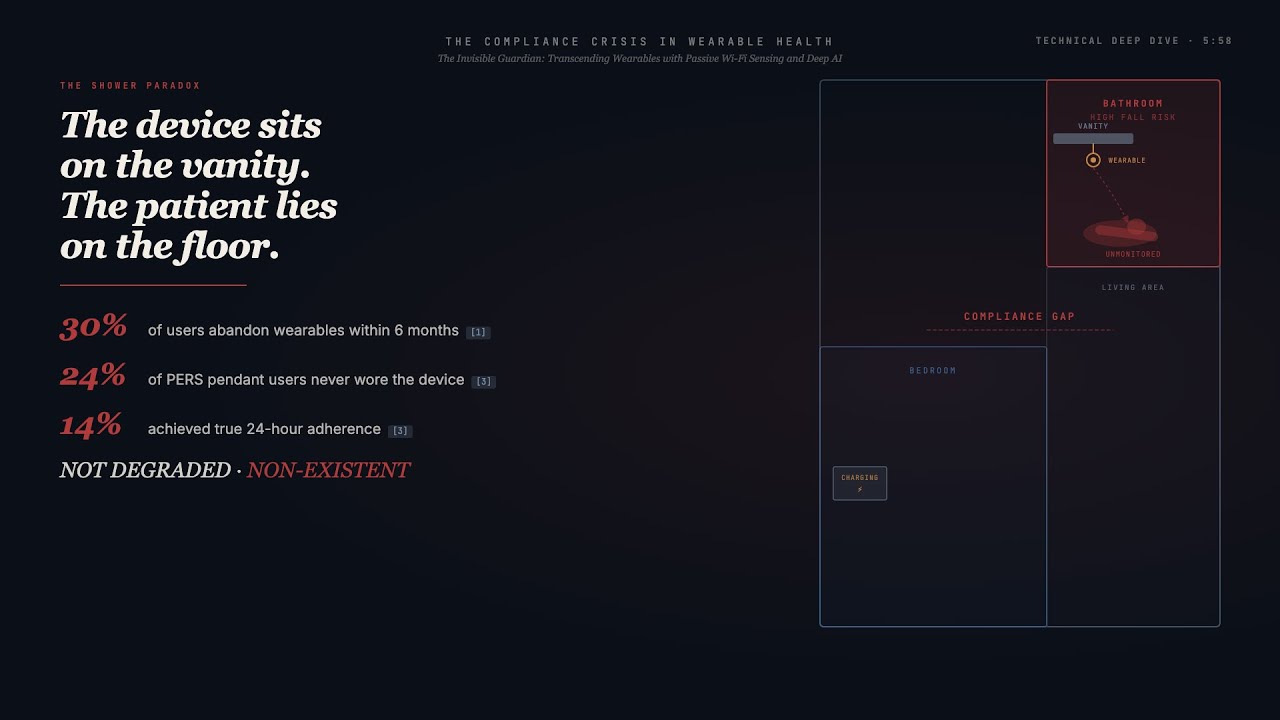
The bathroom is the most hazardous room for the elderly, yet precisely where wearables are removed. Despite IP67/IP68 ratings, users habitually take off devices before bathing—creating a coverage gap at the moment of highest risk.
For individuals with arthritis or Mild Cognitive Impairment, daily charging is a burden. Studies show 24% of PERS users never wore their pendant, and only 14% achieved true 24-hour adherence.
Medical alert pendants "brand" users as old and vulnerable. Many seniors hide devices under clothing or refuse to wear them in public, undermining the entire monitoring system. Fear of false alarms creates hesitation to use the SOS button.
"The reliance on the user to be an active participant in their own surveillance creates a compliance gap—a perilous chasm between the theoretical safety provided by the technology and the practical reality of its non-use in daily life."
— Veriprajna Whitepaper: The Invisible Guardian, 2024
Why passive sensing transcends traditional approaches
| Feature | Wearables (Active Monitoring) |
Cameras (Visual Monitoring) |
Passive Wi-Fi Sensing (Veriprajna) |
|---|---|---|---|
| User Compliance | ❌ High Friction: Requires wearing, charging, manual alerts | ✓ Zero Effort: Passive | ✓ Zero Effort: Passive |
| Privacy Impact | ✓ Low: Data only (acceleration/HR) | ❌ Severe: Visual recording of intimate spaces | ✓ Low: Abstract CSI signals; no visual identifiers |
| Bathroom Safety | ❌ Critical Failure: Often removed for showering/bathing | ❌ Unacceptable: Privacy concerns prohibit use | ✓ Excellent: Works in NLOS; penetrates steam/curtains |
| Maintenance | ❌ High: Battery replacement, lost device management | Medium: Lens cleaning, power supply | ✓ Low: Software updates; leverages existing Wi-Fi |
| Blind Spots | None (if worn) | ❌ High: Blocked by furniture, walls, darkness | ✓ Minimal: Signals penetrate walls and furniture |
| Data Richness | Acceleration, Heart Rate | Gait, Pose, Context | ✓ Respiration, Gait, Sleep Stages, Falls |
| Dementia Suitability | ❌ Poor: Users forget to wear or actively remove devices | Medium | ✓ High: Cannot be removed or forgotten |
True Ambient Intelligence requires access to Channel State Information (CSI)—the high-resolution "image" of the wireless environment that RSSI cannot provide.
Early Wi-Fi sensing relied on Received Signal Strength Indication (RSSI)—a coarse metric that can detect presence but lacks sensitivity for fine-grained movements like breathing.
Modern Wi-Fi (802.11n/ac/ax) uses OFDM, dividing channels into dozens of subcarriers. CSI captures how each subcarrier interacts with objects, providing granular detail RSSI cannot see.
Radio waves propagate through concentric ellipsoids (Fresnel zones) between transmitter and receiver. Human movement within these zones causes phase shifts detectable in CSI.
Breathing detection: Chest displacement of 4-12mm is sufficient to cause rhythmic CSI oscillations—comparable to medical-grade respiratory belts.
Different human activities generate unique Doppler frequency shifts. A fall is characterized by rapid acceleration (gravity), followed by sudden immobility (the "Long Lie").
Wi-Fi signals at 2.4/5 GHz penetrate drywall, wood, and glass. Even if the access point is in the hallway and the user is behind a closed door, signals reflect off the user and return to the receiver.
This physics-based ubiquity eliminates "blind spots" that plague camera systems. A single Wi-Fi link can monitor an entire room or adjacent rooms—coverage that would require multiple cameras.
Watch how Channel State Information captures human motion that traditional RSSI cannot detect. Toggle between breathing detection and fall detection modes.
CSI data is governed by the laws of physics, not grammar. Veriprajna engineers bespoke deep neural networks for temporal signal processing—not generic language models.
Phase unwrapping, Hampel filtering, PCA dimensionality reduction. Remove hardware artifacts (CFO/SFO) and extract principal components.
Treat CSI matrix as pseudo-image. 2D convolutions learn spatial correlations across subcarriers—distinguishing human motion from spinning fans.
Falls are sequences: standing → losing balance → descending → impact → lying still. LSTM maintains memory to understand context, not isolated frames.
Branch A (Amplitude): Macro-movements. Branch B (Phase): Micro-movements. Attention mechanism dynamically prioritizes relevant stream.
Why Domain Adversarial Neural Networks (DANN)?
A model trained in "Lab A" often fails in "Apartment B" due to different room layouts. DANN forces the network to learn environment-invariant features—the "platonic ideal" of a fall signature that looks the same in a studio apartment or nursing home hallway. Train once, deploy everywhere.
From respiratory monitoring to fall detection to sleep analysis—clinical-grade accuracy without a single wearable device.
Respiratory Rate (RR) is the "forgotten vital sign"—yet a leading indicator for COPD, CHF, and pneumonia deterioration. Chest displacement of 4-12mm creates rhythmic CSI phase oscillations.
Sleep apnea detection without cumbersome PSG lab studies
Falls are the leading cause of fatal injury in the elderly. The "Long Lie" (remaining on floor for hours) causes rhabdomyolysis and pressure ulcers. Veriprajna detects the entire sequence.
"Whole Body Actigraphy" analyzes movement intensity and periodicity to classify sleep stages. Track bed exits for dementia wandering detection.
Sleep Onset Latency, WASO, Total Duration—all without wrist actigraphy
Visual privacy is paramount for the elderly. Wi-Fi sensing resolves the "Camera vs. Sensor" debate—it is visually blind.
CSI matrices consist of complex numbers representing signal propagation. It is impossible for a human to look at CSI packets and "see" a person's face or body. Even if intercepted, the data is unintelligible signal distortions—not images or video.
CSI is biometric data under GDPR Article 9. Veriprajna ensures compliance through strict Edge AI processing:
"This makes Wi-Fi sensing uniquely suitable for bathroom monitoring—the most dangerous room in the house where cameras are strictly prohibited."
IEEE 802.11bf (WLAN Sensing) will standardize CSI extraction by 2024/2025, turning every router into a radar.
Wi-Fi 7 chipsets with integrated Hexagon NPU enable on-device deep learning inference. Veriprajna converts PyTorch models to quantized binaries for real-time edge processing.
BroadStream wireless telemetry engine designed specifically for sensing data offload. High-frequency, low-latency CSI streams for AI training/inference.
Low-cost ($5) microcontrollers with ESP-CSI Toolkit enable dense sensing mesh in large facilities. ESP32 acts as dedicated receiver feeding central gateway.
Provides foundational CSI extraction and basic motion classification API. Veriprajna integrates on top for medical-grade interpretation.
Time Reversal Machine technology for multipath analysis. TruPresence and fall detection engines run entirely on edge—aligning with privacy-first architecture.
The "Zero-Hardware Retrofit" transforms existing Wi-Fi networks into comprehensive safety systems.
Modern Wi-Fi using OFDM divides channels into dozens of subcarriers, each captured as complex amplitude and phase data in Channel State Information (CSI). Human movement within Fresnel zones between transmitter and receiver causes phase shifts detectable in CSI. A fall produces a characteristic high-energy Doppler surge followed by sudden cessation, distinguishable from sitting through velocity profile analysis. At 5 GHz wavelength of approximately 6cm, a 3cm movement creates a full phase shift.
Yes. Chest displacement of 4-12mm during breathing creates rhythmic CSI phase oscillations comparable to medical-grade respiratory belts, achieving error under 3.2 breaths per minute with correlation greater than 0.92 versus reference belts. For sleep analysis, the system performs whole-body actigraphy by analyzing movement intensity and periodicity to classify wakefulness, light sleep, and deep/REM stages, tracking sleep onset latency, wake after sleep onset, and total duration.
A model trained in one room often fails in another due to different layouts and materials. Domain Adversarial Neural Networks (DANN) force the network to learn environment-invariant features by adding an adversary that tries to identify which environment produced the data. If the adversary succeeds, the main network is penalized, forcing it to learn the universal fall signature that looks the same in a studio apartment or nursing home hallway. This enables train-once, deploy-everywhere capability.
Veriprajna's Passive Wi-Fi Sensing doesn't just improve upon wearables—it fundamentally eliminates the compliance burden.
Schedule a consultation to model deployment for your facility, explore our Deep AI architecture, and understand the path to zero-hardware ambient intelligence.
Complete engineering report: CSI physics, Fresnel zone mathematics, CNN/LSTM/Transformer architectures, DANN domain adaptation, GDPR/HIPAA compliance, hardware ecosystem analysis, 53 academic citations.