The Physics of Verification: Beyond the LLM Wrapper
Converting Human Motion into Auditable Assets via Temporal Convolutional Networks
Executive Summary: The Bifurcation of Artificial Intelligence
The technological landscape of the mid-2020s is defined by a singular, overwhelming narrative: the ascendancy of Generative Artificial Intelligence. The proliferation of Large Language Models (LLMs) and diffusion-based image synthesizers has fundamentally altered the trajectory of software development, shifting the industry's focus toward the creation of plausible, human-like output. We are currently witnessing a "Generative Gold Rush," where capital and engineering talent are disproportionately allocated to systems capable of writing code, composing poetry, and generating photorealistic imagery. This era has spawned a new class of software consultancies: the "LLM Wrapper." These entities function primarily as user interface layers atop foundational models like GPT-4, Claude, or LLaMA, delivering value through prompt engineering and context window management rather than novel architectural innovation. 1
While Generative AI offers immense utility in creative, administrative, and coding domains, it suffers from a critical, intrinsic limitation when applied to the physical world: it is probabilistic, not deterministic. It is designed to produce the most likely next token, not the true physical state. In high-stakes environments—healthcare, insurance, and corporate wellness—plausibility is a liability. A medical diagnosis, a rehabilitation protocol, or a premium adjustment cannot be based on a hallucination; it must be grounded in empirical reality.
Veriprajna rejects the consensus that AI’s primary purpose is generation. We position ourselves at the forefront of the counter-movement: Physical AI . We are not an LLM wrapper; we are a deep technology consultancy focused on the rigorous, mathematical verification of human movement. We operate on the premise that the digital health market is currently drowning in "Vibes"—unverifiable, self-reported, and easily spoofed data—and that the only sustainable path forward is a transition to "Physics."
This whitepaper serves as a technical and economic manifesto for that transition. It details the Veriprajna solution: the use of Temporal Convolutional Networks (TCNs) to treat human exercise not as a sequence of images to be classified, but as a periodic signal to be analyzed. By leveraging the superior architectural properties of TCNs—specifically causal dilated convolutions—over legacy Recurrent Neural Networks (RNNs) and Transformers, we enable Proof of Physical Work . This document provides an exhaustive analysis of the "Video Player" fallacy plaguing current fitness apps, the signal processing mathematics required for true verification, and the immense economic value of transforming ephemeral human motion into an immutable, auditable asset class.
1. The Crisis of Verification in the "Vibes" Economy
1.1 The "Video Player" Fallacy
The modern digital fitness industry, valued in the billions, is built upon a fundamental architectural flaw. Despite the proliferation of "smart" devices and "AI-powered" coaching apps, the primary mechanism for content delivery and user engagement remains the "Video Player" model. In this paradigm, the application functions essentially as a Content Management System (CMS). Users are served a video stream of an instructor performing an exercise—a pushup, a yoga flow, a rehabilitation movement—and are expected to mimic the action. The "intelligence" of these platforms is typically limited to the recommendation engine that selects the video, rather than any system that verifies the user's compliance. 3
This creates a profound disconnect between the digital instruction and the physical execution. The application assumes that consumption equals completion. A user may watch a 20-minute High-Intensity Interval Training (HIIT) session while sedentary, or perform the movements with such significant biomechanical deviation that they risk injury. Yet, at the conclusion of the video, the app logs the activity as "complete," estimates caloric burn based on generic actuarial tables, and awards digital badges.
This data is fundamentally "Vibes-based." It feels correct to the user, providing a dopamine loop of perceived accomplishment, and it looks encouraging on a corporate dashboard. However, it lacks physical fidelity . It is data that dissolves under audit. In an enterprise context, where this data is used to calculate insurance premiums or distribute corporate wellness incentives, the "Video Player" model represents a systemic failure of verification. It essentially asks the user, "Did you do the work?" and uncritically accepts "Yes" as the answer, ignoring the misalignment of incentives inherent in human behavior. 4
1.2 The Behavioral Economics of "Cheating"
The reliance on self-reported data or easily spoofed heuristics (like step counts) ignores a core tenet of behavioral economics: Campbell’s Law . This sociological principle states that "The more any quantitative social indicator is used for social decision-making, the more subject it will be to corruption pressures and the more apt it will be to distort and corrupt the social processes it is intended to monitor."
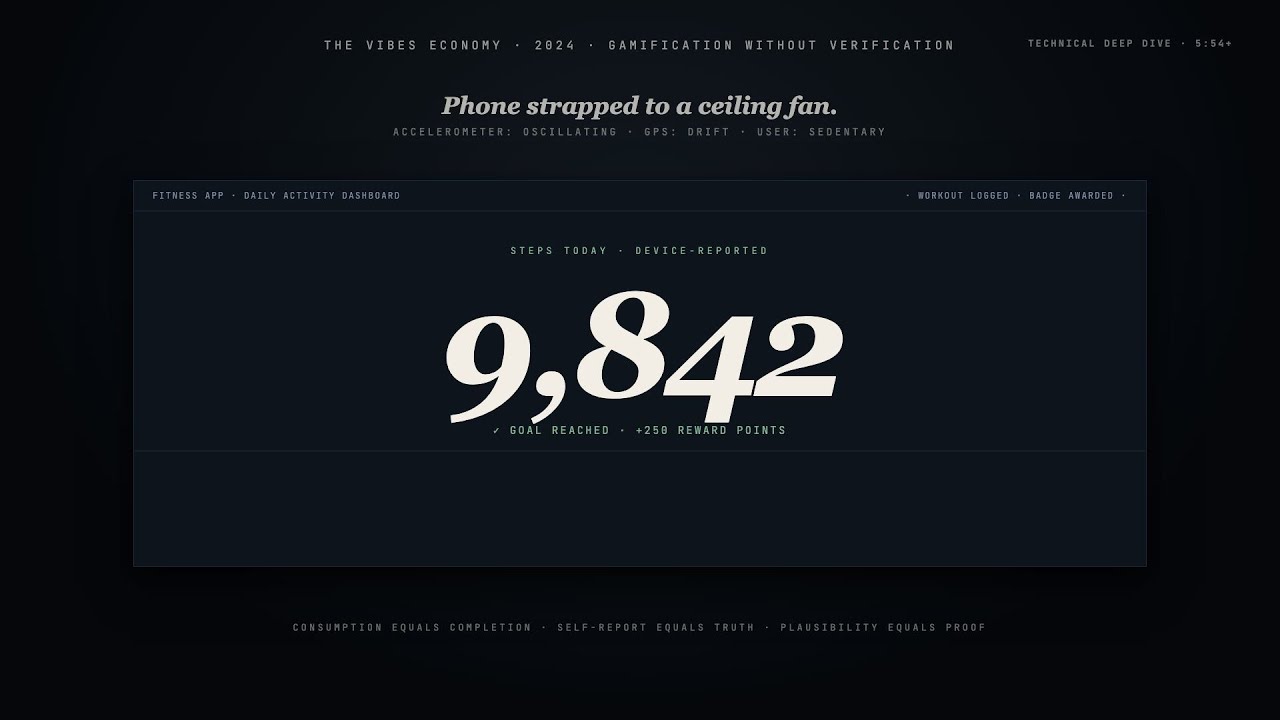
In the context of digital health, when you attach extrinsic value—money, insurance discounts, status—to a metric, that metric ceases to be a measure of health and becomes a target for optimization. 6 If the system optimizes for "steps," users will attach their Fitbits to ceiling fans or metronomes. If the system optimizes for "workout completion," users will let videos play while they eat dinner.
This is not a theoretical concern; it is an observed reality in "Move-to-Earn" economies and gamified fitness platforms. The collapse of early Web3 fitness projects like STEPN was driven in part by the arms race between the protocol’s ability to detect valid movement and the users' ability to simulate it via GPS spoofing and mechanical shakers. 7 When verification is weak, the "Cheater's Dividend" creates a market for fraud, devaluing the efforts of honest participants and bankrupting the incentive provider.
1.3 Gamification Requires Verification
The industry's response to low engagement has been aggressive gamification: leaderboards, streaks, badges, and social sharing. However, Veriprajna posits a fundamental law of digital incentives: You cannot gamify what you cannot verify.
Gamification without verification is merely a simulation of achievement. In a corporate wellness challenge, if Employee A performs 100 valid pushups and Employee B logs 200 "self-reported" pushups to win the leaderboard, the system has penalized effort and rewarded dishonesty. This destroys the social contract of the platform, leading to disengagement by high-performers and a "race to the bottom" in data integrity. 9
True gamification—the kind that drives behavioral change and sustainable economic models—requires a bedrock of physics-based truth. The user must know that the only way to increment the counter is to perform the physical work. This shifts the user's focus from "gaming the system" to "performing the action," aligning the digital incentive with the physical outcome.
2. Theoretical Framework: From Computer Vision to Signal Processing
2.1 The Limitations of Static Computer Vision
To solve the verification crisis, we must move beyond the limitations of traditional Computer Vision (CV). For the past decade, CV has been dominated by object detection and classification tasks: identifying a cat in an image, or labeling a frame as "soccer." Convolutional Neural Networks (CNNs) are exceptionally good at these spatial tasks.
However, exercise is not a state; it is a process. It is a temporal event defined by the evolution of geometry over time. A single static frame of a person with their elbows bent tells us nothing about the quality of a pushup. Are they lowering themselves? Are they pushing up? Have they been holding that position for 30 seconds (an isometric hold) or 30 milliseconds (a transition)? Are they trembling with fatigue? 10
Standard pose estimation libraries—like OpenPose, BlazePose, or MoveNet—are often marketed as "AI Solutions." In reality, they are merely "Sensors." They extract the (x, y, z) coordinates of skeletal joints from a video stream. While this is a critical first step, raw coordinate data is noisy, uninterpreted, and semantically void. Using pose estimation alone to verify fitness is akin to handing a layman a raw voltage reading from an electrocardiogram (ECG) and asking for a diagnosis. The sensor provides the data; the intelligence must interpret the signal. 12
2.2 Human Motion as a Periodic Signal
Veriprajna reframes Human Activity Recognition (HAR) not as an image classification problem, but as a Digital Signal Processing (DSP) problem.
The human body, when performing repetitive exercise, functions as a mechanical oscillator.
● The Squat: The vertical displacement of the hip joint () traces a sinusoidal wave over time.
● The Jumping Jack: The angular velocity of the shoulder abduction traces a periodic waveform.
● The Gait Cycle: Walking or running produces complex, multi-harmonic signals across the lower kinetic chain.
By treating movement as a signal, we unlock the powerful mathematical toolkit of signal processing. We can analyze:
1. Amplitude: The magnitude of the displacement (Depth of the squat).
2. Frequency: The rate of repetition (Cadence/Speed).
3. Phase: The coordination between different joints (Symmetry).
4. Spectral Purity: The smoothness of the movement (Control vs. Tremor).
This transition from "Vision" to "Signal" allows for objective quantification. We are no longer asking an AI to "guess" what exercise is happening; we are measuring the physics of the waveform. However, raw DSP techniques (like Fourier Transforms) are brittle when applied to the noisy, non-stationary signals of human movement in the wild. People change speeds; camera angles shift; occlusions occur. This is where Deep Learning returns to the equation—not as a classifier of images, but as a learner of temporal signals. 14
3. The Veriprajna Engine: Temporal Convolutional Networks (TCNs)
3.1 The Failure of Recurrent Neural Networks (RNNs)
For years, the standard architecture for processing sequential data (text, audio, time-series) was the Recurrent Neural Network (RNN) and its more stable variants, the Long Short-Term Memory (LSTM) network and the Gated Recurrent Unit (GRU). These networks process data sequentially: the output at time is dependent on the input at time and the "hidden state" from time .
While LSTMs were a breakthrough in 2014, they are fundamentally ill-suited for the high-fidelity, real-time demands of modern fitness verification for three critical reasons:
3.1.1 The Serial Bottleneck (Latency)
Because LSTMs must process the sequence step-by-step (Markov property), they cannot be parallelized. To compute the state of the skeleton at frame 100, the network must sequentially compute frames 1 through 99. In a real-time application running on a mobile device (Edge Computing), this serial processing creates unacceptable latency and creates a bottleneck for GPU acceleration, which thrives on parallel matrix operations. 10
3.1.2 The Vanishing Gradient (Memory)
LSTMs struggle to retain information over long sequences. While the "forget gate" was designed to mitigate this, in practice, LSTMs often fail to capture dependencies that span thousands of frames. A 5-minute set of yoga or a 50-rep set of pushups generates a temporal sequence that exceeds the effective memory window of standard LSTMs. This leads to "drift," where the model forgets the context of the start of the set by the time it reaches the end. 11
3.1.3 Computational Expense
Maintaining and updating the complex hidden states of an LSTM requires significant memory bandwidth. For Veriprajna's enterprise clients—who may be processing thousands of concurrent streams—the computational cost of LSTMs at scale is prohibitive. 16
3.2 The TCN Advantage: Architecture of the Future
Veriprajna utilizes Temporal Convolutional Networks (TCNs) . TCNs adapt the convolutional architecture that revolutionized image recognition (CNNs) and apply it to the time domain. This architecture offers a mathematically superior alternative to RNNs for HAR tasks.
3.2.1 Causal Convolutions
In a standard image CNN, a filter looks at pixels all around a target pixel (future and past/left and right). In a fitness verification context, we cannot look into the future—we must verify the rep as it happens. TCNs utilize causal convolutions, meaning the output at time is convolved only with elements from time and earlier. There is no leakage from the future to the past. This strict causality ensures that our verification engine is mathematically honest and capable of real-time streaming inference. 17
3.2.2 Dilated Convolutions and the Exponential Receptive Field
The defining feature of the TCN is the dilated convolution . Standard convolutions have a fixed field of view. To see a long history, you would need an impossibly deep network. Dilated convolutions introduce a spacing factor () between the kernel points.
The dilation factor increases exponentially with the depth of the network layers ( for layer ).
● Layer 1 (): The filter sees adjacent time steps.
● Layer 2 (): The filter skips one step, seeing a wider range.
● Layer 3 (): The filter skips three steps.
● Layer 10 (): The filter captures a massive historical window.
This architecture allows the TCN to have a Receptive Field that grows exponentially with depth. The network can simultaneously attend to the instantaneous physics of a single frame (e.g., "Is the knee valgus collapsing right now?") and the long-term temporal context (e.g., "Is the periodicity of this movement consistent with the fatigue curve established over the last 3 minutes?"). 19
3.2.3 Parallelism and Training Stability
Because TCNs use convolutions, the computation for all time steps can be performed in parallel (provided the input sequence is available during training, or buffered during inference). This results in training times that are magnitudes faster than LSTMs. Furthermore, TCNs avoid the exploding/vanishing gradient problem because the backpropagation path is through a fixed-depth network rather than unrolled through time. 10
3.3 Comparative Performance Analysis
Research validating the TCN approach over LSTM in HAR contexts highlights clear performance deltas:
| Feature | LSTM / GRU | Veriprajna TCN | Implication for Verifci ation |
|---|---|---|---|
| Parallelism | Serial (Slow) | Parallel (Fast) | TCNs enable real-time verifcation on edge devices. |
| Receptive Field | Limited by Gradient Flow |
Flexible / Exponential |
TCNs detect long-term fatigue & form degradation. |
| Memory Footprint | High (Gate States) | Low (Filter Weights) | TCNs are cheaper to run at enterprise scale. |
|---|---|---|---|
| Gradient Stability | Vanishing/Explodin g |
Stable (ResNet-like) |
TCNs are more robust to training on diverse datasets. |
| Temporal Resolution |
Frame-by-Frame | Hierarchical | TCNs capture multi-scale dynamics (micro & macro). |
Table 1: Architectural comparison of sequence modeling approaches for Human Activity Recognition. 10
4. The Metrics of Truth: Analyzing the Signal
The TCN provides the engine, but the value of Veriprajna lies in the specific Biometric Signal Analysis it performs. We do not simply classify activity; we deconstruct it into component physics.
4.1 Class-Agnostic Repetition Counting via Self-Similarity
Traditional fitness apps use "heuristics" or specific classifiers for counting (e.g., a "Pushup Counter" model). This is brittle; it requires training a new model for every single exercise variation. Veriprajna employs a Class-Agnostic approach using Temporal Self-Similarity Matrices (TSMs) . 21
4.1.1 The Mechanism of Repetition
1. Embedding Projection: The TCN maps the skeletal pose sequence into a lower-dimensional latent space.
2. Matrix Construction: We compute the similarity (Euclidean distance or Cosine similarity) between the embedding at frame and frame for all .
3. Pattern Recognition: A repetitive action generates a distinct texture in the TSM—lines of high similarity parallel to the main diagonal.
○ The distance between these lines corresponds to the period (duration) of the rep.
○ The intensity of the lines corresponds to the fidelity of the repetition (how similar was Rep 2 to Rep 1?).
4. Integration: The TCN predicts the period length and periodicity probability for each frame. By integrating these probabilities over time, we derive a precise count that is robust to interruptions, speed changes, and non-standard forms. 23
This allows Veriprajna to verify any periodic movement—kettlebell swings, rowing, jumping jacks, or specialized rehab movements—without needing a specific "classifier" for that movement. It detects the physics of repetition itself. 22
4.2 Quality Scoring: The Physics of Form
Counting is necessary but not sufficient. A user can perform 50 "pushups" with 1-inch range of motion. To solve this, Veriprajna calculates a Quality Score derived from kinematic signal properties.
4.2.1 Amplitude Thresholding (The "Depth" Metric)
We isolate the trajectory of key joints (e.g., the hip in a squat, the chest in a pushup). We apply a Min-Max Peak Detection algorithm to the TCN-filtered signal.
● Logic: A rep is only valid if the normalized amplitude exceeds a biomechanical threshold .
● Example: For a squat, must traverse from to . If the signal inflection point occurs above , the TCN flags the rep as "Insufficient Depth." This is not an opinion; it is a measurement of displacement. 25
4.2.2 Log Dimensionless Jerk (The "Control" Metric)
Smoothness is a hallmark of skilled motor control. In signal processing, Jerk is the third derivative of position (the rate of change of acceleration).
High jerk values indicate tremors, instability, or the use of momentum to "cheat" the movement. Veriprajna calculates the Log Dimensionless Jerk (LDLJ), a metric that normalizes for speed and amplitude.
● Application: A high LDLJ score indicates the user is struggling or performing the rep explosively with poor control. This is a critical predictor for injury risk in corporate wellness and rehab settings. 15
4.2.3 Symmetry Analysis (The "Balance" Metric)
Using the bilateral nature of the human skeleton, we compare the signal energy and phase of the left and right extremities.
● Asymmetry Index:
● Use Case: Identifying a user who is favoring one leg during a squat, which is often a precursor to injury or an indicator of incomplete rehabilitation. This metric is impossible to self-report; it must be measured. 27
5. Engineering "Proof of Physical Work"
5.1 Defining the Asset Class
We propose a new concept for the digital economy: Proof of Physical Work (PoPW) . In blockchain technology, "Proof of Work" derives value from the expenditure of computational energy (electricity). PoPW derives value from the expenditure of human metabolic energy, verified by physics-based AI.
This asset class transforms a "workout" from an ephemeral event into a verifiable record. A "Veriprajna Verified Rep" is a data packet containing:
1. Timestamp & Geolocation.
2. Skeletal Keypoint Hash.
3. TCN Confidence Score.
4. Kinematic Telemetry (Depth, Speed, Jerk).
This packet is immutable and auditable. It is the currency of the future health economy. 28
5.2 System Architecture
Veriprajna is designed for privacy-first, low-latency enterprise deployment.
5.2.1 The Edge-First Approach
We do not stream video to the cloud. Streaming video (GBs of data) is expensive, slow, and a privacy nightmare.
1. On-Device Sensing: The mobile device runs a lightweight pose estimator (e.g., MoveNet Thunder) on the Neural Processing Unit (NPU). This extracts only the skeletal coordinates (a few KBs of data).
2. Privacy Barrier: The video frames are discarded immediately after coordinate extraction. No pixel data ever leaves the user's device.
3. Cloud TCN Analysis: The coordinate stream—which is anonymous and purely kinematic—is sent to the Veriprajna Cloud Engine (or processed on-device for high-end phones).
4. TCN Inference: The TCN analyzes the coordinate stream for periodicity and quality.
5. Feedback Loop: Results are returned to the user in milliseconds ("Go Lower," "Good Rep").
This architecture ensures GDPR/HIPAA compliance by design, as the "biometric data" (video face) is never stored or transmitted. 30
6. Economic Impact and Enterprise Use Cases
The transition from "Vibes" to "Physics" unlocks billions in value across key sectors.
6.1 The Insurance Revolution: Dynamic Underwriting
The insurance industry is currently limited to static risk assessment. A 30-year-old male is priced based on aggregate tables, not his individual health.
● The "Vibes" Status Quo: Insurers offer discounts for gym memberships (which verify location, not effort) or step counts (which verify device movement, not exertion).
● The Veriprajna Solution: Interactive Risk Assessment. A policyholder can perform a 2-minute "Functional Movement Screen" (5 squats, 5 lunges, balance hold) via the insurer's app.
● Value: The TCN scores the user's stability, range of motion, and symmetry. This data correlates strongly with fall risk (in seniors) and general metabolic health. Insurers can dynamically adjust premiums based on verified functional capacity, reducing claims payouts and attracting lower-risk customers. 32
6.2 Corporate Wellness: Eliminating the "Cheater's Dividend"
Corporate wellness is a $60 billion industry with a fraud problem. Companies pay for outcomes they don't get.
● The "Vibes" Status Quo: Employees shake their phones to hit step targets and claim Health Savings Account (HSA) contributions. The employer pays the incentive but gets no productivity gain.
● The Veriprajna Solution: Incentives are tied to Verified Active Minutes . The barrier to entry for fraud becomes physical effort. To fake a pushup on Veriprajna, you effectively have to build a robot that looks like a human—or just do the pushup.
● Value: Marketing ROI becomes tangible. Wellness budgets effectively target actual health improvements. 35
6.3 Digital Physical Therapy (Tele-Rehab)
Musculoskeletal (MSK) disorders are a top cost driver for employers. Tele-rehab solves the access problem but fails the compliance problem.
● The "Vibes" Status Quo: Patients are assigned home exercises. Adherence is self-reported and notoriously low (often <50%). Patients do exercises with poor form, delaying recovery.
● The Veriprajna Solution: The TCN acts as an AI Physical Therapist . It monitors the specific joint angles (e.g., "Knee Flexion < 90 degrees") prescribed by the clinician.
● Value: The clinician receives a dashboard of verified compliance and quality trends. They can intervene when the data shows the patient is struggling, rather than waiting for the next appointment. This "Remote Therapeutic Monitoring" (RTM) is now a reimbursable CPT code in the US, creating a direct revenue stream for providers using verified tech. 36
6.4 The "Move-to-Earn" Redemption
Web3 projects attempting to tokenize fitness failed because they relied on GPS, which is easily spoofed.
● The Veriprajna Solution: We provide the Oracle for physical effort. Token minting is gated by TCN verification. This creates a sustainable economy where the token supply is capped by the physical capacity of the user base. 37
7. Comparative Analysis: Veriprajna vs. The Field
To assist decision-makers, we provide a direct comparison of Veriprajna against alternative market solutions.
| Feature | LLM Wrappers (ChatGPT/Cla ude) |
Basic Computer Vision (OpenPose/Vi sionKit) |
Legacy AI (LSTM/RNN) |
Veriprajna (TCN + Signal Processing) |
|---|---|---|---|---|
| Core Function | Text Generation / Chat |
Joint Detection (Sensing) |
Sequential Prediction |
Physics Verifcation |
| Verifcation Method |
None (Trusts User Input) |
None (Raw Coordinates) |
History-Depen dent State |
Causal Signal Analysis |
| Real-Time Capability |
Low (Cloud Latency) |
High | Low (Serial Processing) |
High (Parallel Processing) |
| Counting Accuracy |
N/A | Heuristic (Thresholds) |
Moderate (Drif issues) |
High (Periodicity Engine) |
| Fraud Resistance |
Zero | Low (Easy to spoof) |
Moderate | High (Biometric/Ph |
| Col1 | Col2 | Col3 | Col4 | ysics) |
|---|---|---|---|---|
| Economic Utility |
Content Delivery |
Data Collection |
Basic Tracking | Auditable Asset Creation |
Table 2: Strategic positioning of Veriprajna against current market alternatives.
8. Conclusion: The Immutable Ledger of Health
The integration of Artificial Intelligence into human health is inevitable, but its current trajectory is flawed. We are building systems that generate plausible text rather than verifying physical truth. We are building "video players" that passively consume attention rather than active auditors that measure effort.
Veriprajna represents the necessary correction. We assert that in the domain of physical health, physics is the only API that matters.
By replacing subjective self-reports and brittle heuristics with the rigorous mathematical framework of Temporal Convolutional Networks, we are creating a new standard of trust. We enable insurers to underwrite reality, employers to reward effort, and patients to recover with confidence.
We invite forward-thinking enterprises to join us in building the "Physics" economy. It is time to stop gamifying vibes and start verifying work.
9. Future Roadmap: The Path to Biometric Sovereignty
As we look beyond the immediate horizon, Veriprajna is developing the next generation of Physical AI technologies:
1. Hybrid TCN-Transformer Architectures: While TCNs are superior for temporal verification, Transformers excel at semantic context. We are researching hybrid models where the TCN handles the high-frequency signal verification (the "physics") and a lightweight Transformer interprets the global context (the "environment"), allowing the system to understand where the workout is happening (gym vs. home) to further contextualize the risk profile. 38
2. On-Device Personalization (Few-Shot Learning): Future TCNs will employ meta-learning to adapt to a user's specific biomechanics after just a few reps. This creates a "Biometric Fingerprint" of movement—meaning the system will eventually reject a valid pushup if it determines you didn't do it, further securing the "Proof of Physical Work" against account sharing. 40
3. The "Veriprajna Standard": We aim to establish the ISO-equivalent standard for digital fitness data. Just as HTTPS secured the web, the Veriprajna Protocol will secure the transmission of physical effort data, allowing it to move seamlessly and trustlessly between apps, insurers, and healthcare providers.
The future is not just smart; it is verified.
Works cited
AI vs generative AI: Key differences and use cases - N-iX, accessed December 11, 2025, https://www.n-ix.com/ai-vs-generative-ai/
Innovation Beyond LLM Wrapper - AI at work for all - secure AI agents, search, workflows, accessed December 11, 2025, https://shieldbase.ai/blog/innovation-beyond-llm-wrapper
The privacy nightmare of modern fitness apps: Why is "local-only" so rare? Reddit, accessed December 11, 2025, https://www.reddit.com/r/privacy/comments/1pfssw5/the_privacy_nightmare_of_modern_fitness_apps_why/
New study finds popular fitness apps may actually demotivate users - New Atlas, accessed December 11, 2025, https://newatlas.com/health-wellbeing/popular-fitness-apps-may-demotivate-users/
How and Why I Cheated On My App: User Experience of Cheating Physical Activity Exergame Applications | Request PDF - ResearchGate, accessed December 11, 2025, https://www.researchgate.net/publication/317488447_How_and_Why_I_Cheated_On_My_App_User_Experience_of_Cheating_Physical_Activity_Exergame_Applications
(PDF) Gaming the Quantified Self - ResearchGate, accessed December 11, 2025, https://www.researchgate.net/publication/277331055_Gaming_the_Quantified_Self
STEPN Will Use AI to Detect Cheaters on Move-to-Earn Platform - Tokenist, accessed December 11, 2025, https://tokenist.com/stepn-will-use-ai-to-detect-cheaters-on-move-to-earn-platform/
SMAC: STEPN Model for Anti Cheating, accessed December 11, 2025, https://stepnofficial.medium.com/smac-stepn-model-for-anti-cheating-a36bc1d6ecb0
Health Wearables, Gamification, and Healthful Activity - PMC - PubMed Central NIH, accessed December 11, 2025, https://pmc.ncbi.nlm.nih.gov/articles/PMC10403254/
arXiv:1611.05267v1 [cs.CV] 16 Nov 2016, accessed December 11, 2025, https://arxiv.org/pdf/1611.05267
Temporal Convolutional Networks for Action Segmentation and Detection - arXiv, accessed December 11, 2025, https://arxiv.org/abs/1611.05267
Applications of Pose Estimation in Human Health and Performance across the Lifespan, accessed December 11, 2025, https://pmc.ncbi.nlm.nih.gov/articles/PMC8588262/
Artificial Intelligence in Fitness: Pose Estimation and Movement Correction | Cureus Journals | Article, accessed December 11, 2025, https://www.cureusjournals.com/articles/747-artificial-intelligence-in-fitness-pose-estimation-and-movement-correction
Deep Learning-Based Human Activity Recognition Using Dilated CNN and LSTM on Video Sequences of Various Actions Dataset - MDPI, accessed December 11, 2025, https://www.mdpi.com/2076-3417/15/22/12173
Smooth Moves: Comparing Log Dimensionless Jerk Metrics from Body Center of Mass Trajectory and Wearable Sensor Acceleration During - Aisberg, accessed December 11, 2025, https://aisberg.unibg.it/retrieve/8f26c15d-c3b5-40f5-b788-3081124251fd/2025_Brasiliano_Sensors_Smoothness.pdf
(PDF) A Comparative Study of Detecting Anomalies in Time Series Data Using LSTM and TCN Models - ResearchGate, accessed December 11, 2025, https://www.researchgate.net/publication/357171924_A_Comparative_Study_of_Detecting_Anomalies_in_Time_Series_Data_Using_LSTM_and_TCN_Models
Human Activity Recognition via Attention-Augmented TCN-BiGRU Fusion - MDPI, accessed December 11, 2025, https://www.mdpi.com/1424-8220/25/18/5765
Temporal Convolutional Networks and Forecasting - Unit8, accessed December 11, 2025, https://unit8.com/resources/temporal-convolutional-networks-and-forecasting/
arXiv:2305.13778v1 [cs.CV] 23 May 2023, accessed December 11, 2025, https://arxiv.org/pdf/2305.13778
Temporal Convolutional Attention Neural Networks for Time Series Forecasting Yang Lin, accessed December 11, 2025, https://yanglin1997.github.io/files/TCAN.pdf
Rethinking temporal self-similarity for repetitive action counting - arXiv, accessed December 11, 2025, https://arxiv.org/html/2407.09431v1
RepNet: Counting Repetitions in Videos - Google Research, accessed December 11, 2025, https://research.google/blog/repnet-counting-repetitions-in-videos/
Live Repetition Counting - TAU, accessed December 11, 2025, https://www.cs.tau.ac.il/~wolf/papers/repcounticcv.pdf
TEMPORAL REPETITION COUNTING WITH DYNAMIC ACTION QUERIES OpenReview, accessed December 11, 2025, https://openreview.net/pdf/62e872a4dc4d01b2aca8bbcd1a0e6c4b452c9e92.pdf
Quality Evaluation Algorithm for Chest Compressions Based on OpenPose Model, accessed December 11, 2025, https://www.researchgate.net/publication/360534961_Quality_Evaluation_Algorithm_for_Chest_Compressions_Based_on_OpenPose_Model
Comparison of Various Smoothness Metrics for Upper Limb Movements in Middle-Aged Healthy Subjects - MDPI, accessed December 11, 2025, https://www.mdpi.com/1424-8220/23/3/1158
Assessing Smoothness of Arm Movements With Jerk: A Comparison of Laterality, Contraction Mode and Plane of Elevation. A Pilot Study - PubMed Central, accessed December 11, 2025, https://pmc.ncbi.nlm.nih.gov/articles/PMC8814310/
Welcome to the News Archive - yin.kit.edu, accessed December 11, 2025, https://www.yin.kit.edu/english/1172.php
SOLLONG: A New Application of the DEPIN Data Concept - Beardsley Farmers Elevator, accessed December 11, 2025, https://www.beardsleyfe.com/markets/stocks.php?article=marketersmedia-2024-5-6-sollong-a-new-application-of-the-depin-data-concept
EEOC: Avoid Bias with Wearable Tech in the Workplace - Goldberg Segalla, accessed December 11, 2025, https://www.goldbergsegalla.com/news-and-knowledge/knowledge/eeoc-avoid-bias-with-wearable-tech-in-the-workplace/
Fitbits at Work: Navigating the Legal Risks of Wearables in Corporate Wellness Programs, accessed December 11, 2025, https://www.akerman.com/en/perspectives/hrdef-fitbits-at-work-navigating-the-legal-risks-of-wearables-in-corporate-wellness-programs.html
New Medical Insights from LexisNexis Health Intelligence Helps Life Insurers Expand Accelerated Programs, Mitigate Mortality Slippage and Improve Customer Experience, accessed December 11, 2025, https://risk.lexisnexis.com/about-us/press-room/press-release/20251111-medical-insights-health-intelligence
Data analytics (ab) use in healthcare fraud audits - NHH, accessed December 11, 2025, https://www.nhh.no/globalassets/departments/accounting-auditing-and-law/digaudit/suton-et-al.-ijais-2021-data-analytics-ab-use-in-healthcare-fraud-audits.pdtf
Issue Brief - Big Data and Algorithms in Actuarial Modeling and Consumer Impacts, accessed December 11, 2025, https://actuary.org/wp-content/uploads/2022/10/IB-BigData-10-22.pdf
Common Mistakes Corporate Health Programs Make With Wearable Devices WellSteps, accessed December 11, 2025, https://www.wellsteps.com/blog/2020/01/02/corporate-health-programs/
Human pose estimation in physiotherapy fitness exercise correction using novel transfer learning approach - NIH, accessed December 11, 2025, https://pmc.ncbi.nlm.nih.gov/articles/PMC12193033/
StepN: Move-to-Earn without the Ponzi | HTX Square, accessed December 11, 2025, https://square.htx.com/wp-content/uploads/2023/05/b8937-stepn-move-to-earn-without-a-ponzi.pdf
A Hybrid Visual Transformer for Efficient Deep Human Activity Recognition - CVF Open Access, accessed December 11, 2025, https://openaccess.thecvf.com/content/ICCV2023W/NIVT/papers/Djenouri_A_Hybrid_Visual_Transformer_for_Efficient_Deep_Human_Activity_Recognition_ICCVW_2023_paper.pdf
A Transformer-Based Hybrid Model for Human Activity Recognition Using Smart Home Environmental Sensor Data - Engineering Management and Soft Computing, accessed December 11, 2025, https://jemsc.qom.ac.ir/article_3653.html
Intelligent Repetition Counting for Unseen Exercises: A Few-Shot Learning Approach with Sensor Signals - arXiv, accessed December 11, 2025, https://arxiv.org/html/2410.00407v2
Prefer a visual, interactive experience?
Explore the key findings, stats, and architecture of this paper in an interactive format with navigable sections and data visualizations.
Frequently Asked Questions
What is the Video Player fallacy in fitness AI?
The Video Player fallacy describes the fundamental flaw where digital fitness platforms function as content management systems — serving exercise videos and assuming that watching equals performing. Users can log a 20-minute HIIT session while sedentary, perform movements with dangerous biomechanical deviation, or let videos play during dinner, yet the app records the activity as complete and awards badges. This data is Vibes-based — it feels correct and looks encouraging on dashboards but dissolves under audit, creating systemic fraud risk when used for insurance premiums or corporate wellness incentives.
How do Temporal Convolutional Networks verify exercise better than LSTMs?
TCNs use causal dilated convolutions where dilation factors grow exponentially (d=2^i per layer), creating receptive fields that simultaneously capture instantaneous physics (knee valgus collapse in a single frame) and long-term temporal context (fatigue curves over 3 minutes). Unlike LSTMs which process sequentially and suffer vanishing/exploding gradients, TCNs parallelize computation across all time steps, train magnitudes faster, have lower memory footprints from filter weights versus gate states, and maintain strict causality ensuring the verification engine never uses future data to validate past movement.
What is Proof of Physical Work and why does it matter for insurance?
Proof of Physical Work is Veriprajna's system for converting ephemeral human motion into immutable, auditable digital assets. The TCN engine verifies repetition count via self-similarity matrices, scores movement quality through physics-based joint angle analysis, and produces cryptographically timestamped verification tokens. For insurance, this enables dynamic underwriting where premiums adjust based on verified physical activity rather than self-reported questionnaires. For corporate wellness, it eliminates the Cheater's Dividend where dishonest participants game leaderboards, destroying program integrity.
Also Published On
Build Your AI with Confidence.
Partner with a team that has deep experience in building the next generation of enterprise AI. Let us help you design, build, and deploy an AI strategy you can trust.
Veriprajna Deep Tech Consultancy specializes in building safety-critical AI systems for healthcare, finance, and regulatory domains. Our architectures are validated against established protocols with comprehensive compliance documentation.