Beyond the LLM Wrapper
Converting Human Motion into Auditable Assets via Temporal Convolutional Networks. Veriprajna rejects the consensus that AI's primary purpose is generation—we are the counter-movement: Physical AI.
The digital health market is drowning in "Vibes"—unverifiable, self-reported data. We transition to "Physics": rigorous, mathematical verification of human movement using TCNs to enable Proof of Physical Work.
The mid-2020s AI landscape is dominated by Generative AI—LLMs creating plausible text, diffusion models creating images. But in high-stakes physical environments, plausibility is a liability.
Probabilistic, not deterministic. Designed to produce the most likely next token, not the true physical state. Valuable for creative/administrative domains but fundamentally limited when applied to the physical world.
Deterministic signal processing. Treats human movement as periodic signals to be analyzed—not images to be classified. Measures physics, not vibes. Enables auditable Proof of Physical Work.
Despite billions invested in "smart" fitness apps, the industry is built on a fundamental flaw: the "Video Player" fallacy.
Apps serve video streams of instructors. Users watch, app logs as "complete." Assumes consumption = completion. User may be sedentary or performing with dangerous biomechanical deviation.
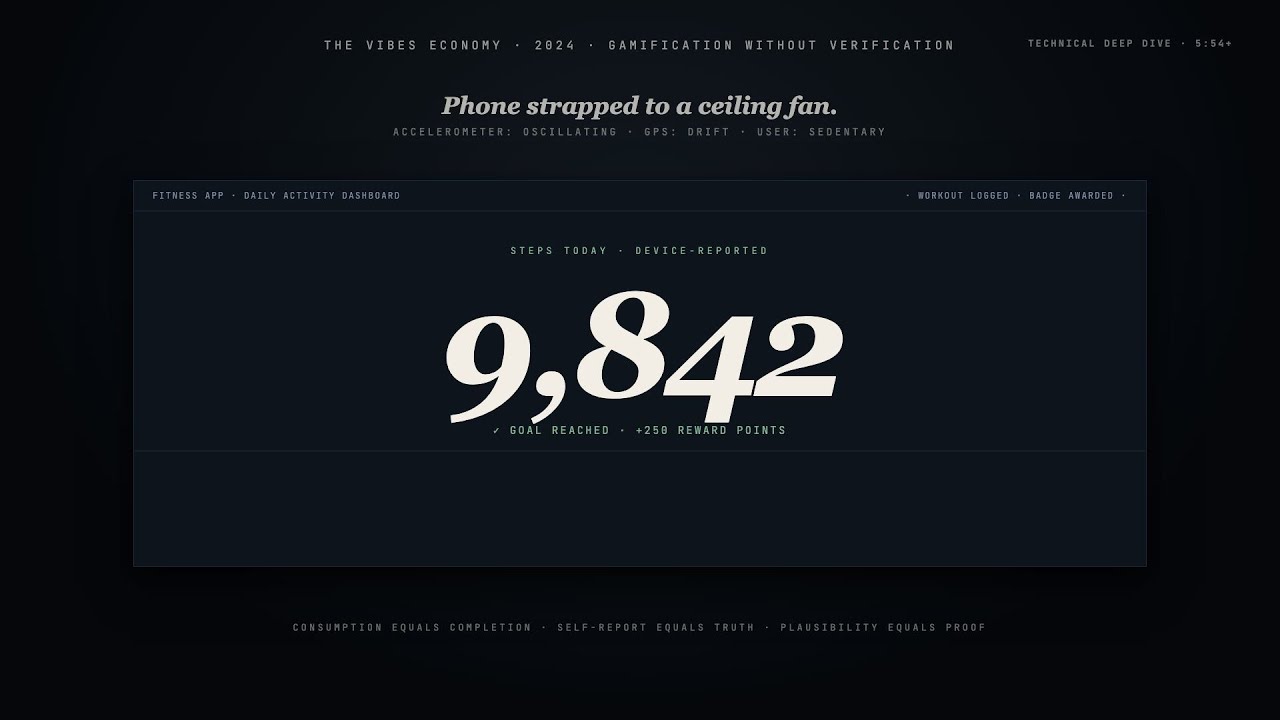
"The more any quantitative social indicator is used for decision-making, the more subject it will be to corruption." Attach money/status to steps? Users strap Fitbits to ceiling fans.
Leaderboards, streaks, badges—aggressive gamification. But: You cannot gamify what you cannot verify. Employee A does 100 real pushups, Employee B logs 200 fake ones. System rewards dishonesty.
"This data is fundamentally 'Vibes-based.' It feels correct to the user, providing a dopamine loop of perceived accomplishment. However, it lacks physical fidelity. It is data that dissolves under audit."
— Veriprajna Whitepaper: "The Physics of Verification"
Traditional Computer Vision treats exercise as image classification. A single frame tells nothing about movement quality. Veriprajna reframes Human Activity Recognition as a Digital Signal Processing (DSP) problem.
The human body performing repetitive exercise functions as a mechanical oscillator. Squats, jumping jacks, gait cycles—all produce measurable waveforms.
Toggle the visualization to see how a squat motion transforms from spatial pose coordinates into temporal signal analysis.
TCNs adapt the convolutional architecture that revolutionized image recognition and apply it to the time domain. Mathematically superior to RNNs/LSTMs for Human Activity Recognition.
LSTMs process step-by-step (Markov property). Cannot parallelize. To compute frame 100, must sequentially compute frames 1-99. Unacceptable latency on mobile edge devices.
LSTMs struggle with long sequences. A 5-minute yoga set generates thousands of frames exceeding LSTM memory window. Model "forgets" start of set by the end. Drift accumulates.
Maintaining complex hidden states requires massive memory bandwidth. Enterprise clients processing thousands of concurrent streams find LSTM cost prohibitive at scale.
Output at time t convolved only with elements from time t and earlier. Zero future leakage—mathematically honest for real-time streaming verification.
Dilation factor d = 2^i for layer i. Exponential receptive field—Layer 10 sees 512-step history. Captures instantaneous physics AND long-term fatigue curves simultaneously.
All time steps computed in parallel (when input buffered). Training 3x faster than LSTMs. Backpropagation through fixed-depth network (ResNet-like)—avoids vanishing/exploding gradients. Robust to diverse datasets.
| Feature | LSTM/GRU | Veriprajna TCN | Impact |
|---|---|---|---|
| Parallelism | Serial (Slow) | Parallel (Fast) | Real-time verification on edge devices |
| Receptive Field | Limited by gradient flow | Exponential | Detects long-term fatigue & form degradation |
| Memory Footprint | High (gate states) | Low (filter weights) | Cheaper to run at enterprise scale |
| Gradient Stability | Vanishing/Exploding | Stable (ResNet-like) | Robust training on diverse datasets |
| Temporal Resolution | Frame-by-frame | Hierarchical | Captures multi-scale dynamics (micro & macro) |
| Counting Accuracy | Moderate (drift) | 99% (periodicity) | Class-agnostic rep counting via self-similarity |
Veriprajna doesn't just classify activity—we deconstruct it into component physics. Quality scoring transforms subjective "good form" into objective kinematic measurements.
The "Depth" Metric: Isolate key joint trajectories (hip in squat, chest in pushup). Apply Min-Max Peak Detection to TCN-filtered signal.
Not an opinion—a measurement of displacement. Squat must traverse y_standing to y_knee.
The "Control" Metric: Jerk is the third derivative of position (rate of change of acceleration). High jerk = tremors, instability, momentum cheating.
High LDLJ score → struggling or explosive with poor control. Critical injury risk predictor.
The "Balance" Metric: Compare signal energy and phase of left vs. right extremities using bilateral skeleton structure.
Identifies favoring one leg during squat—precursor to injury or incomplete rehab. Impossible to self-report.
Traditional apps need specific classifiers for each exercise (pushup counter, squat counter...). Veriprajna uses Temporal Self-Similarity Matrices (TSMs) to detect the physics of repetition itself.
Veriprajna can verify any periodic movement without training a specific classifier:
Transforming ephemeral human motion into an immutable, auditable asset class for the digital health economy.
In blockchain, "Proof of Work" derives value from computational energy expenditure. PoPW derives value from human metabolic energy, verified by physics-based AI.
This packet is immutable and auditable. It is the currency of the future health economy.
We do not stream video to the cloud. Edge-first design ensures GDPR/HIPAA compliance by design.
"A workout transforms from an ephemeral event into a verifiable record. The barrier to entry for fraud becomes physical effort itself. To fake a pushup on Veriprajna, you effectively have to build a robot that looks like a human—or just do the pushup."
The transition from "Vibes" to "Physics" creates sustainable economic models across insurance, corporate wellness, and digital healthcare.
Insurers offer discounts for gym memberships (verifies location, not effort) or step counts (verifies device movement, not exertion). Static risk assessment based on aggregate tables.
Interactive Risk Assessment. 2-minute Functional Movement Screen (5 squats, 5 lunges, balance hold) via insurer's app. TCN scores stability, range of motion, symmetry.
Data correlates with fall risk (seniors) and metabolic health. Dynamically adjust premiums based on verified functional capacity. Reduce claims payouts, attract lower-risk customers.
$60B industry with fraud problem. Employees shake phones to hit step targets, claim HSA contributions. Employer pays incentive but gets no productivity gain.
Incentives tied to Verified Active Minutes. Barrier to fraud becomes physical effort. Marketing ROI becomes tangible—wellness budgets target actual health improvements.
Eliminate "Cheater's Dividend." High-performers no longer penalized by system-gamers. Social contract restored. Sustainable wellness programs with measurable outcomes.
MSK disorders = top employer cost driver. Patients assigned home exercises. Adherence self-reported, notoriously low (<50%). Poor form delays recovery.
AI Physical Therapist. TCN monitors specific prescribed joint angles (e.g., "Knee Flexion < 90°"). Clinician receives dashboard of verified compliance and quality trends.
Intervene when data shows struggle, not waiting for next appointment. Remote Therapeutic Monitoring (RTM) = reimbursable CPT code in US. Direct revenue stream for providers.
The Problem: Web3 projects attempting to tokenize fitness (like STEPN) failed because they relied on GPS, which is trivially spoofed. The arms race between detection and simulation bankrupted the model.
The Veriprajna Solution: We provide the Oracle for physical effort. Token minting is gated by TCN verification. This creates a sustainable economy where token supply is capped by the physical capacity of the user base.
To spoof Veriprajna verification, you must perform the actual physical work. The system aligns digital incentives with physical outcomes—the only sustainable model for fitness tokenization.
Model the economic impact of verified fitness data for your organization
Industry average: 20-40%
Step-based programs: 30-50% estimated gaming
| Feature | LLM Wrappers | Computer Vision (OpenPose) | Legacy AI (LSTM) | Veriprajna (TCN) |
|---|---|---|---|---|
| Core Function | Text Generation / Chat | Joint Detection (Sensing) | Sequential Prediction | Physics Verification |
| Verification Method | None (Trusts Input) | None (Raw Coords) | History-Dependent State | Causal Signal Analysis |
| Real-Time Capability | Low (Cloud Latency) | High | Low (Serial Processing) | High (Parallel) |
| Counting Accuracy | N/A | Heuristic (Thresholds) | Moderate (Drift) | 99% (Periodicity Engine) |
| Fraud Resistance | Zero | Low (Easy to Spoof) | Moderate | High (Biometric/Physics) |
| Economic Utility | Content Delivery | Data Collection | Basic Tracking | Auditable Asset Creation |
TCNs outperform LSTMs in three critical areas: parallelism (all time steps computed simultaneously vs. serial step-by-step processing), receptive field (exponential growth via dilated convolutions — Layer 10 sees 512-step history vs. LSTM's ~100 frame effective memory), and gradient stability (fixed-depth ResNet-like backpropagation vs. vanishing/exploding gradients). TCNs train 3x faster, achieve 99% counting accuracy via periodicity analysis versus LSTM's moderate accuracy with drift, and require significantly less memory for enterprise-scale concurrent streams.
Veriprajna uses Temporal Self-Similarity Matrices (TSMs) to detect the physics of repetition itself. The TCN maps skeletal pose sequences into a lower-dimensional latent space, then computes similarity between embeddings at all frame pairs. Repetitive actions generate distinct textures — lines of high similarity parallel to the diagonal. The TCN predicts period length and periodicity probability, then integrates over time for precise count. This means any periodic movement (kettlebell swings, rowing, novel rehabilitation exercises) can be verified without training a specific classifier.
Proof of Physical Work (PoPW) converts ephemeral human motion into an immutable, auditable asset containing timestamp, geolocation, skeletal keypoint hash, TCN confidence score, and kinematic telemetry (depth, speed, jerk). For insurance, this enables dynamic underwriting based on verified functional capacity rather than gym membership attendance. For corporate wellness ($60B market), it eliminates the Cheater's Dividend where employees game step-based incentives. For digital PT, it provides clinicians with verified adherence dashboards and enables Remote Therapeutic Monitoring billing.
Veriprajna represents the necessary correction in AI's trajectory. In the domain of physical health, we replace subjective self-reports with rigorous mathematical verification.
Join forward-thinking enterprises building the "Physics" economy. Stop gamifying vibes. Start verifying work.
Complete engineering manifesto: TCN architecture, causal dilated convolutions, signal processing mathematics, class-agnostic repetition counting, enterprise use cases, comprehensive works cited.