The Latency Kill-Switch: Engineering the Post-Cloud Industrial Architecture
Executive Summary
The trajectory of the Fourth Industrial Revolution (Industry 4.0) has, for the last decade, been defined by a singular, overwhelming architectural philosophy: centralization. The prevailing wisdom dictated that the path to manufacturing intelligence lay in the aggregation of massive datasets within hyperscale cloud environments. This "Cloud First" orthodoxy promised infinite scalability, centralized management, and the democratization of machine learning. However, as the industrial sector pivots from passive monitoring to active, closed-loop autonomous control, this centralized architecture is colliding violently with the unyielding laws of physics. Specifically, the speed of light and the stochastic nature of wide-area networks have revealed a critical vulnerability in the cloud-dependent factory: Latency .
Veriprajna, as a premier deep AI solutions provider, posits that the era of cloud-dependent real-time control is effectively over. We argue that for the high-speed, deterministic environments of modern manufacturing—where conveyor belts move at 2 meters per second and CNC spindles rotate at 30,000 RPM—the cloud is not merely inefficient; it is an operational liability.
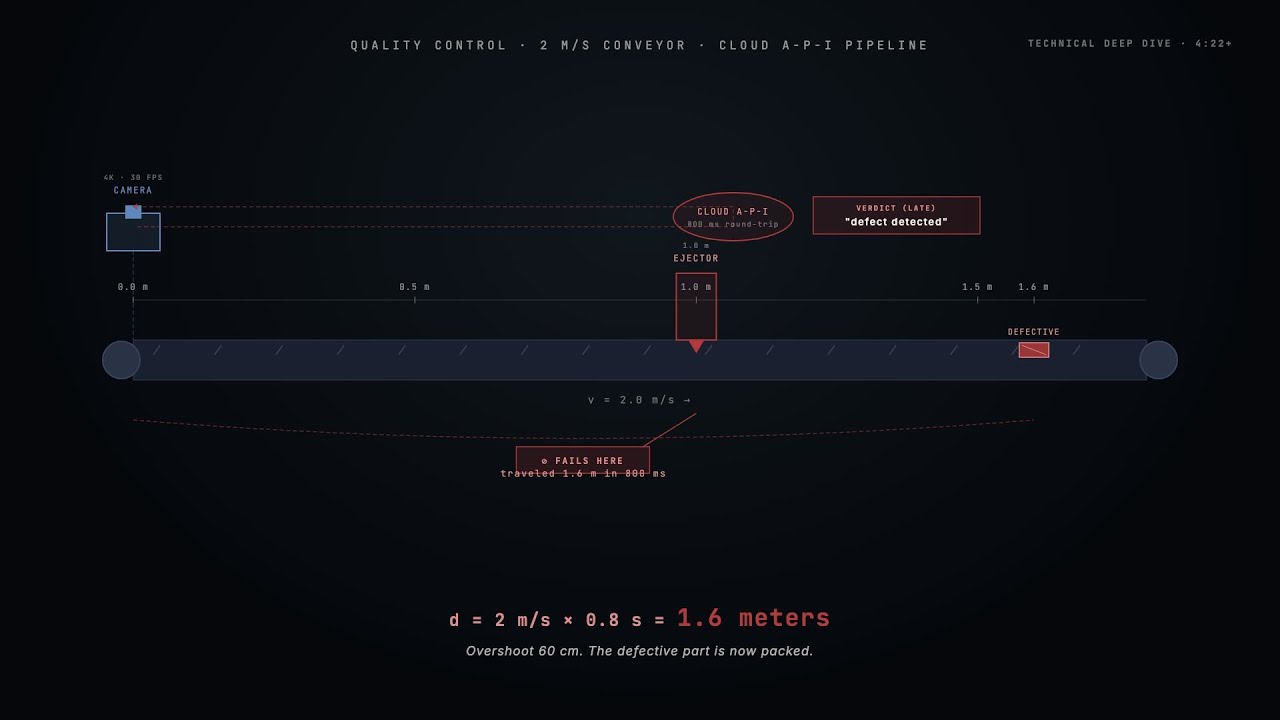
This whitepaper dissects a paradigm-shifting failure mode: a manufacturer attempting to use a cloud-based AI API for visual inspection, only to find that the 800-millisecond round-trip latency rendered the system useless. By the time the "Defect Detected" signal returned from the data center, the defective part had traveled 1.6 meters, escaping the rejection mechanism and entering the supply chain. This failure illustrates the "Latency Gap"—the dangerous chasm between the speed of digital inference and the speed of physical reality.
In response, Veriprajna advocates for and implements Edge-Native AI . By deploying quantized computer vision models directly onto NVIDIA Jetson devices, we have demonstrated the ability to reduce inference latency from 800ms to 12ms—a 98.5% improvement that restores deterministic control to the factory floor. Furthermore, we explore the frontier of Edge-Native Audio AI, where high-frequency microphones and TinyML models detect the spectral signatures of bearing faults milliseconds before catastrophic failure, triggering kill-switches in as little as 5 milliseconds.
We present a comprehensive economic and technical analysis of why the cloud was fired from the factory floor. We detail the crippling costs of unplanned downtime—averaging $22,000 per minute in the automotive sector—and provide a rigorous technical roadmap for implementing quantized, multi-modal AI at the edge. The future of industrial intelligence is not in the cloud; it is on the device, at the point of action, where code meets kinetic energy. "Stop talking to your machines. Start listening to them."
Chapter 1: The Deterministic Imperative
The fundamental conflict in modern industrial automation is not between human and machine, but between two opposing concepts of time: the probabilistic time of the internet and the deterministic time of the machine. To understand why cloud architectures fail in high-speed manufacturing, one must first appreciate the rigid temporal constraints of the physical world.
1.1 The Physics of the Conveyor Belt
Let us analyze the foundational case study that drives Veriprajna’s architectural philosophy. A manufacturer sought to modernize a quality control line using a standard Cloud AI API. The physical parameters were non-negotiable: a conveyor belt moving at a velocity () of 2 meters per second.
In a deterministic control loop, the system must observe, decide, and act within a window defined by the physical dimensions of the process. If a part is defective, it must be ejected before it passes the pneumatic actuator. Let us assume the distance between the camera (observation point) and the ejector (action point) is 1 meter.
The Time to Actuate () is calculated as:
This 500ms is the "Hard Real-Time" deadline. If the control signal arrives at $t = 501\text{ms}$, the system has failed. The part has physically passed the ejector. There is no "buffering" in the physical world; atoms do not wait for bits.
1.2 The Cloud Latency Tax
The manufacturer’s cloud-based solution introduced a latency chain that made meeting this 500ms deadline statistically impossible. The observed round-trip time was 800ms . To the uninitiated, 800ms (0.8 seconds) appears instantaneous. In the context of human-computer interaction, a 1-second delay is noticeable but acceptable. In the context of a 2 m/s conveyor, it is catastrophic.
During that 800ms delay, the part travels:
The part has traveled 1.6 meters—overshooting the 1-meter ejection station by 60 centimeters. The defect is detected, the cloud API returns a correct result, but the physics of the line have rendered the insight worthless. The "bad" part is already packed.
This 800ms latency is not a monolith; it is the aggregate sum of multiple inefficiencies inherent to wide-area networking (WAN):
● Image Capture & Encoding (20-40ms): The camera captures a frame (e.g., 5MB 4K image), which must be serialized and compressed (JPEG/PNG) for transmission.
● The "First Mile" Upload (100-300ms): The data must traverse the factory's local network, often competing with other traffic, pass through a firewall, and upload via an ISP. Upstream bandwidth is often the bottleneck.
● Network Jitter & Routing (50-200ms): The internet does not guarantee a direct path. Packets hop through multiple routers. If a packet is dropped—highly probable in factories rife with electromagnetic interference (EMI)—TCP retransmission mechanisms introduce unpredictable delays (jitter). 1
● Cloud Ingestion & Queueing (50-100ms): Upon reaching the data center, the request enters a load balancer and sits in a queue waiting for an available GPU worker.
● Inference (50-150ms): The actual AI processing takes time, especially if the model is large or not optimized for the specific hardware instance. 2
● The Return Trip (100-200ms): The result must travel all the way back to the factory PLC.
This architecture fundamentally violates the requirement for determinism. A control loop cannot rely on a communication channel (the public internet) where the variance in latency (jitter) can exceed the total allowable cycle time.
1.3 The Veriprajna Solution: 12ms at the Edge
By moving the inference engine from the cloud to the edge—specifically onto an NVIDIA Jetson device mounted directly on the conveyor—Veriprajna collapsed the topology.
● Distance to Compute: Reduced from ~500 miles to <1 meter.
● Transmission Medium: Changed from Public Internet (unreliable) to PCIe/MIPI-CSI (deterministic).
● Inference Speed: Reduced from 100ms+ (Shared Cloud GPU) to ~3-8ms (Dedicated TensorRT Optimized).
The total system latency dropped to 12ms.
With only 2.4 cm of travel during processing, the system has 97.6 cm of "spare" distance before the part reaches the ejector. This vast safety margin allows for precise timing, multiple verification checks, and absolute reliability. The 12ms response is not just faster; it transforms the system from a passive observer into an active, real-time controller.
Chapter 2: The Economic Physics of Downtime
To justify the investment in Edge-Native AI, we must translate milliseconds into dollars. The cost of latency is ultimately the cost of the downtime it causes. When a cloud-based system fails to catch a defect (escaped defect) or fails to prevent a machine crash due to lag, the financial repercussions are immediate and severe.
2.1 The $22,000 Per Minute Baseline
The automotive industry provides the starkest example of this financial gravity. According to multiple industry surveys, the average cost of unplanned downtime for an automotive manufacturer is $22,000 per minute . 3 This figure is not an outlier; for larger, high-volume facilities, respondents cite costs as high as $50,000 per minute . 3
In 2024, Siemens released an updated analysis indicating that for large automotive plants, the cost has escalated to a staggering $2.3 million per hour (approx. $38,000 per minute). 5 This represents a doubling of downtime costs since 2019, driven by inflation, increased automation complexity, and the extreme interdependence of modern supply chains. 6
Table 1: The Cost of Unplanned Downtime by Industry Sector
| Industry Sector |
Cost Per Minute (Avg) |
Cost Per Hour (Avg) |
Key Drivers of Cost |
Source |
|---|---|---|---|---|
| Automotive | $22,000 - $38,300 |
$1.32M - $2.3M |
JIT Supply Chain, Labor Overhead, Production Volume |
3 |
| Heavy Industry |
$16,000 - $25,000 |
$1M - $1.5M | Energy Restart Costs, Material Waste, Equipment Sync |
7 |
| FMCG | $5,000 - | $300k - | High Volume, | 6 |
| Col1 | $10,000 | $600k | Perishability, Packaging Botltenecks |
Col5 |
|---|---|---|---|---|
| Oil & Gas | Variable (High Variance) |
Variable | Safety Incidents, Environmental Fines, Global Oil Prices |
8 |
2.2 Deconstructing the Financial Loss
Why does a stopped minute cost $22,000? It is rarely the loss of the machine's output alone. The cost is an aggregate of several compounding factors:
1. Lost Production Revenue: In a plant producing one car every minute (a typical takt time), a 60-second stop means one less car to sell. If the average wholesale price is $30,000, that is $30,000 of revenue deferred or lost.
2. Direct Labor Overhead: A typical assembly line might have 200-500 workers. When the line stops, these workers are still paid. If 500 workers earn $30/hour, a 1-hour stop burns $15,000 in wages for zero output. 9
3. Scrap and Restart Waste: In processes like injection molding or chemical processing, a sudden stop often ruins the material currently in the machine. Restarting may require purging the system, wasting tons of raw material and energy. 9
4. Supply Chain Ripple Effect: Automotive uses Just-In-Time (JIT) delivery. If a Tier 1 supplier stops for an hour, they may miss a delivery window to the OEM assembly plant. The contractual penalties for stopping an OEM's line can be millions of dollars per incident. 3
5. Outsourcing & Overtime: To make up for lost production, manufacturers often force overtime shifts (paying 1.5x wages) or outsource production to expensive third-party vendors. 3
2.3 The "Hidden Factory" of Micro-Stoppages
While catastrophic outages grab headlines, the "Hidden Factory" of micro-stoppages causes insidious damage. A micro-stop is a pause of less than 5 minutes—often caused by a sensor misread, a network timeout, or a brief synchronization error.
If a cloud-based AI system experiences "network jitter" (variable latency) ten times a day, causing the line to pause for 30 seconds each time to re-sync, the facility loses 5 minutes per day. Over a year, this accumulates to over 30 hours of lost production. At $22,000/minute, those "minor" network glitches cost the company $39.6 million annually.
The cloud architecture inherently introduces these micro-stops because it introduces external dependencies (ISP, Cloud Provider, DNS) into the control loop. Edge-Native AI eliminates them. By localizing the compute, the system becomes immune to network fluctuations, reclaiming the millions lost to the "Hidden Factory" of latency. 10
2.4 ROI of Edge Implementation
Against the backdrop of $22,000/minute, the investment in Edge AI hardware is negligible. Deploying a $2,000 NVIDIA Jetson module and $5,000 in sensor hardware is paid for if it prevents 19 seconds of downtime per year.
The ROI of Edge AI is not measured in years, but in seconds.
Chapter 3: The Cloud's Broken Promise
For the last decade, manufacturers were sold a vision of the "Industrial Cloud" where 5G connectivity and infinite server farms would solve all optimization problems. This chapter analyzes why this vision failed to materialize for real-time control applications, focusing on the technical limitations of connectivity and the bandwidth trap.
3.1 5G vs. Fiber vs. Physics
A common counter-argument to Edge AI is: "Why not just use 5G?" The marketing narrative suggests that 5G's low latency (1-5ms air interface) renders local compute obsolete. This is a dangerous simplification. 12
The Signal Propagation Problem: 5G, particularly the high-speed mmWave bands required for low latency, suffers from poor penetration. Industrial environments are hostile RF environments:
● Metal Reflections: Factories are built of steel beams, metal siding, and massive machinery. This creates severe multipath propagation and signal shadowing.
● Interference: High-voltage motors, arc welders, and VFDs (Variable Frequency Drives) generate massive electromagnetic noise that can jam or degrade wireless signals. 1
● Blockage: A forklift driving between a sensor and a 5G small cell can break the line-of-sight required for mmWave, causing a sudden latency spike or connection drop. 1
The Fiber Alternative: Fiber optics offer speed and reliability but lack flexibility. Tethering every machine with fiber is expensive and practically impossible for mobile assets (AGVs) or reconfigurable production cells.
The Edge Advantage: Edge AI makes the connectivity medium irrelevant for the control loop. Whether the factory is on 5G, Fiber, or completely disconnected (air-gapped), the Jetson device on the machine continues to infer and act. The network is relegated to a secondary role: reporting status after the action has been taken, rather than being a dependency for the action. 14
3.2 The Bandwidth Trap: The Cost of Uplink
Visual inspection generates massive data. Consider a quality control station with 4 cameras, each 4K resolution, running at 30 FPS.
● Raw Data Rate: (Uncompressed)
● Compressed (H.265):
Streaming 80 Mbps continuously from a single station is manageable. But a factory has hundreds of stations. Streaming 8 Gbps of video to the cloud 24/7 is not only technically challenging (requiring massive dedicated fiber backhauls) but economically ruinous.
● Egress/Ingress Fees: Cloud providers charge for data movement. Petabytes of video ingress can cost tens of thousands of dollars monthly. 15
● Storage Costs: Storing this video in the cloud adds another layer of OpEx.
Edge-Native Efficiency: With Edge AI, the video is processed locally. The AI decides: "This frame is normal." That data is discarded or overwritten. Only when a defect is detected does the system save the image and upload it for record-keeping.
● Data Reduction: From 100% of frames to <1% of frames (only anomalies).
● Bandwidth Savings: >99% reduction in uplink requirements. 16
3.3 The Fragility of TCP/IP in Control Loops
The internet runs on TCP/IP. TCP (Transmission Control Protocol) is designed for reliability, not timeliness. If a packet is lost, TCP waits, requests a retransmission, and waits again. This mechanism, while ensuring your email arrives intact, is poison for real-time control. 1
In a control loop, late data is often worse than lost data. If the sensor reading for arrives at , acting on it is dangerous because the system state has changed. Cloud protocols fundamentally struggle to provide the Time-Sensitive Networking (TSN) guarantees required for industrial safety.
Veriprajna fires the cloud because we refuse to build safety-critical systems on a protocol designed for best-effort delivery. We build on the PCIe bus, the MIPI-CSI interface, and the GPIO pin—channels where latency is bounded, predictable, and microscopic.
Chapter 4: The Edge Vision Stack
To achieve the 12ms inference benchmark, Veriprajna utilizes a sophisticated stack of hardware and software optimization. It is not enough to simply "run code locally"; the code must be physically adapted to the silicon.
4.1 Hardware: The NVIDIA Jetson Advantage
Our preferred platform is the NVIDIA Jetson family (Orin NX, AGX Orin, AGX Thor). Unlike standard x86 Industrial PCs (IPCs), the Jetson is an embedded supercomputer designed specifically for AI. 17
Key Architectural Features:
1. Unified Memory Architecture (UMA): In discrete GPU setups (e.g., a PC with a GPU card), the CPU must copy image data from system RAM to GPU VRAM via the PCIe bus. This copy operation consumes precious milliseconds. Jetson's CPU and GPU share the same physical memory pool. The GPU can read the camera buffer directly, eliminating the copy bottleneck. 17
2. Tensor Cores: These are specialized arithmetic logic units (ALUs) designed solely for matrix multiplication/accumulation—the core operation of Deep Learning. The AGX Orin delivers up to 275 TOPS (Trillions of Operations Per Second), rivaling server-class GPUs of just a few years ago. 17
3. DLA (Deep Learning Accelerator): Jetson includes dedicated hardware blocks (DLAs) for fixed-function inference, allowing the main GPU to be offloaded or run parallel tasks. 19
4.2 Software: The Power of Quantization
The 12ms breakthrough is largely achieved through Model Quantization . Standard AI models are trained using 32-bit Floating Point numbers (FP32). While precise, FP32 models are heavy:
● Memory Footprint: 4 bytes per parameter.
● Bandwidth Load: High pressure on memory interfaces.
Veriprajna converts these models to INT8 (8-bit Integer) precision.
● Size Reduction: 4x smaller (1 byte per parameter).
● Speedup: 8-bit integer math is significantly faster to compute than 32-bit floating point math. 20
The Accuracy Trade-off: Skeptics worry about accuracy loss. However, empirical studies and our own deployments show that with Post-Training Quantization (PTQ) and calibration (running sample data to map the dynamic range of activations), the accuracy drop is typically less than 1%.20 For a defect detection task (e.g., "Is there a scratch?"), the difference between 99.5% confidence and
99.1% confidence is irrelevant—both trigger the rejection.
4.3 TensorRT Optimization
We do not run raw PyTorch or TensorFlow code on the device. We compile the models using NVIDIA TensorRT . This SDK performs graph optimization:
● Layer Fusion: Combines multiple layers (e.g., Convolution + ReLU + Bias) into a single kernel to reduce memory access overhead.
● Kernel Auto-Tuning: TensorRT tests different algorithms for matrix multiplication and selects the one that runs fastest on the specific Jetson chip being used. 21
Benchmarking the Difference: A standard YOLOv8 model (Object Detection) might run at 30-40ms on a Jetson using standard PyTorch. After conversion to TensorRT INT8, the same model runs at 3-5ms.22 Adding pre-processing (resize, normalization) and post-processing (Non-Maximum Suppression) brings the total pipeline to our 12ms target. Table 2: Inference Performance Comparison (YOLOv8)
| Platof rm / Confgi uration |
Precision | Latency (ms) | FPS |
|---|---|---|---|
| Cloud API (Hyperscaler) |
FP16 | 800ms+ (w/ Network) |
< 1.5 |
| Jetson Orin NX (PyTorch) |
FP32 | 35ms | ~28 |
| Jetson Orin NX (TensorRT) |
FP16 | 7.2ms | ~139 |
| Jetson Orin NX (TensorRT) |
INT8 | 3.2ms | ~313 |
This table illustrates the massive performance gulf. The INT8 TensorRT implementation is not just "faster"; it is in a different order of magnitude, enabling ultra-high-speed inspection that Cloud APIs simply cannot touch.
Chapter 5: The Acoustic Revolution
While computer vision is the eyes of the factory, Acoustic AI is its ears and stethoscope. Many of the most expensive failures—seized bearings, cracked spindles, cavitation in pumps—happen internally, invisible to cameras until it is too late. Veriprajna's tagline, "Stop talking to your machines. Start listening to them," reflects a shift toward using sound as a primary diagnostic tool.
5.1 Beyond Vibration: The Physics of Ultrasound
Traditionally, manufacturers use accelerometers (vibration sensors) to monitor equipment. However, vibration is a lagging indicator . A bearing only vibrates significantly after physical damage (spalling, pitting) has occurred on the race. 25
Ultrasound (Acoustic Emission) is a leading indicator .
● Mechanism: When a bearing lacks lubrication or develops a microscopic crack, the increased friction generates high-frequency stress waves. These occur in the ultrasonic range (20 kHz - 100 kHz), long before they manifest as low-frequency vibration or audible noise. 27
● Detection Window: Ultrasound can detect lubrication failure weeks before vibration sensors trigger an alarm. This provides a massive window for preventative maintenance. 29
5.2 The 5ms Kill-Switch: TinyML in Action
For critical machinery like high-speed CNC spindles (spinning at 20,000+ RPM), even a few seconds of "dry running" (lubrication failure) can weld the bearings, destroying a $50,000 spindle.
Veriprajna implements a 5ms acoustic kill-switch .
1. Sensors: We use high-frequency MEMS microphones capable of sampling at 96kHz or 192kHz to capture the ultrasonic spectrum. 30
2. Compute: Unlike vision, audio data is lightweight. We do not need a powerful Jetson. We use TinyML microcontrollers (like the ARM Cortex-M7 or specialized DSPs). 31
3. Model: A lightweight 1D-Convolutional Neural Network (1D-CNN) trained on the spectral signature (spectrogram) of the bearing. 33
4. Action: The model runs continuously. If it detects the specific spectral "scream" of a cracking bearing or lubrication loss, it triggers a GPIO pin connected to the machine's Emergency Stop circuit.
Why 5ms?
● Acquisition Window: 2ms of audio is sufficient to detect the pattern.
● Inference: <1ms on a microcontroller.
● Actuation: <1ms electrical signal.
This 5ms reaction time stops the machine before the heat builds up enough to fuse the metal. The difference is a $500 bearing replacement (maintenance) versus a $50,000 spindle replacement (catastrophe).
5.3 Beamforming: Isolating the Signal in the Noise
Factories are loud. How does a microphone distinguish a failing bearing from a forklift driving by? We use Acoustic Beamforming.
● Array Technology: By using an array of microphones (e.g., 64 or 124 mics), the system can measure the minute time-of-arrival differences of sound waves. 34
● Spatial Filtering: This allows the AI to mathematically "steer" its listening focus to a specific point in 3D space (the bearing housing), effectively muting all ambient noise coming from other directions. 36
● Result: A clean, isolated signal of the machine's internal condition, even in a 100dB industrial environment.
5.4 Case Study: The Ball Bearing Whisperer
A Veriprajna client, an automotive parts manufacturer, struggled with random spindle failures on their CNC line. Metal shavings would occasionally contaminate the coolant, leading to rapid bearing degradation.
● The Old Way: Operators listened for "bad noises." By the time they heard it, the spindle was dead. Cost: $45,000 per incident + 2 days downtime.
● The Veriprajna Way: We installed a non-contact acoustic sensor directed at the spindle. We trained a TinyML model on the specific frequency shift (25kHz to broadband noise) associated with contamination. 38
● Outcome: The system detected the signature of contamination-induced friction. It triggered the kill-switch in 5ms. The machine stopped. The bearing was damaged but the spindle shaft was saved.
● Savings: The repair cost $800 instead of $45,000. The ROI for the sensor system was achieved in the first event.
Chapter 6: Security, Sovereignty, and Resilience
The argument for Edge-Native AI extends beyond speed and cost. In an era of cyberwarfare and industrial espionage, the architecture of the factory network is a matter of national and corporate security.
6.1 The Air Gap as the Ultimate Firewall
Cloud-based AI requires a constant stream of sensitive data—images of prototypes, production rates, proprietary assembly techniques—to leave the factory premises. This exposes the manufacturer to:
● Data Interception: Man-in-the-middle attacks.
● Compliance Violations: Many defense (ITAR), aerospace, and pharmaceutical regulations strictly prohibit sensitive data from residing on shared public cloud servers. 39
● "Shadow AI": The risk that proprietary data might be used to train a foundation model that eventually benefits a competitor. 40
The Edge Solution: Veriprajna's Edge-Native architecture restores the Air Gap. The Jetson device processes the image locally. The raw data never leaves the device's RAM. Only the metadata—"Part #1234: PASS"—is sent to the central dashboard. This "Data Sovereignty" ensures that the manufacturer retains absolute control over their intellectual property.14
6.2 Operational Resilience
Cloud dependency creates a single point of failure. If the internet connection is severed—by a backhoe cutting a fiber line, a severe storm, or a DDoS attack on the ISP—the cloud-connected factory stops.
The Edge-Native factory is autonomous . Because the intelligence resides on the machine, the loss of internet connectivity has zero impact on production. The cameras continue to inspect, the microphones continue to listen, and the PLCs continue to act. The system simply caches the logs and syncs them when the connection is restored. This resilience is the difference between a "Smart Factory" that is fragile and an "Intelligent Factory" that is robust. 11
Chapter 7: The Edge-Native Implementation Playbook
Transitioning from cloud to edge is not just a hardware swap; it is a strategic initiative. Veriprajna employs a rigorous implementation methodology modeled on best-in-class frameworks.
7.1 Strategic Checklist for Deployment
To ensure success, we guide clients through the following readiness checklist 42 :
1. Latency Audit: Identify all control loops where action depends on external data. Measure the "Time to Criticality" (e.g., how fast does the conveyor move?). If the criticality time < 1 second, the Cloud is fired.
2. Data Sovereignty Assessment: Categorize data by sensitivity. Vision and Audio data usually fall into "High Sensitivity" and should be processed at the edge.
3. Hardware Selection: Match the compute to the task.
○ Heavy Vision (4K, High FPS): NVIDIA Jetson AGX Orin.
○ Standard Vision (1080p): Jetson Orin NX.
○ Audio/Vibration: Microcontrollers (Cortex-M7) or Jetson Nano. 44
4. Network Partitioning: Ensure OT (Operational Technology) networks are segmented from IT networks, with Edge devices acting as secure gateways. 45
7.2 The Hardware Stack
We utilize standardized, ruggedized hardware to ensure longevity in harsh environments.
| Component | Specifci ation Recommendation |
Rationale |
|---|---|---|
| Compute Module | NVIDIA Jetson Orin NX (16GB) |
Balanced cost/performance (100 TOPS) for multi-model inference.17 |
| Enclosure | IP67 Fanless Aluminum Chassis |
Passive cooling, protection from oil mist and metal dust.46 |
| Camera | Global Shuter, GigE Vision | Global shuter prevents "jello efect" motion blur on fast conveyors.47 |
| Audio Sensor | MEMS Array (20kHz - 80kHz) |
Capture ultrasonic precursors to failure.35 |
| Integration | Modbus TCP / OPC-UA | Native protocols to talk to Siemens/Allen-Bradley PLCs.48 |
7.3 Software: Containerized Microservices
Our software delivery is modern and agile:
● Docker Containers: The entire AI application (DeepStream, TensorRT model, Business Logic) is packaged in a Docker container. This allows for Over-the-Air (OTA) updates. If we retrain the model to detect a new type of scratch, we push the new container to the fleet instantly. 49
● Kubernetes (K3s) at the Edge: For larger deployments, we use lightweight Kubernetes to orchestrate the fleet, ensuring high availability and self-healing if a service crashes.
Conclusion: The New Industrial Reality
The experiment with Cloud-based real-time control has concluded, and the results are definitive. For the distinct, unforgiving physics of the factory floor, the cloud is an absentee manager—too far away, too slow to react, and too unreliable to trust with the heartbeat of production.
Latency is the enemy. In a world where unplanned downtime burns $22,000 every minute, the 800ms lag of the cloud is an operational tax that manufacturers can no longer afford to pay.
Veriprajna offers the alternative.
● We fire the cloud from the control loop, reclaiming determinism.
● We deploy the edge, putting 275 TOPS of compute right next to the conveyor.
● We stop talking to machines with outdated vibration sensors.
● We start listening with ultrasonic AI that hears failure before it happens.
The Post-Cloud factory is not disconnected; it is decentralized. It is resilient, sovereign, and faster than human reaction time. It is the realization of the true promise of AI: not just to analyze the past, but to control the present.
Veriprajna. Deep AI. Zero Latency. Real Reality.
Works cited
AI is on the Edge and Network Jitter is Pushing It Over, accessed December 10, 2025, https://www.badunetworks.com/ai-is-on-the-edge-and-network-jiter-is-pushintg-it-over/
Fastest Cloud Providers for AI Inference Latency in U.S. - DEV Community, accessed December 10, 2025, https://dev.to/julia_smith/fastest-cloud-providers-for-ai-inference-latency-in-us-2j4a
The $22000-Per-Minute Manufacturing Problem, accessed December 10, 2025, https://www.manufacturing.net/home/article/13055083/the-22000perminute-manufacturing-problem
National Instruments Has Developed a Maintenance as a Service Solution, accessed December 10, 2025, https://fieldserviceusa.wbresearch.com/blog/national-instruments-has-developed-a-maintenance-as-a-service-solution
8 strategic challenges in manufacturing that you can eliminate by implementing Predictive Maintenance - ConnectPoint, accessed December 10, 2025, https://connectpoint.eu/8-strategic-challenges-in-manufacturing-that-you-can-eliminate-by-implementing-predictive-maintenance/
The True Cost of an Hour's Downtime: An Industry Analysis | Siemens Blog, t b accessed December 10, 2025, https://blog.siemens.com/2024/07/the-true-cost-of-an-hours-downtime-an-industry-analysis/
The True Costs of Downtime in 2025: A Deep Dive by Business Size and Industry, accessed December 10, 2025, https://www.erwoodgroup.com/blog/the-true-costs-of-downtime-in-2025-a-deep-dive-by-business-size-and-industry/
The True Cost of Downtime 2024 - Digital Asset Management, accessed December 10, 2025, https://assets.new.siemens.com/siemens/assets/api/uuid:1b43afb5-2d07-47f7-9eb7-893fe7d0bc59/TCOD-2024_original.pdf
Unplanned Downtime Costs More Than You Think - Forbes, accessed December 10, 2025, https://www.forbes.com/councils/forbestechcouncil/2022/02/22/unplanned-downtime-costs-more-than-you-think/
Why Understanding Machine Downtime is Essential for Manufacturers - FourJaw, accessed December 10, 2025, https://fourjaw.com/blog/why-understanding-machine-downtime-is-essential-for-manufacturers
Latency is Unsafe: Why Your Real-Time Control Loops Demand Local Edge AI Oxmaint, accessed December 10, 2025, https://www.oxmaint.com/blog/post/edge-ai-latency-real-time-manufacturing-control-safety
5G vs Fiber Speed: Which Is Faster? (Full Answer) - EPB, accessed December 10, t b 2025, https://epb.com/get-connected/gig-internet/5g-vs-fiber-speed/
Unleashing the true potential of 5G with cloud networks | Microsoft Azure Blog, t b accessed December 10, 2025, https://azure.microsoft.com/en-us/blog/unleashing-the-true-potential-of-5g-with-cloud-networks/
How does edge AI benefit industrial automation? - Milvus, accessed December 10, 2025, https://milvus.io/ai-quick-reference/how-does-edge-ai-benefit-industrial-automation
00Cloud Rendering vs Edge Processing: When Users Complain About Lag — Which Scales Better for Digital-Twin Platforms? - AlterSquare, accessed December 10, 2025, https://altersquare.medium.com/cloud-rendering-vs-edge-processing-when-users-complain-about-lag-which-scales-beter-for-5d69f9628e94t
Edge AI vs Cloud AI: Which Is Better For Visual Inspection? - Averroes AI, t b accessed December 10, 2025, https://averroes.ai/blog/edge-ai-vs-cloud-ai
Jetson Benchmarks - NVIDIA Developer, accessed December 10, 2025, t b https://developer.nvidia.com/embedded/jetson-benchmarks
Optimizing AI Inference Latency: NUMA Binding, HugePages & Kernel Tuning | ZMTO, accessed December 10, 2025, https://zmto.com/blog/ai-inference-latency-optimization
Quantized Object Detection for Real-Time Inference on Embedded GPU Architectures - The Science and Information (SAI) Organization, accessed December 10, 2025, https://thesai.org/Downloads/Volume16No5/Paper_3-Quantized_Object_Detection_for_Real_Time_Inference.pdf
Model Quantization: Concepts, Methods, and Why It Matters | NVIDIA Technical Blog, accessed December 10, 2025, https://developer.nvidia.com/blog/model-quantization-concepts-methods-and-why-it-maters/ t
Optimizing LLMs for Performance and Accuracy with Post-Training Quantization, accessed December 10, 2025, https://developer.nvidia.com/blog/optimizing-llms-for-performance-and-accuracy-with-post-training-quantization/
YOLOv8 Performance Benchmarks on NVIDIA Jetson Devices - Seeed Studio, accessed December 10, 2025, https://www.seeedstudio.com/blog/2023/03/30/yolov8-performance-benchmarks-on-nvidia-jetson-devices/
Yolov8 model latency on jetson orin nx - NVIDIA Developer Forums, accessed December 10, 2025, https://forums.developer.nvidia.com/t/yolov8-model-latency-on-jetson-orin-nx/327990
Nderstanding Real-World Latency vs. Theoretical Estimates on Jetson Orin NX for YOLOv8s, accessed December 10, 2025, https://forums.developer.nvidia.com/t/nderstanding-real-world-latency-vs-theoretical-estimates-on-jetson-orin-nx-for-yolov8s/308749
Fault Detection in Rotating Machinery Using Acoustic Emission - ResearchGate, accessed December 10, 2025, https://www.researchgate.net/publication/289479163_Fault_Detection_in_Rotating_Machinery_Using_Acoustic_Emission
Bearing Condition Monitoring Using Ultrasound < MACH Exhibition, accessed December 10, 2025, https://www.machexhibition.com/bearing-condition-monitoring-using-ultrasound/
Ultrasonic Condition Monitoring, accessed December 10, 2025, http://media.noria.com/sites/WhitePapers/WPFILES/UESYSTEMS200901.pdf
Ultrasound Condition Monitoring | UE Systems, accessed December 10, 2025, https://www.uesystems.com/wp-content/uploads/ultrasound-condition-monitoring-1.pdf
Understanding the Complexities of Ultrasound for Machine Condition Monitoring, accessed December 10, 2025, https://www.alliedreliability.com/blog/understanding-the-complexities-of-ultrasound-for-machine-condition-monitoring
Fault Detection in Rotating Machinery Based on Sound Signal Using Edge Machine Learning - IEEE Xplore, accessed December 10, 2025, https://ieeexplore.ieee.org/iel7/6287639/6514899/10017251.pdf
Low-cost prototype for bearing failure detection using Tiny ML through vibration analysis, accessed December 10, 2025, https://pmc.ncbi.nlm.nih.gov/articles/PMC12155922/
Edge Impulse Audio Classification Tutorial: Build Smart Audio Recognit - Think Robotics, accessed December 10, 2025, https://thinkrobotics.com/blogs/learn/edge-impulse-audio-classification-tutorial-build-smart-audio-recognition-models-for-edge-devices
Anomaly detection on audio data - Edge Impulse Forum, accessed December 10, 2025, https://forum.edgeimpulse.com/t/anomaly-detection-on-audio-data/942
Beamforming Applied to Ultrasound Analysis in Detection of Bearing Defects, accessed December 10, 2025, https://www.researchgate.net/publication/355202637_Beamforming_Applied_to_Ultrasound_Analysis_in_Detection_of_Bearing_Defects
Datasheet 90019000-L001 Technical Specifications - NL Acoustics, accessed December 10, 2025, https://nlacoustics.com/wp-content/uploads/2020/09/NL_Camera_Datasheet_L001-1.pdf
Acoustic-Based Rolling Bearing Fault Diagnosis Using a Co-Prime Circular Microphone Array - MDPI, accessed December 10, 2025, https://www.mdpi.com/1424-8220/23/6/3050
NL Acoustic Imager | PDF | Frame Rate | Camera - Scribd, accessed December 10, 2025, https://www.scribd.com/document/815854847/NL-acoustic-imager
Ultrasound Sensors for Vibration Condition Monitoring - NCD.io, accessed December 10, 2025, https://ncd.io/blog/ultrasound-sensors-for-vibration-condition-monitoring/
AI Data Security: The 83% Compliance Gap Facing Pharmaceutical Companies Ziwei: AI-powered Visual Inspection Solution Provider for Pharma, accessed December 10, 2025, https://www.ziwei.io/news/180
Exploring privacy issues in the age of AI - IBM, accessed December 10, 2025, https://www.ibm.com/think/insights/ai-privacy
Edge AI - Intel, accessed December 10, 2025, https://www.intel.com/content/www/us/en/learn/edge-ai.html
Procurement efficiency: A modern strategy for state and local leaders McKinsey, accessed December 10, 2025, https://www.mckinsey.com/industries/public-sector/our-insights/procurement-eficiency-a-modern-strategy-for-state-and-local-leaders
How AI enables new possibilities in chemicals - McKinsey, accessed December 10, 2025, https://www.mckinsey.com/industries/chemicals/our-insights/how-ai-enables-new-possibilities-in-chemicals
Transforming Manufacturing with AI and Edge Computing - Dell, accessed December 10, 2025, https://www.delltechnologies.com/asset/en-my/solutions/business-solutions/briefs-summaries/transforming-manufacturing-with-ai-and-edge-computing-ebook.pdf
The Top 10 Challenges Preventing Industrial AI at Scale... And Exactly How to Beat Them, accessed December 10, 2025, https://xmpro.com/the-top-10-challenges-preventing-industrial-ai-at-scale-and-exactly-how-to-beat-them/
Reducing Latency: Edge AI vs. Cloud Processing in Manufacturing - VarTech Systems, accessed December 10, 2025, https://www.vartechsystems.com/articles/reducing-latency-edge-ai-vs-cloud-processing-manufacturing
How does AI image processing achieve real-time inference? - Tencent Cloud, accessed December 10, 2025, https://www.tencentcloud.com/techpedia/125197
Achieving robust closed-loop control in remote locations with Kelvin's edge-cloud communication | AWS for Industries, accessed December 10, 2025, https://aws.amazon.com/blogs/industries/achieving-robust-closed-loop-control-in-remote-locations-with-kelvins-edge-cloud-communication/
AI-Focused Edge Inference: Use Cases And Guide for Enterprise - Mirantis, accessed December 10, 2025, https://www.mirantis.com/blog/ai-focused-edge-inference-use-cases-and-guide-for-enterprise/
Prefer a visual, interactive experience?
Explore the key findings, stats, and architecture of this paper in an interactive format with navigable sections and data visualizations.
Frequently Asked Questions
Why does cloud AI fail for industrial conveyor inspection?
Cloud AI introduces 800ms round-trip latency through image encoding, upload, network routing, queueing, inference, and return. On a conveyor belt moving at 2 m/s, the defective part travels 1.6 meters during this delay — overshooting the 1-meter ejection station by 60cm. The defect is correctly detected but the physics of the line render the insight worthless. TCP/IP's retransmission mechanisms add unpredictable jitter, making cloud architectures fundamentally incompatible with deterministic control loops.
How does edge AI achieve 12ms industrial inspection latency?
By deploying quantized vision models on NVIDIA Jetson devices mounted directly on the conveyor, Veriprajna reduces compute distance from 500+ miles to under 1 meter and switches from public internet to PCIe/MIPI-CSI interfaces. Jetson's Unified Memory Architecture eliminates CPU-GPU copy overhead, TensorRT optimization compresses models to INT8 precision with negligible accuracy loss, and dedicated Tensor Cores deliver 275 TOPS. At 12ms total latency, part displacement is only 2.4cm — leaving 97.6cm of safety margin.
What is Edge-Native Audio AI for predictive maintenance?
Veriprajna deploys high-frequency microphones with TinyML models that detect the spectral signatures of mechanical faults — such as bearing degradation patterns invisible to vibration sensors — milliseconds before catastrophic failure. Using beamforming to isolate individual machine signals in noisy factory environments, the system triggers hardware kill-switches in as little as 5ms, preventing cascading failures that cost $22,000 per minute in automotive manufacturing.
Also Published On
Build Your AI with Confidence.
Partner with a team that has deep experience in building the next generation of enterprise AI. Let us help you design, build, and deploy an AI strategy you can trust.
Veriprajna Deep Tech Consultancy specializes in building safety-critical AI systems for healthcare, finance, and regulatory domains. Our architectures are validated against established protocols with comprehensive compliance documentation.