Engineering the Post-Cloud Industrial Architecture
For high-speed manufacturing where conveyor belts move at 2 meters per second and CNC spindles rotate at 30,000 RPM, the cloud is not merely inefficient—it is an operational liability.
Veriprajna's Edge-Native AI reduces inference latency from 800ms to 12ms—a 98.5% improvement that restores deterministic control to the factory floor.
The fundamental conflict in modern industrial automation is between probabilistic time of the internet and deterministic time of the machine.
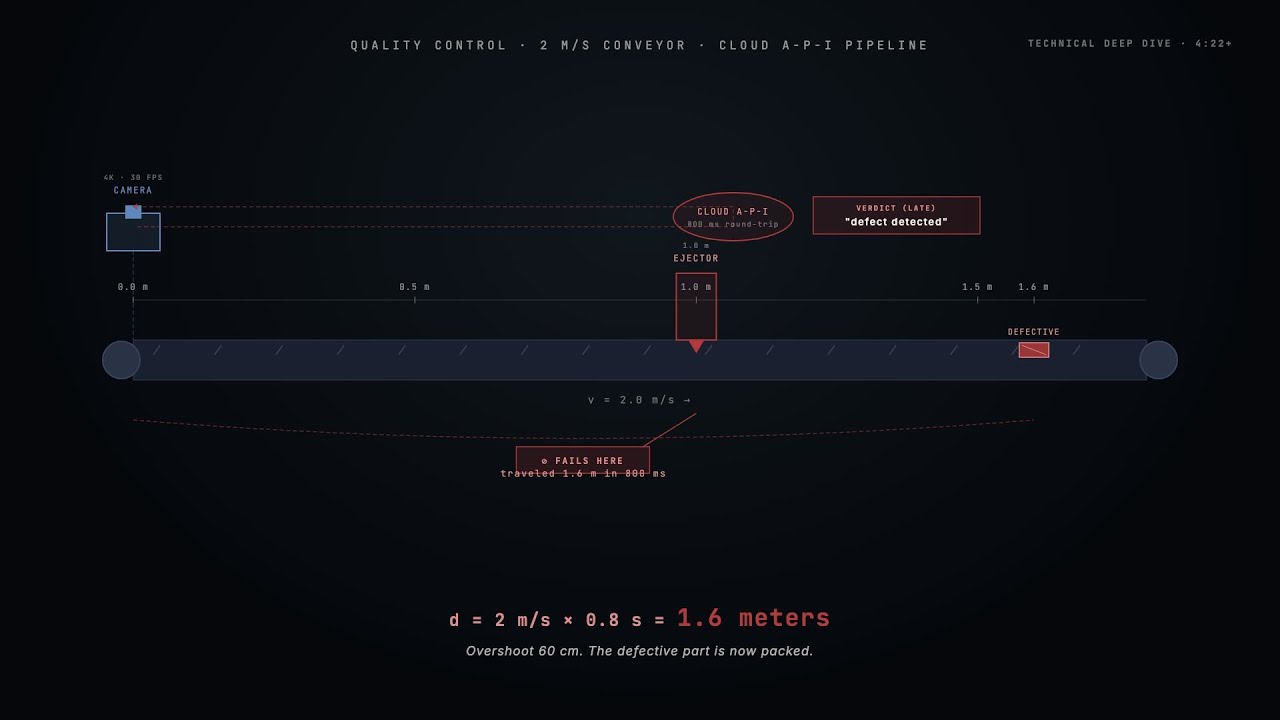
Conveyor belt: 2 m/s. Camera to ejector: 1 meter. Time budget: 500ms maximum. Cloud latency: 800ms. Result: System failure.
Automotive downtime: $22,000/minute (avg). Large facilities: up to $2.3M/hour. Even 10 micro-stops per day = $39.6M/year lost.
Cloud latency = Image encoding (20-40ms) + Upload (100-300ms) + Network jitter (50-200ms) + Queueing (50-100ms) + Inference (50-150ms) + Return trip (100-200ms)
Watch how a defective part escapes the ejection mechanism when using Cloud AI vs Edge AI
Belt Speed: 2 m/s | Camera-to-Ejector Distance: 1 meter
By the time the "Defect Detected" signal returns (800ms), the part has traveled 1.6 meters and escaped the 1m ejection zone.
With 12ms latency, the part travels only 2.4cm, leaving 97.6cm of safety margin. Defect successfully ejected.
Network jitter causing 10 × 30-second pauses per day = 5 minutes/day = 30 hours/year
These "minor" glitches are invisible but devastating
The ROI of Edge AI is not measured in years, but in seconds. If the system prevents just 19 seconds of downtime per year, it has paid for itself.
Marketing promises 1-5ms latency, but factories are hostile RF environments with metal reflections, EMI from motors/welders, and line-of-sight blockages.
4 cameras × 4K @ 30fps = 80 Mbps continuous upload. For 100 stations = 8 Gbps. Cloud egress/ingress fees: tens of thousands monthly.
TCP prioritizes reliability over timeliness. Packet loss → retransmission → unpredictable delay. In control loops, late data is worse than lost data.
Hardware captures reality. AI translates pixels into action at <300ms latency.
AGX Orin delivers 275 TOPS with Unified Memory Architecture—GPU reads camera buffer directly, zero copy overhead.
FP32 → INT8 conversion: 4× smaller model, 8× faster inference. Accuracy loss: <1% (imperceptible for defect detection).
Layer fusion + kernel auto-tuning. YOLOv8: 35ms (PyTorch) → 3.2ms (TensorRT INT8). That's 10× faster.
Total pipeline (capture + preprocess + inference + postprocess): 12ms. No network jitter. No TCP retransmission. Pure predictability.
INT8 TensorRT is not just "faster"—it's in a different order of magnitude, enabling ultra-high-speed inspection impossible with Cloud APIs.
"Stop talking to your machines. Start listening to them."
Traditional accelerometers are lagging indicators—they only detect vibration after physical damage has occurred. Ultrasound (20-100 kHz) detects friction and lubrication failure weeks earlier.
For high-speed CNC spindles (20,000+ RPM), even seconds of dry running can weld the bearings, destroying a $50,000 spindle. Veriprajna's TinyML acoustic system detects the spectral "scream" of bearing failure and triggers emergency stop in 5 milliseconds.
Interactive demo: See how spectral signatures change as bearing condition deteriorates
Factories are loud. How does a microphone distinguish a failing bearing from a forklift driving by? Acoustic Beamforming with 64-124 mic arrays.
Cloud-based AI requires streaming sensitive data—images of prototypes, production rates, proprietary assembly techniques—to shared public servers.
Cloud dependency creates a single point of failure. Internet cut by backhoe, storm, or DDoS attack? Cloud-connected factory stops.
Transitioning from cloud to edge is not just a hardware swap; it is a strategic initiative.
DeepStream + TensorRT model + business logic in container. Retrain model to detect new defect? Push new container to fleet instantly.
Fleet management, high availability, self-healing if service crashes. Enterprise-grade reliability on edge devices.
Cloud AI introduces 800ms round-trip latency from image encoding, upload, network jitter, queueing, inference, and return. On a conveyor moving at 2 meters per second with a 1-meter camera-to-ejector distance, the 500ms time budget cannot tolerate 800ms delay—the defective part travels 1.6 meters, escaping 60cm past the ejection zone into the supply chain.
Edge AI deploys optimized models like YOLOv8 with INT8 quantization directly on NVIDIA Jetson AGX Orin hardware (275 TOPS) at the factory floor. By eliminating network round-trips, encoding overhead, and queueing delays, inference drops to 12ms. At 2m/s conveyor speed, the part moves only 2.4cm, leaving 97.6cm of safety margin for ejection.
Network jitter causing just 10 micro-stoppages of 30 seconds per day equals 5 minutes daily, or 30 hours annually. At the automotive industry average of $22,000 per minute downtime cost, these invisible micro-stoppages accumulate to $39.6 million per year in lost production—the 'Hidden Factory' that conventional monitoring cannot detect.
The experiment with Cloud-based real-time control has concluded. For the unforgiving physics of the factory floor, the cloud is an absentee manager—too far away, too slow, too unreliable.
Latency is the enemy. In a world where unplanned downtime burns $22,000 every minute, the 800ms lag of the cloud is an operational tax manufacturers can no longer afford to pay.
Complete engineering report: Latency analysis, NVIDIA Jetson specs, TensorRT optimization, quantization mathematics, acoustic AI implementation, security architecture, comprehensive works cited.