The Forensic Imperative: The Case for Deterministic Computer Vision in Insurance Claims Automation
Executive Summary: The Hallucination of Safety
The insurance industry currently stands at a technological precipice, balancing precariously between the promise of unprecedented automation and the peril of catastrophic evidentiary failure. The catalyst for this tension is the rapid, often unbridled, integration of Generative Artificial Intelligence (GenAI) into the claims ecosystem. While the allure of Large Language Models (LLMs) and Generative Image Models is undeniable—promising to slash operational costs and streamline customer interaction—their deployment in high-stakes visual forensics has revealed a critical, structural flaw in the modern InsurTech stack.
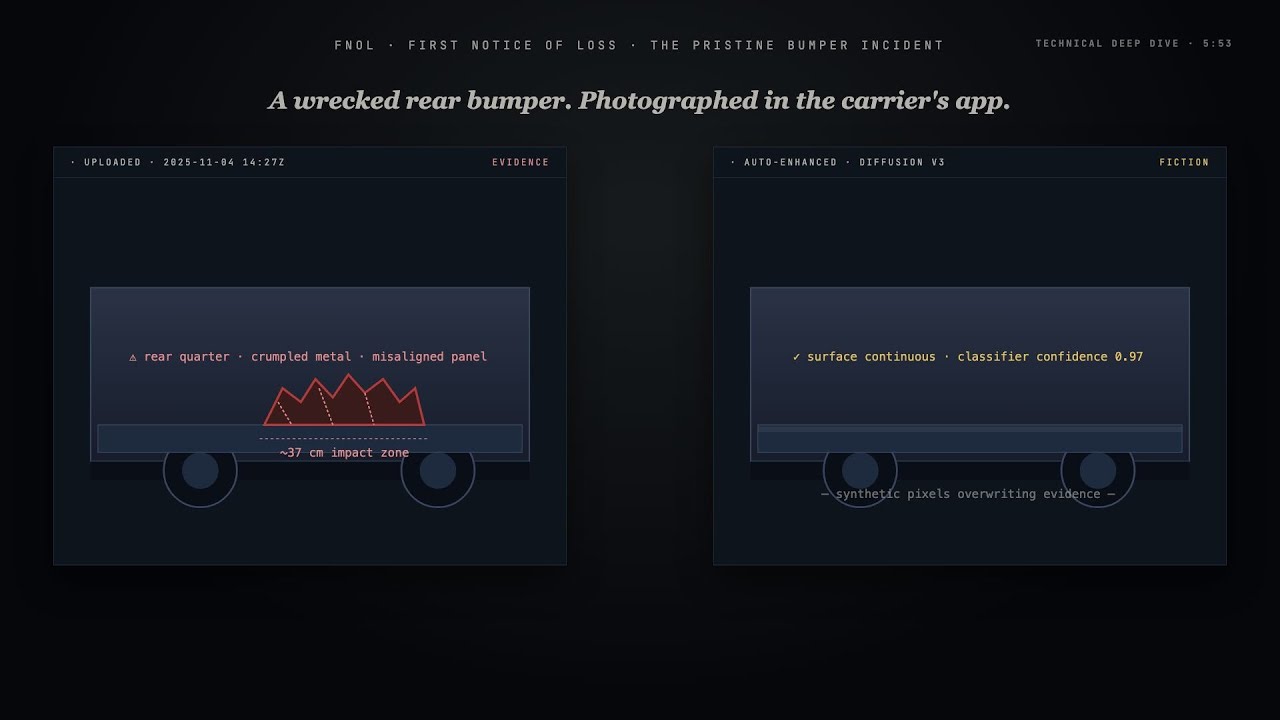
This flaw is not merely theoretical; it has already manifested in costly, reputation-damaging litigation. We refer to the now-infamous "Pristine Bumper" incident, a paradigmatic case study that serves as the genesis for this whitepaper. A major insurer, seeking to modernize its First Notice of Loss (FNOL) workflow, integrated a generic Generative AI tool into its mobile application. The objective was ostensibly benign: to enhance the quality of customer-uploaded claim photos to ensure clarity for adjusters. A policyholder, following a collision, uploaded an image of a severely dented rear bumper. The AI, built on latent diffusion architecture designed to "complete" and "denoise" images, analyzed the geometric irregularity of the dent. Interpreting the crunched metal as visual noise—a deviation from the statistical probability of a smooth car surface—the model utilized "Inpainting" to digitally smooth out the damage.
The resulting output was a high-resolution, perfectly lit, and utterly fictitious image of an undamaged car. The automated claims engine, processing this sanitized evidence, denied the claim on the grounds of zero visible damage. The customer, possessing the physical reality of a wrecked vehicle, sued for bad faith. The insurer was left holding a digitally spoliated record that directly contradicted physical reality. 1
This incident illuminates the central thesis of this report: Generative AI is fundamentally unsuited for the forensic analysis of insurance evidence. In the domain of risk and claims, "enhancement" is a liability. The requirement is not aesthetic perfection; it is Forensic Accuracy . Insurers do not need models that modify pixels to make them pretty; they need Deterministic Computer Vision models that analyze pixels to measure truth.
Veriprajna positions itself as the antithesis of the prevailing "Wrapper" economy. We do not provide a thin API layer over general-purpose foundational models like OpenAI or Claude. We are a Deep AI Solution Provider . We construct proprietary, physics-informed computer vision architectures that deploy Semantic Segmentation, Monocular Depth Estimation, and Specular Reflection Analysis to assess damage without altering a single bit of the evidentiary record. This whitepaper exhaustively details the technical, legal, and operational arguments for why the future of claims automation lies not in creative generation, but in deterministic, forensic analysis.
Section 1: The Epistemological Crisis in Digital Claims
To understand the magnitude of the risk facing carriers today, one must first interrogate the nature of the tools being deployed. The industry is currently witnessing a collision between two fundamentally different types of Artificial Intelligence: Generative and Discriminative. This is not merely a technical distinction; it is an epistemological one. It concerns how a system determines what is "true."
1.1 The Mechanics of "Hallucination by Design"
The "Pristine Bumper" error was not a glitch. It was the system functioning exactly as it was designed. Generative AI models, particularly the Diffusion Models (e.g., Stable Diffusion, Midjourney, DALL-E) that power modern image enhancement tools, are probabilistic synthesis engines. 3 They are trained on billions of images to learn the statistical distribution of visual data. They learn what a "cat" looks like, what a "sunset" looks like, and crucially, what a "car" looks like.
In the latent space of these models—the multi-dimensional mathematical representation of concepts—a "car" is overwhelmingly represented as a smooth, symmetrical object with continuous lines and unbroken surfaces. When such a model encounters a dent, it perceives a high-frequency disruption in the expected pattern. It sees chaos where there should be order. 4
When tasked with "enhancing" or "processing" an image, the model utilizes a process known as Inpainting or Denoising. It treats the dent as an anomaly, similar to grain or a smudge on the lens. The model's objective function is to maximize the likelihood that the output image belongs to the distribution of "normal car images." Therefore, it mathematically "heals" the dent, filling the chaotic pixels with the smooth, predictable pixels of a perfect fender. 5
This process is governed by the mathematics of diffusion, where the model reverses the introduction of noise. A dent, to a diffusion model, looks like noise. The model removes it to uncover the "clean" signal underneath. In art, this is a feature; it allows for the restoration of old photographs. In insurance, it is the automated spoliation of evidence. It replaces the messy, expensive reality of a crash with a plausible, inexpensive fiction. 7
1.2 The "Wrapper" Trap and the Commoditization of Risk
The rapid proliferation of these tools is driven by the "Wrapper" economy. A vast number of new InsurTech entrants are not building AI; they are building user interfaces (wrappers) that send data to public APIs provided by tech giants. 8 These wrappers rely on foundational models that are General Purpose .
A General Purpose model does not understand the concept of "indemnity." It does not know the difference between a "blemish" and "impact damage." It operates on the logic of semantic plausibility, not forensic reality. When an insurer integrates a wrapper solution, they are effectively outsourcing their claims adjudication logic to a model trained on the entire internet, with no specific understanding of the physics of collision. 10
This creates a dangerous dependency. If the foundational model provider updates their weights to be more "creative" or "aesthetic," the insurer’s damage assessment tool might suddenly start repairing cars digitally with greater aggression. 11 The insurer has no control over the "brain" making these decisions, yet they retain 100% of the liability for the outcome.
1.3 The Rise of Synthetic Fraud: The Deepfake Threat
While insurers inadvertently use AI to delete damage, fraudsters are using the same technology to manufacture it. The barrier to entry for insurance fraud has collapsed. We are witnessing the industrialization of claims fraud through Generative Adversarial Networks (GANs) and diffusion models. 1
1.3.1 Synthetic Damage Generation
Fraudsters can now take a photo of a pristine vehicle and use text-to-image prompting to "add a smashed front bumper" or "simulate fire damage." Modern inpainting tools handle lighting, shadows, and reflections with frightening realism. 1 A generic image classifier (the standard "AI" used by many insurers) will look at this deepfake and confirm: "Yes, this is a smashed car." It fails to detect that the damage is synthetic because it looks only at the content, not the structure of the generation.
1.3.2 The Ghost Policyholder
Beyond damage, we see the rise of "Synthetic Identity Fraud" or the "Ghost Policyholder." Criminal rings use GenAI to create hyper-realistic faces of non-existent people, generate fake driver's licenses, and even synthesize medical records or death certificates. 12 These digital phantoms purchase policies, pay premiums for a short duration to establish legitimacy, and then file catastrophic claims.
In Life Insurance, this manifests as "Death Faking," where AI generates obituary notices, coroner reports, and photos of accident scenes. 12 In Health Insurance, AI generates invoices from non-existent clinics and X-rays showing fractures that never happened. 13
The traditional defenses—checking metadata or relying on human intuition—are failing. AI-generated images often have scrubbed or synthesized EXIF data. 1 Humans are notoriously poor at detecting high-quality deepfakes, often performing no better than random chance. 2
1.4 The Value of Veriprajna: Deep Forensic Tech
This context sets the stage for Veriprajna. We are not a wrapper. We do not use Generative AI to "guess" what an image should look like. We use Discriminative Deep Learning to analyze what the image is .
Our approach is grounded in Forensic Computer Vision . We treat every pixel as a piece of evidence. Our models are trained not to create, but to measure. We utilize Semantic Segmentation to identify the exact boundaries of damage. We use Monocular Depth Estimation to calculate the volume of a dent. We use Deflectometry to analyze the physics of light reflection to verify the authenticity of the surface.
In the following sections, we will dismantle the technical architecture of this solution, proving why it is the only viable path for an industry regulated by strict legal and ethical standards.
Section 2: The Regulatory & Legal Minefield
The adoption of AI in insurance is no longer a sandbox experiment; it is a regulated activity under intense scrutiny. The legal landscape has shifted dramatically in the last 24 months, creating new liabilities for insurers who deploy "Black Box" or non-deterministic AI.
2.1 The NAIC Model Bulletin: The Demand for Governance
The National Association of Insurance Commissioners (NAIC) has issued the Model Bulletin: Use of Artificial Intelligence Systems by Insurers, a landmark guidance document that has been adopted by numerous states. 15 This bulletin fundamentally changes the compliance requirements for AI in claims.
2.1.1 Governance and Accountability
The NAIC Bulletin explicitly places the responsibility for AI outcomes on the insurer. It mandates that insurers must have a written "AIS Program" (Artificial Intelligence System Program) that governs the development, deployment, and monitoring of AI.17 Crucially, the Bulletin addresses the issue of Third-Party Vendors. Insurers cannot hide behind the "Wrapper" excuse. If an insurer uses a third-party AI tool (like an OpenAI wrapper) that hallucinates or discriminates, the insurer is liable. The insurer is required to perform due diligence on the vendor’s data lineage, model architecture, and validation testing.19 Veriprajna’s architecture is built for this compliance. Because we build our models from scratch (Deep Tech), we provide full lineage of our training data. We can prove that our models were trained on diverse datasets of real vehicles, not scraped internet data that might contain biases or copyrighted material. We offer full "Model Cards" and version control, allowing insurers to audit exactly why a decision was made. 2.1.2 Explainability vs. The Black Box
The NAIC emphasizes transparency. If a claim is denied based on AI analysis, the insurer must be able to explain the decision. 15
● Generative AI Failure: If a GenAI tool inpaints a dent and the claim is denied, the explanation is: "The model's probabilistic distribution preferred a smooth bumper." This is not a legally defensible explanation.
● Veriprajna Success: Our Semantic Segmentation output allows for a precise, mathematical explanation: "The claim was processed based on the detection of damage on the rear-left quarter panel. The system identified a scratch measuring 14cm in length and a dent with a surface area of 45cm², validated by depth map analysis." This is empirically verifiable and admissible.
2.2 The EU AI Act: High-Risk Classification
For insurers with global exposure, the European Union's AI Act sets the global standard. The Act classifies AI systems based on risk. AI used for "risk assessment and pricing in relation to natural persons in the case of life and health insurance" is designated as High Risk . 20 While property claims are treated slightly differently, the trajectory of regulation suggests that any AI affecting a consumer’s financial standing or access to services will face strict scrutiny.
High-Risk Obligations include:
● Data Governance: Training, validation, and testing datasets must be subject to appropriate data governance. 22
● Record Keeping: Automatic recording of events (logs) over the system's lifetime.
● Human Oversight: The system must be designed to allow for effective human oversight.
Veriprajna’s "Mask Overlay" technology is specifically designed to meet the Human Oversight requirement. We do not replace the adjuster; we augment them. The adjuster sees the original photo with a togglable layer of analysis. They remain the "Human in the Loop" (HITL), retaining final decision authority, which is a critical safe harbor under the AI Act. 23
2.3 The Doctrine of Spoliation and Digital Evidence
In the US legal system, Spoliation of Evidence refers to the intentional, reckless, or negligent withholding, hiding, altering, fabricating, or destroying of evidence relevant to a legal proceeding. 14
When an insurer uses a tool that automatically "enhances" or "upscales" an image using Generative AI, they are altering the evidentiary record. Even if the intention is to improve visibility, the introduction of synthetic pixels (pixels that were not captured by the camera sensor) technically constitutes alteration. 1
If a case goes to court, the plaintiff’s attorney will demand the "original" file. If the insurer’s workflow automatically overwrote the original with the AI-enhanced version, the insurer has committed spoliation. They may face sanctions, adverse inference jury instructions (where the jury is told to assume the lost evidence was damaging to the insurer), or summary judgment. 25
Veriprajna adheres to strict Digital Evidence Management (DEM) standards. 26
1. Ingestion: We hash the original image (SHA-256) immediately upon receipt.
2. Read-Only Analysis: Our AI reads the image buffer but never writes to it.
3. Sidecar Metadata: Our analysis (masks, depth maps, JSON reports) is saved as a separate file linked to the original hash.
4. Chain of Custody: We log every access and processing step. 24
This approach ensures that the evidence remains pristine and admissible, protecting the insurer from legal procedural failure.
Section 3: The Wrapper Problem – Why Thin AI Fails Enterprise Needs
In the current AI gold rush, the market is flooded with "Thin" AI companies. These entities essentially repackage the APIs of major research labs. While efficient for simple tasks, this architecture is structurally unsound for enterprise insurance applications.
3.1 The Dependency Risk
A "Wrapper" has no intellectual property of its own regarding the core intelligence. If OpenAI deprecates a model, changes its pricing, or alters its safety alignment (e.g., refusing to process images of car crashes due to "violence" filters), the Wrapper’s product breaks instantly.9 Veriprajna is Deep Tech. We own our weights. We train our own Convolutional Neural Networks (CNNs) and Transformers. We are immune to the whims of the public API market. Our models are deployed within the insurer's controlled environment, ensuring business continuity.
3.2 Data Sovereignty and Privacy
Passing claim data to a public API is a massive privacy risk. Photos of accidents often contain Personally Identifiable Information (PII) such as license plates, faces of bystanders, or even medical situations inside the vehicle.27 Public APIs may use this data for training their foundational models, leading to data leakage. Veriprajna supports Virtual Private Cloud (VPC) and On-Premise deployment. The data never leaves the insurer’s secure perimeter. This "Bring Your Own Cloud" (BYOC) model is essential for compliance with GDPR, CCPA, and internal enterprise security policies.29
3.3 Prompt Injection and Adversarial Attacks
LLM-based wrappers are susceptible to "Prompt Injection." A savvy user could potentially upload an image with hidden text (steganography) or visual patterns designed to trick the model into approving a claim or ignoring damage.27 Because wrappers rely on "instruction following" models, they can be manipulated. Veriprajna’s models are Deterministic. They do not follow instructions; they extract features. You cannot "talk" a Semantic Segmentation network into ignoring a dent. It operates purely on pixel intensity gradients and texture analysis, making it robust against linguistic or prompt-based adversarial attacks.
Section 4: Veriprajna’s Forensic Architecture – The Technology of Truth
Our solution replaces the creative ambiguity of generation with the mathematical precision of analysis. We employ a tripartite architecture comprising Semantic Segmentation, Monocular Depth Estimation, and Physics-Informed Specular Reflection Analysis.
4.1 Layer 1: Semantic Segmentation – The Digital Overlay
The first line of defense is identifying where the damage is and what it is. We do not simply classify an image as "damaged." We segment the damage at the pixel level.
4.1.1 The Architecture: Mask R-CNN and U-Net
We utilize advanced computer vision architectures such as Mask R-CNN and U-Net . 30 These are not generative models; they are discriminative.
● The Encoder (Contracting Path): The network ingests the image and downsamples it, extracting high-level features like edges, corners, and textures. It identifies the "car" and its constituent parts (bumper, hood, fender). 31
● The Decoder (Expanding Path): The network upsamples the features back to the original resolution, allowing for precise localization. It classifies every individual pixel.
4.1.2 The Output: The Semantic Mask
The result is a Binary Mask or a Multi-Class Mask .
● Pixel Class 0: Background
● Pixel Class 1: Undamaged Paint
● Pixel Class 2: Scratch (Yellow Overlay)
● Pixel Class 3: Dent (Red Overlay)
● Pixel Class 4: Rust (Brown Overlay)
This mask is overlaid on the original image. It provides immediate visual confirmation to the adjuster. Crucially, it allows for Automated Surface Area Calculation . By counting the pixels in the "Dent" class and correlating them with the known physical dimensions of the car part (e.g., knowing a 2024 Toyota Camry bumper is 180cm wide), we can calculate the exact square centimeter area of the damage. 33 This metric is directly ingestible by estimating software (like Audatex or Mitchell) to generate repair hours.
4.2 Layer 2: Monocular Depth Estimation – Seeing 3D in a 2D World
The failure of the "Bumper Case" GenAI was that it treated the image as a flat collection of colors. It failed to understand the 3D geometry of the dent. Veriprajna employs Monocular Depth Estimation (MDE) to solve this.
4.2.1 The Challenge of Scale Ambiguity
Estimating depth from a single camera is mathematically "ill-posed"—there are infinite 3D scenes that could produce the same 2D image. 34 However, by training on massive datasets of car geometries using LiDAR ground truth, our models learn "Scale Priors." The model "knows" the curvature of a wheel arch and the flatness of a door panel.
4.2.2 The Architecture: Depth Anything V2 & Vision Transformers
We utilize state-of-the-art architectures like Depth Anything V2 . 36 This is a foundation model specifically for depth. It uses a Vision Transformer (ViT) to pay attention to global context (the whole car) and local details (the dent).
● Input: A standard RGB photo.
● Output: A high-fidelity Depth Map (or disparity map), where pixel value equals distance from the camera.
4.2.3 Forensic Application: Dent Severity Scoring
On a pristine car panel, the depth map shows a smooth, continuous gradient. A dent appears as a "sinkhole"—a localized depression in the depth map.
● Gradient Analysis: We calculate the derivative of the depth map across the damaged area. A steep gradient indicates a sharp crease (hard to repair, likely replacement needed). A shallow gradient indicates a soft dent (repairable via PDR - Paintless Dent Repair). 30
● Volume Estimation: We integrate the depth values over the segmented area to estimate the displaced volume of the metal. This scientific metric allows for automated triage between "Light Repair" (Low), "Medium Repair" (Medium), and "Replace" (High), removing subjective human guessing from the process.
4.3 Layer 3: Specular Reflection Analysis – Physics-Informed AI
The most sophisticated layer of our stack addresses the "Invisible Damage" problem. Modern cars are shiny. Their surfaces act as mirrors. A dent on a shiny black car might not change the color of the pixels, but it warps the reflection . Standard AI sees the reflection of a tree and thinks it is paint texture. Veriprajna uses Deflectometry .
4.3.1 The Physics of Deflectometry
In a factory, quality control uses "Structured Light"—projecting zebra stripes onto a car to see distortions. In the wild, we rely on Natural Scene Statistics.38 The world is full of straight lines: horizons, power lines, building edges, road markings. When these lines are reflected in a car's clear coat, they should follow the curvature of the body. A dent acts like a concave or convex mirror, causing these reflection lines to pinch, swirl, or break (a singularity).
4.3.2 Reflection-Aware Models
Our models are trained to decouple the "albedo" (paint color) from the "specularity" (reflection). 40
1. Reflection Separation: We separate the reflection layer from the diffuse paint layer.
2. Flow Analysis: We analyze the vector flow of the reflection lines.
3. Surface Normal Reconstruction: By applying Snell’s Law and Fresnel equations in reverse, we reconstruct the Surface Normal Map —a 3D vector representing the angle of the surface at every pixel. 42
This allows us to detect:
● Hail Damage: Tiny indentations that are invisible to the naked eye but warp the reflection field. 44
● Ripple Effects: Structural buckling far away from the impact site, indicated by subtle waves in the reflection of the horizon.
● Previous Repairs: "Orange peel" texture or sanding marks in the clear coat that disrupt the perfect specularity, flagging potential fraud or pre-existing damage. 45
This is the ultimate definition of Forensic Accuracy . We are not guessing; we are measuring the interaction of light and matter.
Section 5: Operational Integration – The Life of a
Veriprajna Claim
How does this deep technology integrate into an enterprise workflow? We support the entire claims lifecycle, from First Notice of Loss (FNOL) to Settlement.
5.1 Step 1: Intelligent Ingestion (The Anti-Fraud Gate)
When a user snaps a photo in the insurer’s app, our SDK activates.
● Metadata Locking: We capture atomic time and GNSS coordinates, hashing them to the image file to prevent spoofing. 1
● Live Capture Verification: We use accelerometer data to ensure the phone was moving naturally, preventing "photo of a screen" fraud.
● Quality Check: The AI instantly assesses blur, glare, and angle. If the photo is unusable, it coaches the user in real-time ("Move closer," "Too much glare"). 46
5.2 Step 2: The Forensic Scan
The image is uploaded to the secure Veriprajna Cloud (or the insurer’s Private Cloud).
● Fraud Scan: PRNU (sensor noise) analysis checks for deepfake manipulation or Photoshop editing. 1
● Segmentation & Depth: The deep learning models run in parallel. The Segmentation Engine masks the damage. The Depth Engine measures it. The Reflection Engine verifies the surface continuity.
5.3 Step 3: The Decision Matrix
The system outputs a structured JSON report containing:
● Damage Inventory: List of damaged parts (e.g., "Front Bumper Cover").
● Severity Score: (e.g., "Severity 3/5 - Penetration of plastic, potential reinforcement bar damage").
● Repair vs. Replace Recommendation: Based on the insurer's configured business rules (e.g., "If dent depth > 10mm, recommend Replace").
● Cost Estimation: Auto-generated estimate based on parts and labor data. 47
5.4 Step 4: The Adjuster Review
The human adjuster opens the dashboard. They do not see a "fixed" car. They see the evidence, augmented.
● The Toggle: They can toggle the "Damage Mask" on and off to verify the AI's findings.
● The Heatmap: They can view the "Depth Heatmap" to understand the severity.
● The Audit Trail: They can see exactly why the AI flagged the bumper for replacement (e.g., "Crack detected in sensor zone").
● One-Click Approval: For low-severity, high-confidence claims, the system can enable Straight-Through Processing (STP), automating the payout in seconds. 48
Section 6: Comparative Analysis – Veriprajna vs. The Industry
To assist decision-makers, we provide a direct comparison of the Veriprajna approach against standard market alternatives.
Table 1: Technical & Operational Comparison
| Feature | Generic GenAI "Wrapper" |
Standard Computer Vision |
Veriprajna Deep Tech |
|---|---|---|---|
| Core Technology | Latent Difusion (OpenAI/Midjourne y) |
Simple Classifcation (ResNet) |
Semantic Segmentation + MDE + Defectometry |
| Handling of Damage |
"Inpaints" (Removes/Smooths ) |
"Flags" (Yes/No Damage) |
"Measures" (Area, Depth, Normals) |
| Evidence Integrity | Spoliation (Alters pixels) |
Preserved | Preserved + Forensic Metadata |
| Fraud Detection | High vulnerability to Deepfakes |
Moderate | High (PRNU + Physics Analysis) |
| Refective Surfaces |
Hallucinates textures |
Fails on glare | Defectometry (Uses glare as data) |
| Regulatory Risk | High (Unexplainable, Black Box) |
Medium | Low (Auditable, Deterministic) |
| Data Privacy | High Risk (Public APIs) |
Varies | Secure (VPC/On-Prem |
| Col1 | Col2 | Col3 | Deployments) |
|---|---|---|---|
| Deployment Model |
SaaS Only | SaaS | SaaS / On-Prem / Edge |
Conclusion: Truth is the Ultimate Asset
The "Bumper Case" serves as a stark warning to the insurance industry. In the rush to adopt AI, carriers must not confuse plausibility with truth . Generative AI creates plausible fictions. It is a creative tool, an artist's brush. But an insurance adjuster does not need a brush; they need a magnifying glass.
Veriprajna offers that magnifying glass. By rejecting the "Wrapper" model and investing in Deep, Deterministic Computer Vision, we provide a solution that is legally robust, operationally efficient, and forensically accurate.
We do not just look at the car. We analyze the curve of the metal, the depth of the impact, and the physics of the light. We provide the mathematical certainty required to pay a claim or deny a fraudster.
Veriprajna. We don't change the evidence. We reveal it.
About Veriprajna
Veriprajna is a specialized AI consultancy and solutions provider focused on high-stakes computer vision for the insurance and automotive sectors. Moving beyond the "Wrapper" economy, Veriprajna develops proprietary Deep Tech architectures that solve the "Last Mile" problems of automated claims: quantifying damage severity, analyzing reflective surfaces, and ensuring forensic data integrity. Our mission is to automate trust through the physics of light and the certainty of mathematics.
Works cited
How AI-Generated Damage Manipulation Increases Risks for ..., accessed December 11, 2025, https://viewapp.io/news/how-ai-generated-damage-manipulation-increases-risks-for-insurers-and-why-the-market-needs-viewapp/
Accidents that never happened: Generative AI and fraud in motor ..., accessed December 11, 2025, https://www.milliman.com/en/insight/accidents-that-never-happened-genai-motor-fraud
Gen AI Risks for Businesses: Exploring the role for insurance - The Geneva Association |, accessed December 11, 2025, https://www.genevaassociation.org/sites/default/files/2025-10/gen_ai_report_0110.pdf
Can someone explain 'inpainting models' to me? : r/StableDiffusion - Reddit, accessed December 11, 2025, https://www.reddit.com/r/StableDiffusion/comments/1oj28gj/can_someone_explain_inpainting_models_to_me/
Introduction to image inpainting with a practical example from the e-commerce industry | by Karol Zak | Data Science at Microsoft | Medium, accessed December 11, 2025, https://medium.com/data-science-at-microsoft/introduction-to-image-inpainting-with-a-practical-example-from-the-e-commerce-industry-f81ae6635d5e
Exploring Diffusion Models in AI: How They Shape the Future - Simplilearn.com, accessed December 11, 2025, https://www.simplilearn.com/tutorials/generative-ai-tutorial/diffusion-models
Model collapse - Wikipedia, accessed December 11, 2025, https://en.wikipedia.org/wiki/Model_collapse
How LLM Services Can Help Define a New Product Using Value Proposition Canvas and Lean Canvas - Seedworks Geneva, accessed December 11, 2025, https://seedworks.ch/how-llm-services-can-help-define-a-new-product-using-value-proposition-canvas-and-lean-canvas/
Innovation Beyond LLM Wrapper - AI at work for all - secure AI agents, search, workflows, accessed December 11, 2025, https://shieldbase.ai/blog/innovation-beyond-llm-wrapper
Everyone is Talking About LLMs; We Need to Talk about Computer Vision. Here's Why., accessed December 11, 2025, https://www.buddywise.co/blog/talking-about-llms-we-need-to-talk-about-computer-vision
Wrappers, deeptechs, and generative AI: a profitable but fragile house of cards, accessed December 11, 2025, https://www.duperrin.com/english/2025/05/20/wrappers-deeptechs-generative-ai/
Generative AI and Insurance Fraud: The Deepfake Threat Across Insurance Lines Arya.ai, accessed December 11, 2025, https://arya.ai/blog/artificial-intelligence-fraud-in-insurance
Artificial Intelligence and Insurance Fraud: Four dangers and four opportunities | RGA, accessed December 11, 2025, https://www.rgare.com/knowledge-center/article/artificial-intelligence-and-insurance-fraud-four-dangers-and-four-opportunities
Admissibility of Digital Evidence: a definitive guide - TrueScreen, accessed December 11, 2025, https://truescreen.io/admissibility-of-digital-evidence/
AI Regulation in Insurance: NAIC & PIA's Take on Federal Oversight | One Inc, accessed December 11, 2025, https://www.oneinc.com/resources/blog/ai-regulation-in-insurance-naic-pias-take-on-federal-oversight
NAIC Model Bulletin, accessed December 11, 2025, https://content.naic.org/sites/default/files/cmte-h-big-data-artificial-intelligence-wg-ai-model-bulletin.pdf.pdf
When Algorithms Underwrite: Insurance Regulators Demanding Explainable AI Systems, accessed December 11, 2025, https://www.bipc.com/when-algorithms-underwrite-insurance-regulators-demanding-explainable-ai-systems
The Implications and Scope of the NAIC Model Bulletin on the Use of AI by Insurers | Insights, accessed December 11, 2025, https://www.hklaw.com/en/insights/publications/2025/05/the-implications-and-scope-of-the-naic-model-bulletin
States Adopt NAIC Model Bulletin on Insurers' Use of AI - Quarles, accessed December 11, 2025, https://www.quarles.com/newsroom/publications/states-adopt-naic-model-bulletin-on-insurers-use-of-ai
EU Digital Omnibus: Implications for MedTech Companies, accessed December 11, 2025, https://datamaters.sidley.com/2025/12/10/eu-digital-omnibus-implications-for-mtedtech-companies/
High-level summary of the AI Act | EU Artificial Intelligence Act, accessed December 11, 2025, https://artificialintelligenceact.eu/high-level-summary/
REGULATORY FRAMEWORK APPLICABLE TO AI SYSTEMS IN THE INSURANCE SECTOR | EIOPA's, accessed December 11, 2025, https://www.eiopa.europa.eu/document/download/b53a3b92-08cc-4079-a4f7-606cf309a34a_en?filename=Factsheet-on-the-regulatory-framework-applicable-to-AI-systems-in-the-insurance-sector-july-2024.pdf
A guide to high-risk AI systems under the EU AI Act - Pinsent Masons, accessed December 11, 2025, https://www.pinsentmasons.com/out-law/guides/guide-to-high-risk-ai-systems-under-the-eu-ai-act
What is the Chain of Custody in Digital Forensics? - Champlain College Online, accessed December 11, 2025, https://online.champlain.edu/blog/chain-custody-digital-forensics
Section 1119. Digital evidence - Trial Court Law Libraries - Mass.gov, accessed December 11, 2025, https://www.mass.gov/guide-to-evidence/section-1119-digital-evidence
Streamlining insurance claims with digital evidence management - Secure Redact, accessed December 11, 2025, https://www.secureredact.ai/articles/streamlining-insurance-claims-with-digital-evidence-management
LLM Risks: Enterprise Threats and How to Secure Them, accessed December 11, 2025, https://www.lasso.security/blog/llm-risks-enterprise-threats
The Security Risks of Using LLMs in Enterprise Applications - Coralogix, accessed December 11, 2025, https://coralogix.com/ai-blog/the-security-risks-of-using-llms-in-enterprise-applications/
Enterprise LLM Security: Risks, Frameworks, & Best Practices - Superblocks, accessed December 11, 2025, https://www.superblocks.com/blog/enterprise-llm-security
AI in Car Damage Detection: A Game Changer for Insurance - Binariks, accessed December 11, 2025, https://binariks.com/blog/ai-car-damage-detection/
Automated inspection of damaged vehicles in the auto insurance domain - WNS, accessed December 11, 2025, https://www.wns.com/capabilities/analytics/wns-ai-lab/automated-inspection-of-damaged-vehicles-in-the-auto-insurance-domain?utm_campaign=information+chains_04/05/23
Training AI Models With Car Damage Detection Datasets - Macgence, accessed December 11, 2025, https://macgence.com/blog/car-damage-detection-datasets/
Attention For Damage Assessment | Climate Change AI, accessed December 11, 2025, https://www.climatechange.ai/papers/icml2021/37
Camera Height Doesn't Change: Unsupervised Monocular Scale-Aware Road-Scene Depth Estimation - arXiv, accessed December 11, 2025, https://arxiv.org/html/2312.04530v1
Single-Camera Depth Estimation - Emergent Mind, accessed December 11, 2025, https://www.emergentmind.com/topics/single-camera-depth-estimation
What Is Depth Anything V2: Depth Estimation Tutorials - Roboflow Blog, accessed December 11, 2025, https://blog.roboflow.com/depth-anything/
Safety Helmet-Based Scale Recovery for Low-Cost Monocular 3D Reconstruction on Construction Sites - MDPI, accessed December 11, 2025, https://www.mdpi.com/2075-5309/15/23/4291
High Precision Inspection and Analysis of Surface Defects in Automotive Applications, accessed December 11, 2025, https://mepca-engineering.com/high-precision-inspection-and-analysis-of-surface-defects-in-automotive-applications/
Automotive Exterior Inspection and Paint Defects Detection Using Advanced Sensors and Computer Vision – Metrology and Quality News - Online Magazine, accessed December 11, 2025, https://metrology.news/automotive-exterior-inspection-and-paint-defects-detection-using-advanced-sensors-and-computer-vision/
[2502.14573] Self-supervised Monocular Depth Estimation Robust to Reflective Surface Leveraged by Triplet Mining - arXiv, accessed December 11, 2025, https://arxiv.org/abs/2502.14573
Self-supervised Monocular Depth Estimation on Water Scenes via Specular Reflection Prior, accessed December 11, 2025, https://arxiv.org/html/2404.07176
Deep Photometric Stereo - AIML, accessed December 11, 2025, https://pingguo.mech.northwestern.edu/projects/dpps/
Prior-shape-guided photometric stereo model for 3D damage measurement of worn surfaces | Request PDF - ResearchGate, accessed December 11, 2025, https://www.researchgate.net/publication/387580558_Prior-shape-guided_photometric_stereo_model_for_3D_damage_measurement_of_worn_surfaces
Shape from Shading | Baumer USA, accessed December 11, 2025, https://www.baumer.com/us/en/service-support/technology-highlights/shape-from-shading/a/Shape-from-shading
Defect detection on painted car bodies | Micro-Epsilon, accessed December 11, 2025, https://www.micro-epsilon.com/measuring-systems/automotive-industry/defect-detection-painted-car-bodies/
Computer Vision in Insurance: Benefits, Examples & Use Cases - Intelliarts, accessed December 11, 2025, https://intelliarts.com/blog/computer-vision-in-insurance/
AI-powered solution for vehicle damage assessment - Infovision, accessed December 11, 2025, https://www.infovision.com/case-study/ai-powered-solution-for-vehicle-damage-assessment/
6 use cases of computer vision in insurance | Computer vision insurance benefits | Fraud detection | Lumenalta, accessed December 11, 2025, https://lumenalta.com/insights/6-use-cases-of-computer-vision-in-insurance
Prefer a visual, interactive experience?
Explore the key findings, stats, and architecture of this paper in an interactive format with navigable sections and data visualizations.
Frequently Asked Questions
How does generative AI spoliate insurance evidence?
Generative AI models treat vehicle dents as visual anomalies — high-frequency disruptions in the expected pattern of a smooth car surface. Through inpainting/denoising, the model 'heals' the damage by filling chaotic pixels with smooth, predictable ones that maximize the likelihood of the output resembling a 'normal car.' In the Pristine Bumper incident, this process digitally repaired a severely dented bumper, causing the automated claims engine to deny a legitimate claim for zero visible damage.
How are deepfakes used for insurance fraud?
Fraudsters use text-to-image prompting to add synthetic damage to photos of pristine vehicles, generating realistic dents, fire damage, and collision marks with correct lighting and shadows. Criminal rings also create 'Ghost Policyholders' using AI-generated faces for fake driver's licenses. Generic image classifiers confirm the damage looks real because they analyze content, not generation artifacts. Detection requires forensic methods like frequency-domain analysis and PRNU noise pattern verification.
What regulatory frameworks apply to AI in insurance claims?
Three frameworks converge: the NAIC Model Bulletin demands governance for AI systems making underwriting and claims decisions; the EU AI Act classifies insurance AI as high-risk under Article 6, requiring human oversight, transparency, and bias testing; and the doctrine of spoliation holds that AI-modified evidence can result in adverse inference sanctions against the carrier. Using generative AI that modifies claim photos creates liability under all three frameworks.
Also Published On
Build Your AI with Confidence.
Partner with a team that has deep experience in building the next generation of enterprise AI. Let us help you design, build, and deploy an AI strategy you can trust.
Veriprajna Deep Tech Consultancy specializes in building safety-critical AI systems for healthcare, finance, and regulatory domains. Our architectures are validated against established protocols with comprehensive compliance documentation.